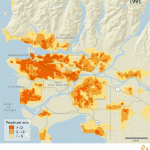
Vancouver, British Columbia, is the Northwest’s smart-growth leader, with six out of ten residents in compact communities in 2001. view graphic »
Research by Type
Vancouver, British Columbia, is the Northwest’s smart-growth leader, with six out of ten residents in compact communities in 2001. view graphic »
Date Range: 1970-2002
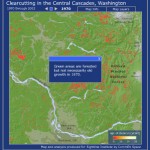
More clearcutting occurred in the Central Cascades than in any other study area from the Cascadia Scorecard – more than 1.7 million acres from 1971 to 2002. view graphic »
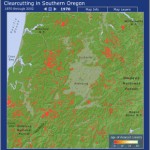
In this region of Southern Oregon, home to many valuable species, 27 percent of forestland has been clearcut since 1971. view graphic »
In a region that includes a globally unique ecosystem, 19 percent of mostly virgin forest was clearcut between 1976 and 2002. view graphic »
Date Range: 1970-2002
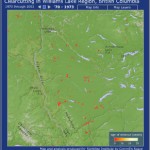
Clearcuts leveled 20 percent of the forests – most of them previously untouched – in the Williams Lake region between 1976 and 2002. view graphic »
Date Range: 1970-2002
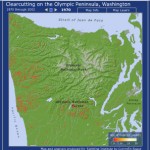
In the Olympic Peninsula, clearcutting felled 29 percent of all forests – and 36 percent of forests without federal protection – from 1971 to 2002. view graphic »
Date Range: 1990-2000
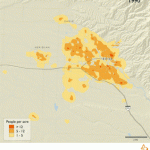
Boise, Idaho, is the Northwest’s most sprawling metropolis.
view graphic »
Date Range: 1990-2000
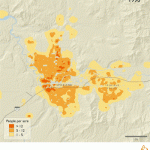
Though not nearly as densely populated as Victoria, BC, the Eugene, OR, area is slightly more compact then either of the regions other mid-size cities Spokane, WA, or Boise, ID. view graphic »
Date Range: 1991-2001
Despite recent successes in growth management, Seattle-area jurisdictions authorized 46,000 residences outside the urban growth boundary from 1991 through 2001. view graphic »
Date Range: 1990-2000
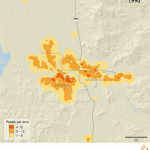
The outskirts of Spokane, Washington, are dominated by low-density housing. view graphic »