
Messaging the Northwest’s Energy Future
Public opinion research shows strong support for grid modernization—and how to talk about it.
Anna Fahey, Sightline Institute | August 2026
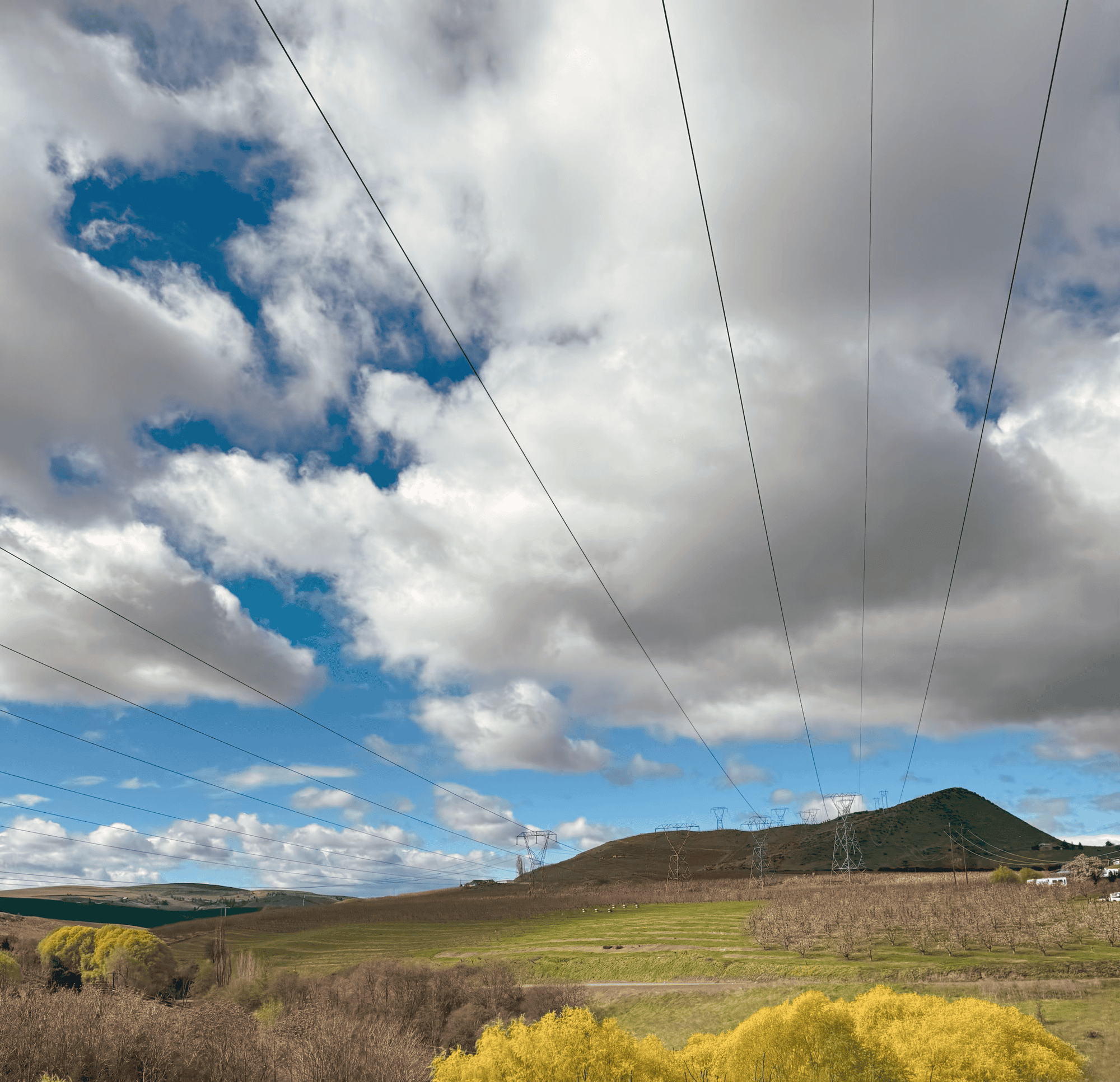
Download the report (pdf)Power lines stretch between transmission towers along the Dalles-California Highway, south of The Dalles, Oregon.
A modernized, high-capacity electric grid is essential for achieving Washington and Oregon’s climate and clean energy goals and for connecting Cascadian homes and businesses to reliable, affordable power as the region’s energy demand grows. Much of this critical public infrastructure is over 50 years old, requiring basic repairs as well as upgrades and expansion to serve the region in the years ahead.
When it comes to energy solutions, transmission system investments should be low-hanging fruit. New lines and towers that can deliver efficient, low-cost electricity to Cascadian communities come with a lighter footprint and a lower price tag than developing new power generation. But the politics prove thorny when it comes to siting new lines as well as updating existing ones. It can take 20 years to usher a proposed grid project through permitting and approvals; for local consumers, that means added costs and delayed benefits. Washington and Oregon cannot update the grid swiftly or adequately without reforming the approval process.
A key challenge is communications: for most Cascadian voters, the electric grid is out of sight, out of mind. The lights come on when we flip the switch, but most of us rarely consider the condition of the grid or what it has to do with our utility bill, let alone its role in delivering clean energy or cutting climate emissions.
Sightline measured policy support and tested effective messages to develop strategic communications recommendations for lawmakers and advocates eager to address this issue. We partnered with FM3 Research to hold in-person focus groups—two in Spokane, Washington, and two in Bend, Oregon—and to survey 840 likely voters in the two states.
The good news: strong majorities of Oregon and Washington voters favor electric grid expansion, and robust majorities across party lines support several commonsense measures to speed project approvals. The job for advocates and policymakers is not to convince but to educate and inspire: to shine a spotlight on grid upgrades as an urgent priority and to clear a political pathway to get the job done.
Methodology
Focus groups: FM3 conducted two pairs of two-hour, 10-person in-person discussions in Spokane, Washington, and Bend, Oregon, on March 31 and April 2, 2026. In each location, groups were segmented by ideology (a more conservative and a more liberal group, with moderates in both) and by urbanicity, with the more conservative groups drawn from more rural and exurban areas. Qualitative research is suggestive of voters’ attitudes but cannot represent them with statistical precision, even where views are quantified. Still, it offers valuable insight into language, values, and the reasons behind opinions.
Survey: From May 19–26, 2026, FM3 Research completed 840 online and telephone interviews with likely November 2028 voters in Oregon and Washington. The margin of sampling error for the study is ±3.5 percent at the 95 percent confidence level (±4.9 percent for each state’s half-sample); margins of error for population subgroups within the sample are higher. Due to rounding, not all totals sum to 100 percent.
Both studies were conducted by FM3 Research for Sightline Institute.
Baseline attitudes are promising
A robust majority of Washington and Oregon voters supports grid expansion
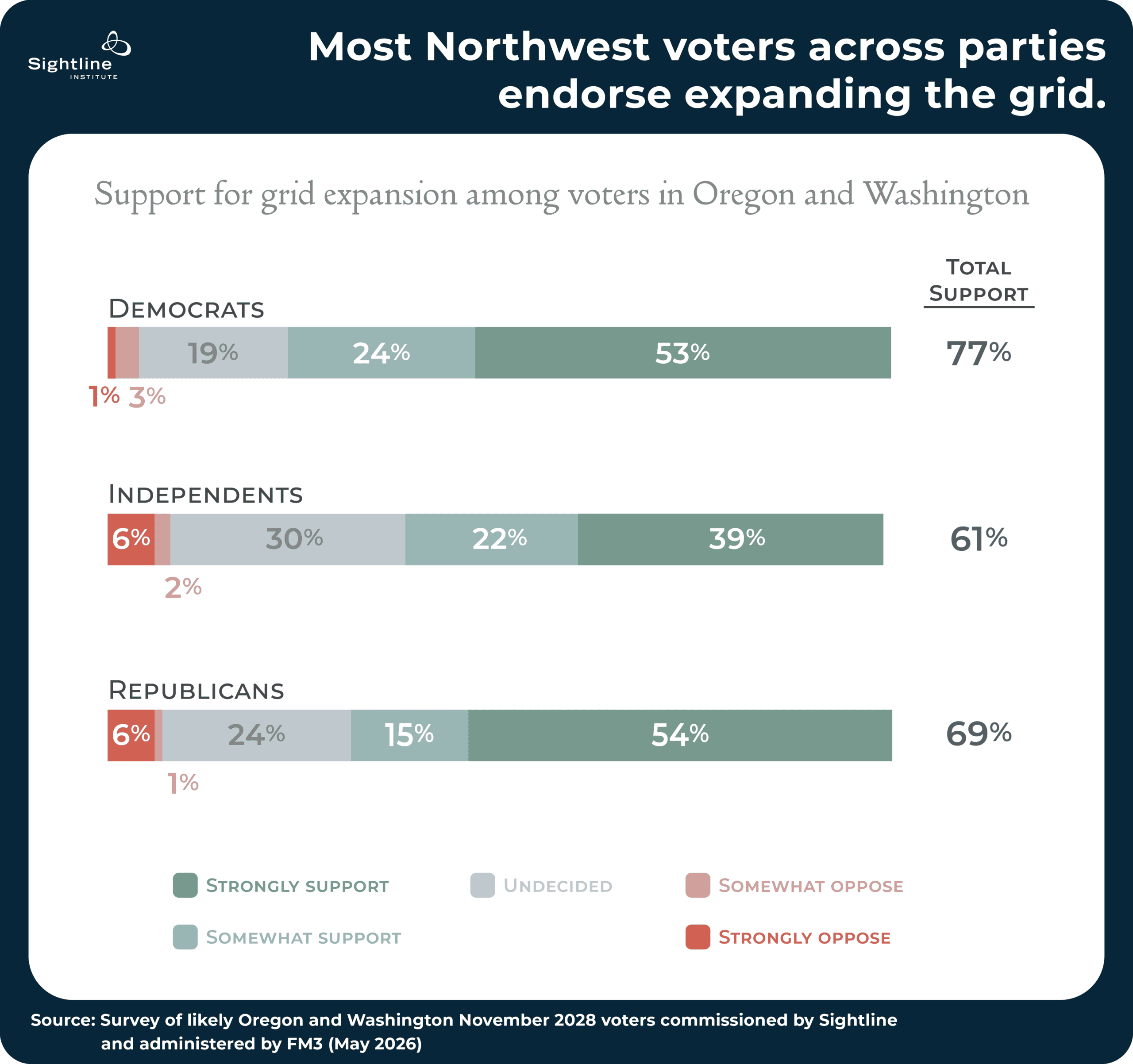
Sightline’s survey of Oregon and Washington state voters found overwhelming baseline support for expanding the electric grid. Seven in ten voters support expanding the electric grid in their state, and the intensity of that support is significant, with nearly half of respondents (49 percent) saying they strongly support the idea. Just 6 percent oppose grid expansion. Support reaches across partisan lines, too—nearly 80 percent of Democrats and nearly 70 percent of Republicans support electric grid expansion, with over fifty percent of voters in each party who support it strongly. Independent voters are just slightly more likely to be undecided.
💡Messaging Tip
Emphasize Electricity. The word “electricity” does emotional work that insider jargon like “transmission” or “the grid” cannot do alone, shifting from abstract ideas to something people rely on every day. So wherever possible, put electricity front and center. While industry and policy experts more commonly use “electric grid” or “electrical grid,” Sightline and FM3 tested “electricity grid” for exactly this reason: it’s more descriptive and familiar, and it spotlights the grid’s essential role—to deliver electricity to people’s homes and businesses.
Reactions to the proposal are similar in Oregon and Washington: total support around 70 percent and strong support around 50 percent. Across both states, support is highest among city and suburban voters, but rural and small-town voters’ support doesn’t lag much, at around 65 percent total support and 45 percent strong support. Notably, opposition is low across parties and demographics.
Majority support holds even after opposition messaging. While support dropped after voters heard a handful of arguments against grid expansion, a clear majority holds—and opposition intensity stays low. Nearly half of all voters (49 percent) are strong supporters at the outset of the poll; just 4 percent strongly oppose. Opposition messaging moves the needle, dropping total support from 70 percent to 56 percent and strong support from 49 percent to 36 percent. Even then, the share of voters who strongly oppose only climbs from below 10 percent to 14 percent.
Because backing for grid expansion starts quite high, favorable messaging has little room to lift it: total support and strong support held essentially flat after voters heard positive messaging—likely a ceiling effect. In an open-ended question, survey respondents volunteered increasing capacity and meeting growing demand as their top reasons for expanding the grid.
A note about independent and moderate voters
“Independents” are those not registered with the Democratic or Republican parties in Oregon, and in Washington, they are voters who identify themselves as independent. In both states, “moderates” are those who self-identify as moderate on a scale that includes liberal, moderate, and conservative.
Independents’ viewpoints tend to fall along party lines depending on ideological leaning. In other words, right-leaning independents’ responses generally align with Republican views and left-leaning independents tend to align with Democrats.
When it comes to political ideology, Washington state independents tend more conservative than Oregon independents. For example, in Oregon, 38 percent of independents describe themselves as liberal and in WA just 14 percent do.
Pacific Northwest voters see the electric grid as critical but outdated public infrastructure
Overwhelming majorities agree the grid is “essential” and “critical public infrastructure.” Before hearing any messaging, pro or con, fully 82 percent of survey respondents agreed that the word “essential” describes the electric grid well, with 63 percent saying very well. This holds across the political spectrum and across both states, with 85 percent of Democrats, 77 percent of Republicans, and 86 percent of independents agreeing with that description. A majority, 63 percent, said “critical public infrastructure” describes the grid well, with 43 percent saying very well.
💡Messaging Tip
Visualize It. Describe the grid in familiar terms: “The system of poles and wires that deliver electricity across the region.” Photos can help illustrate the electric grid’s relatively light footprint.
Voters understand that the electric grid is outdated and in need of repair. Nearly two in three voters (63 percent) believe “outdated” describes the electric grid well, including 65 percent of Democrats, 69 percent of independents, and 68 percent of moderates. Only Republicans trailed slightly behind, with 55 percent who agreed. Focus group participants were quick to see the grid in the context of other American infrastructure in need of repair, “just like the country’s roads and bridges.”
Age and the grid’s current capacity are concerning. Only slim majorities of survey respondents see the grid as “maxed out” or “at max capacity,” but fully 72 percent agree that “adding capacity” is extremely or very important. Nearly two-thirds, 58 percent overall, see the electric grid as “inadequate to meet demand,” and 71 percent find it concerning that “homes and businesses need more electricity than in the past, but the electric grid has barely expanded in recent years” (37 percent extremely). The fact that “most of the electricity grid in our region is more than 50 years old” concerns 68 percent (39 percent extremely).
The time it takes to add a new power line is most concerning for voters. Given a range of facts about the state of today’s electric grid, by far the most concerning to voters is that it can take 20 years to add new power lines. The 20-year timeline is concerning to 74 percent of Oregon and Washington voters, with nearly half (47 percent) calling it extremely concerning. Adding the phrase “in part due to extensive government review” to this statement only moves the total slightly (75 percent overall, 46 percent extremely). However, for Republicans, the excessive government review language bumps support to 91 percent. Government review language has the opposite effect on Democrats, dropping concern from 81 percent to 68 percent.
Safety, modernization, and upgrades resonate more than a bigger grid
Voters prioritize safety, modernization, and upgrades over grid expansion alone. Voters across party and state rank the importance of physical grid improvements similarly; fixes to the existing grid are prioritized over expansion per se. “Improving the electricity grid’s safety” tops the list at 80 percent important overall, with nearly half (48 percent) calling it extremely important, followed by “modernizing the grid” (76 percent important, 46 percent extremely), “upgrading the grid” (76 percent, 43 percent extremely), “adding capacity” (72 percent, 38 percent extremely), and “adding more energy sources to the electricity grid” (68 percent, 37 percent extremely).
Support falls off for improvements that have more to do with the grid’s size or reach. Phrases like “expanding the grid,” “building a bigger electricity grid,” and “adding electricity grid lines to exchange energy across regions” were viewed as less important on net.
- “Building a bigger grid” is important to just 60 percent overall (Republicans are slightly more supportive), with the share who say “extremely important” dropping to 28 percent.
- “Expanding the grid” is important for 58 percent overall and 31 percent extremely.
- “Adding lines to exchange energy across regions,” “connecting more places,” and “extending the grid to span longer distances” all hover around 50 percent overall, with only about 25 percent deeming those improvements extremely important.
Concern about connecting the grid to renewables reveals a partisan split. The fact that “the electricity grid today doesn’t reach all currently available wind and solar power” was concerning to just 49 percent overall. A stark partisan divide is at work here, with the share of Republicans who find it concerning at 24 percent and the share of Democrats at 74 percent. About seven in ten voters find it concerning that “the electricity grid today isn’t adequate to power added electric vehicles and electric home appliances,” including Democrats and Republicans alike.
There is strong, cross-party appetite for measures to speed approvals for grid expansion projects
Sightline assessed voter support for a menu of specific permitting reforms recommended to speed grid expansion in Oregon and Washington. From setting deadlines to standardizing environmental rules to removing redundancies, majorities of voters support measures that would enable faster permitting and approvals of grid expansion projects. Six of the seven proposals Sightline and FM3 tested received majority support across the political spectrum; four measures received strong support. Notably, majorities of Republicans favor every proposal.
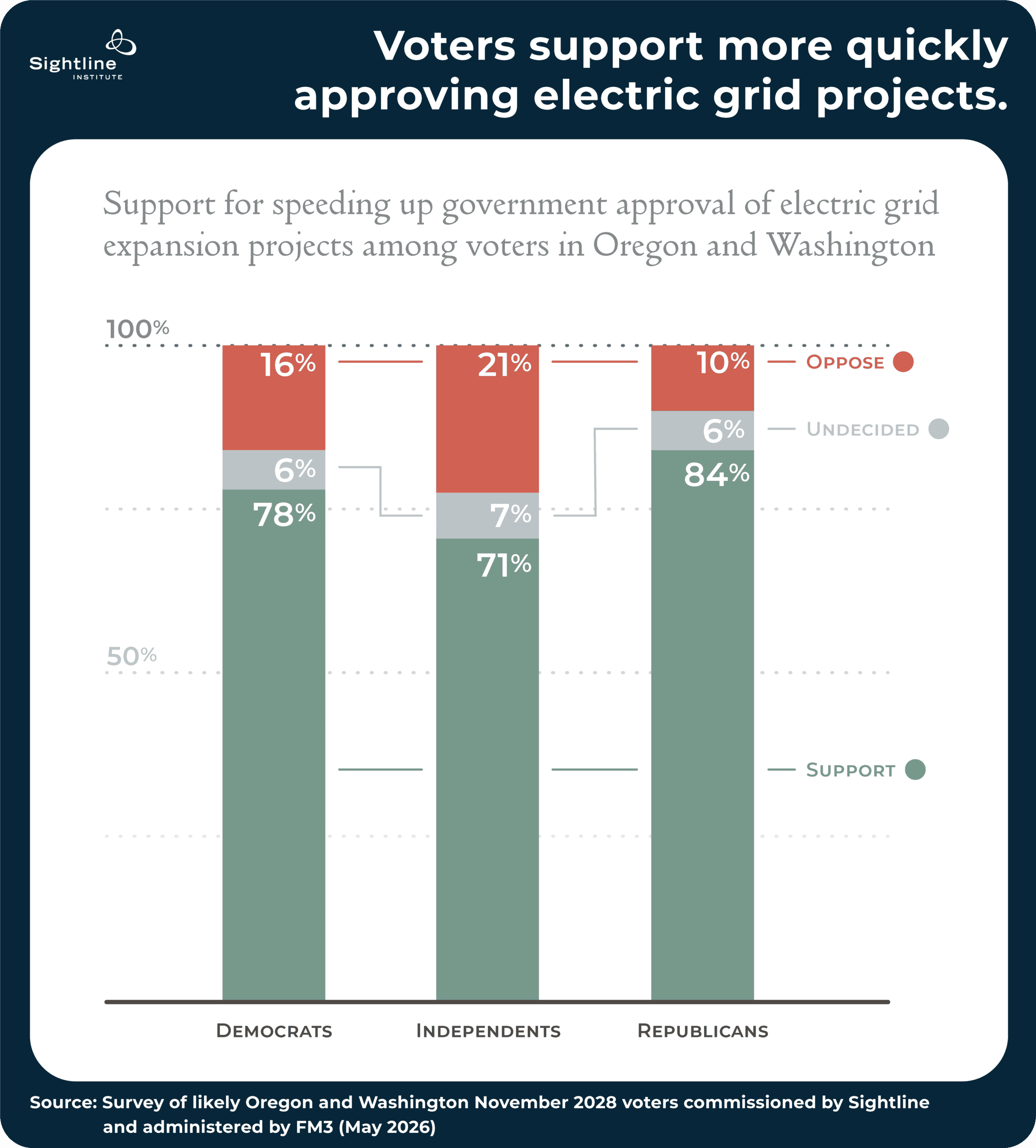
Speeding up government approval of electric grid expansion projects has support across party lines. Seventy-eight percent support speeding up government approval generally, including 43 percent who strongly support speedier approvals. And speeding approvals for grid expansion is popular across party lines, including for 78 percent of Democrats, 72 percent of independents, and 84 percent of Republicans.
Drilling down to more specific measures to expedite approvals, Sightline and FM3 found majority support for all but one of the measures tested. Notably, there was robust cross-partisan support for three key measures: setting deadlines, standardizing environmental rules, and removing redundant reviews by multiple agencies.
- More than 8 in 10 voters (82 percent) back setting deadlines for government agencies to approve electric grid expansion projects. “Setting deadlines for government agencies to approve electricity grid expansion projects” is supported by 82 percent of voters overall, 47 percent strongly. Democrats and Republicans both support this measure by large margins (84 percent), and 80 percent of independents across both states support deadlines. Support is especially strong among Republican voters (54 percent strongly support), but Democrats and independents aren’t far behind—44 and 43 percent strongly support, respectively.
- Majorities of voters want to standardize environmental reviews, with the strongest support among Democrats. “Standardizing environmental rules for electricity grid projects” is supported by 76 percent of voters overall, with slightly more partisan variation: 84 percent of Democrats, 50 percent strongly; 67 percent of Republicans, 42 percent strongly; and 75 percent of independents, 39 percent strongly.
- Seventy percent support removing redundant reviews. “Removing redundant reviews by multiple government agencies for grid expansion projects” is supported by 70 percent of voters overall, breaking out to 66 percent of Democrats, 81 percent of Republicans, and 65 percent of independents. Over half of Republicans strongly support removing redundant reviews (57 percent).
Procedural or administrative reforms are more popular than measures that seem to shift power from one group to another. Slightly slimmer survey majorities, across parties, support a measure to “prevent a small minority of opponents from blocking electricity grid expansion projects” (60 percent total support; 58 percent of Democrats, 72 percent of Republicans, 50 percent of independents, and 65 percent of moderates).
Nearly six in ten voters support “automatically approving electricity grid expansion projects that are located in designated pathways,” with Democrats and Republicans more likely than independent voters to favor this idea. Democrat support is 59 percent, Republican support is 62 percent, moderate voters support at 61 percent, and independents come in a bit lower, at 47 percent.
Finally, support for a measure to allow state agencies to approve projects blocked by local agencies is split. This idea is much less popular with Democrats and independents than GOP voters. Overall, 44 percent total support; 44 percent total oppose. Fifty-four percent of Republicans support this idea, but only 45 percent of Democrats do and only 32 percent of independents voters.
🔦 Spotlight: Northwest Electric Grid Attitudes at a Glance
Opportunities: Across party lines, voters already support expanding the electric grid (70 percent support, 6 percent oppose). They see the grid as essential but outdated; they support modernization and added capacity; they worry about how long upgrades take now; and, across party lines, majorities back most proposed commonsense fixes that would speed grid project approvals.
Obstacles: For Washington and Oregon voters, updates to existing grid infrastructure take priority over expansion. When it comes to speeding approvals for grid projects, voters are protective of local control.ntent

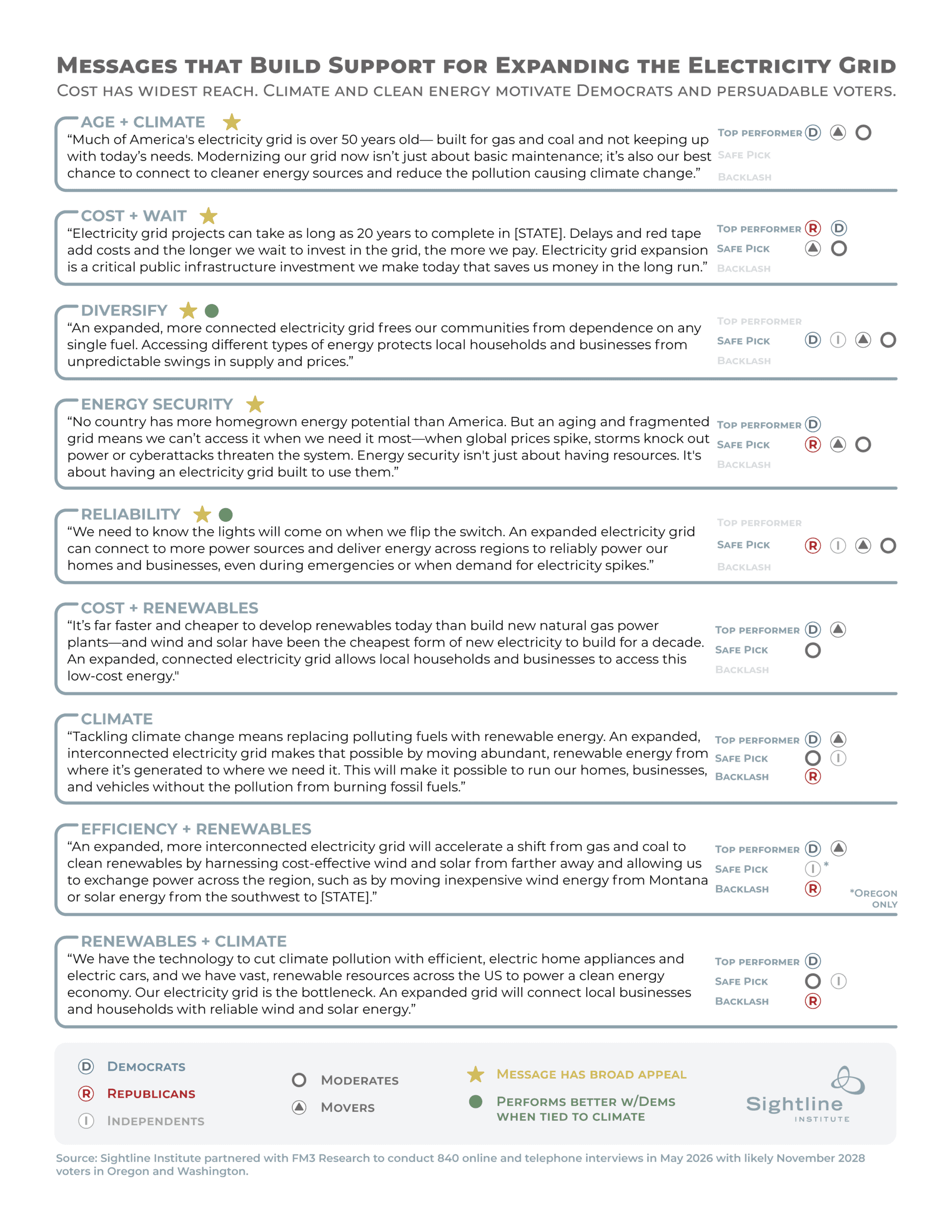
Messages that work: Cost is broadly persuasive; climate and clean energy is #1 for Democrats
Sightline and FM3 tested a range of messages making the case for and against electric grid expansion. In the focus groups and among survey respondents in both Washington and Oregon, the single frame with broadest appeal, performing strongly across party lines, concerned cost—specifically, that electric grid investments save money in the long run, and the longer we wait to expand the grid, the more we pay.
A handful of other messages were broadly persuasive, but not necessarily highly motivating to any target voter block, including energy security and reliability, and the upsides of diversifying power sources.
Counter to the trending recommendation among some strategists to “climate hush” one’s messages,1 Sightline and FM3 found climate and clean energy framing to be the most convincing for Democrats, by far. In fact, climate and clean energy language deepens intensity of support on the left while largely suppressing it on the right. In several cases, climate and clean energy framing was also effective for moderates and movers, voters who shifted to grid expansion support over the course of the survey. But any message that mentioned climate or wind and solar energy fell flat among conservatives.
Support for grid expansion is vulnerable to messages that highlight the cost to consumers and the specter of data centers. And when it comes to messengers, people want to hear from experts without financial interest.
A note about shorthand and respondents
Throughout the following section, we refer to each tested message in all-caps shorthand, like “COST + RENEWABLES.” Survey respondents hear only the message itself; they do not hear these shorthand titles.
We also use the term “movers” to refer to respondents who moved positively toward support for grid expansion over the course of the survey. Notably, movers in this study were disproportionately liberal or moderate independents and more likely to be under age 30, Democratic women, and college-educated women.
Most broadly persuasive: Across party lines, a cost argument—invest now to save later
The message that grid expansion today is a cost-saver in the long run resonated with voters across the political spectrum, with 77 percent finding it convincing overall and 37 percent very convincing.
COST + WAIT: “Electricity grid projects can take as long as 20 years to complete in Oregon and Washington. Delays and red tape add costs, and the longer we wait to invest in the grid, the more we pay. Electricity grid expansion is a critical public infrastructure investment we make today that saves us money in the long run.”
Fully 41 percent of Republicans found this message very convincing—the top-performing message for Republicans. It was very convincing for 39 percent of Democrats, 29 percent of independents, and 35 percent of moderates.
With affordability top of mind for most US voters, the cost-saving message hit a nerve. This message also characterized the electric grid as “critical public infrastructure” and echoed a top-testing concern: that it takes too long to make needed infrastructure upgrades.
Several other messages performed well broadly, and without alienating any particular group of voters, but with less intensity—that is, fewer voters finding these messages very convincing. An energy security message was convincing to 74 percent of all voters and very convincing for 32 percent. It was a top performer for Democrats (42 percent very convincing) and holds up for moderates, independents, and Republicans.
ENERGY SECURITY: “No country has more homegrown energy potential than America. But an aging and fragmented grid means we can’t access it when we need it most—when global prices spike, storms knock out power, or cyberattacks threaten the system. Energy security isn’t just about having resources. It’s about having an electricity grid built to use them.”
A reliability message was convincing to 72 percent of voters but very convincing for only 25 percent; in other words, it wasn’t particularly energizing for any group, but it has broad appeal and links expansion and upgrades neatly to voters’ expressed priority for grid safety.
Across all four focus groups, over half of respondents called out energy diversification as a compelling idea. Several participants rephrased the concept in familiar terms, like “not putting all your eggs in one basket.” It was especially compelling for conservative focus group participants. Survey findings back this up: 74 percent of survey respondents found diversification of energy sources framing to be convincing. Forty-three percent of survey movers found it very convincing.
DIVERSIFY: “An expanded, more connected electricity grid frees our communities from dependence on any single fuel. Accessing different types of energy protects local households and businesses from unpredictable swings in supply and prices.”
Adding a line about renewable wind and solar resources to the energy diversity message bumped it to a top performer for Democrats. Fifty-four percent of Democrats found an energy diversification featuring renewables very convincing:
DIVERSIFY + RENEWABLES: “An expanded, more connected electricity grid frees our communities from dependence on any single fuel. Accessing different types of energy, like our vast renewable wind and solar resources, protects local households and businesses from unpredictable swings in supply and prices.”
Climate and clean energy are major motivators for Democrats—and convincing for persuadable voters
This pattern played out across the message testing: messages that included climate and clean energy language bumped up persuasiveness among Democrats especially, and more left-leaning independents and movers as well. Climate and clean energy framing had the opposite effect on right-leaning voters.
By far, climate and clean energy messages were top performers for Democrats, eliciting particular intensity of support. The six messages that half or more Democrats found to be very convincing explicitly focused on climate and clean energy (full text of the messages Sightline and FM3 tested can be found in the appendix):
- AGE + CLIMATE—66 percent very convincing;
- CLIMATE—59 percent very convincing;
- COST + RENEWABLES—55 percent very convincing;
- DIVERSIFY + RENEWABLES—54 percent very convincing;
- LOCAL ECONOMY + RENEWABLES—52 percent very convincing; and
- CLIMATE + RENEWABLES—50 percent very convincing.
Three more messages were very convincing for more than 40 percent of Democrats: ENERGY SECURITY; RELIABILITY + RENEWABLES; and EFFICIENCY + RENEWABLES.
Climate and clean energy framing boosts intensity of messages’ persuasiveness for Democrats. For messages that Sightline and FM3 tested in pairs, with and without climate and clean energy framing, the climate and clean energy language boosted persuasibility for Democrats by a significant degree. For example, adding language about wind and solar energy to a LOCAL ECONOMY message bumped Democrats’ very convincing number from 30 percent to 52 percent; climate framing lifted an EFFICIENCY message nearly 10 points for Democrats; and RELIABILITY without climate framing garnered 26 percent very convincing from Democrats but 42 percent very convincing with climate framing.
Climate framing deepens intensity on the left while suppressing it on the right. While climate and clean energy framing boosted performance for Democrats, messages with renewable energy and climate pollution framing tanked Republican favorability. The CLIMATE message, for example (a top-tier message for Democrats, at 59 percent very convincing), was very convincing to only 7 percent of Republicans; it registered not convincing for fully 75 percent of Republicans. A LOCAL ECONOMY message is somewhat or very convincing for 68 percent of Republicans, while only 28 percent found the same message with climate and clean energy language added to be somewhat or very convincing.
For Democrats, a cost argument that also emphasized affordable clean energy resonated even more strongly than the cost message without climate framing (55 percent very convincing). This framing also proved more convincing for movers, with 43 percent finding it very convincing.
COST + RENEWABLES: “It’s far faster and cheaper to develop renewables today than build new natural gas power plants—and wind and solar have been the cheapest form of new electricity to build for a decade. An expanded, connected electricity grid allows local households and businesses to access this low-cost energy.”
Climate and clean energy framing is appealing to certain persuadable voters. Beyond the consistent Democrat support, certain climate and clean energy messages performed well for persuadable independents and moderates. For movers, five of the seven best performing messages explicitly reference climate or wind and solar energy:
- AGE + CLIMATE (51 very convincing);
- ELECTRIFICATION + RENEWABLES (48 percent very convincing);
- COST + RENEWABLES (43 percent very convincing);
- CLIMATE (41 percent very convincing); and
- EFFICIENCY + EXCHANGE (41 percent very convincing).
AGE + CLIMATE is a standout. Emphasizing the age of the grid, plus touting how upgrades could connect clean energy and cut climate pollution, AGE + CLIMATE drew the most intense support of any message from Democrats (66 percent very convincing) as well as Oregon independents (43 percent very convincing) and Washington independents (30 percent very convincing). AGE + CLIMATE was very convincing for 40 percent of voters overall and scored 41 percent very convincing with moderates and fully 51 percent very convincing for movers.
What’s more, this message did not drop off a cliff for independent voters, as 36 percent of them found it very convincing. Finally, it was the only climate-framed message that didn’t appear to lose all conservative voters: a decent share of moderate Republicans found it convincing, even as just 18 percent of Republicans overall found the message very convincing. Oregon independents found it more convincing than their Washington state counterparts.
AGE + CLIMATE: “Much of America’s electricity grid is over 50 years old—built for gas and coal and not keeping up with today’s needs. Modernizing our grid now isn’t just about basic maintenance; it’s also our best chance to connect to cleaner energy sources and reduce the pollution causing climate change.”
Notably, even with the left-leaning base, highlighting the age of the grid gives a message more persuasive power than talking about climate alone. The AGE + CLIMATE message outperformed others for Democrats and independents. In focus groups, the age of the grid was the single most important reason participants named for upgrades.
As noted, Republican voters did not find climate or clean energy messages convincing. In fact, in pairs of messages that shared a common frame and were tested with or without climate and clean energy language included, Republican support fell off for the climate and clean energy version. A message about local economic benefits of grid expansion, for example, dropped from 20 percent to 7 percent very convincing for Republicans when wind and solar language was added. When asked to choose among the three, cutting climate pollution was the top rationale for grid expansion for Democrats; Republicans voters were evenly split between reliability and cost.
Additional messages tested in the survey that largely fell flat had to do with efficiently exchanging energy from more sources and more places, the local economic benefits of grid expansion, and an argument that grid enhancements cost far less than building expensive new power plants. Generally speaking, the benefits of grid expansion are new, unfamiliar, and not necessarily believable, especially claims that wind and solar plants and renewable electricity cost less. Focus group participants found arguments about low-cost renewables hard to believe, even those who supported a shift from fossil fuels.
🔦 Spotlight: Connecting Climate Change and the Grid
Obstacles: Climate messages inspire left-leaning voters and turn off right-leaning voters.
- For Republicans, clean energy is now a climate “dog whistle,” risking otherwise solid support among conservatives for modernizing the grid.
- On the left, meanwhile, there’s an education gap: our focus groups showed that voters who already care about climate don’t automatically connect grid expansion to curbing climate pollution or accessing clean energy. There’s also skepticism that wind and solar are in fact cheaper, along with cynicism that utilities will capture any cost savings rather than pass them on.
Opportunities: For Democrats and left-leaning persuadable voters, climate and clean energy are powerful motivators for grid modernization and expansion.
- The two top-testing messages among Democrats framed an expanded grid as a climate and clean energy solution.
- Among independents in both Oregon and Washington, the strongest message linked the grid’s age to opportunities to upgrade the system and cut climate pollution.
- For movers, climate and clean energy messages were convincing.
- Democrats and some movers consistently voiced intense support for messages about accessing low-cost renewable energy.
And while explicit clean energy language may turn off conservative voters, Sightline sees productive openings worth exploring: namely, zeroing in on cost savings from low-cost renewable energy and finding messengers who are credible and trusted by conservative voters. Research by Sightline and others has found messages of energy source diversification (or an “all of the above” frame), energy resilience, and cost savings compelling to conservative voters. Further testing could explore linking those themes to renewable electricity generation, including domestic, utility-scale solar and wind.
Local benefits and protections matter, as do messengers
Voters want to know what’s in it for them and for their local community. Focus group participants wanted to know whether the increased electric grid capacity would benefit them personally. Participants also felt that rural communities shouldn’t bear the burden for electricity that serves the state’s urban population centers, with no local advantages. In the Spokane conservative-leaning group, respondents keyed in early on the “east vs. west” divide and resented a proposal that they assumed would harm them. Enthusiasm grew if grid investments were described as powering local communities. Consistent with survey findings, most focus group participants were skeptical about grid expansion projects driving local job creation.
💡Messaging Tip
Proceed with Caution. Avoid saying “high-voltage” to describe power lines. To some focus group participants, it sounds dangerous. Shift to “high-capacity” or “long-distance” power lines.
Focus group participants value accountability and local control but want to “get things done.”The prospect of state leaders making decisions that could directly affect people’s local land and communities bothered respondents in every group. When it came to measures to speed grid expansion approvals more specifically, focus group participants were particularly cautious if they thought reforms would bypass accountability or take shortcuts. That said, while focus group participants didn’t want to cut corners, they did want to “get things done” and “get on with it.”
“Regulations are needed, but they are also an inefficient part of the process. So you want to minimize it as much as possible. Not that you are letting things slip by, by not regulating, but let’s make the approval fast. When we make our decision, let’s get it approved.” –Liberal-leaning voter in Bend, Oregon
Data centers and the cost of upgrades are the most persuasive grid expansion opposition messages. Data centers were a persistent flashpoint for focus group participants, both liberal and conservative, prompting cynicism about grid expansion and skepticism about benefits to local people and communities. Participants didn’t object to grid upgrades for their communities; they objected to paying for infrastructure that primarily serves corporate interests, especially data centers. Consistently, focus group participants believed they would pay for grid upgrades and expansion, and they worried that the increased capacity would serve data centers or other corporate entities—not their own communities.
“There’s all these data centers that are going to just absolutely demand that either the grid grows and gets updated or they’re just going to take all the power.” –Conservative-leaning voter, Spokane area, Washington
For survey respondents, no single negative message proved extremely effective. But taken as a whole, support for grid expansion declined after respondents heard all the opposition messages. By a slim margin, data centers and the cost of upgrading were the most convincing arguments against grid expansions for survey respondents. Cost stood out for Republicans (49 percent very concerning), and data center message reactions were similar across party lines. Cost and data center messages were more concerning than a local control argument, as well as a message highlighting that rural communities on the the east side of each state would bear the costs and disruptions only to serve urban communities west of the mountains.
Trusted messengers don’t have any skin in the game.When it comes to getting information about the electric grid, focus group participants consistently displayed distrust of utilities and government—messengers who have a profit motive are not trusted or credible on grid issues. Participants preferred to hear about grid expansion from frontline workers, retired industry insiders, Tribal groups, and environmental groups (for left-leaning participants).
🔦 Spotlight: Dealing with Data Centers
Obstacle: Attitudes about data centers threaten to derail grid expansion efforts. Data centers emerged as a significant sore point for focus group participants when it came to investing in the electric grid. A majority in each group agreed with the statement that “we shouldn’t build new transmission infrastructure just to serve power-hungry tech companies and data centers.” Many participants found it to be counterproductive to facilitate data centers with the clean energy available on an expanded grid, and an economic argument for grid expansion about winning the A.I. race was alienating to focus group participants, including conservatives.
The survey also found a message about grid expansion “only serving data centers” to be a persuasive opposition argument, across party lines. A throughline that disarms objections to grid updates is local benefit: voters didn’t reject the idea of grid upgrades to serve their own communities, but they railed against paying for infrastructure to serve data centers, corporate interests, or customers elsewhere.
Proceed with caution: When it comes to messaging about data centers, Sightline’s research points toward several hypotheses worth further testing:
- Leading with data centers, let alone defending them, is counterproductive. Folding them into the broader context of essential grid upgrades, with their potential to deliver concrete local benefits to households and businesses, may show promise.
- Messages that pair community control with the local benefits of grid expansion may temper some distrust. Consider positing guardrails, even outside of the context of the electric grid, that communities can adopt to feel some control when it comes to data centers.
- Finally, the “who pays?” question may be better addressed directly than left to conjecture. Voters appear to assume they will foot the bill while utilities, corporate entities (including A.I. companies and data centers), and customers in big cities will reap the rewards of grid investments that impact rural residents. Further message testing could discern whether naming that concern up front defuses it or instead raises its salience.
How to use these findings: Messaging strategies to grow the electric grid
Advocates and lawmakers don’t need to convince voters to support grid expansion. Baseline support is solid across party lines, and voters have a healthy appetite for a range of permitting reforms that would expedite grid project approvals. Still, modernizing the electric grid is politically difficult. Project approvals can take decades. The challenge for communicators is to spotlight solutions and boost their urgency and salience.
And there are obstacles: as focus group participants revealed, the electric grid isn’t top of mind; there’s skepticism about the local benefits of grid expansion; data centers spark significant concerns; and even where climate and clean energy messages tested well, their connection to grid expansion isn’t readily obvious. Policymakers’ and advocates’ job is to educate and motivate—to lift awareness, boost buy-in, and inspire enthusiasm for modernizing the electric grid.
In that context, an effective case for measures to speed electric grid expansion should hit several important notes, stressing the importance of grid modernization for all. Strong messages will 1) define the electric grid as essential infrastructure that’s aging and in need of modernization and upgrades; 2) make cost-saving arguments (for all voters); 3) emphasize climate and clean energy benefits (for a base of Democrats and persuadable voters); 4) and define permitting reforms as commonsense fixes to address a sluggish process.
Based on focus groups and survey findings, Sightline and FM3 recommend the following strategies:
- Define the electric grid as essential and critical public infrastructure. The electric transmission system is largely out of sight, out of mind. But when prompted, people understand it as essential public infrastructure—not only to keep the lights on, but to keep up with demand and keep utility bills in check.
- Underscore the age of the grid and the sluggish pace of upgrades. Voters can readily grasp that the grid is old and outdated. A broadly shared concern is grid projects’ 20-year lag time. These delays and a grid built over 50 years ago are compelling reasons to get a move on and invest in upgrades. Messages perform well when they start with a well-understood problem in need of a fix and then offer a meaningful way forward.
- Bridge from basic upkeep to keeping up. Frame grid investments as “modernizing,” “improving safety,” “upgrading,” and “adding capacity,” not just “expansion.” Link the grid’s outdated condition to the need to keep up and add capacity. Pair any mention of expansion with modernization, safety, and upgrades.
- Connect on the price tag that comes with delay. “The longer we wait, the more we pay” is a message that works across the political spectrum, and access to low-cost energy is an opening for voters of all stripes who are concerned about the cost of living.
- Link grid modernization to climate change and affordable clean energy—for solid Democrats and for persuadable voters. For Democrats, left-leaning independents, and persuadable movers, don’t shy away from defining grid expansion and modernization as a key climate solution and an opportunity to access low-cost wind and solar power.
- Highlight local benefits. Voters experience the grid primarily through their utility bills. When it comes to transmission system upgrades, concerns crop up about who pays and who stands to gain. Skip abstract claims about energy demand and population growth and instead find concrete ways to illustrate how an expanded grid delivers low-cost electricity to local households and businesses. Keep the focus on personal, local benefits.
- Build the case for energy diversification, safety, and reliability. For all voters, there’s an opportunity to bolster the case for a modern, expanded grid that “doesn’t put all its eggs in one energy basket.” Connecting with diverse energy sources keeps the lights on and protects electricity customers from unpredictable supply and price swings through weather emergencies and periods of high demand. For Democrats especially, enthusiasm centers on adding wind and solar to the mix.
- Offer simple, commonsense process solutions to speed grid project approvals and “get the job done.” Support for grid expansion is strong, and Pacific Northwest voters find it highly concerning that projects can take decades. Voters also overwhelmingly support a handful of specific measures to speed up grid project approvals, especially when they address costly, wasteful process delays and when they are presented as obvious procedural improvements. Majorities support setting deadlines, reducing redundancy, and standardizing environmental review—as well as automatically approving projects in designated pathways and preventing a small minority from derailing progress. Voters are a bit more cautious about giving up local control.
- Find messengers with know-how but nothing to gain. Credible messengers have first-hand experience and proven electricity transmission system expertise, but no personal or professional profit motive: frontline workers, retired industry insiders, Tribal groups, and, for left-leaning voters in particular, environmental groups.
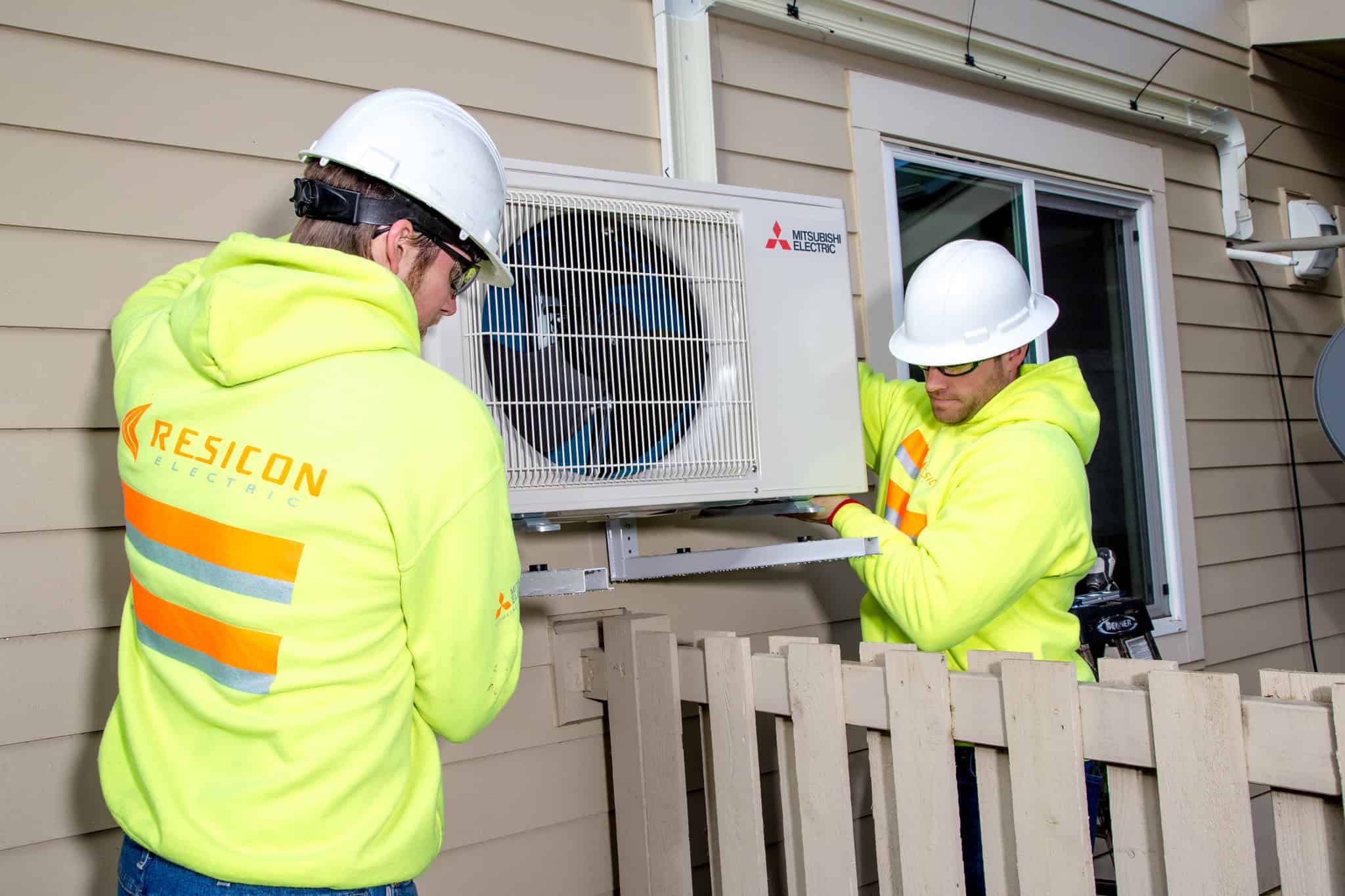
Conclusion: The job is to spotlight essential electric infrastructure and connect it to people’s everyday energy needs
In Oregon and Washington, the politics of the electric grid are more challenging than the public opinion. Voters are already on board: strong, cross-partisan majorities support expanding the grid, recognize it as essential but aging infrastructure, and back commonsense measures to speed project approvals.
The challenge for advocates and lawmakers is less to persuade than to break through, to spotlight the transmission system as imperative and beneficial. The opportunity is to connect grid modernization with the affordability, economic, and clean-energy benefits that key segments of voters already value, to contrast these upsides with more disruptive and expensive energy investments, and to present permitting reforms as practical process fixes rather than loss of voice.
Testing by Sightline and FM3 reveals framing that’s effective in making those connections, as well as partisan divisions on certain messages and gaps in understanding among supporters. Open questions remain: how best to inoculate against the data-center backlash and ease resistance to ceding local control, and which frames—cost savings from credible messengers, a believable local economic benefits message—carry low-cost clean energy furthest with more independents and conservatives.
In sum, support is broad, and the appetite for reform is real. The work now is to turn that widespread goodwill into momentum—for the energy infrastructure needed to carry Northwest households and businesses affordably and sustainably through the coming decades.
Appendix
Full text of messages tested in favor of electric grid expansion
DIVERSIFY: “An expanded, more connected electricity grid frees our communities from dependence on any single fuel. Accessing different types of energy protects local households and businesses from unpredictable swings in supply and prices.”
DIVERSIFY + RENEWABLES: “An expanded, more connected electricity grid frees our communities from dependence on any single fuel. Accessing different types of energy, like our vast renewable wind and solar resources, protects local households and businesses from unpredictable swings in supply and prices.”
AGE: “Much of America’s electricity grid is over 50 years old—and it’s maxed out and not keeping up with local businesses’ and households’ electricity needs. We can patch up an aging system and also make the investments needed today to build a grid that’s ready to power our communities for decades to come.”
AGE + CLIMATE: “Much of America’s electricity grid is over 50 years old—built for gas and coal and not keeping up with today’s needs. Modernizing our grid now isn’t just about basic maintenance; it’s also our best chance to connect to cleaner energy sources and reduce the pollution causing climate change.”
RELIABILITY: “We need to know the lights will come on when we flip the switch. An expanded electricity grid can connect to more power sources and deliver energy across regions to reliably power our homes and businesses, even during emergencies or when demand for electricity spikes.”
RELIABILITY + RENEWABLES: “We need to know the lights will come on when we flip the switch. An expanded electricity grid can connect to renewable energy sources, like wind and solar, allowing us to reliably power our homes and businesses even during emergencies or when demand for electricity spikes.”
COST+ WAIT: “Electricity grid projects can take as long as 20 years to complete in (STATE). Delays and red tape add costs, and the longer we wait to invest in the grid, the more we pay. Electricity grid expansion is a critical public infrastructure investment we make today that saves us money in the long run.”
COST +RENEWABLES: “It’s far faster and cheaper to develop renewables today than build new natural gas power plants—and wind and solar have been the cheapest form of new electricity to build for a decade. An expanded, connected electricity grid allows local households and businesses to access this low-cost energy.”
RENEWABLES + ELECTRIFICATION: “We have the technology to save money on our utility bills and conserve energy by using more efficient, electric home appliances and electric cars. And we have vast, renewable resources across the US to power our economy. Our electricity grid is the bottleneck. An expanded grid will connect local businesses and households with clean, affordable energy.”
RENEWABLES + CLIMATE: “We have the technology to cut climate pollution with efficient, electric home appliances and electric cars, and we have vast, renewable resources across the US to power a clean energy economy. Our electricity grid is the bottleneck. An expanded grid will connect local businesses and households with reliable wind and solar energy.”
LIGHT FOOTPRINT + COST: “The best way to avoid building new power plants near our communities is an expanded, better-connected electricity grid. When we can share energy across long distances, we can draw on the vast resources we already have across the country instead of overbuilding expensive new plants closer to home. And the grid itself is a network of wires with a light footprint: the least disruptive energy investment we can make to power local homes and businesses.”
LIGHT FOOTPRINT + CLIMATE: “Building out the clean energy infrastructure we need to address climate change will take a lot of land. But if we expand the grid, we’ll need much less land for solar and wind farms, because we can share resources across regions. And the grid itself is a network of wires with a lighter footprint than any other form of energy infrastructure.”
EFFICIENCY + EXCHANGE: “An expanded, more interconnected electricity grid quickly and efficiently delivers energy from far away, and allows us to exchange power across the region, moving inexpensive wind energy from Montana or solar power from the southwest to (STATE) or selling a surplus of our hydroelectricity to places that need it.”
EFFICIENCY + RENEWABLES: “An expanded, more interconnected electricity grid will accelerate a shift from gas and coal to clean renewables by harnessing cost-effective wind and solar from farther away and allowing us to exchange power across the region, such as by moving inexpensive wind energy from Montana or solar energy from the southwest to (STATE).”
CLIMATE: “Tackling climate change means replacing polluting fuels with renewable energy. An expanded, interconnected electricity grid makes that possible by moving abundant, renewable energy from where it’s generated to where we need it. This will make it possible to run our homes, businesses, and vehicles without the pollution from burning fossil fuels.”
ENERGY SECURITY: “No country has more homegrown energy potential than America. But an aging and fragmented grid means we can’t access it when we need it most—when global prices spike, storms knock out power, or cyberattacks threaten the system. Energy security isn’t just about having resources. It’s about having an electricity grid built to use them.”
LOCAL ECONOMY: “An expanded electricity grid connects (STATE) delivering reliable, affordable power for businesses to compete, grow, and support our local workforce. A modern, interconnected grid makes it possible for our communities to attract economic investment and innovation, create local jobs, and build long-term economic stability.”
LOCAL ECONOMY + CLIMATE: “An expanded electricity grid connects (STATE) to a wider range of clean energy sources, delivering the power businesses need to compete, grow, and support our local workforce. A modern, interconnected grid powered by wind and solar will allow us to attract new businesses, create jobs, and build long-term economic stability—without burning fossil fuels for our electricity.”
Full text of messages tested in opposition to electric grid expansion
DATA CENTERS: “Without electricity demand from the A.I. industry, we wouldn’t need to expand our grid. We shouldn’t build new electricity grid projects just to serve tech companies and their power-hungry data centers.”
US VS. THEM: “These new electricity grid projects will run through rural areas for hundreds of miles. Rural communities shouldn’t bear the burden on their land, water, and landscapes for power that serves (WA: Seattle) (OR: Portland).”
LOCAL CONTROL: “Local communities should get to decide what gets built in their backyards. Expanding the electricity grid would mean ignoring the concerns of those most impacted by new infrastructure.”
COST: “Expanding our electricity grid will cost billions of dollars—a cost that will get passed on to us through our utility bills.”
Photo Credits
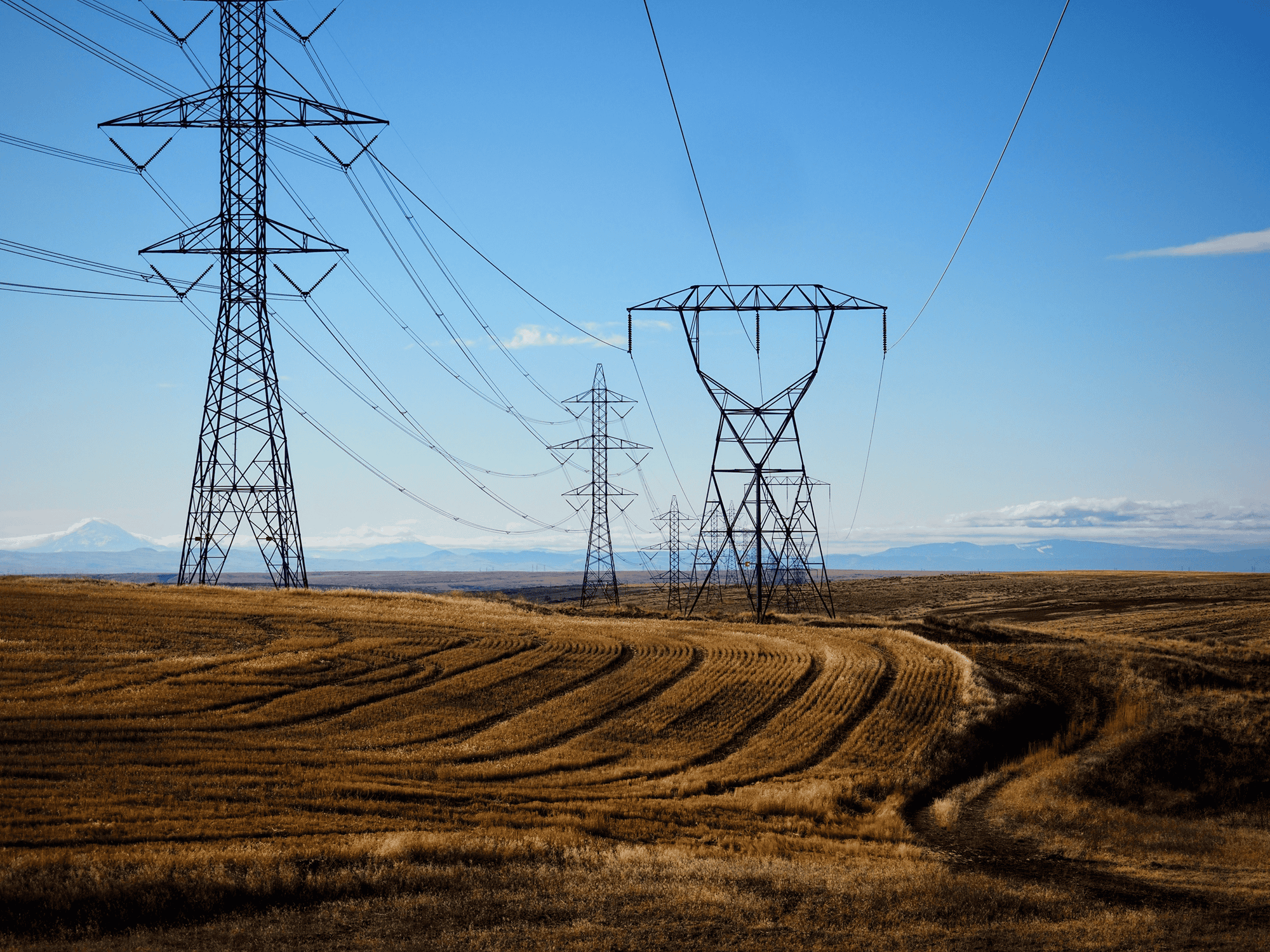
- “Power lines stretch between transmission towers along the Dalles-California….” Photo by Anna Fahey, Sightline Institute, April 2, 2026, rights reserved.
- “Transmission lines stretch over wheat fields….” Photo by Poggensee, December 1, 2020, via Shutterstock.
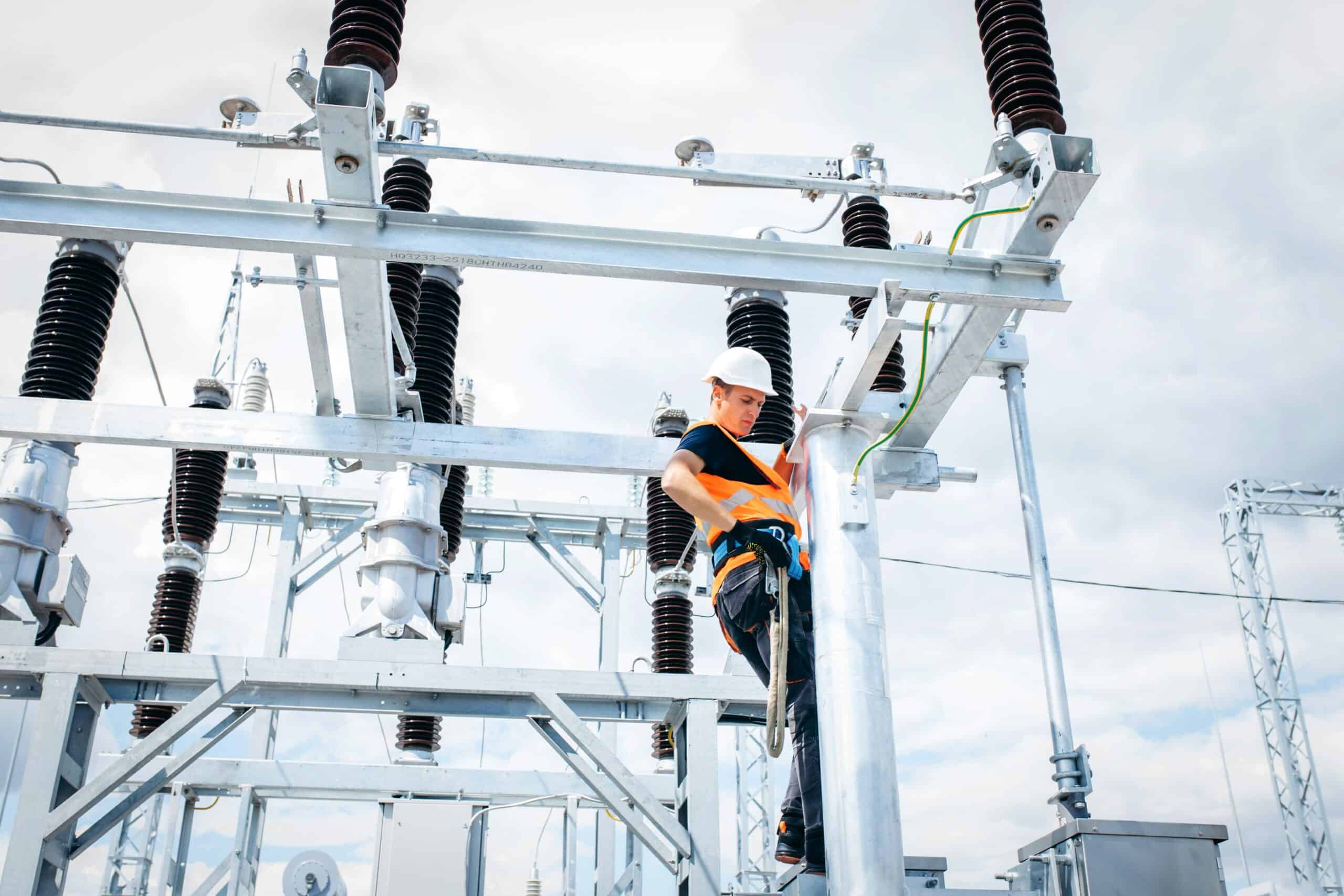
- “An electrician services….” Photo by Andrewshots, August 15, 2022, via Shutterstock.
- “Family fun….” Photo by Wosunan, April 22, 2025, via Shutterstock.
- “Agrivoltaics co-locates solar panels and agricultural production….” Photo by Rob Davis, AgriSolar Clearinghouse, August 5, 2020, via Flickr.
- “Helping to charge up….” Photo by Oregon Department of Transportation, June 19, 2012, via Flickr.
- “Construction workers help install….” Photo by Marcela Gara, Resource Media, February 15, 2017, via Flickr.
About the Author

Anna Fahey, Principal Director of Strategy, leads Sightline Institute’s framing and messaging strategies and coordinates the organization’s cross-cutting legislative campaigns.
Email her at anna@sightline.org, and follow her on Bluesky or LinkedIn.