
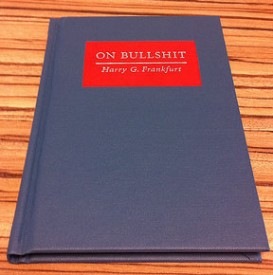
An essay by philosopher Harry Frankfurt, first published in the mid-1980s but re-released in book form in 2005, offered what was perhaps the first serious analysis of a topic near and dear to any political observer’s heart: bullshit. Frankfurt argues that bullshit differs from lies in one important way. The liar believes that there IS such a thing as the truth: it’s the thing that the lie is designed to conceal. In contrast, a bullshitter has no regard for the very idea of truth. To a true bullshit artist, words are little more than a tool to achieve some arbitrary purpose — to seem informed, for example, or to manipulate other people so that they’ll do what you want them to. Whether words are true or false is beside the point; all that matters to the bullshitter is the effect that his or her words achieve.
Frankfurt’s essay came to mind when I read a WSDOT spokesperson’s recent article about traffic growth on the SR-520 bridge across Lake Washington. The spokesperson was responding, indirectly, to one of my previous posts pointing out that WSDOT data shows zero traffic growth across the SR 520 bridge for the last 15 years. Here’s his rebuttal:
[Sightline’s] analysis didn’t capture a complete picture of traffic on the corridor. Its analysis starts in 1996, the peak year of growth and traffic over the last 25 years, and continued through 2010, capturing the dot-com bust between 2000 and 2003 and the subsequent national recession, both with significant traffic effects in this region.
In contrast, the Washington State Department of Transportation’s (WSDOT) longer view of traffic data on the SR 520 bridge begins in 1984 and projects to the year 2030, capturing nearly 30 years of historical data to produce a more accurate trend. Traffic generally rose annually since 1984, until the beginning of economic uncertainty in the middle of the 2000s.
WSDOT’s response is about as pure an example of B.S. as one is likely to find in public discourse. Let’s break it down, point by point.