Donate Newsletters

Honest Elections Seattle Tames Lobbying Money

In 2013, during the last municipal election campaigns in Seattle, the ridesharing company Lyft was fighting for its life in a dispute over local taxi regulations. It contributed $2,600 to candidates for mayor and city council and also spent $15,000 lobbying city hall. Eventually, it won city rules agreeable to its interests.

Meanwhile, Clise Properties, a developer involved in an enormous set of construction projects north of downtown Seattle for which it sought city permission to take over alleys and install a new district energy system, spent $48,000 lobbying city officials that year. It also contributed $2,800 to candidates for city office. It has since won permission for many of its projects.

The Rental Housing Association (RHA), which represents landlords in city hall in policy fights over apartment regulations, tenant protections, and land-use ordinances, spent $30,000 on city lobbying in 2013 and $2,600 on campaign contributions.
Read more

Video: Who Funds Seattle’s Political Candidates?

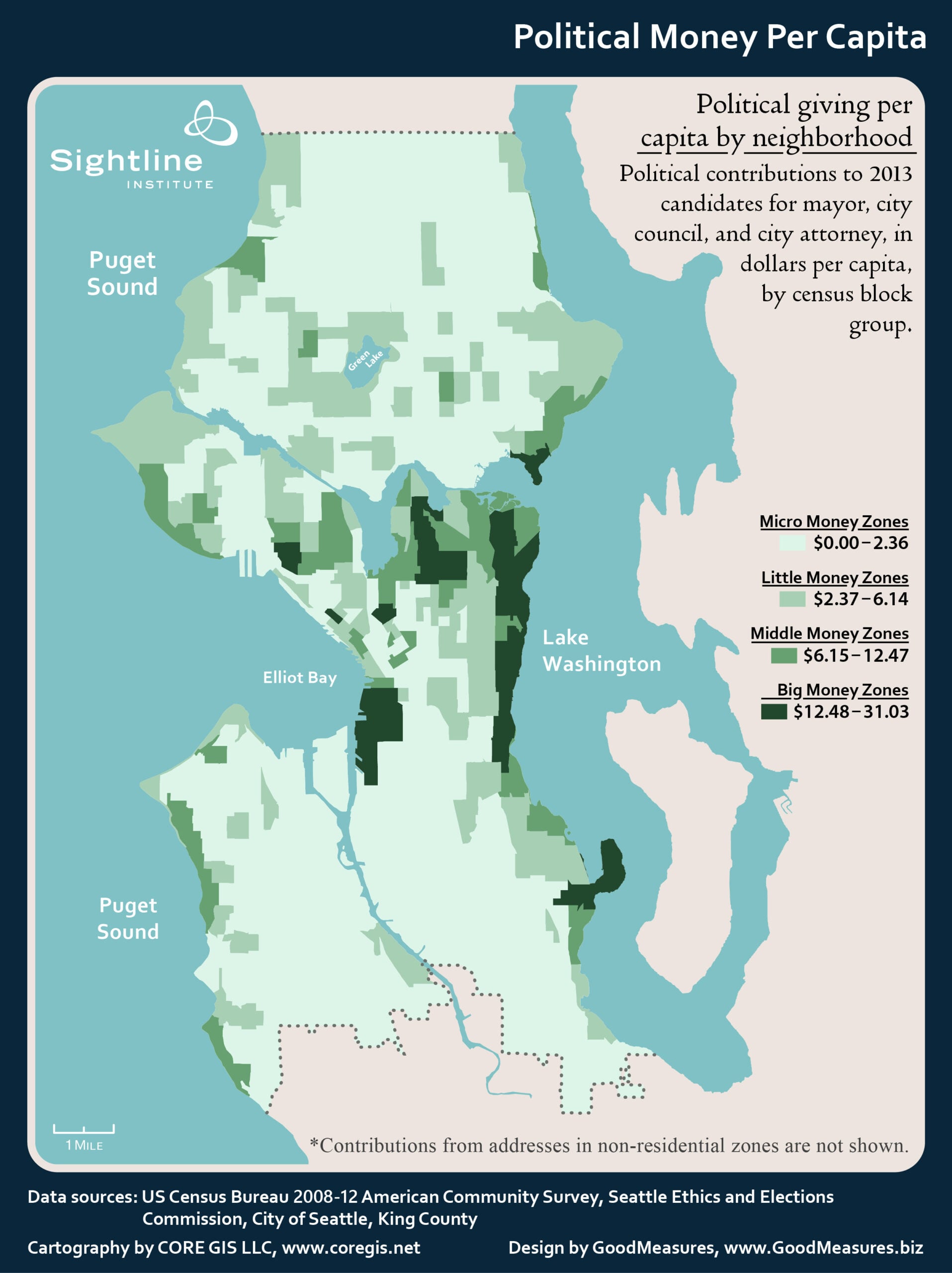
Ever wondered who funds Seattle’s political candidates? Well, Sightline has—so we mapped it. For your convenience and viewing pleasure, we condensed the report into a two minute video that paints a picture of Seattle’s money in politics.

To win elections, local candidates depend on a tiny share of the people who live in Seattle: mostly, rich, white people in view homes. Honest Elections Seattle (Initiative 122) would lower the limit on contributions to candidates and let every voter contribute $100 of public campaign vouchers to the candidate of his or her choice. Now that’s what a true participatory democracy looks like.

[sightline-embed]

View the full report here.

View the interactive map here.

Read more

Interactive Map: Who Funds Seattle’s Political Candidates?

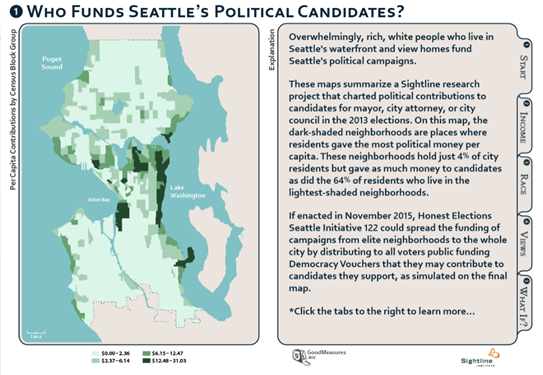
Did you miss Sightline Institute’s new report released yesterday? Or didn’t have time to read all 27 pages? Don’t fret—here’s your political funding cheat sheet. Simply click the image below and explore the tabs to see how Seattle’s largest political contributions overlap with the wealthiest and whitest neighborhoods with view homes. The alarmingly small number of contributors that dominate Seattle’s political game demonstrates the need for democracy reform.

What would political contributions look like if Honest Elections Seattle (Initiative 122) is enacted in November? Don’t forget to click the last tab to find out.

Who Funds Seattle’s Political Candidates?

Overwhelmingly, rich, white people who live in Seattle’s waterfront and view homes fund Seattle’s political candidates. That’s the picture that emerges from a new Sightline Institute study released today. If enacted by voters in November, Honest Elections Seattle (Initiative 122) could spread the funding of campaigns from elite neighborhoods to the whole city.

The report analyzes the pattern of political contributions in the 2013 city elections to explore how Honest Elections Seattle might affect giving. The city’s most-giving neighborhoods (dubbed “Big Money Zones”) hold just 4 percent of the population, but they gave as much political money as the least-giving neighborhoods that house 64 percent of the city. Per person, the Big Money Zones gave more than 18 times as much as the least-giving ones.

Event: Lawrence Lessig at Town Hall Seattle

Good news: professor Lawrence Lessig, the greatest orator of democracy reform, is Cascadia-bound. He’s helping to launch a new film. He’s also promoting campaigns near and far to tamp down the systemic money-corruption of government. Event details are below. What: Seattle premier of “Killswitch” and post-screening discussion with Dr. Lawrence Lessig and Marianne Williamson When: Thursday, June 4, 2015, … Read more

How the Big Apple Boosted Small Donors

In the Northwest, as across the United States, political giving is an elite affair, heavily concentrated among one percenters and residents of affluent, white neighborhoods. Even in Seattle, which has more campaign participation than most places, only 1.7 percent of adults made a contribution to any local candidate in the last municipal election, in 2013. Half of those people made contributions, to all candidates combined, of $100 or less.

Vouchers could be a huge boost for participatory democracy.
Tweet This

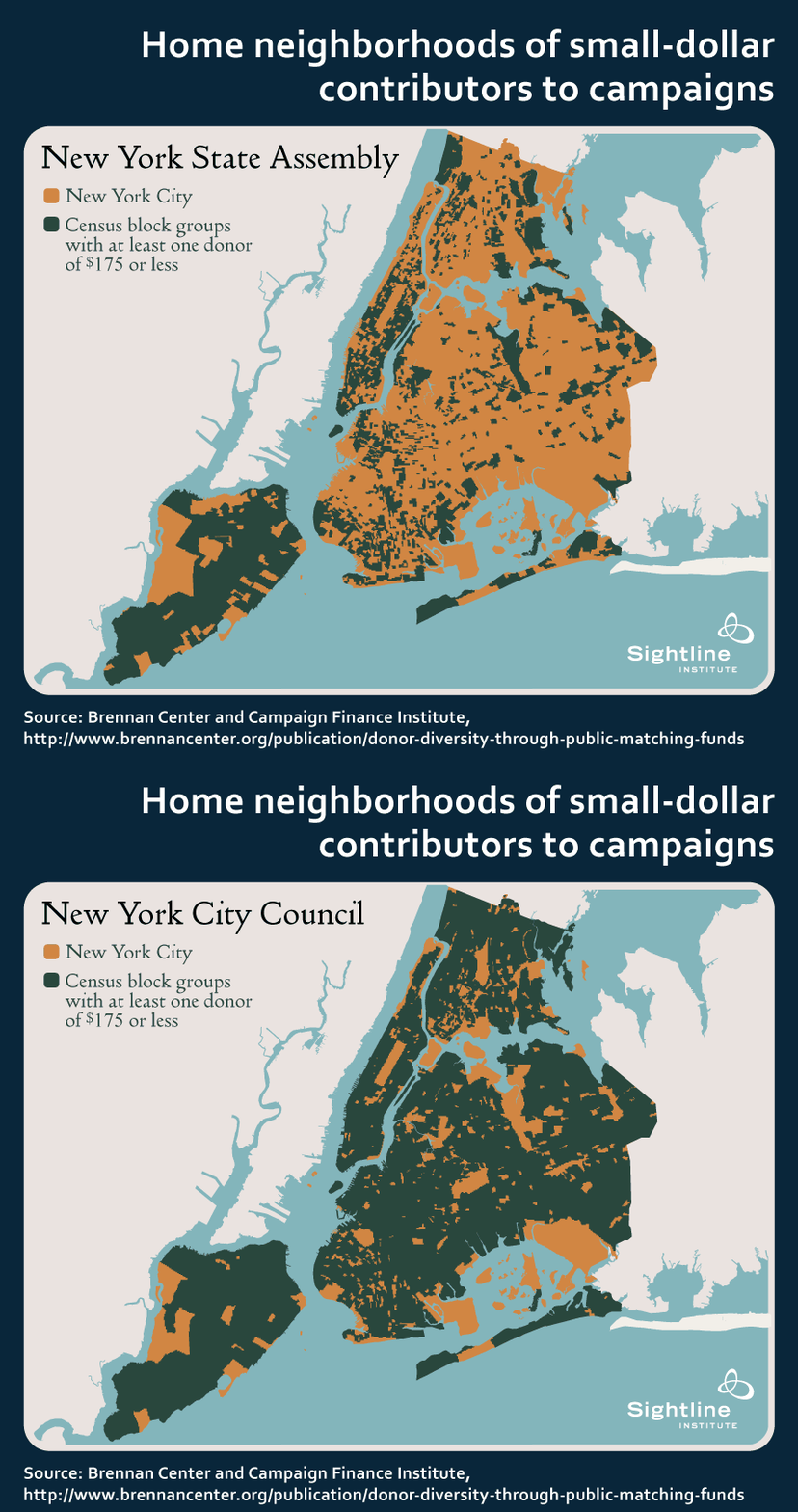
Honest Elections Seattle’s Democracy Voucher program could change all that, though, multiplying the number of residents who give to campaigns and expanding the geography of contributors to the whole city. Vouchers could be a huge boost for participatory democracy. Another day, I’ll lay out the specific case of Seattle, complete with maps and statistics. Today, I describe how public funding has transformed campaign giving in New York City. In the Big Apple, candidates for state assembly and city council run in districts of similar size and in similarly competitive races. Candidates for state assembly raise money the old-fashioned way: dialing for dollars. Candidates for city council, in contrast, raise money through a system of public-matching funds for small-dollar contributions. The first $175 of any resident’s gift is matched six-to-one with public funds. This one difference makes New York a fascinating natural experiment in how public campaign funds change politics.

Read more

Event: Innovative Solutions to Money in Politics

Next Thursday, join our executive director Alan Durning to discuss how unfettered money has changed the political landscape and what Oregonians can do to make sure their voices are heard. Deb Field, executive board member of Main Street Alliance, will be joining Alan. There will be a live jazz performance by the Mel Brown B3 Organ Group after the event (note … Read more

Event: Buying the Ballot Box

Your ballot is in. Most of the races have been called. The TV screen is political ad-free again. But it’s a different world out there for voters since the 2010 Citizens United decision and other massive campaign finance rule changes. This Saturday, join in conversation with Sightline Executive Director Alan Durning and KIRO Radio’s Dave Ross … Read more

Jury-Rigging Democracy

“The best argument against democracy,” Winston Churchill reportedly said, “is a five-minute conversation with the average voter.” Watching native-born Americans belly flop on a citizenship test suggests Churchill wasn’t far wrong.

But what about a week-long conversation? Worse? Actually, no.

An intriguing model of citizen participation in Oregon suggests that prolonged conversations with voters—or, conversations among voters—can dramatically improve democracy. The model is based on the jury: the panel of disinterested voters, operating under strict rules of procedure, presented with arguments and evidence, and left to apply their judgment to a case.

What an independent, nonpartisan Oregon group called Healthy Democracy has begun doing, with the sanction of state government, is to submit pending ballot measures to quasi-jury trials and then publish the results in the voters’ pamphlet. What’s so intriguing is that Oregon voters are starting to pay special heed to the one-page verdicts of these mock trials. In fact, before long, such juries could hold more sway than millions of dollars in campaign cash.

Oregon’s Citizens’ Initiative Reviews (CIRs) are perhaps the brightest light in the constellation of reforms to the initiative process that I’ve been mapping in this set of articles. And paradoxically, they do nothing to stem the tide of Big Money (after all, SCOTUS won’t let us). Instead, they just aim to make money matter less.

Read more

Have You Signed?

You know the drill. To get into the Safeway, you’re going to have to walk past the man with the clipboards. “Are you a registered voter?” he is asking you already, when you’re still 10 feet away. “Have you signed for…?” Whatever the pitch, it’s hard to decline, because he looked you in the eye and asked politely. It’s a small request. He’ll be here on the way out, too.

Who are these people? They’re paid signature gatherers. They travel from state to state, chasing the big initiatives, working as independent contractors for shady companies that reward them for each signature—a dollar or two or even more per valid signer. This petition derby yields intense incentives for gatherers to mislead voters, making the initiative sound sweeter than it is, and to engage in fraud, copying names from phone books, for example. But it’s also how the system works nowadays.

Citizens’ initiatives have become another business. Petitioning is no longer a test of popular ferment; it’s a test of sponsors’ money. As Western Washington University politics professor Todd Donovan says, “No one can get on the ballot unless they’ve got a million bucks.”

There are ways to mend this signature-gathering process, and they mostly focus on eliminating abuses. That’s the good news.

Read more

×
Privacy Overview
Sightline Institute

More information about our privacy notice

Strictly Necessary Cookies

Strictly Necessary Cookie should be enabled at all times so that we can save your preferences for cookie settings.

3rd Party Cookies

This website uses Google Analytics to collect anonymous information such as the number of visitors to the site, and the most popular pages.

Keeping this cookie enabled helps us to improve our website.

Additional Cookies

This website uses social media to collect anonymous information such as which platform are our users coming from.

Keeping this cookie enabled helps us better reach our audiences.