Donate Newsletters

WA’s First Ocean Acidification Legislation

On the heels of Washington State’s pioneering efforts to identify local steps to slow ocean acidification, Sen. Kevin Ranker (D-Orcas Island) has introduced legislation to begin coordinating that response. SB 5547 would create a new council of elected and tribal representatives and affected industries to oversee research and action to curb profoundly troubling changes in ocean chemistry.

The bill would also include acidification as a possible justification for extending urban sewer services to rural areas (normally not allowed under the state’s Growth Management Act), in areas where local pollution from leaky septic systems combines with global carbon dioxide emissions to make the problem worse.

Read more

Gregoire Pushes for Ocean Acidification Action

Update: Outgoing governor Chris Gregoire this morning announced a $3.3 million budget recommendation and signed an executive order to begin funding ocean acidification research and other initiatives outlined in her blue ribbon panel’s report. The money would create an ocean acidification research center at the University of Washington, help shellfish hatcheries forecast when lethal water is headed their way, and allow the state to begin teasing apart how much of the problem is caused by global carbon emissions and local pollution that could be regulated. Gregoire’s proposal would reallocate funds from existing taxes on hazardous substances and revenue from leasing state shellfish beds, and would require legislative approval next year.

Here’s a quick rundown of recommendations made this week by Washington’s blue ribbon panel on ocean acidification, a phenomenon driven by carbon dioxide pollution that is making the oceans more corrosive and acidic. That’s a problem for creatures that need calcium carbonate to build shells and skeletons.

Read more

Ocean Acidification: The Local Story

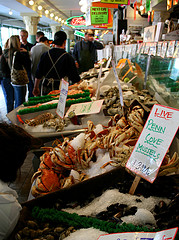
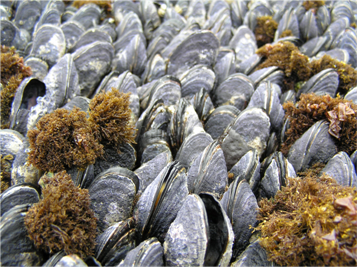
Mussels at Pike Place Market

When people learn that carbon dioxide pollution is turning our oceans more corrosive, it’s tempting to decide that the problem is too big for any person or local government to tackle.  But as our knowledge of ocean acidification continues to evolve, it turns out that in hotspots like Washington State, local factors—from nutrient pollution to seasonal currents and maybe emissions from ships or our own traffic—are playing a role too.

As Betsy Peabody, executive director of Puget Sound Restoration Fund, put it at this week’s meeting of the state’s Ocean Acidification Blue Ribbon Panel:

This is not just the carbon story that we’ve been hearing about happening somewhere out there. It’s different. It’s here.

The bad news? These local drivers are combining with rising global carbon dioxide emissions to make local waters increasingly acidic and put the Northwest on the leading edge of destructive changes in ocean chemistry.  For example, seawater in the depths of Hood Canal is already among the most corrosive found anywhere on earth. As that trend accelerates, it could profoundly change our marine systems, what appears on our dinner plates and whether shellfish farmers and, potentially, commercial fishermen will be able to stay in business.

The good news? While Washington State can’t do much about global carbon emissions, it does have some control over the local impacts that are contributing to the problem. Figuring out what those contributors are, and where the opportunities are to better control them, is one of the tasks of the blue ribbon panel that Gov. Christine Gregoire convened to look at the problem of ocean acidification. Washington State is the first to tackle the issue, and other states whose economies depend on a healthy seafood industry (such as Maine) are looking to us for solutions.

The basic problem is that excess carbon dioxide causes seawater to become more acidic (although it still remains above neutral on the pH scale). These chemical changes also bind up carbonate ions, which thousands of species of marine creatures need to build shells and skeletons. As those ions become scarce, those creatures have a hard time building and maintaining those protective structures. Although responses to acidifying seas vary widely among different species, mollusks such as oysters and clams and tiny creatures at the bottom of the food chain appear particularly vulnerable so far.

Since the ocean absorbs roughly a third of the carbon dioxide emissions we release into the atmosphere, rising climate pollution is making the oceans more acidic worldwide. This long-term trend is what scientists refer to as “ocean acidification.” But there are other sources of carbon dioxide in our local waters, which are contributing factors to the problems that have already begun to affect the state’s $270 million shellfish industry.

Here are some of the local influences that the panel is investigating:

Read more

Climate Pollution Killing Oysters

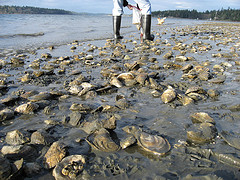
Simply put, this ocean acidification news coming out of Oregon State University is huge. Scientists have solved the mystery of what’s been killing baby oysters at the Whiskey Creek Shellfish Hatchery, proving that elevated carbon dioxide is the culprit.

It’s the first concrete evidence that ocean acidification–-a phenomenon caused by pollution from cars, coal plants and other machines that burn fossil fuel-–is harming commercially valuable species and Northwest businesses.

And unlike laboratory experiments that expose creatures to water that’s been chemically manipulated, the study published in the journal Limnology and Oceanography used real-world conditions encountered by one of the region’s largest independent shellfish hatcheries. As Burke Hales, an OSU chemical oceanographer and co-author of the study, explains:

This is one of the first times that we have been able to show how ocean acidification affects oyster larval development at a critical life stage. The predicted rise of atmospheric CO2 in the next two to three decades may push oyster larval growth past the break-even point in terms of production.

Read more

Washington Creates Ocean Acidification Panel

Washington State has become the first in the nation to convene an expert panel to tackle ocean acidification—a phenomenon driven by fossil fuel emissions and polluted runoff that threatens the Northwest’s shellfish and seafood industry.

(For much more on the problem and what’s driving it, see Sightline’s primer and blog series on Northwest Ocean Acidification.)

In a nutshell, excess carbon dioxide causes oceans to become more acidic, and also removes key building blocks that thousands of species need to build shells and skeletons. This carbon-dioxide-rich water has been linked to massive die-offs in Northwest oyster hatcheries. In laboratory experiments, the shelled animals that struggle or dissolve range from mussels to endangered abalone to cornerstones of the marine food web like krill and pteropods—tiny sea snails that make up more than half of the diet of some young Alaskan pink salmon.

And Northwest waters are on the leading edge of the problem, with some of the most acidic readings taken anywhere in the world’s oceans.

Here’s how panel co-chair Jay Manning put it today:

This has some pretty scary ramifications for what this could mean, both for Puget Sound and our coasts here and globally. I think it’s great that Washington is on the cutting edge of this issue. We’re taking it on before just about anyone else is, and it’s high time.

Read more

Fossil Fuels R Us

Cathy Pfister’s “wow” moment came when she and colleague Tim Wootton were studying the chemistry and sea life of Washington’s Tatoosh Island and found a decrease in pH over an 8-year-period that was an order of magnitude greater than what they expected.

It was a troubling trend—given the problems that sea life can run into as a result of ocean acidification, a change in ocean chemistry accelerated by fossil fuel pollution. As we pump more carbon dioxide into the atmosphere, seawater becomes more acidic and some creatures have trouble building shells and skeletons. In more acidic water, oysters struggle, some forms of plankton dissolve, squid become lethargic, and fish embryos can die. (For more detail on the phenomenon, check out Sightline’s primer on ocean acidification.)

Even on Tatoosh Island, where ecological studies have been underway for five decades, there was little historical pH data to put that alarming drop into context. How unusual was this, wondered Pfister, an associate professor in the Department of Ecology and Evolution at the University of Chicago. That’s how she turned to the historical record hidden inside mussel shells to answer that question. Ultimately, those shells would suggest that some of the changes taking place at Tatoosh Island were unprecedented.

Read more

Report: Northwest Ocean Acidification

Editor’s Note 8/11/2015: Everyone in the Northwest is feeling the heat this summer, and the Pacific Ocean is no exception. Record-breaking warm water temperatures have negative impacts on marine ecosystems, from toxic algae blooms to early shellfish closures and salmon deaths. Possibly worse than rising ocean temperatures is ocean acidification, the absorption of carbon dioxide into the sea. Ocean acidification also negatively affects mollusks and other marine animals, and hurts lucrative Northwest industries. Want to learn more about ocean acidification and its impact on the Northwest? Here’s your primer.

This primer is also available in a two-page summary format.

Tiny sea butterflies dissolve before researchers’ eyes. Baby oysters die by the tankful. Sea urchins grow deformed. These are a few consequences of raising marine creatures in increasingly corrosive water. And they could preview what’s in store for the Northwest as carbon dioxide pollution from cars, power plants, and other human sources changes the chemistry of our marine waters.

Tackling the Other Carbon Problem

In this blog series, we’ve explained how carbon dioxide pollution is making the oceans more acidic, demonstrated that it’s happening now, looked at which marine creatures are most at risk and talked to oyster growers, commercial fishermen, and Native American teenagers about their prospects if the ocean systems that support their businesses and culture collapse.

So what can we do about ocean acidification? Here are some of the key solutions:

  • Reduce carbon emissions by developing policies that assign a cost to that pollution and encourage a shift away from fossil fuels and towards clean energy.
  • Use existing laws—from local land use planning to building codes to the Clean Water Act—to curb pollutants that make the problem worse.
  • Invest in research and monitoring to see how important marine species will be affected, inform fisheries and ocean management plans, and help seafood producers adapt.

Read more

Carbon Dioxide: The Evil Ninja

To explain ocean acidification to second graders, here’s a start: Think of carbon dioxide as an evil ninja.

He’s buried in the ground in the form of coal, oil or some other fossil fuel. Someone digs him up and lights him on fire, sending him up into the atmosphere in a plume of smoke, or perhaps a polluting helicopter. The stealthy ninja parachutes out and lands in the ocean, where he begins to turn the ocean more acidic.

The ninja also runs into a happy clam, whose shell is made of calcium and carbonate. But the evil ninja breaks the molecule apart, kidnaps the carbonate and locks it away where no one can get to it. With that fundamental bond broken, the shell dissolves, the clam inside dies, and sea life as we know it is under attack.

That, at least, is the way students from the Suquamish Tribe Middle School see the situation unfolding in our oceans, as they brainstorm ideas for an animated video that will help younger kids understand the mechanics of ocean acidification. It’s a problem that people like Paul Williams, the shellfish management policy advisor for the tribe, sees as a grave threat to their culture. As he explained to a room of 11- to 14-year-old students on a recent summer day:

The goal today is to make videos to explain what’s going on out on the water because this is your future. If any of you want to be fishermen or fisherwomen, it’s really up to you guys. This is something that’s happening right now and it’s getting worse. If we want to have any alternative to McDonald’s, we’re going to have to work on this. And I have to apologize to you because my generation couldn’t do it. It’s a shame to have to tell you guys that this is your problem…but it’s the truth and I think you guys are old enough to be told the truth.

Read more

Are You a Banker or a Gambler?

Not every commercial fisherman is convinced that curbing carbon emissions is necessary to stop global warming. But the evidence that fossil fuel pollution is making the oceans more corrosive—and removing basic building blocks of the marine world—starts to get their attention.

In Alaska, commercial fishing supports one-sixth of the state’s economy and employs 70,000 people in high season, more than any other basic industry. Mark Vinsel, the executive director of United Fishermen of Alaska, the state’s largest commercial fishing organization, last year ranked his concerns about ocean acidification this way:

I’d say probably on a scale of 1 to 10, it would be 20 or 30.

If you sliced open the bellies of our most popular eating fish, at one point in their life cycle you would probably find krill, plankton, oceanic snails or other shelled creatures—the kinds of species likely to run into trouble as the oceans absorb more carbon dioxide from burning fossil fuels and other industrial processes.

As those carbon emissions rise, seawater becomes more acidic and sea life has more trouble finding calcium carbonate, a material that many creatures need to construct shells or skeletons, and, ultimately, to survive.

So if creatures at the bedrock layer of the marine food chain start to struggle in more corrosive seas, how might that affect an industry that provides nearly one-sixth of the world’s animal protein, not to mention $3.9 billion in personal income in Washington (roughly 2 percent of net earnings in the state) and more than $400 million in personal income in Oregon (one-half percent of net earnings)?

Here’s how Jeremy Brown, a Bellingham-based commercial fisherman who has spent nearly three decades fishing for salmon, halibut, black cod and albacore tuna, sees it:

Read more

×
Privacy Overview
Sightline Institute

More information about our privacy notice

Strictly Necessary Cookies

Strictly Necessary Cookie should be enabled at all times so that we can save your preferences for cookie settings.

3rd Party Cookies

This website uses Google Analytics to collect anonymous information such as the number of visitors to the site, and the most popular pages.

Keeping this cookie enabled helps us to improve our website.

Additional Cookies

This website uses social media to collect anonymous information such as which platform are our users coming from.

Keeping this cookie enabled helps us better reach our audiences.