
Unlocking the Northwest’s Energy Future
Policy recommendations to responsibly speed up electric transmission line permitting in Oregon and Washington—for a safe, modern grid and shared climate progress.
Emily Moore and Kelly Trumbull, Sightline Institute | August 2026
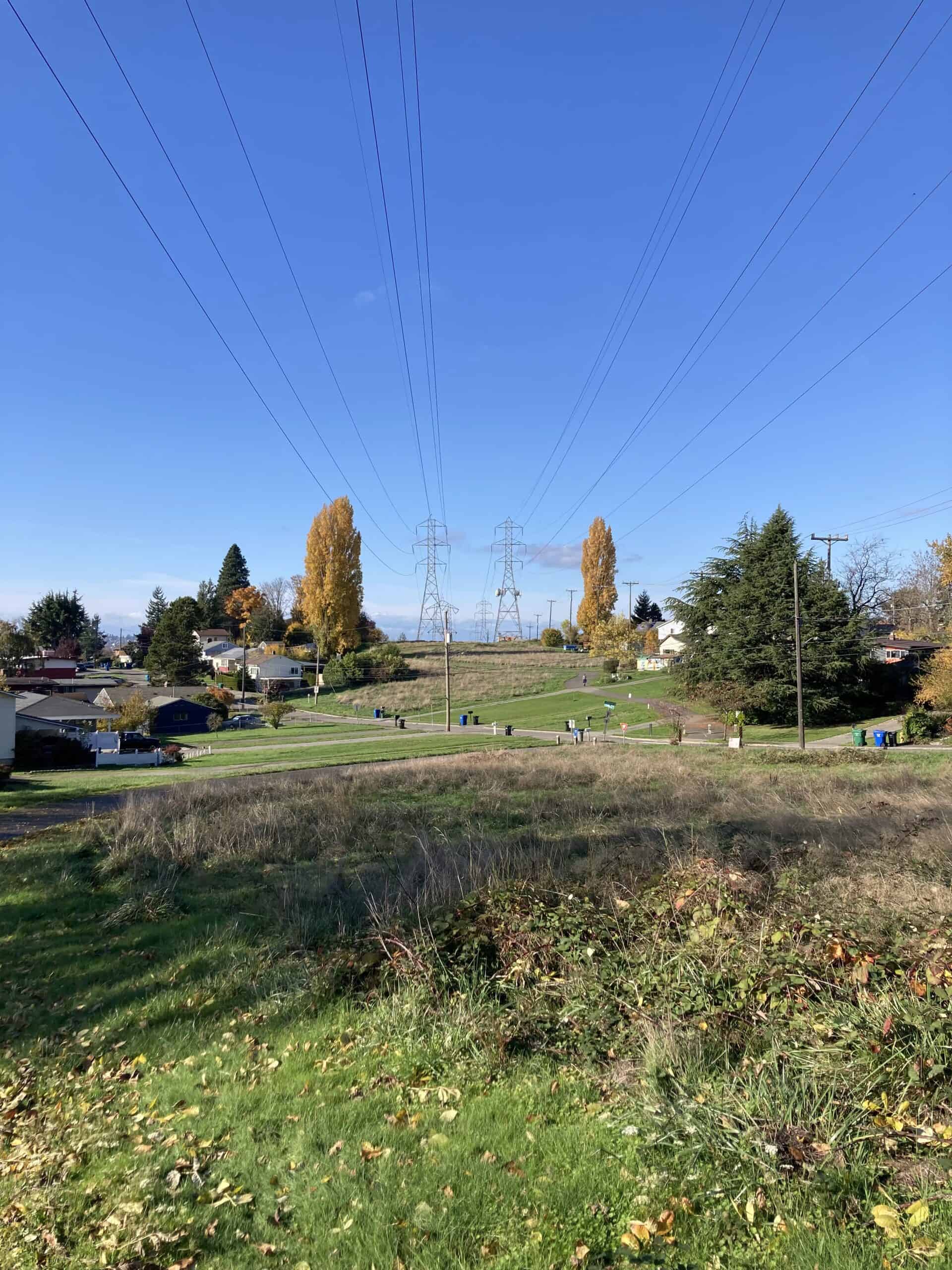
Download the report (pdf)Transmission lines run along the popular Chief Sealth Trail in Seattle, connecting the Beacon Hill neighborhood with the Rainier Beach area using the greenbelt under transmission lines.
Executive Summary
Oregon and Washington state are suffering the devastating, expensive, and deadly effects of a warming planet at an accelerating clip. In the past few years alone, mega wildfires killed 11 people and burned 4,000 homes in Oregon; an unprecedented heat dome spiked temperatures above 121 degrees, killing 650 people across the Pacific Northwest; and historic flooding inundated 4,000 homes, causing $182 million in damage in Washington.
Northwest residents and leaders have consistently affirmed their desire for this region to do its part to stop heating the planet. Oregon and Washington have both committed to slashing their climate-warming pollution over the next 25 years, and each state is less than 5 years away from its first major milestone.
But without expanding the electric grid, neither state is likely to achieve its climate goals. Many of the region’s electric transmission lines are more than 50 years old, and the system is not keeping up with today’s needs. Modernizing the grid will allow Oregon and Washington to connect to clean, affordable, and reliable energy sources—whether utility solar power in California or wind farms in Montana—instead of relying on polluting and expensive natural gas for longer.
What’s more, a modern, updated grid will let Northwesterners swap gas appliances and cars for more efficient, healthier, and cleaner electric alternatives. State energy strategies for both Oregon and Washington anticipate that electricity use will double by 2050, with the switch to electric vehicles driving much of the increase.
The Northwest can quickly build the grid it needs—and keep costs down—by adopting more predictable permitting processes, without compromising on environmental values. Despite several recent reforms and improvements, as well as state leaders’ growing recognition that an expanded grid is central to addressing climate change, Oregon and Washington’s project approval processes threaten to stall crucial grid infrastructure. It takes Oregon an average of 2.6 years and Washington an average of 2.2 to greenlight energy infrastructure, and some projects can languish for far longer.1
Current state-level permitting procedures suffer from inconsistent and unclear project requirements; overreliance on varied and vague local zoning rules; the risk of drawn-out legal challenges that burden agency staff without changing outcomes; and a lack of clear mandate for state siting councils to approve the projects Oregon and Washington depend on to achieve climate targets. Without changes to the status quo, Northwesterners could end up spending more on grid projects whose costs balloon from delays—and lose the chance to access affordable, clean, and reliable electricity.
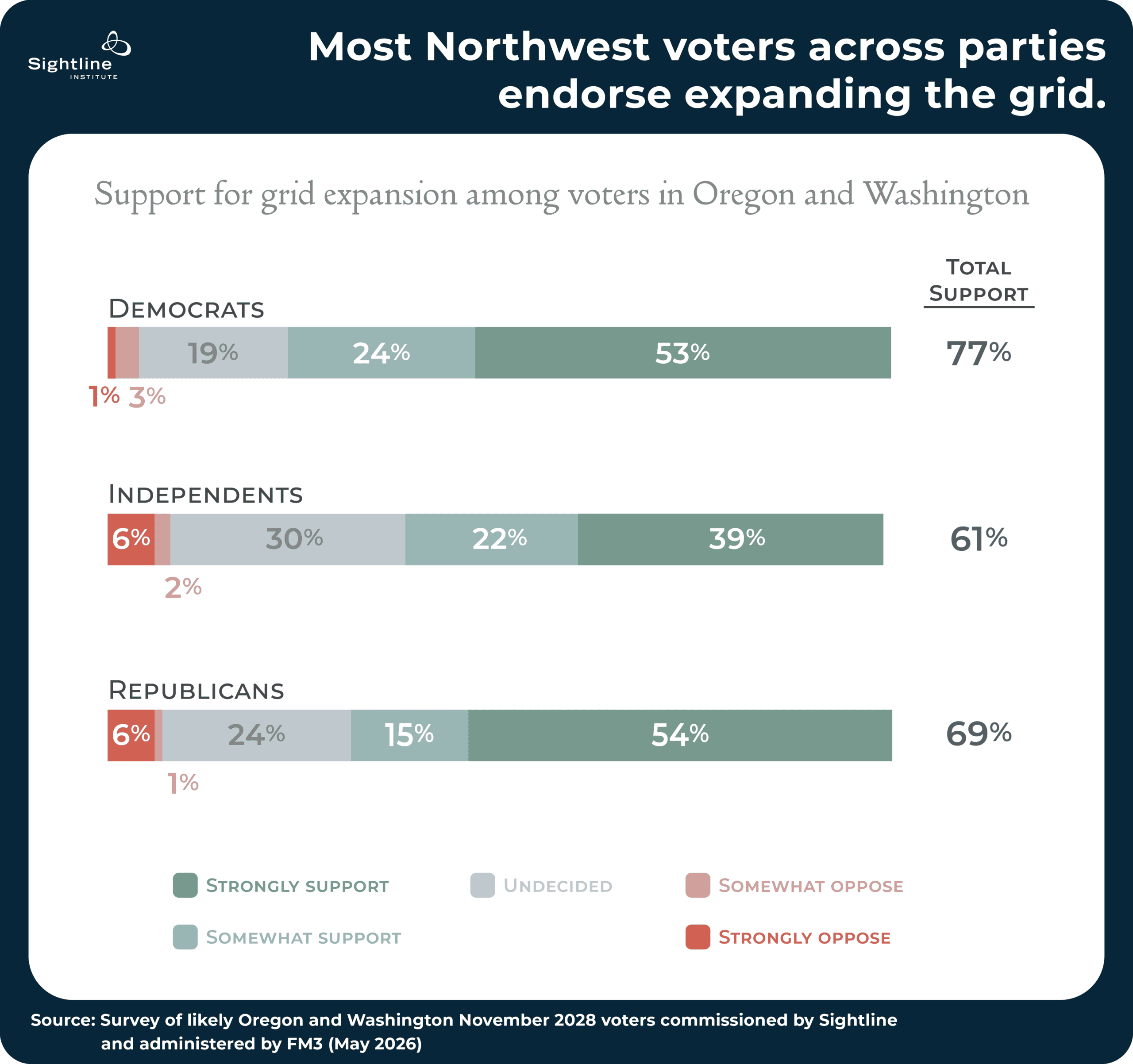
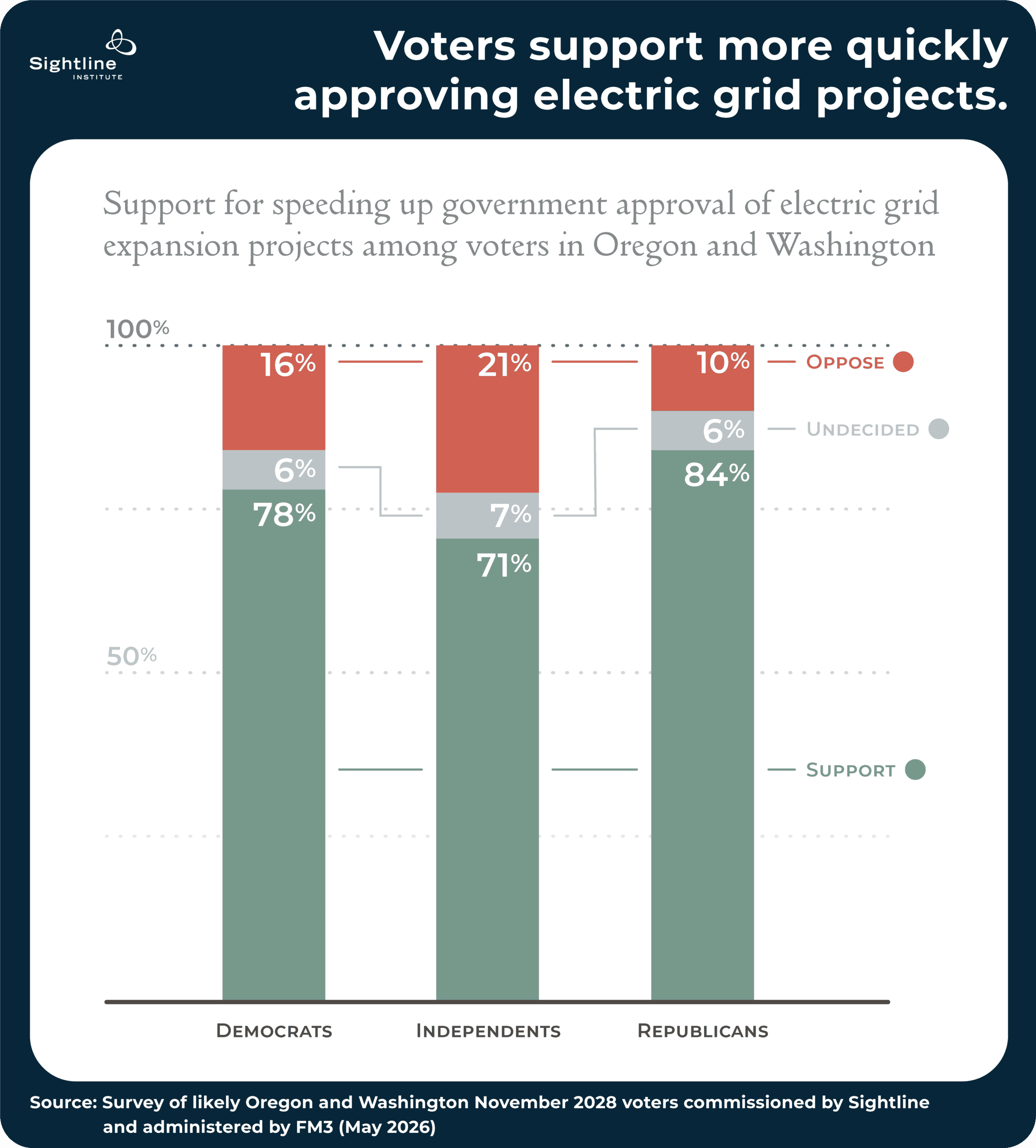
The good news is that most voters support modernizing the grid and accelerating permitting processes. According to a survey Sightline commissioned, 70 percent of Oregon and Washington voters support expanding the grid, and 78 percent support speeding up government approval of electricity grid expansion projects.
Leaders in Oregon and Washington can take up the mantle and give the region a fighting chance at freeing itself from fossil fuels. Specifically, policymakers can
- hold electric transmission projects to clear and objective environmental mitigation criteria and consistent application requirements;
- standardize land use rules for electric transmission projects statewide;
- expedite approval of certain transmission lines by eliminating trial-like hearings and introducing earlier Tribal and community consultation; and
- empower state siting councils to advance statewide climate goals when reviewing energy projects, thereby insulating them from political pressure.
These reforms would introduce predictability and reduce redundancy without jettisoning the region’s commitment to strong environmental and community protections. In turn, they would help Oregon and Washington get poles in the ground and wires in the air at the pace climate change demands.
Table of Contents
Executive Summary
Part 1. How state-level transmission line permitting works in Oregon and Washington
- State siting councils assess projects’ environmental and other impacts
- Both states require Tribal engagement or consultation
Part 2. Challenges with the transmission line permitting status quo
- Challenge 1: Inconsistent and unclear project requirements
- Challenge 2: Overreliance on inconsistent and vague local zoning rules
- Challenge 3: Risk of drawn-out legal challenges
- Challenge 4: Lack of clear climate mandate, creating space for political pressure
Part 3. Recommendations to speed transmission line approval and construction—with popular support
- Polling finds Northwesterners support an expanded grid and faster approval processes
- Predictable, clear permitting processes can help the Northwest quickly and responsibly build crucial grid infrastructure
- Opportunity 1: Project review. Hold projects to clear and objective environmental mitigation criteria and consistent application requirements
- Opportunity 2: Land Use. Standardize land use rules statewide
- Opportunity 3: Administrative proceedings. Expedite approval of certain transmission lines by avoiding trial-like hearings and requiring earlier Tribal and community engagement
- Opportunity 4: Governance. Empower siting councils to advance statewide climate goals
Conclusion: Northwest states can make it easier for their residents to harness clean, affordable power by reforming how they review electric grid projects
Appendix A: Oregon Energy Facility Siting Council’s review process and timeline
Appendix B: Washington Energy Facility Site Evaluation Council’s review process and timeline
Appendix C: Oregon Policy Recommendations
Appendix D: Washington Policy Recommendations
Appendix E: Oregon polling results for permitting reform policies
Appendix F: Washington polling results for permitting reform policies
Photo credits
Scope, methodology, and structure
This report focuses specifically on state-level permitting processes for electric transmission projects in Oregon and Washington state. It does not analyze or recommend changes to local or federal permitting processes, nor does it specifically recommend changes to permitting processes for energy generation projects. That said, many of the reforms this report identifies would likely help accelerate approval of those types of projects as well.
To understand the status quo and develop recommendations, Sightline analyzed available permitting documents for energy projects that state siting councils have reviewed in Oregon and Washington. Because only one electric transmission line has received state-level approval in either state since 1983, Sightline also analyzed permitting documents from generation projects.
To complement the document review, Sightline interviewed more than 60 people with knowledge or experience of the states’ processes, including state lawmakers and regulators, energy infrastructure developers, Tribal representatives, members of environmental organizations, land use lawyers, and utility employees.
Finally, Sightline analyzed recent bills and laws that amended (or would have amended) state permitting processes in each state, reviewed recent state-commissioned permitting and siting reports, and analyzed reforms that states in other regions have enacted.
Sightline’s analysis identified common cross-cutting challenges and opportunities across Oregon and Washington and unearthed state-specific policy ideas. Part 1 of this report outlines the status quo of state-level permitting processes for electric transmission lines. Part 2 showcases the common challenges across Oregon and Washington that can hamstring approval of these projects. Part 3 identifies cross-cutting opportunities and breaks out state-specific policy recommendations.
Part 1. How state-level transmission line permitting works in Oregon and Washington
State siting councils assess projects’ environmental and other impacts
In the 1970s, Oregon and Washington each established a government body to evaluate fossil fuel and nuclear generating projects. Today these siting councils—Oregon’s Energy Facility Siting Council (EFSC) and Washington’s Energy Facility Site Evaluation Council (EFSEC)—assess all large energy project proposals, including large transmission lines.1 Rather than relying on multiple state agencies and local jurisdictions to separately review a project, transmission builders gain access to a consolidated permitting process through the siting councils.2
One of the councils’ primary responsibilities is to evaluate projects for their potential impact on the environment. Power lines can, for example, obscure views or disrupt animals’ habitat, but thoughtful project design, which the councils can demand, can avoid or mitigate most of these impacts.
Oregon’s EFSC assesses transmission projects against 16 standards, including Recreation, Scenic Resources, Soil Protection, and Waste Minimization, soliciting input from up to 13 state agencies to do so.3 Washington’s EFSEC reviews projects under the State Environmental Protection Act (SEPA) (the state’s National Environmental Protection Act [NEPA] equivalent), a process that involves analyzing projects’ impacts on 16 elements of the environment.
The depth and duration of Washington’s SEPA review depend on a project’s likely impact; EFSEC must prepare the most detailed review—an environmental impact statement (EIS)—for any project it determines is likely to significantly affect the environment. On average, it takes Washington state agencies 27 months to prepare an EIS.4 If EFSEC determines that a developer can mitigate the project’s impact, it will issue a mitigated determination of nonsignificance (MDNS), a finding that avoids an EIS. Separate from the SEPA process, Washington also requires all projects that EFSEC approves to comply with the council’s six construction and operation standards, which outline mitigation measures based on state and federal regulations. For example, EFSEC’s fish and wildlife standard mandates that energy facilities result in “no net loss of fish and wildlife habitat function and value.”
The state councils also assess projects’ compatibility with land use laws and rules. Oregon law requires all projects approved by EFSC to comply with the state’s 19 land use planning goals by either meeting them directly or satisfying whatever local zoning criteria each city or county has adopted (which themselves flow from the statewide planning goals).5 In practice, most developers prefer to comply with local criteria to garner goodwill with the local communities where they want to build.6 City and county governments, which also review applications through the EFSC process, must issue local permits if the state council approves the project. In Washington, transmission projects eligible for EFSEC review do not need to secure local land use permits, but the council still reviews projects for consistency with city and county rules and can impose local land use and zoning criteria in the site certificate it issues.
In both states, the public can comment on a project at least three different times, plus a fourth time if a project goes through an administrative proceeding.7 Known as the contested case in Oregon, this additional step allows parties to the proceeding to present evidence on unresolved project issues; for example, a project opponent could challenge whether a project’s design sufficiently minimizes impacts to soil or protects wildlife. The contested case process occurs only if a party challenges the Oregon Department of Energy’s (ODOE) recommendation to EFSC on whether to approve or reject a project.8 Washington, meanwhile, requires that EFSEC hold its version of this proceeding, an adjudicative hearing, for any project that is inconsistent with local land use ordinances and/or receives a determination of significance (i.e., needs an EIS) under SEPA.9
Both states also offer expedited permitting processes, but they have largely closed these paths to transmission line projects. Only some natural gas energy projects and small energy generating facilities can apply for Oregon EFSC’s expedited permitting path, which skips the “notice of intent” step (the first step of the process, in which developers submit pre-application information). Oregon’s expedited process sets a six-month application review deadline for projects without a contested case hearing and a nine-month deadline for those with such a hearing. In Washington, developers can apply to EFSEC’s expedited process and avoid the adjudicative hearing process, but only if their projects are consistent with local land use codes and receive a SEPA determination of nonsignificance or mitigated determination of nonsignificance (i.e., do not need an EIS); a lengthy transmission line project that crosses multiple jurisdictions is unlikely to meet the land use consistency criteria.
While the councils’ responsibilities overlap, each body is governed slightly differently. Oregon’s EFSC is composed of a seven-member volunteer board that the governor appoints, and ODOE staff supports the council. In Washington, by contrast, six state agency representatives make up EFSEC, which employs its own staff. Unlike in Oregon, Washington’s governor decides whether a project can proceed based on EFSEC’s recommendation.
Finally, in Oregon, the Oregon Public Utilities Commission (OPUC), the state’s utility regulator, also reviews transmission lines to determine if they are in the public interest. If they are, the OPUC issues a Certificate of Public Convenience and Necessity (CPCN), which project backers can use in eminent domain proceedings, if necessary. By contrast, Washington automatically grants transmission owners eminent domain authority and does not require a CPCN. In practice, utilities and developers prefer to avoid relying on eminent domain and instead seek to negotiate agreements to compensate landowners for a project that crosses their property. Separately, through rate-making processes, regulators in both states assess a project’s “prudency” to determine if an investor-owned utility can charge its customers for its costs.
Both states require Tribal engagement or consultation
Oregon and Washington both require siting councils and applicants to engage or consult federally recognized Tribes through the permitting process. Early, meaningful government-to-government consultation is critical to both respect Tribal sovereignty and avoid repeating the devastating consequences of the last big energy infrastructure build-out in the Northwest, when the United States built hydropower dams that flooded burial grounds, displaced communities, and decimated fish populations, among other lasting harms.
ODOE’s siting division, which provides staff support to EFSC, notifies all Tribal governments when a project could affect them and allows the council to financially compensate Tribes (as well as state agencies and local governments) for their time spent reviewing project materials. EFSC also requires applicants to consult with the Legislative Commission on Indian Services, a 13-member advisory body that facilitates relations between the state and Tribes, to identify Tribes that the project may affect. To receive EFSC’s approval, applicants must show that their project is not likely to result in significant adverse impacts to historic, cultural, and archeological resources. In 2023 Oregon created a Tribal Consultation Task Force to address gaps in government-to-government consultation between the state and Tribes; lawmakers renewed the task force in 2025, and its recommendations to the legislature are due in September 2026.
Washington requires EFSEC to consult with federally recognized Tribes whose resources, rights, or interests a project may affect and to offer government-to-government consultation “to address issues of concern raised by such a tribe.”
In recent years, both states have reformed processes to encourage or require developers to engage Tribes earlier. As of 2026, Oregon’s EFSC requires applicants to document efforts to reach out to Tribes prior to submitting a “notice of intent” (the first step of the process). And in October 2025, Washington Governor Bob Ferguson issued an executive order directing cabinet agencies to consult “early and often” with Tribal governments and convening cabinet agencies, Tribes, and “other appropriate parties” to identify how to better protect sensitive Tribal information. Washington now mandates that developers offer government-to-government consultation with affected Tribes in the first 90 days after submitting a project application to EFSEC, and EFSEC requires project backers to summarize all consultation they have conducted with Tribes prior to submitting an application.
Both states also aim to safeguard sensitive Tribal information. Making public the locations of sacred sites, first foods, or archaeological sites, for example, can risk their looting, vandalism, or destruction. Oregon protects information about the location of archeological objects and “sites of archeological significance” from public records disclosure. In 2026 Washington lawmakers exempted government-to-government consultation on a project application from public records requirements.
Part 2. Challenges with the transmission line permitting status quo
To date, the Boardman-to-Hemingway project, which will span 271 miles in Idaho and Oregon, is the only transmission line that either Oregon or Washington’s siting council has approved since 1982. It took 17 years for utility Idaho Power to plan and receive permits for the project, including 8 years awaiting the green light from Oregon (more than three times longer than the average review time for other energy projects in Oregon). Permitting delays helped balloon the project’s costs by at least $300 million.
But Oregon and Washington’s siting councils have reviewed a combined 71 battery energy, renewable energy, and transmission projects as of July 2026, giving Sightline insight into how these processes have played out and how they might affect future grid projects.
Sightline found that despite many recent improvements, state-level permitting processes still suffer from inconsistency and unpredictability, which could delay approval of future grid projects, increase the review burden on the siting council and other agency staff, and drive up transmission project costs that land on customers’ utility bills.10 To date, the average time Oregon’s EFSC and Washington’s EFSEC took to permit any clean energy project (including battery storage, renewable generation, and transmission lines) was 30.7 months and 26.9 months, respectively.11
To date, the average time Oregon’s EFSC and Washington’s EFSEC took to permit any clean energy project (including battery storage, renewable generation, and transmission lines) was 30.7 months and 26.9 months, respectively.
Challenges hampering efficient project review include: 1) inconsistent and unclear project requirements, 2) overreliance on varied and vague local zoning rules, 3) the risk of drawn-out legal challenges, and 4) a lack of clear climate mandate, creating space for political pressure.
Challenge 1: Inconsistent and unclear project requirements
For starters, neither Oregon nor Washington clearly defines objective actions a project developer can take to mitigate transmission lines’ effect on the environment.
In Oregon, EFSC and the state agencies from which it solicits input determine what information a developer must provide in its application, such as botanical or wildlife surveys or traffic impact analyses, on a case-by-case basis. For example, after reviewing the Umatilla Electric Cooperative’s “notice of intent” for its proposed 14-mile Umatilla-Morrow County Connect transmission line, the Oregon Department of Forestry recommended that EFSC ask the utility to include fire prevention safety shutoff measures in its formal application, and the Department of State Lands recommended that it identify any wetlands within the project boundaries. These agencies will no doubt make the same requests of future transmission projects, but they wait for a project to land on their desk before doing so. Reviewing a “notice of intent” takes EFSC an average of 4 months.
EFSC then asks applicants to demonstrate in their project application how they will meet each of its standards, rather than proactively telling the applicants how they could do so. For example, to determine compliance with the Soil standard, EFSC requires applicants to describe “any measures the applicant proposes to avoid or mitigate adverse impact to soils.”
Agencies will also sometimes make multiple requests for additional information on the same project in the review phases that follow the notice of intent, adding months to the permitting timeline. On average, almost 16.4 months pass after EFSC issues the project order specifying what a developer must include in its application and before a developer submits that application. It then takes an additional 11.4 months on average for EFSC to issue a final decision.
In Washington, the legislature attempted to clarify upfront how projects can mitigate potential impacts when, in 2023, it directed EFSEC to prepare a programmatic environmental impact statement (PEIS) for transmission lines with a voltage at or above 230 kV. The purpose of the PEIS is to analyze possible adverse environmental effects of all transmission line projects of this size and identify ways to mitigate them before a developer proposes a specific project, ideally saving time later. The legislature also directed EFSEC to find that if an individual project proposal incorporates the PEIS’s mitigation measures, the project should receive a “mitigated determination of nonsignificance” (MDNS)—again, avoiding an EIS—unless the project will affect the environment in ways the PEIS does not address.
In theory, Washington’s new transmission PEIS should make it easier for individual project backers to understand how to mitigate transmission lines’ environmental impact under SEPA, cutting down on application development and review time and potentially avoiding a lengthy EIS process. Indeed, some of the mitigation measures in the document, such as using “low-reflectivity finishes” on transmission facilities, are straightforward and commonsense.
However, not all the mitigation measures in the PEIS are objective, clear, or practical, which limits how effective the document may be at speeding up a project’s review. For example, one such measure is to “minimize soil disturbance, including footprints related to access roads and permanent structures, to the greatest extent practicable”; another is to “locally source raw materials, components, and fuel to the extent practicable”; and yet another encourages applications to “include a cost-benefit analysis,” without specifying any additional detail. The PEIS also requires transmission lines to “avoid incompatible land uses and adhere to all applicable zoning and development regulations” to receive a MDNS, which is likely to be challenging, if not impossible.
Washington also still requires SEPA review for upgrades on lines rated above 115 kV, even though EFSEC’s PEIS found the impact of upgrades on the environment akin to routine operations and maintenance of power lines. The average duration of the SEPA review process for EFSEC-jurisdictional projects is 21 months.12
Finally, both states’ processes include redundancies. Washington’s EFSEC’s six construction and operation standards overlap with four elements the council reviews under SEPA: 1) air, 2) animals, 3) noise, and 4) water. Because EFSEC’s standards already mandate that projects comply with existing regulations, SEPA review for duplicative elements may not add anything meaningful to the assessment (or vice versa) but could extend review timelines.
And in Oregon, both OPUC and EFSC evaluate the same project against essentially the same criteria. OPUC and EFSEC both examine a line’s need, whether it’s in the public interest, and its route.13 In 2025 the legislature allowed OPUC to issue a CPCN without waiting for EFSC’s land use approval, thus allowing the two reviews to run in parallel and enabling developers to use EFSC’s site certificate as evidence of “need” in eminent domain proceedings. However, because Oregon has not gotten rid of its CPCN requirement, project backers may still need to secure approval from both agencies.
Challenge 2: Overreliance on inconsistent and vague local zoning rules
Despite their roles as state-level approval bodies, both Oregon and Washington’s siting councils continue to rely on local land use criteria to assess projects. In Oregon, project applicants can choose to have EFSC evaluate projects against either the 19 statewide planning goals—none of which addresses the grid, renewable energy, or climate change—or local land use rules (which themselves stem from land use goals). EFSC rules lock applicants into whichever land use approval path they select in their preliminary application. And though Oregon law requires counties to furnish local permits once EFSC issues the site certificate approving the project, counties can drag their feet in doing so.
Even after EFSC had issued a site certificate for the Boardman-to-Hemingway transmission line, Idaho Power was still waiting for both Morrow and Umatilla Counties to provide the local permits the utility needed to start construction, according to both EFSC and Idaho Power. “It seems like we’re still going through the county process and then have to show the proof to ODOE,” an Idaho Power representative told Sightline.
In Washington, EFSEC assesses projects’ compliance with local zoning criteria through a land use consistency hearing and, if the project is not consistent with these criteria, through an adjudicative hearing. It can, however, overrule local zoning requirements. EFSEC has taken 12.5 months on average to evaluate land use consistency.
Local zoning criteria can be vague in both states. Whatcom County, Washington, for example, requires transmission lines to be “harmonious and appropriate in appearance with the existing or intended character of the general vicinity.”
Rules can also vary across jurisdictions even for the same land use type. For example, the proposed Cascade Renewable Transmission System would cross “open space districts” in both The Dalles and the City of Mosier in Oregon.14 The Dalles spells out specific criteria—noise levels, lighting, dust, vibration, and traffic impacts—while the City of Mosier’s rules are more ambiguous, prohibiting “unacceptable adverse impacts” and major health, safety, or welfare impacts.
Local land use criteria are similarly patchy in Washington. For example, Island County prohibits transmission lines in several rural zones; Kittitas County and Whatcom County are among the many jurisdictions that require conditional use permits; and Snohomish County and Kitsap County expressly allow transmission lines in all zones. Spokane County falls somewhere in the middle, allowing transmission facilities as “limited uses” in all zones but imposing a height restriction of 125 feet. (A transmission tower can stand between 50 and 200 feet tall depending on its voltage and location.)
Large transmission lines that connect Oregon and Washington to clean power will necessarily cross multiple local jurisdictions. The states’ overreliance on inconsistent and vague local zoning rules adds both uncertainty and potential delay to future grid projects.
Challenge 3: Risk of drawn-out legal challenges
Each state’s administrative proceeding, in which opponents can formally challenge a project, can also prolong review by years, without necessarily augmenting environmental protections. The contested case process added more than two years to Oregon’s review of the Boardman-to-Hemingway transmission line project. (A 2025 policy change directs EFSC to make “every effort” to complete the contested case process in 12 months.) In Washington, EFSEC’s adjudicative hearings have added from three months to nearly 3.5 years to project reviews. (The average length of an adjudicative hearing is 12.7 months; the median is 7.1.)15
The “greatest wildcard is the adjudicative process,” an EFSEC representative told Sightline.
Administrative proceedings can also lead siting councils to re-review issues they had examined earlier in the process and hear repetitive comments from the same parties. For example, in the eight-month-long adjudicative hearing for the Wild Horse Wind project near Kittitas, Washington, the EFSEC chair asked a witness to clarify the visual impacts of the project, including whether the turbines would have a semi-gloss or full-gloss finish; these questions were also studied (and mitigation measures identified) in the final EIS.
However, until 2026, adjudicative hearings also offered Tribes in Washington a crucial and unique space to privately share sensitive information, according to several Tribal representatives Sightline interviewed. By contrast, all information shared in public hearings, including SEPA-related hearings, must be made public according to Washington law. EFSEC’s adjudicative hearings in the Horse Heaven wind, solar, and battery project allowed the Yakama Nation to influence the project design EFSEC initially recommended to the governor without compromising the confidentiality of sensitive information. (The Yakama Nation continues to oppose the project, suing then-Governor Jay Inslee in 2024 over his approval of a revised design.) In 2026 lawmakers made it possible for Tribes to privately share sensitive information with EFSEC outside of the adjudicative hearing process; all government-to-government consultation is now exempt from public record requirements, meaning the adjudicative hearing process no longer offers additional privacy benefits.
Contested case hearings in Oregon can also unnecessarily re-litigate issues. In the hearing for the Obsidian Solar Center project in Lake County, Oregon, parties raised eight issues related to whether the project complied with Lake County zoning ordinances and the Lake County Comprehensive Plan. They also pointed out a typo related to well water usage that the parties, the applicant, and ODOE agreed was an error. Parties had already raised these issues in earlier comments, as required per Oregon statute. After 16 months of hearings, the administrative law judge found that parties failed to show noncompliance for all eight issues raised (although ODOE proposed clarifying two conditions it had already imposed and corrected the typo). In its 2026 Draft Report on Siting and Permitting Large Scale Energy Infrastructure, ODOE itself argues that “some of the Contested Case steps duplicate other parts of the Siting Program review, taking additional time without providing value.” The report notes that the contested case hearing process lasts an average of 14 months.
Part of the reason the public relies on administrative proceedings may be that project developers consult local communities too late in the process—after they have already made many crucial project decisions. Early engagement can help prevent opposition. Oregon and Washington’s siting councils encourage but do not require applicants to meet with local governments and community groups before submitting any information. Projects that fail to engage the public face delays; for example, a 100-mile transmission line in Utah stalled for ten months due to litigation after developers had not involved local communities in initial transmission line site selection.
Challenge 4: Lack of clear climate mandate, creating space for political pressure
Oregon and Washington both grant their siting councils discretion in approving projects. In Oregon, EFSC can greenlight a project if it determines the line meets its standards or if the “public benefits” of a project outweigh its adverse effects, though the state does not clearly define what these benefits are. In Washington, EFSEC “provides little or no binding guidance as to what applicants must demonstrate to receive a recommendation for approval,” a 2024 state-commissioned report found; instead, the legislature directs it to “balance [demand for energy facilities] with the broad interests of the public.”
Washington’s legislature attempted to provide EFSEC clearer guidance in a 2025 bill that would have required the council to recommend approval of clean energy facilities, including transmission lines, that met certain standards. But the standards were still subjective, including that a project presented no “unreasonable threat to health and safety” and that applicants “agreed to reasonable requirements for project decommissioning.”
Most glaringly, both councils lack a clear mandate to approve transmission projects that advance the state’s climate goals, though Washington has taken steps in this direction. In 2022, the legislature affirmed its intent that EFSEC “streamline application review for energy facilities to meet the state’s energy goals” and to “provide abundant clean energy at reasonable cost.” And EFSEC itself identifies “sustainable” energy as one of its aims in its strategic plan. But these steps fall short of state leadership mandating that the council approve projects that Washington’s climate goals depend on and that meet environmental mitigation measures, Tribal consultation requirements, and community engagement standards. Oregon’s EFSC lacks any climate mandate.
This lack of guidance exposes siting council decisions to political shifts. A change in the priorities of each state’s highest office can influence project approval, since the governor appoints at least one siting council member in each state. Plus, Washington EFSEC’s agency-representative structure means councilmembers may act in furtherance of their own individual agencies’ missions rather than prioritizing the state’s overarching climate goals.
Washington is also the only state in the United States with a siting board that requires governor approval after the council makes its final recommendation. Awaiting the governor’s sign-off has added between 1.5 months and almost six months to an already lengthy process—and adds another possibility for a politically motivated decision. Washington imposes a 60-day deadline for the governor to approve, reject, or send the application back to EFSEC for reconsideration. If the governor sends the application back, the process can drag on even longer.
Part 3. Recommendations to speed transmission line approval and construction—with popular support
Polling finds Northwesterners support an expanded grid and faster approval processes
The good news is that majorities of Northwesterners want to expand the grid. A survey commissioned by Sightline and administered by FM3 in May 2026 found that 82 percent of voters in Oregon and Washington view the grid as “essential,” and 70 percent support expanding it, with support high across state and party lines.
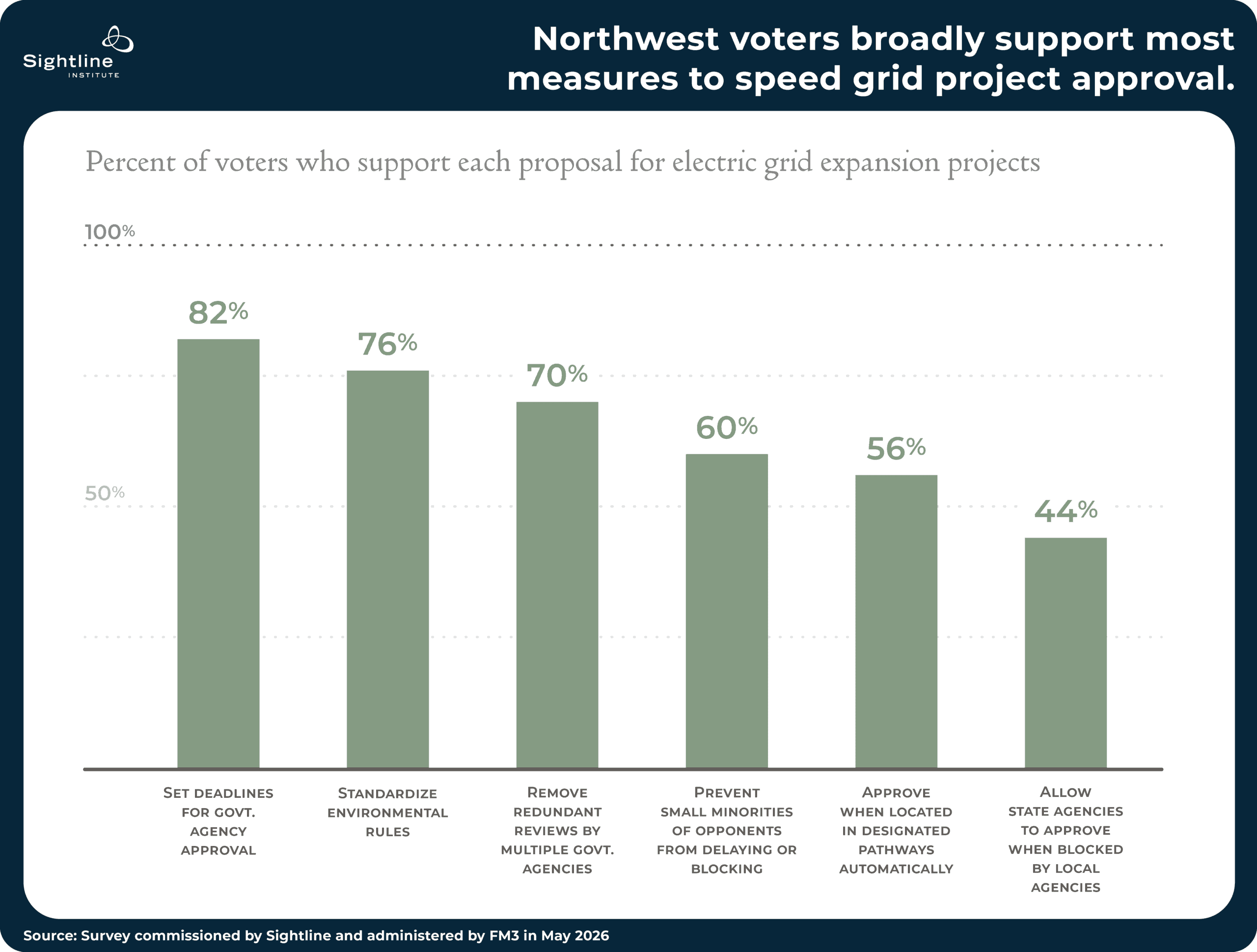
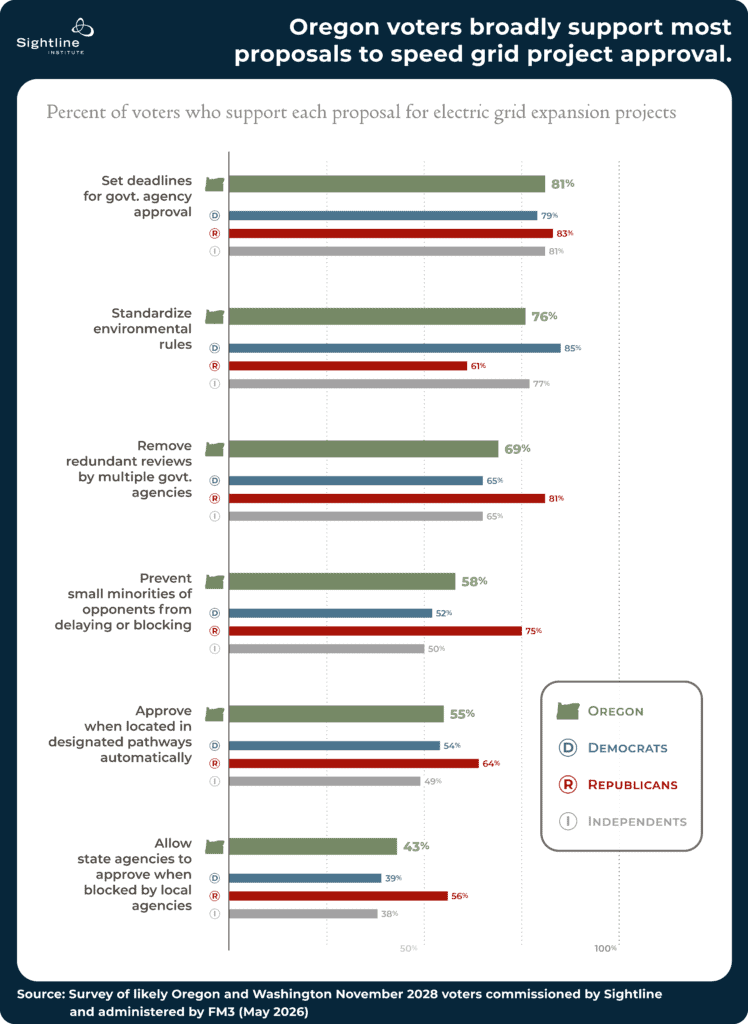
Plus, 78 percent of Oregon and Washington voters endorse speeding up government approval of electricity grid expansion projects. And robust majorities of survey respondents across the political spectrum supported almost every policy idea Sightline tested to speed project approval. In short, lawmakers can take action, well assured of the strong bipartisan endorsement of efforts to reform permitting processes in service of right-sizing the grid.
Predictable, clear permitting processes can help the Northwest quickly and responsibly build crucial grid infrastructure
To make good on climate promises—and act on what voters want—legislators can 1) hold projects to clear and objective environmental mitigation criteria and application requirements, 2) standardize land use rules statewide, 3) expedite approval of certain transmission lines by eliminating trial-like hearings and requiring earlier Tribal and community consultation, and 4) empower siting councils to advance statewide climate goals.16
Oregon and Washington will need to invest in the people and budget to successfully implement these reforms. However, these changes will ultimately ease the burden agencies face in reviewing the mounting number of new energy projects in the Northwest, protecting precious staff time and resources.
Below are top opportunities for both states to improve their permitting processes, with specific policy recommendations broken out for each state.
Opportunity 1: Project review. Hold projects to clear and objective environmental mitigation criteria and consistent application requirements
Oregon and Washington can pre-identify information a project developer must include in its application, including clear and objective mitigation actions it can take, to meet environmental review requirements. Clear and objective standards are those based on measurable criteria, such as a height limit, rather than on subjective judgments, like neighborhood character. Lawmakers can also eliminate redundancies in project reviews.
Many environmental impacts (even those that are geographically dependent, such as effects on a wetland) are similar across transmission projects and demand similar mitigation measures. Still, some projects may have unusual designs; standardizing application requirements and mitigation measures does not preclude councils from reviewing issues unique to individual projects or imposing additional project-specific conditions.
Oregon project review recommendations
OR 1.1 Pre-identify project application needs
EFSC can collaborate with state agencies to pre-identify information needs, study requests, and design recommendations common across most transmission projects. EFSC can then incorporate these into application requirements for all grid projects, eliminating the repeated demands from agencies for additional information.
EFSC can also work with agencies to identify areas that, when a transmission line crosses them, would trigger a special study or condition. In the Umatilla-Morrow County Connect project, for example, the Oregon Department of Fish and Wildlife instructed the developer to survey Washington ground squirrels and raptor nests. The state has already mapped historical places, natural resources, and other sensitive areas to help developers determine ideal locations for siting renewable generation resources.
ODOE can adapt the tool to allow developers to map possible transmission line routes and identify these necessary studies without waiting on agencies to request them. The map excludes sensitive Tribal cultural resources and instead directs users to contact relevant state agencies that in turn identify affected Tribes the developer should consult. An expanded resource for transmission lines can do the same to protect Tribal confidentiality and ensure necessary consultation.
Requiring standardized information in all transmission project applications reduces the burden on agencies to review every project, saving staff resources and time, while making it clearer to transmission builders how they can design their projects to protect Oregon’s environment and natural resources.
OR 1.2 Develop clear and objective mitigation criteria to meet EFSC’s environmental standards
EFSC can develop clear, objective actions that project builders can take to meet its standards. For example, rather than asking applicants to tell EFSC how they will mitigate visual impacts on scenic resources, EFSC can, depending on the area, require projects to comply with certain setbacks (i.e., the minimum distance the transmission line must be from a protected area). ODOE itself recommends something similar in its draft 2026 Siting and Permitting Report. If a project developer adopts these established measures, EFSC can consider the relevant standard met, unless the project includes a unique design that affects the environment in an unusual way.
Standardized mitigation measures allow Oregon to hold similar projects to similar standards, without compromising environmental protection.
OR 1.3 Eliminate redundancies between OPUC and EFSC
Oregon can eliminate redundancy by no longer demanding that both EFSC and OPUC to evaluate a project’s “need.” One way to do this is by ending the requirement that OPUC issue a CPCN for transmission projects. Twenty-two states, including Washington, do not require a CPCN. In 2024 Minnesota lawmakers eliminated the CPCN for a subset of transmission projects. Removing the CPCN requirement does not diminish the OPUC’s role in protecting ratepayers from paying for unnecessary transmission lines, nor will it change the procedures that utilities must follow in Oregon to secure power of eminent domain.
Alternatively, EFSC can eliminate its “need for facility” standard, which it only applies to transmission lines, and leave that assessment to utility regulators at OPUC. In fact, EFSC already must rely on the OPUC’s “acknowledgement” of a utility plan that includes the transmission line as evidence of the project’s need, rendering the “need for facility” standard unnecessary.
Either change prevents Oregon agencies from unnecessarily duplicating work, which strains limited staff resources and can delay project approval, without changing the project’s design or impact.
Washington project review recommendations
WA 1.1 Eliminate redundancy between EFSEC standards and SEPA impact categories
To avoid duplicative review, Washington legislators can direct EFSEC to exempt transmission lines that comply with its standards (air, animals, noise, and water) from SEPA review of these specific elements, barring an unusual project design. The council can update the standards to ensure they include adequate mitigation measures, relying on its PEIS. This change can shorten SEPA review and improve predictability, without weakening environmental protections.
WA 1.2 Develop clear and objective environmental mitigation measures
Lawmakers can also direct EFSEC to develop objective mitigation criteria. If a project complies with them, EFSEC can issue a “mitigated determination of nonsignificance” (which, again, avoids an EIS). Lawmakers can exclude projects that are likely to affect the environment in an unforeseen way due to unique design. As discussed earlier, lawmakers intended for the transmission PEIS to serve this purpose, but it fell short. To complete the job, they can task EFSEC with revising the environmental mitigation measures in the transmission PEIS so that they are as clear and objective as possible.
Alternatively, legislators can direct EFSEC to develop new standards with objective mitigation criteria that, if a project meets them, demonstrates that it has mitigated its impact on the relevant SEPA element. Lawmakers can focus this effort on the SEPA elements that transmission lines affect consistently and for which it is more straightforward to develop criteria, such as “energy and natural resources” and “transportation,” while keeping the standard SEPA process for other elements, including “historic and cultural resources.”
Relying on clear, consistent, upfront environmental mitigation measures improves predictability for both project applicants and EFSEC staff, maintains strong environmental standards, and preserves the ability for the state to review unique project-specific impacts under SEPA. Importantly, this change will not affect EFSEC’s mandate to consult with Tribal governments and to identify and address projects’ potential harms to Tribal rights and resources.
WA 1.3 Exempt projects with limited environmental impact, such as grid upgrades, from environmental review
Washington can also make it easier to upgrade existing power lines by expanding an existing SEPA exemption for grid upgrades to include lines rated above 115 kV and for projects that would widen existing rights-of-way on previously disturbed lands. (Legislators considered this change in 2025 and 2026.) This revision would mirror a 2024 Biden administration policy that excluded from NEPA review grid upgrades or rebuilds of any length as well as relocation within (and widening of) existing rights-of-way or on previously disturbed lands. Swapping out old wires for modern ones can double a line’s capacity for less than half the cost.
Exempting these upgrades from SEPA review will allow the state to expand the capacity of the grid more quickly, in the least environmentally damaging way possible. The legislature will still need to consult with Tribes to preserve their ability to ensure that upgrades do not harm Tribal rights or resources.
Opportunity 2: Land Use. Standardize land use rules statewide
Oregon and Washington can standardize land use rules for transmission lines that cross multiple jurisdictions. States can implement any combination of the recommendations below, but the most effective change would be to allow transmission lines in all land use zones under statewide clear and objective criteria. (Transmission lines would still be subject to all state and federal environmental and safety regulations.) In an analogous example, in 2023, Illinois set statewide objective zoning standards for siting wind and solar projects, including outlining the specific distance that wind towers must be set back from commercial buildings; Illinois counties may adopt less, but not more, restrictive standards.
Oregon land use recommendations
Options before Oregon legislators range from more modest updates to how local governments assess projects to more ambitious changes to the state’s 19 land use planning goals.
OR 2.1 Condition land use approval only on local clear and objective standards
At a minimum, lawmakers can require localities to assess all power line projects against only clear and objective standards in all zones.
In fact, Oregon already requires local jurisdictions to assess transmission lines on clear and objective standards in one zone. Since 1999, the state has allowed projects on all Exclusive Farm Use land, subject to certain criteria. These transmission lines must still comply with local rules, but unlike on other types of land, those conditions must be clear and objective. This state statute can make it more straightforward to site on priority pastures than on other types of land, such as rural industrial zones.17 Oregon also requires local governments to rely on clear and objective standards to approve housing and a subset of grid upgrades.
This change prevents cities and counties from imposing subjective approval criteria, making it easier for EFSC to assess project compliance with local codes and saving review time. But each jurisdiction could still impose different requirements.
OR 2.2 Allow transmission lines in all zones subject to statewide clear and objective standards
Alternatively, Oregon can explicitly allow transmission lines in all zones and develop statewide standards for transmission projects. Once again, legislators can port over similar reforms the state has enacted that make it easier to build housing. Oregon requires cities of a certain size to allow “middle housing” in residential zones and created state rules to implement this law that cities and counties must adopt.
This change makes land use criteria consistent for the same zone type (e.g., rural industrial zones) across jurisdictions, holding transmission lines to the same standards in all the counties and cities they cross.
OR 2.3 Empower EFSC to grant land use approval
Alternatively, or in addition, lawmakers can simply allow EFSC to deem transmission projects consistent with statewide planning goals if they meet certain clear and objective criteria (such as the mitigation measures discussed in opportunity 1) for each land use type. In doing so, legislators would empower EFSC to further the priorities of Oregonians statewide, preventing situations in which one local government delays or blocks a project of statewide importance based on vague or impractical rules.
OR 2.4 Update Oregon’s Statewide Land Use Planning Goals to reflect the grid’s essential role
Most ambitiously, legislators can revise the state’s planning goals to reflect the importance of the grid to Oregon’s climate commitments and state energy strategy. Lawmakers can update Land Use Goal 13, Energy Conservation, to include transmission lines, reviving and amending a 2019 bill; or they can create a new Land Use Goal for transmission lines specifically. While potentially expensive, this change will elevate transmission as a statewide priority and remove potential local zoning obstacles.
Washington land use recommendations
Washington legislators also enjoy several options to resolve the patchwork of zoning requirements that EFSEC assesses transmission lines against. Ideally, Washington would authorize transmission lines in all zones subject to statewide clear and objective criteria or eliminate altogether the requirement that EFSEC review projects for consistency with local land use rules.
WA 2.1 Define transmission lines as an “essential public facility” in the state’s Growth Management Act
At a minimum, legislators can ensure that cities and counties allow transmission lines. One way to do this is to add transmission lines to the list of “essential public facilities” in Washington’s Growth Management Act, which requires local governments to include a process for siting such facilities in their comprehensive plans. Washington already defines grid-dependent facilities such as airports, bus rapid transit stops, and correctional facilities as essential. This change will prevent jurisdictions from outright banning transmission lines, but will not resolve the patchwork of differing zoning criteria across the state.
WA 2.2 Allow transmission lines in all zones subject to clear and objective criteria
More ambitiously, lawmakers can direct cities and counties to allow transmission lines in all zones. Senate Bill 5509, which requires local jurisdictions to permit daycare facilities in all zones except industrial ones and open spaces, can serve as inspiration for allowing important infrastructure across the state. In tandem, Washington can develop standard zoning criteria for transmission lines that localities must adopt into their code to remove vague decision-making criteria such as “neighborhood character.” This change ensures Washington is holding grid projects to the same standards statewide.
WA 2.3 Eliminate EFSEC’s land use consistency review
To empower EFSEC to fulfill its role as a state-level siting body, lawmakers can stop asking the council to assess transmission line projects for compliance with local land use laws. This change will not increase EFSEC’s authority, which already includes superseding local codes, nor will it exempt projects from complying with environmental mitigation measures or state and federal regulations. Instead, it cuts a step of the process that can add time without necessarily changing outcomes.
Opportunity 3: Administrative proceedings. Expedite approval of certain transmission lines by avoiding trial-like hearings and requiring earlier Tribal and community engagement
Oregon and Washington can create or amend expedited permitting paths for transmission lines to exclude trial-like hearings and demand that applicants engage Tribes and communities early. Earlier outreach can prevent later conflicts and even potentially obviate the need for judicial proceedings. Lawmakers can look to similar changes in other states: Massachusetts recently mandated community engagement before an application is filed, and Minnesota lawmakers removed the requirement for its contested case equivalent for some transmission projects.18
Oregon administrative proceeding recommendations
OR 3.1 Create an expedited permitting path for transmission lines that eliminates the contested case hearing and mandates early public and Tribal engagement
Oregon’s current expedited path not only excludes transmission lines but may not actually speed approval. The path removes the first steps in the permitting process: filing a notice of intent to apply and holding the first public comment period. These opportunities for early public input can prevent slowdown later in the process.
A new fast-track for transmission lines can require applicants to engage communities before submitting a notice of intent, but exclude the contested case hearing—a step that leads to unpredictability, cost, and delay and may not meaningfully change the project’s outcome. Project developers would still need to notify federally recognized Tribes the project may affect before filing a notice of intent, per ODOE’s 2026 rulemaking.
Washington administrative proceeding recommendations
WA 3.1 Amend the expedited review process to make it easier for transmission lines to qualify
Washington can broaden the types of projects eligible for EFSEC’s expedited processing, a review path that already avoids the adjudicative hearing, to include transmission projects that a) engage the public and Tribes before submitting an application and b) meet objective mitigation criteria (per opportunity 1).
Legislators can build on prior attempts to limit unnecessary adjudicative hearings. In 2018 Washington’s EFSEC asked the legislature for the power to waive adjudicative hearings if no “genuine issues of fact” existed after SEPA review, but lawmakers declined to pass a bill that would have done so. The Washington legislature again considered but did not adopt a policy in 2025 that would have reserved adjudicative hearings for issues of land use inconsistency only. In 2026 Washington legislators proposed a bill that would have eliminated the adjudicative hearing for transmission projects that a) completed a preapplication step to notify and receive input from Tribes and b) have no significant impact on the environment after mitigation.
An expedited permitting path for transmission lines that prioritizes earlier community and Tribal input reduces burdens on agency staff, improves predictability, and preserves opportunities for the public and Tribes to shape the project early.
Opportunity 4: Governance. Empower siting councils to advance statewide climate goals
Oregon and Washington can better insulate councils from shifting political winds by granting decision makers a clear mandate to approve projects that advance their states’ climate goals. Approved projects will still need to comply with council requirements, including objective mitigation measures, community engagement, and Tribal consultation.
Washington can also adjust the composition of the council to better balance the state’s needs against individual agency priorities and grant EFSEC, rather than the governor, final decision-making power.
Oregon governance recommendations
OR 4.1 Direct EFSC to approve climate-necessary projects
The Oregon legislature can create a clear climate mandate for EFSC. This statutory directive ensures that EFSC approves projects that support state decarbonization goals (such as transmission lines that make it possible to retire gas-fired power plants) when developers comply with objective environmental standards and engage communities early.
This change will not revise EFSC’s requirements to consult with the Legislative Commission on Indian Services or notify Tribes, and Oregon can further clarify that EFSC must engage in government-to-government consultation with Tribes affected by the project. Such a directive reflects EFSC’s crucial modern role in helping Oregon achieve its climate commitments.
Washington governance recommendations
WA 4.1 Direct EFSEC to approve climate-necessary projects
Similarly, Washington legislators can direct EFSEC to approve (or recommend the governor approve) projects that advance the state’s climate goals. Again, these projects will need to meet objective environmental criteria and engage nearby communities early and meaningfully. This change doesn’t affect EFSEC’s legal obligation to engage in government-to-government consultation with Tribes affected by the project.
WA 4.2 Remove the governor’s role in approving projects
Washington legislators can also end the governor’s final say over EFSEC-jurisdictional projects. EFSEC already incorporates the governor’s priorities, since the governor appoints several agency representatives that compose the council. This update reduces EFSEC’s exposure to changes in the priorities of state leadership while trimming at least three months off the permitting timeline (the average amount of time that, today, the governor takes to consider an EFSEC recommendation). It also brings Washington’s process in line with that of every other state that relies on a state siting board.
WA 4.3 Appoint siting council members with energy expertise
Finally, to better balance state priorities against individual agencies’ missions, lawmakers in Washington can revise who makes up the council. They can empower experts in clean energy development, the grid, and the state’s energy strategy and climate laws to make the final call while still relying on individual agencies for input and recommendations on specific environmental impacts. For inspiration, legislators can look to a 2026 bill that would have slimmed down the decision makers for transmission lines to three members with relevant expertise.
This change creates a state body explicitly tasked with helping Washington build the projects it needs to achieve its climate commitments, where one does not exist today.
Conclusion: Northwest states can make it easier for their residents to harness clean, affordable power by reforming how they review electric grid projects
Time and again, residents in Oregon and Washington have shown they want their leaders to slow the devastation that climate change is already wreaking on their communities. Expanding and modernizing the electric grid will allow the Northwest to do just that by harnessing clean, abundant, low-cost energy. Moreover, a bipartisan majority across the Northwest supports reforming how states review and assess grid projects, which they understand to be essential public infrastructure.
Lawmakers have their constituents’ support to lead on this issue, building on the impressive array of policy and regulatory reforms they have already enacted in the past several years:
- By holding transmission projects to clear and objective environmental mitigation measures, they can preserve the Northwest’s commitment to responsible modernization and grid development while introducing predictability and clarity into the permitting process.
- By standardizing zoning rules across local jurisdictions, they can hold projects to the same rules statewide while underscoring the importance of the grid to the states’ goals.
- By introducing earlier community and Tribal engagement and eliminating costly legal battles for certain grid projects, they can encourage better, more responsible project design while saving state agencies precious time and money.
- And by clarifying that siting councils must approve projects that reduce Oregon and Washington’s reliance on polluting fossil fuels (subject to environmental mitigation measures, community engagement, and Tribal consultation), they can empower the region to build the infrastructure it needs to access clean, reliable, and affordable energy.
None of these changes means jettisoning environmental regulations, Tribal consultation requirements, or community protection. Instead, they make it possible for Oregon and Washington to more quickly and effectively build projects with environmental guardrails—an approach that can help the region achieve its popular science-backed climate goals and harness clean, affordable power for families and businesses throughout the Northwest.
Appendix A: Oregon Energy Facility Siting Council’s review process and timeline
Figure A-1: Oregon’s Energy Facility Siting Council’s review process
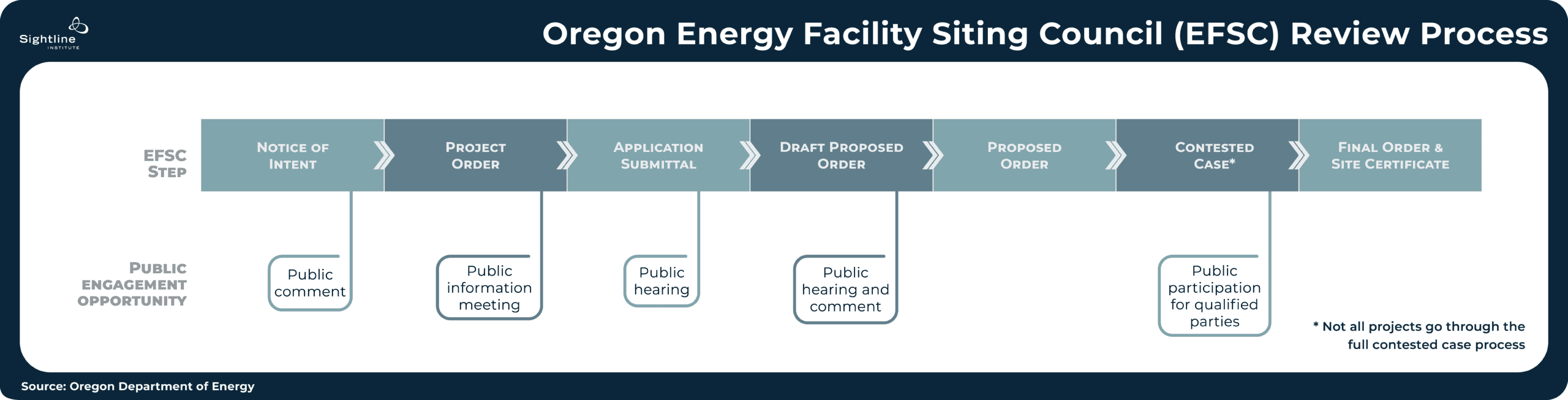
Table A-1: It takes Oregon an average of 2.6 years to greenlight energy infrastructure.
| Step in Review Process | Months | Range in Months | |||
| Oregon | Average | Median | Min | Max | |
| Notice of Intent → Project Order | 4.1 | 4.2 | 1.9 | 7.0 | |
| Project Order → Application Submission | 16.4 | 13.9 | 3.7 | 33.4 | |
| Application Submission → Final Order | 11.4 | 8.1 | 3.4 | 48.0 | |
| Final Order → Site Certificate | 0.4 | 0.0 | 0.0 | 4.0 | |
| Contested case | 14.0 | – | – | – | |
| Total: Notice of Intent → Site Certificate | 30.7 | 26.1 | 10.2 | 70.3 | |
Source: Timeline data collected from Oregon’s EFSC for all battery energy, renewable energy, and transmission facilities with available documents from 1982, as of July 2026.
Definitions:
- Notice of Intent: A developer provides notice of its intent to apply and provides information about the proposed project to EFSC.
- Project Order: EFSC develops this document that spells out what the developer must include in its formal application based on information provided in the notice of intent and feedback given by state agencies, local and Tribal governments, and the public on the notice of intent.
- Application: The complete project submission a developer files for review that demonstrates how the applicant will meet EFSC’s 16 standards.
- Draft Proposed Order: ODOE’s preliminary recommendation on whether EFSC should approve the application with the conditions it will impose on the project.
- Proposed Order: ODOE’s revised recommendation to EFSC, issued after considering comments from the public hearing.
- Contested Case: A quasi-judicial administrative proceeding where parties present evidence on unresolved project issues before a hearing officer.
- Final Order: EFSC’s decision approving, modifying, or denying the application, based on the proposed order and contested case hearing, if applicable.
- Site Certificate: The formal approval document EFSC issues approving a project and authorizing it for construction and operation.
- Public comment period: A window of time for the public to provide written feedback on the project.
- Public Information Meeting: ODOE holds a meeting to share project information with the public.
- Public Hearing: The public can provide written or verbal comments during this step.
Appendix B: Washington Energy Facility Site Evaluation Council’s review process and timeline
Figure B-1: Washington Energy Facility Site Evaluation Council’s review process
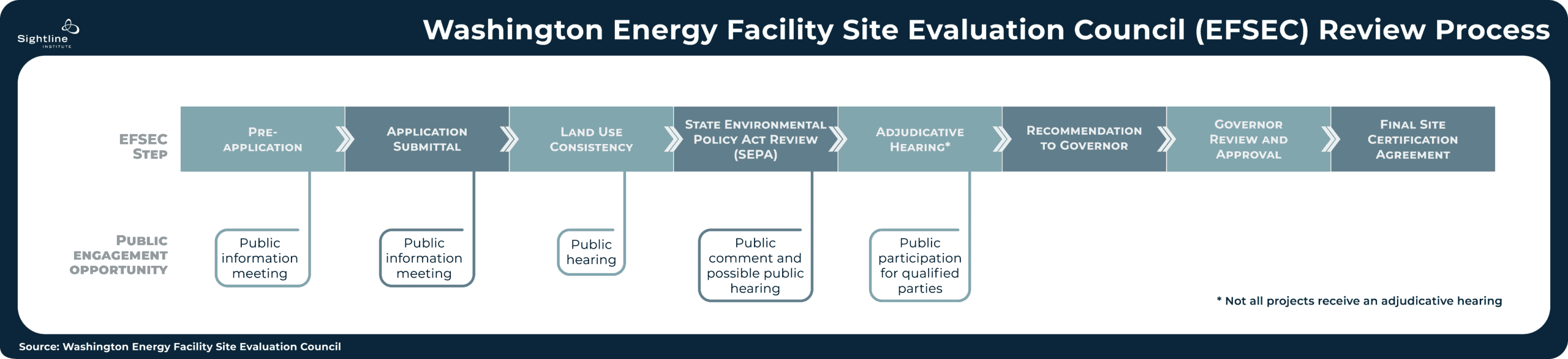
Tables B-1: It takes Washington an average of 2.2 to greenlight energy infrastructure.
| Step in Review Process | Months | Range in Months | ||||
| Washington | Average | Median | Min | Max | ||
| Pre-application → Application Submission | – | – | – | – | ||
| Land Use Hearing → consistency determination | 12.5 | 6.8 | 3.3 | 46.9 | ||
| Application Submission → SEPA review conclusion* | 20.7 | 19.8 | 6.0 | 48.7 | ||
| Adjudicative hearing (if a project requires one) | 12.7 | 7.1 | 3.8 | 40.2 | ||
| Draft Recommendation → Recommendation to Governor | 0.6 | 0.0 | 0.0 | 3.7 | ||
| Recommendation to Governor → Governor Approval | 2.8 | 1.9 | 1.6 | 5.7 | ||
| Total: Application Submission to Governor Approval | 26.9 | 24.4 | 10.9 | 56.2 | ||
*Including the time it takes a developer to prepare an EIS, if applicable.
Source: Timeline data collected from Washington’s EFSEC for all battery energy, renewable energy, and transmission facilities with available documents from 2003, as of July 2026.
Definitions:
- Pre-application: A prospective developer shares project information with EFSEC staff for feedback before formally applying.
- Application (Application for Site Certification, ASC): The formal submission a developer files with EFSEC describing the proposed energy facility.
- Land Use Consistency: EFSEC assesses whether a proposed project complies with local zoning ordinances; if it doesn’t, the project must undergo an adjudicative hearing.
- State Environmental Policy Act (SEPA) Review: EFSEC reviews a project’s impact on 16 elements of the environment through Washington state’s environmental review process. EFSEC can issue a “determination of nonsignificance,” “mitigated determination of nonsignificance,” or “determination of significance” depending on the identified impacts of the project. Projects that receive a “determination of significance” must prepare an environmental impact statement (EIS) and undergo an adjudicative hearing.
- Recommendation to Governor: EFSEC recommends to the governor whether to approve or reject the application; this recommendation includes a draft Site Certification Agreement.
- Governor Review and Approval: The governor reviews EFSEC’s recommendation and either approves, rejects, or returns to EFSEC for reconsideration.
- Final Site Certification Agreement (SCA): A document that lays out binding conditions for the project and grants the developer permission to construct and operate.
Appendix C: Oregon policy recommendations
Opportunity 1: Project review. Hold projects to clear and objective environmental mitigation criteria and consistent application requirements
1.1 Pre-identify project application needs
1.2 Develop clear and objective mitigation criteria to meet EFSC’s environmental standards
1.3 Eliminate redundancies between OPUC and EFSC
Opportunity 2: Land Use. Standardize land use rules statewide
2.1 Condition land use approval only on local clear and objective standards
2.2 Allow transmission lines in all zones subject to statewide clear and objective standards
2.3 Empower EFSC to grant land use approval
2.4 Update Oregon’s Statewide Land Use Planning Goals to reflect the grid’s essential role
Opportunity 3: Administrative proceedings. Expedite approval of certain transmission lines by avoiding trial-like hearings and requiring earlier Tribal and community engagement
3.1 Create an expedited permitting path for transmission lines that eliminates the contested case hearing and mandates early public and Tribal engagement
Opportunity 4: Governance. Empower siting councils to advance statewide climate goals
4.1 Direct EFSC to approve climate-necessary projects
Appendix D: Washington policy recommendations
Opportunity 1: Project review. Hold projects to clear and objective environmental mitigation criteria and consistent application requirements
1.1 Eliminate redundancy between EFSEC standards and SEPA impact categories
1.2 Develop clear and objective environmental mitigation measures
1.3 Exempt projects with limited environmental impact, such as grid upgrades, from environmental review
Opportunity 2: Land Use. Standardize land use rules statewide
2.1 Define transmission lines as an “essential public facility” in the state’s Growth Management Act
2.2 Allow transmission lines in all zones subject to clear and objective criteria
2.3 Eliminate EFSEC’s land use consistency review
Opportunity 3: Administrative proceedings. Expedite approval of certain transmission lines by avoiding trial-like hearings and requiring earlier Tribal and community engagement
3.1 Amend the expedited review process to make it easier for transmission lines to qualify
Opportunity 4: Governance. Empower siting councils to advance statewide climate goals
4.1 Direct EFSEC to approve climate-necessary projects
4.2 Remove the governor’s role in approving projects
4.3 Appoint siting council members with energy expertise
Appendix E: Oregon polling results for permitting reform policies
Appendix F: Washington polling results for permitting reform policies
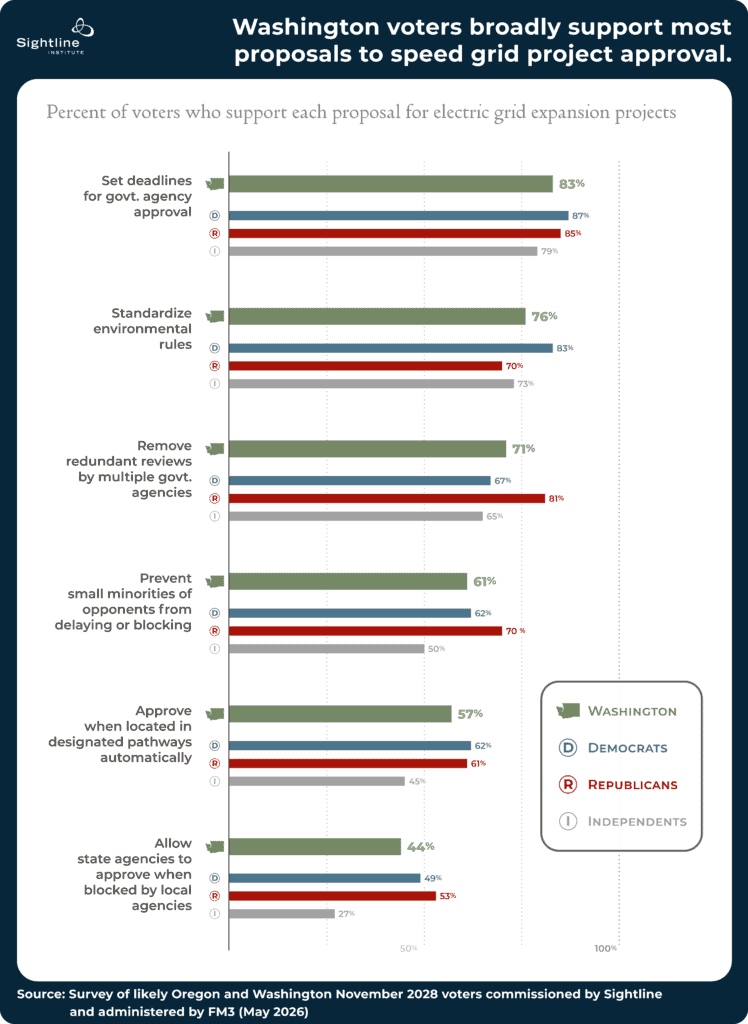
Photo credits
- “Transmission lines run along the popular Chief Sealth Trail….” Photo by Emily Moore, Sightline Institute, November 9, 2023, rights reserved.
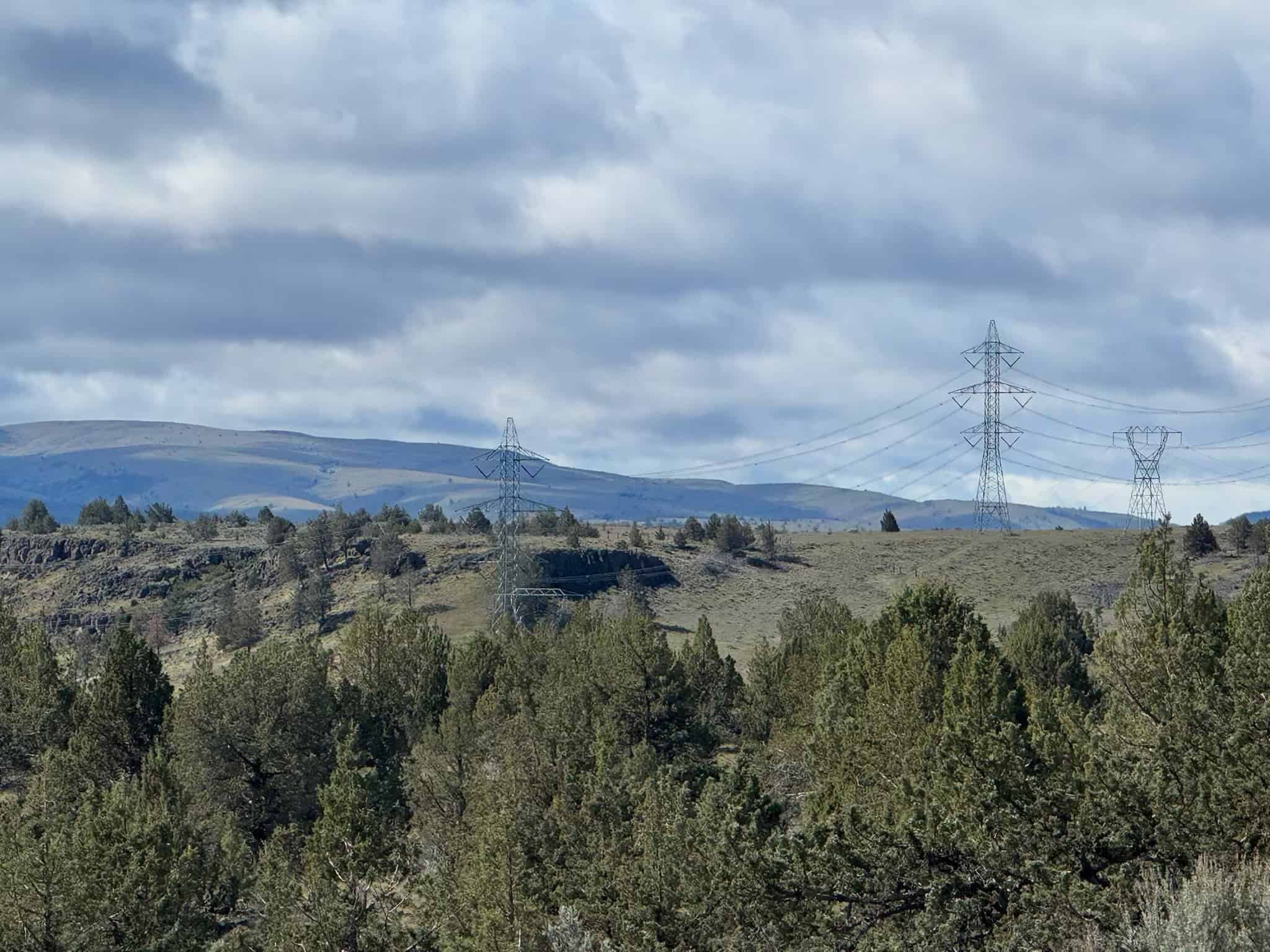
- “A transmission line runs along the Dalles-California….” Photo by Anna Fahey, Sightline Institute, April 2, 2026, rights reserved.
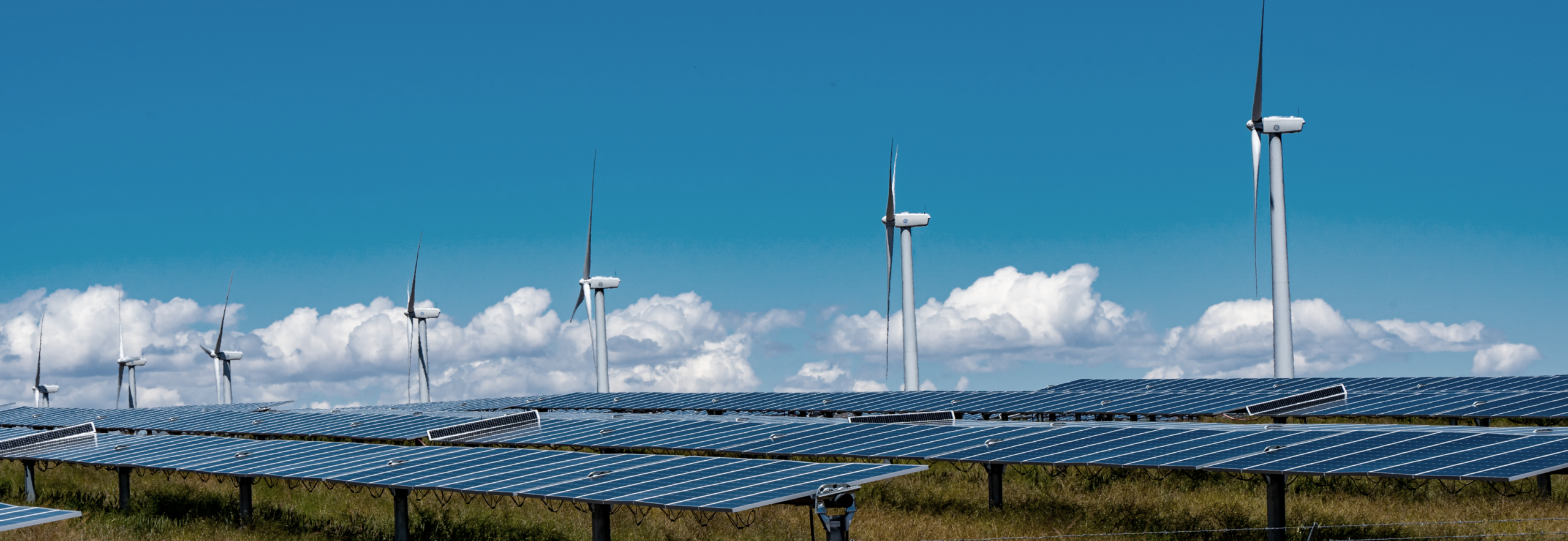
- “A solar and wind farm near Klondike….” Photo by Bob Pool, July 2, 2019, via Shutterstock.
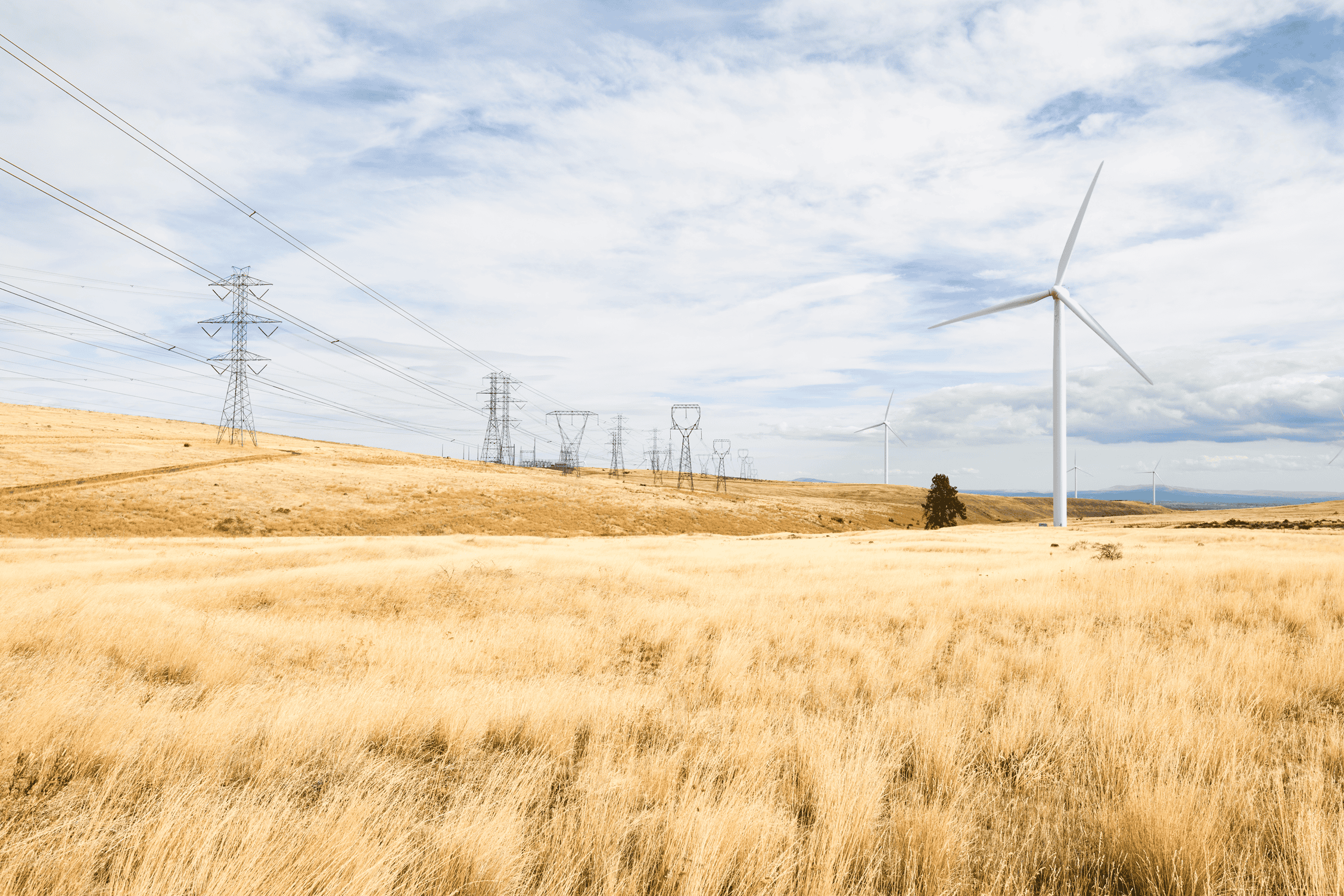
- “Wind turbines neighbor transmission lines….” Photo by Ian Dewar Photography, January 12, 2022, via Shutterstock.
- “Transmission lines stretch through the Palouse….” Photo by Edmund Lowe Photography, June 12, 2014, via Shutterstock.
About the Authors

Emily Moore is the Senior Director of Sightline’s Climate and Energy program.
Email her at emily@sightline.org, view her latest research, and follow her on Bluesky.

Kelly Trumbull is a Senior Researcher with Sightline Institute’s Climate and Energy program.
Email her at kelly@sightline.org, view her latest research, and follow her on Bluesky.