


Takeaways
- Washington just passed the United States’ first statewide bill reforming the building code to allow scissor stairs in apartment buildings.
- Scissor stairs comprise two interlocking stairways with two separate exits, enclosed and separated by fire-resistance rated walls. They conserve square footage and construction costs, enhance apartments’ light and cross-ventilation, and help buildings fit onto smaller lots—great features for higher-quality, less expensive infill homes.
- Representative Janice Zahn sponsored House Bill 2228, and it passed both chambers with unanimous support, though it faces a lengthy implementation process.
- The measure is one more incremental win against the myriad code barriers standing in the way of more homes, and it’s another example of Washington state leading the way for others to follow.
In recent years the pro-housing movement has increasingly turned its attention from zoning reform to adding in building code reform, too—that is, from a community-level look at what kinds of homes are allowed in parts of a city or town to a building-level look at how to maximize their internal space and reduce construction costs. And the turn to building code couldn’t come soon enough to help counteract the high interest rates, labor, and materials costs that are causing a slowdown in homebuilding throughout Washington and North America.
Washington state continues to lead the pack with measures to lower the cost of homebuilding and make it easier to build more homes, in all shapes and sizes, in more places. The state reformed building codes to allow single-stair apartments in 2023, to extend residential code to middle housing in 2024, and in 2026, to legalize smaller elevators, as well as—the focus of this article—scissor stairs.1
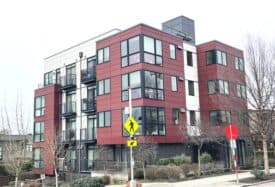
Related: Washington State Leads on Elevator Reform | SB 5156 opens the door to lower-cost, smaller elevators in new apartment and condo buildings—and more accessibility for residents..
Scissor stairs are a design feature common in other countries but rare in most US cities. They help save more of a building’s interior square footage for homes, while still providing two fire-safe staircases for residents and emergency responders. What’s more, scissor stairs make it possible to design for more light and cross-breeze in every apartment, plus accommodate narrow or oddly shaped lots for more infill opportunities.
Sponsored by Representative Janice Zahn (D-Issaquah), with a companion bill sponsored by Senator Jessica Bateman (D-Olympia), House Bill 2228 now makes such benefits possible for Washingtonians. By legalizing scissor stairs, it lets architects and developers design apartments with greater layout flexibility and lower cost.
And just as the Evergreen State’s earlier pro-housing wins have inspired copycat bills elsewhere, scissor stair legalization may cut a similar path across more US jurisdictions in the years to come.
Scissor stairs: More light, breeze, and flexibility—and plenty of precedent
What are scissor stairs?
Building codes that address how people travel up and down in a building—the stairs, elevators, and hallways that make up its “circulation space” or “core”—can have a big impact on its design. That’s because those components take up room that would otherwise be part of a building’s actual homes.
Scissor stairs increase the efficiency of circulation by arranging two separate stairways in one compact, interlocking coil like a double helix. The interlocking stairways have separate exits on each floor. They are enclosed and separated by fire-resistance-rated walls (see diagram below). The stairwells in a scissor stair never cross or intermingle with one another, and their walls ensure that if one stairway is compromised with smoke or fire, residents and emergency responders can safely use the other one.
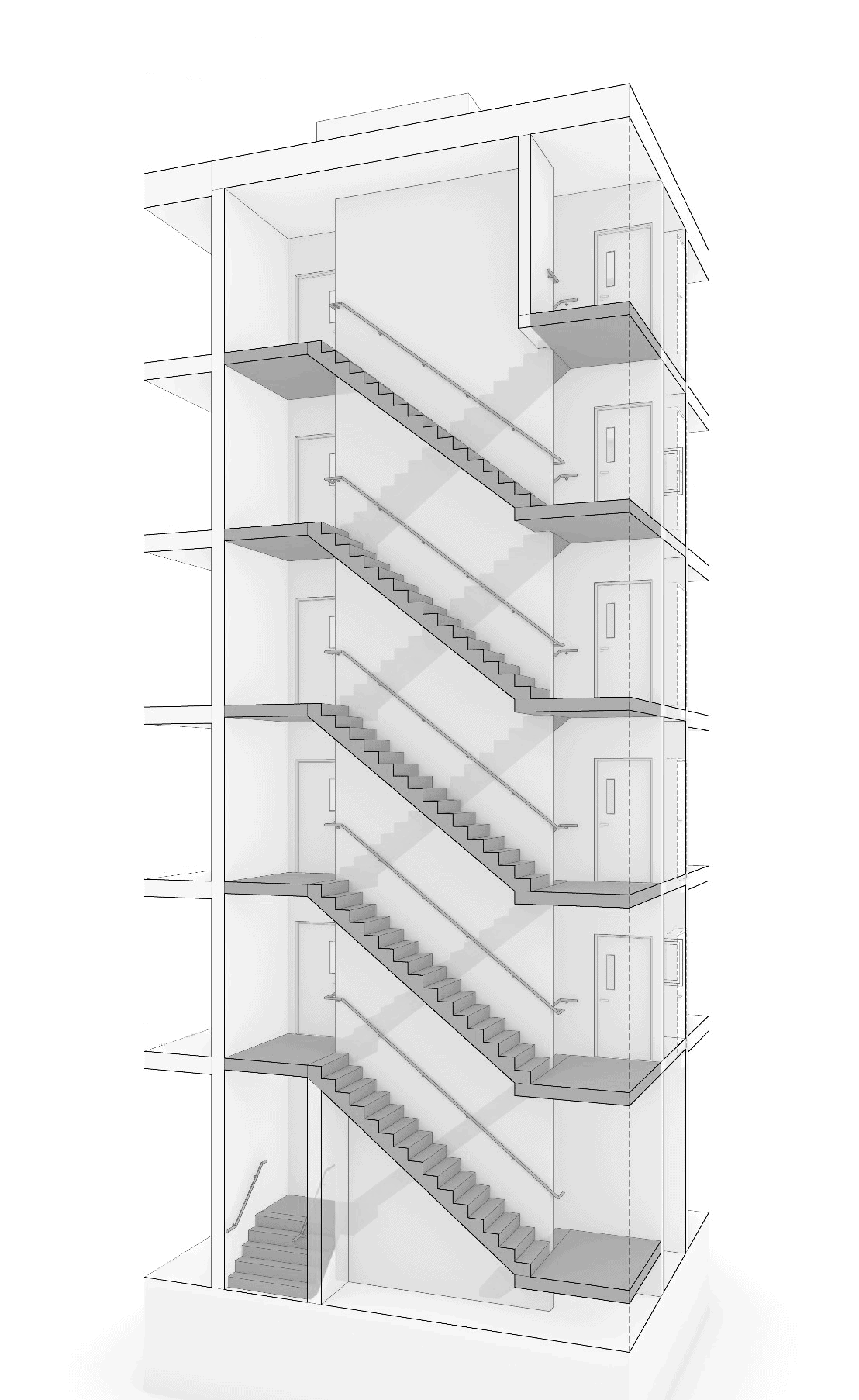
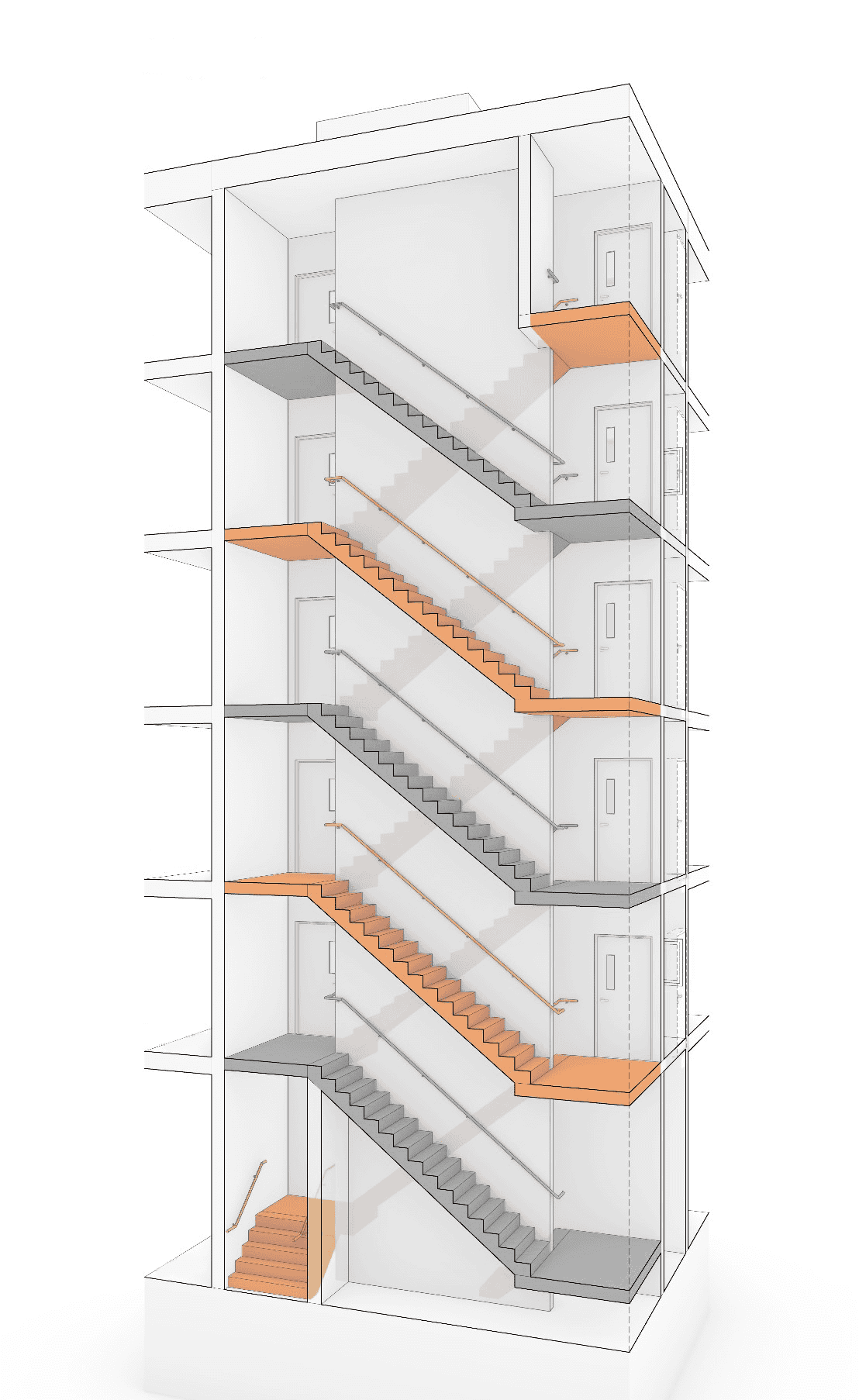
Scissor stairs wrap separate, fire-resistant stairways around each other. Source: Second Egress, by Conrad Speckert.
Better use of space: Vancouver vs. Los Angeles and Seattle
Scissor stairs yield a compact building core that holds stairs, elevators, and hallways. As shown below, less space for the core means more space for living. And the slimmer the building, the more important it is to minimize the size of the core, to keep it from consuming an ever larger portion of the leasable floorspace. In other words, scissor stairs make small footprint designs more financially feasible to build.

Building data from Los Angeles, Seattle, and Vancouver, BC, illustrate the efficiency gains possible with scissor stairs (see summary table below and appendix for complete data set). The average core area for circulation (stairs and hallways, but not elevator hoistways) in Vancouver’s scissor stair buildings is 46 percent smaller than the average in Seattle’s separate-stair buildings and 56 percent smaller than Los Angeles’. The floor plates of Vancouver highrises typically range from 6,000 to 8,000 square feet, while in Seattle and LA, it’s 10,000 to 12,000 square feet.
The Telus Garden building in Vancouver, at 9,717 square feet, is an outlier for Vancouver but offers a nearly apples-to-apples size comparison with Seattle’s 8th and Columbia building, at 10,333 square feet. If 8th and Columbia had the same lower use of space for circulation that Telus Gardens achieved through use of a scissor stair (12 percent), it would have an additional 269 square feet of leasable square feet per floor. That may not seem like much of a difference, but as little as 70 to 100 square feet is enough for an additional bedroom or private outdoor deck.
| Tower footprint (sf) | Space used for stairs and hallways (sf) | Portion of footprint used for stairs and hallways | |
|---|---|---|---|
| Vancouver (5 building average) | 7,476 | 900 | 12% |
| Seattle (4 building average) | 10,988 | 1,654 | 15% |
| Los Angeles (5 building average) | 12,323 | 2,050 | 17% |
Compared with typical buildings in Seattle and Los Angeles, Vancouver’s scissor stair towers are not only more slender, but also have better efficiency, with a higher ratio of living space to circulation space. Source: High-Rise Codes & Housing Affordability in Los Angeles, by Tom Steidl.
Better neighborhood fit, light, and ventilation—inside and out
Scissor stairs also offer benefits beyond raw floor-space efficiency. First, the smaller-footprint buildings they facilitate can fit on smaller lots, making more infill housing possible, reducing land costs, and obviating the onerous process of assembling multiple parcels often needed to hold large buildings.
Second, skinnier buildings yield homes with better natural light and ventilation. That’s because less of the living space is far from the windows, and more of the homes are likely to include corners of the building, allowing for windows on two sides. Skinnier buildings can also leave more space between neighboring buildings, which can improve views for tenants and neighbors passing by.
And not just for the tallest buildings
Lastly, scissor stairs are not just a highrise thing. In New York City (more on this city later), scissor stairs are common in residential buildings from midrise and up. Vancouver recently passed reforms to explicitly expand the allowance for scissor stairs to wood frame midrise buildings.
Scissor stairs offer an efficient option for the size range falling between single stair midrises and double-loaded corridor midrises. Codes regulating single stair set tight size constraints: a cap of four units per floor is the standard. Meanwhile, double-loaded corridor midrise buildings are typically much larger than that, with apartment counts in the low hundreds. That leaves a large size gap between those two midrise types that scissor stair midrise buildings can fill.

A global record of urban success
Countries throughout the world commonly allow scissor stairs, as in Hong Kong and China, for example.2 For over 30 years, builders in Canada, and especially in Vancouver, British Columbia, and Toronto, Ontario, have routinely used scissor stairs in residential towers to help create their exemplary urban neighborhoods near transit and amenities.
In contrast, scissor stair buildings are far less common in most US cities, though scattered examples can be found throughout the country, built as far back as the 1950s. Since then, building code changes adopted across most of the US now prohibit scissor stairs, though the timeline varies.3 In Western states, including Washington, building codes have effectively banned scissor stairs since the early 1970s (page 406, 1967 and page 472, 1973). Code requires stairway doors to be separated by a distance of at least one-half the diagonal dimension of the building, making it impossible to use an interlocking configuration.
The two current US exceptions are New York City and Dallas. New York City continued to allow scissor stairs in residential buildings, opting to not follow the national trend new stair separation restrictions. New York City even allows scissor stairs in office buildings no taller than six stories (between 1968 and 2008, that allowance had no height limit; page 228, 27-363).
Dallas legalized scissor stairs in 2017, but only for buildings up to 75 feet—that is, not for highrise. Chicago may be the next city to join the club, with recently proposed building code amendments to allow scissor stairs in buildings up to 150 feet (pages 314-316).
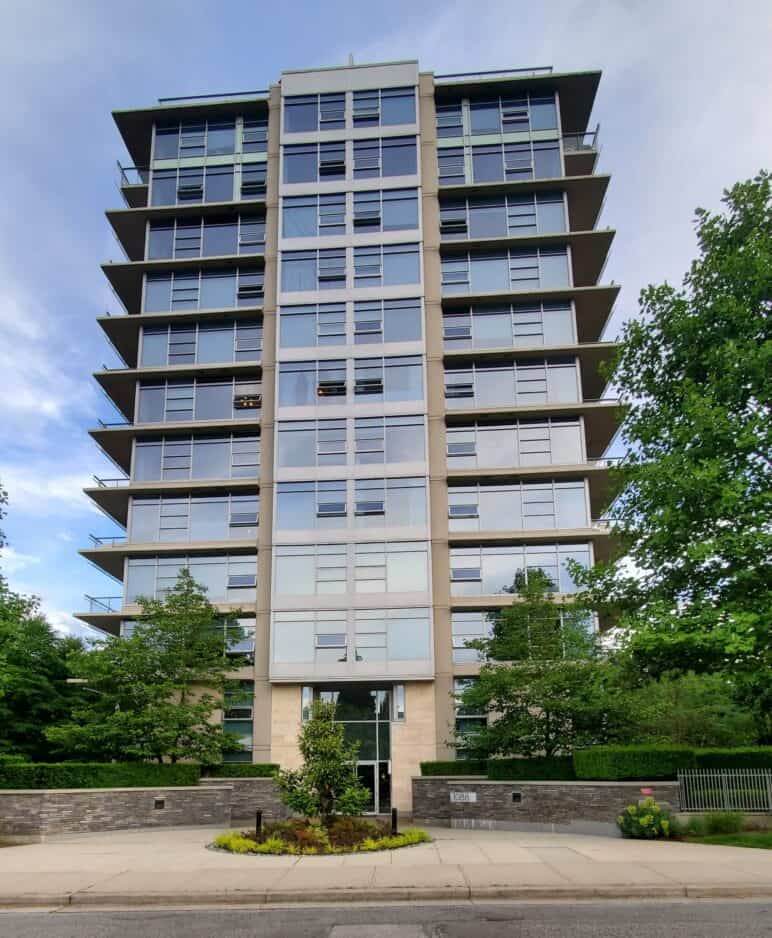
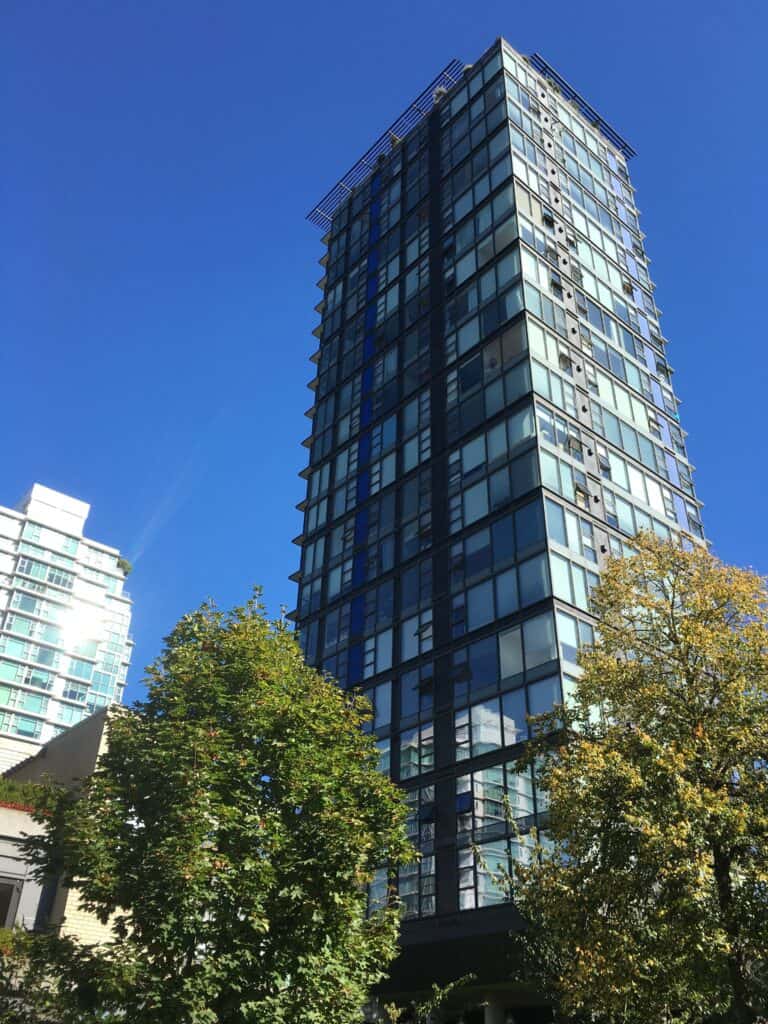
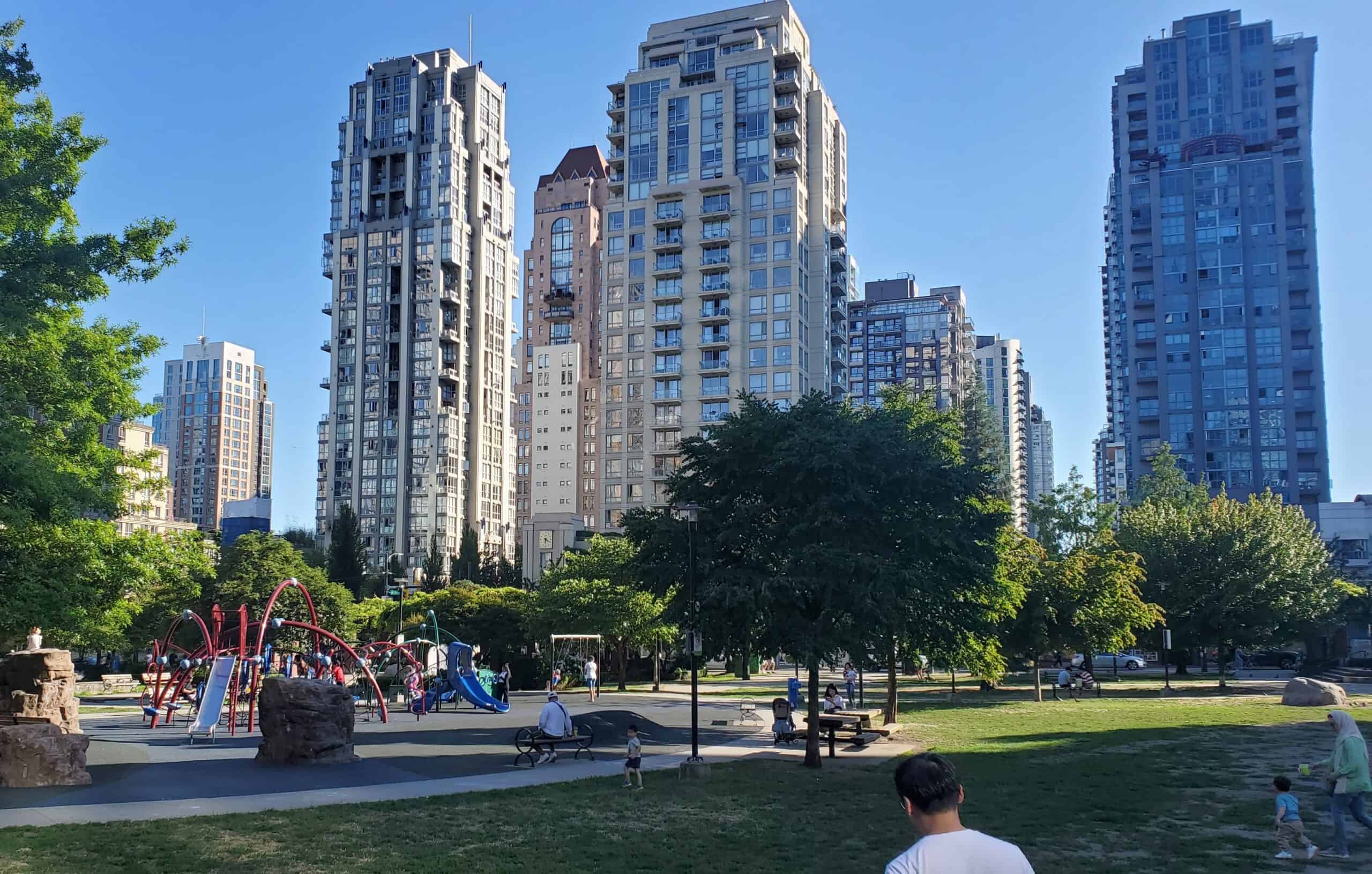
Left: In Vancouver’s Fairview neighborhood, this 12-story scissor stair condominium building with 42 homes is narrow enough to fit on a typical 50-foot wide single-detached house lot. Photo by Markus Johnson. Right: A slender 26-story residential highrise with a scissor stair in Vancouver’s West End neighborhood. Photo by Dan Bertolet.
Unanimous passage, though a slow road ahead
Representative Janice Zahn (D-Issaquah) introduced House Bill 2228, and Senate Housing Committee Chair Jessica Bateman (D-Olympia) prime-sponsored the companion, Senate Bill 6001. It passed unanimously in both the House and Senate, a sign that Washington’s elected leaders understand more every year the urgency and opportunity of every small fix to the state’s housing shortage.
HB 2228 directs the State Building Code Council (SBCC) to convene a technical advisory group to recommend amendments to the state building code that would allow scissor stairs to count toward the minimum two-stairway requirement for certain multifamily residential buildings. The SBCC has proven models to work from and could basically cut and paste New York City’s scissor stair code. Key parameters are the minimum separation between the doorways of each stair, and the fire-resistance-rated wall.
Unfortunately, the SBCC’s code update process will likely delay implementation of scissor stair code until 2030. The bill’s language calls for implementation in the 2027 Washington state code update, which, despite its name, is expected to finish in 2030.
Still, a win for Washingtonians—and a model for code fixes elsewhere
New assessments are revealing that typical building codes in the United States raise construction costs, inhibit accessibility, hamstring good design, and limit the types of homes that can be built compared with peer countries around the world. The net result is fewer and more expensive homes, even amid a dire housing shortage.
Stairway rules are just one such code impediment, and scissor stairs are one important solution. While they won’t solve Washington’s housing shortage all by themselves, they’re a big win nonetheless for higher-quality, less expensive homes. They’re yet one more example of a Washington state first that other jurisdictions will likely copycat.
And step by step—stair by stair?—these small, abstract-feeling reforms, jumping state and national borders with imitations and upgrades, add up to more, very real new homes.
Appendix
| City/Project | Gross SF (Enclosed Area) | Net Res. Area | Circulation Area | Core Area (incl. Hoistways) | Hoistways (Cross-Sect. Area) | Efficiency |
|---|---|---|---|---|---|---|
| Vancouver | ||||||
| 1123 Westwood | 7699 | 6860 | 839 | 1028 | 189 | 89.1% |
| Northwest | 6603 | 5723 | 880 | 1073 | 193 | 86.7% |
| Wall Centre | 7281 | 6375 | 906 | 1080 | 174 | 87.6% |
| Telus garden | 9717 | 8524 | 1193 | 1494 | 301 | 87.7% |
| The Mark | 6081 | 5401 | 680 | 834 | 154 | 88.8% |
| Vancouver Avg: | 7476 | 6577 | 900 | 1102 | 202 | 88.0% |
| City/Project | Gross SF (Enclosed Area) | Net Res. Area | Circulation Area | Core Area (incl. Hoistways) | Hoistways (Cross-Sect. Area) | Efficiency |
|---|---|---|---|---|---|---|
| Seattle | ||||||
| 8th & Columbia | 10333 | 8795 | 1538 | 1848 | 310 | 85.1% |
| 9th & Lenora | 11405 | 9754 | 1651 | 1980 | 329 | 85.5% |
| 2202 8th Ave | 11131 | 9421 | 1710 | 2056 | 346 | 84.6% |
| Holland Paramount | 11084 | 9367 | 1717 | 2007 | 290 | 84.5% |
| Seattle Avg: | 10988 | 9334 | 1654 | 1973 | 319 | 84.9% |
| City/Project | Gross SF (Enclosed Area) | Net Res. Area | Circulation Area | Core Area (incl. Hoistways) | Hoistways (Cross-Sect. Area) | Efficiency |
|---|---|---|---|---|---|---|
| Los Angeles | ||||||
| 1133 Hope | 10046 | 8189 | 1857 | 2065 | 208 | 81.5% |
| Onni 1212 Flower T1 | 10929 | 8845 | 2084 | 2378 | 294 | 80.9% |
| Onni 1212 Flower T2 | 12023 | 9973 | 2050 | 2344 | 294 | 82.9% |
| Mack Urban – Site 1 | 17421 | 14856 | 2565 | 2910 | 345 | 85.3% |
| 888 Olive | 11196 | 9501 | 1695 | 1993 | 298 | 84.9% |
| Los Angeles Avg: | 12323 | 10273 | 2050 | 2338 | 288 | 83.1% |
Source: High-Rise Codes & Housing Affordability in Los Angeles, by Tom Steidl.


