



Takeaways
- One in four Cascadians live in homes governed by community associations such as HOAs, condo associations, or strata corporations. But many associations hamper homeowners’ efforts to install heat pumps and access clean, efficient heating and cooling through procedural hurdles, restrictive rules, and, in a few cases, outright bans.
- Common hurdles include lengthy approval processes, detailed application requirements, aesthetic standards, supermajority homeowner vote mandates, and equipment ownership complications when homes change hands (especially in British Columbia).
- Washington is the only Cascadian jurisdiction that protects residents’ ability to install heat pumps in community associations, even though similar laws prevent community associations from banning solar panels and electric vehicle chargers in most of the region.
- Policymakers throughout Cascadia can establish clear approval standards to give eligible homeowners a reliable path to climate-friendly heating and cooling.
In 2024, three years after a heat dome killed more than 600 people in British Columbia, a Vancouver family tried to install a heat pump that would efficiently cool their apartment. But they lived in a strata corporation—a type of homeowner association—whose bylaws prohibited heat pumps. The family submitted medical documentation to the association’s governing body showing that extreme heat threatened their infant’s health. A year earlier, public health authorities in Vancouver had urged strata corporations to remove barriers to cooling. Yet the strata board denied the request over concerns that the heat pump could damage the building’s exterior, even after the family hired an engineer to show the installation would not pose that risk.
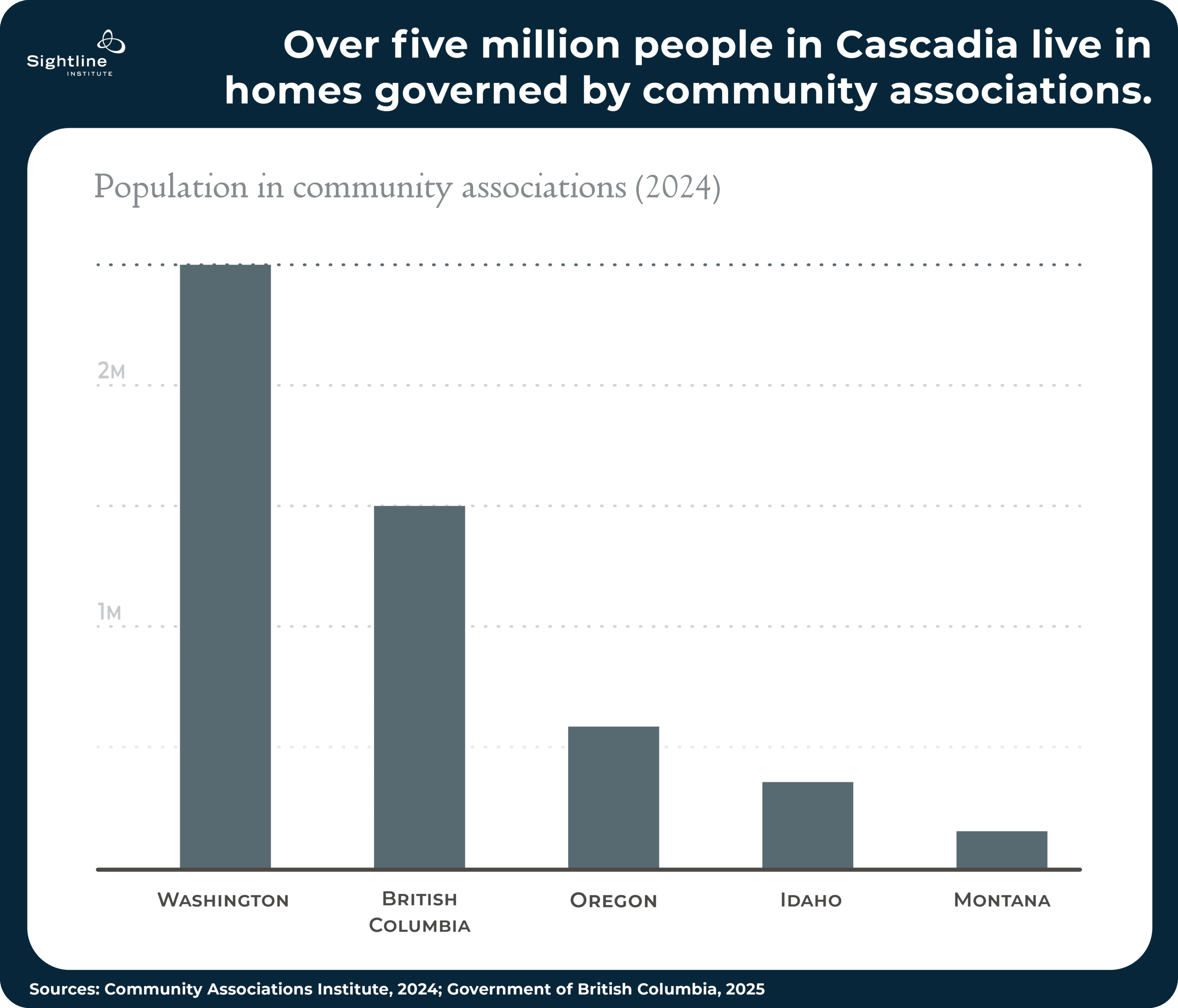
The members of this Vancouver family are among more than five million Cascadians (about one in four residents) who live in homes governed by homeowner associations (HOAs), condominium (condo) associations, and strata corporations—collectively called community associations.1
On paper, some community association residents look like prime heat pump candidates. Households in detached homes governed by HOAs report higher incomes and live in newer homes than comparable households outside HOAs, two factors associated with higher heat pump use. Yet among owner-occupied detached homes, heat pump prevalence is roughly the same inside and outside HOAs, according to American Housing Survey data. That mismatch suggests some homeowners living in HOAs who may want heat pumps have not yet installed one.
Figure 1. Over five million people in Cascadia live in homes governed by community associations
The best solution is for Cascadian policymakers to establish clear, objective approval standards that give eligible homeowners a reliable path to install heat pumps in community associations. Short of this policy change, lawmakers can ease heat pump installations by: 1) prohibiting blanket heat pump bans, following Washington state’s lead; 2) lowering voting thresholds so residents can more easily update building rules to allow heat pumps; and 3) ensuring heat pump maintenance and liability obligations transfer automatically to new owners when a home changes hands. These policies would build on familiar precedents for solar, portable cooling devices, and electric vehicle (EV) charging, allowing more Cascadians to install this lifesaving, climate-friendly technology.
Outright bans and onerous rules block efficient heating and cooling
To assess community associations’ heat pump rules and practices, Sightline analyzed publicly available documents from 66 associations across Cascadia. The sample, though not representative, spans home types, community sizes, and locations across the region. (See appendix for full data and methodology). Sightline found that many community associations hamper homeowners seeking heat pumps through procedural hurdles and restrictions, and, in a few cases, outright bans.
A few associations ban heat pumps outright or in practice
At least eight community associations in Sightline’s sample ban heat pumps, either explicitly or through rules that effectively prevent installation. For example, some associations prohibit mechanical equipment on balconies, restrict wall penetrations, or forbid building exterior alterations—rules that amount to de facto bans.
One egregious—and likely illegal—example comes from a condo association in Bellingham, Washington: “No mini-split or heat pump systems are allowed.” A 2023 Washington law outlaws this type of ban. One strata bylaw in Nanaimo, British Columbia, states that owners “must not install air conditioning units other than portable air conditioners” vented through a window. These bans extend beyond Sightline’s sample; at least 19 respondents to a 2022 Vancouver Island Strata Owners Association survey said that their strata bylaws explicitly ban heat pumps.
Many more impose daunting approval processes
Nearly every community association Sightline analyzed requires homeowners to submit a written application to a condo/strata board or architectural review committee before installing a heat pump. Associations often demand equipment specifications, placement diagrams, contractor credentials, and proof of insurance—paperwork that can take residents weeks or longer to assemble.
One BC contractor guide notes that strata bylaws may dictate “acceptable noise levels,” meaning associations can demand quieter heat pumps than local sound regulations require. In Port Moody, British Columbia, for example, one strata high-rise caps heat pump noise at 56 decibels—a measure of sound—below the city’s daytime limit of 65 decibels in that part of town. Some associations simply reserve the right to refuse heat pump applications on a case-by-case basis. Respondents to the 2022 Vancouver Island Strata Owners Association survey reported denials over noise concerns, bylaws that do not mention heat pumps, and procedural confusion.
Nearly half of the community associations Sightline analyzed restrict where homeowners can place outdoor heat pump units. Roughly one-third cap noise levels or require homeowners to screen or conceal outdoor equipment. Fees pile on top: nearly one-quarter require application fees or deposits, including one Montana HOA that charges $900 just to review an application.
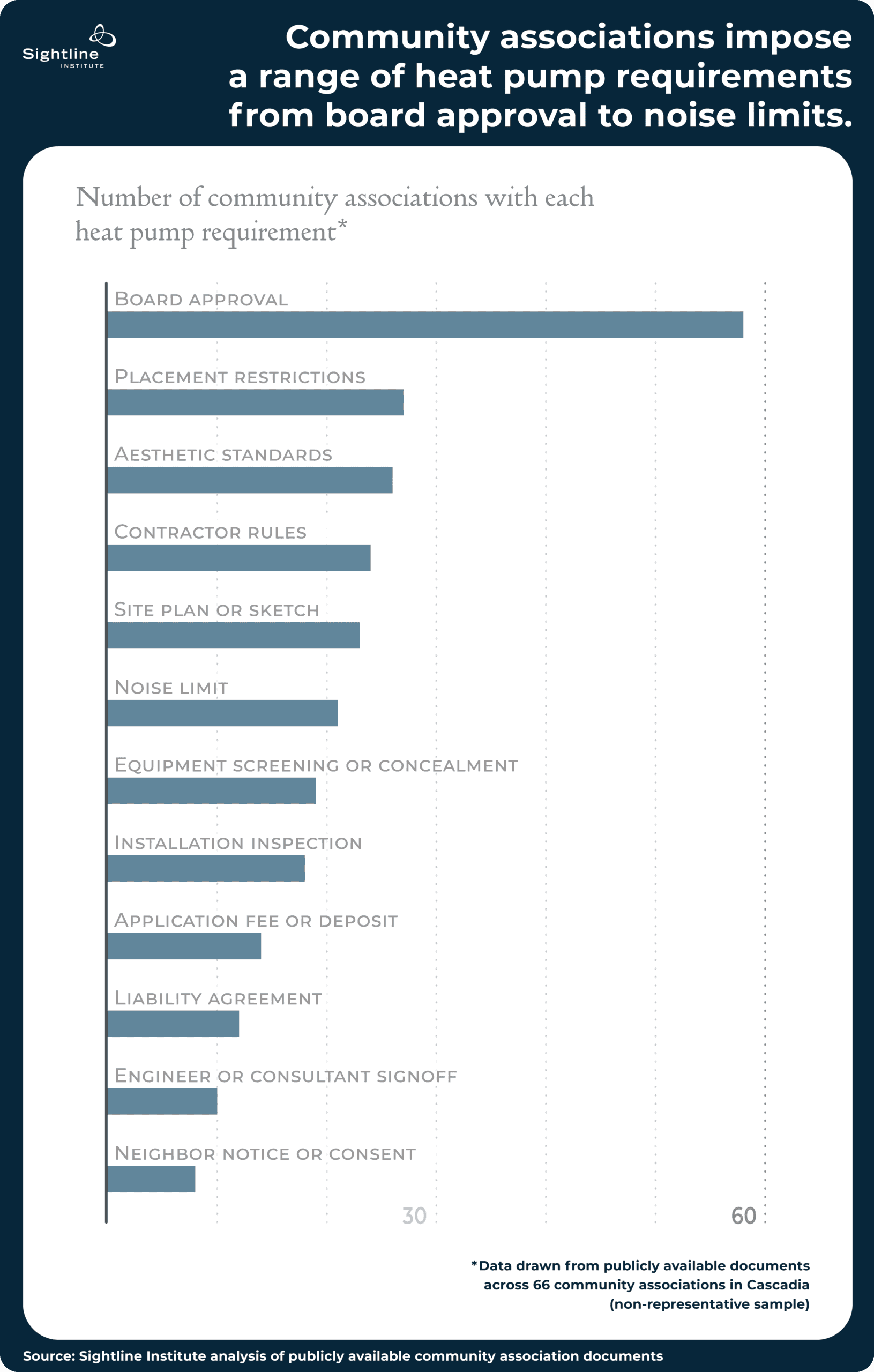
Boards also scrutinize heat pumps more closely in apartments than in detached-home communities because apartment installations affect common property. Installers typically place outdoor compressors for ductless mini-split systems—the most common heat pump type in apartments—on a balcony, patio, or exterior wall, and then run refrigerant lines through a wall to an indoor unit.2 (Emerging models, including window heat pumps, could overcome this issue because they avoid penetrating walls.) Boards weigh risks to building envelopes, electrical capacity, and liability for common property damage. About one-third of condos in Sightline’s sample require homeowners to hire specialized contractors or obtain engineering sign-off.
British Columbia’s policies around liability also complicate residents’ ability to install heat pumps in condos. When a home changes hands, the outgoing owner’s responsibility for maintaining a heat pump and paying for any damage it causes does not automatically transfer to the new owner. Instead, the new owner must voluntarily sign a fresh liability agreement. If the new owner refuses, the strata corporation could inherit the costs of the equipment, which can discourage boards from approving heat pump requests in the first place. (In US condo systems, liability responsibility generally stays with the home when ownership changes.3)
In communities of detached homes, associations often focus on neighborhood appearance. About 60 percent of associations that govern detached homes in Sightline’s sample set aesthetic standards for outdoor equipment, requiring homeowners to screen it, place it out of street view, or match it to the home’s exterior color. One HOA in Bozeman, Montana, specifies that “all mechanical equipment (including air conditioner condensers) must be screened through landscaping or architectural means.”
Even after residents assemble a complete application and satisfy every requirement, associations may still delay or deny the project. Timelines range from a few days to several months. In one Vancouver high-rise condo, a heat pump proposal sat for nearly a year. “Things take time,” the strata board member leading the effort wrote.
Long waits and approval requirements can wear down even the most motivated homeowners pursuing heat pump projects. “Champions burn out navigating these complex processes,” Brady Fraught, a green buildings engineer with the City of Vancouver, told Sightline.
Some heat pump contractors avoid condos altogether. “Once we find out it’s a condo, we say no,” said Mike O’Brien, a Seattle-based heat pump installer (and yes, former Seattle City Councilor) who has bid on roughly a dozen condo projects and has yet to complete one. “They’re just a huge headache.” O’Brien described repeated documentation requests, lengthy back-and-forth discussions, and uncertainty about whether a board would ultimately approve the installation. “It’s just so much time, with so many details to work out.” Contractors either walk away or they charge more.
A minority of owners can block heat pumps, especially in British Columbia
In British Columbia, strata boards can generally approve individual heat pump installation requests, but some proposals require a building-wide owner vote before moving ahead. Under the Strata Property Act, three-quarters of owners must vote to approve any “significant change” to the use or appearance of common property, including balconies. The first heat pump installation in a building likely triggers that requirement, meaning just over one-quarter of owners can block a proposal. The Condominium Home Owners Association of British Columbia (CHOA) identifies this high voting threshold as a barrier to energy upgrades in strata buildings.
The same voting hurdle can block bylaws that would clear the way for heat pumps. BC Hydro and CHOA encourage strata corporations to adopt bylaws that create a transparent and consistent process for approving heat pumps instead of case-by-case approvals. But owners must approve those bylaw changes by a three-quarter vote, a difficult threshold to achieve. “There are often not enough votes to pass new bylaws or amend existing bylaws,” Wendy Wall, president of the Vancouver Island Strata Owners Association (VISOA), told Sightline.
I encountered this problem firsthand. In my Vancouver condo, the board drafted a bylaw amendment to allow heat pumps and brought it to a vote. I spent weeks talking with neighbors and building support. Not everyone agreed. Aesthetics drew the most objections. “Heat pumps look ugly,” one neighbor said at the general meeting. The measure ultimately passed, but just barely.
Unlike British Columbia, Northwest US condo laws require owner votes only to amend core governing documents, not for every significant common property change.4 Montana and Oregon require at least 75 percent of owners to approve amendments to governing documents, while Idaho allows a simple majority to approve some changes. (Washington protects heat pumps in state law, so residents do not need to amend governing documents to install one.) In Sightline’s sample, a few associations address heat pumps directly in their governing documents, but most grant boards authority to set heat pump rules, meaning owners need only board approval, not a building-wide vote.
Outside Washington, state and provincial laws do not protect homeowners seeking heat pumps
In Cascadia, Washington is the only jurisdiction that protects residents’ ability to install heat pumps in community associations. Under the 2023 Washington Uniform Common Interest Ownership Act, community associations may not prohibit or “unreasonably restrict” heat pumps. Washington bars restrictions that “significantly increase the cost of a heat pump or significantly decrease its efficiency or specified performance.” Even so, the law does not define what thresholds count as “significant,” giving community associations—and ultimately courts—considerable room to reject heat pump applications or impose aesthetic requirements.
Elsewhere in Cascadia, state and provincial laws only partially protect homeowners, or do not protect them at all. Oregon lawmakers passed SB 1536 in 2022, limiting community association restrictions on portable cooling devices, but the law does not apply to heat pumps. Idaho and Montana do not protect homeowners against community association restrictions.
British Columbia’s Strata Property Act says strata corporations cannot “unreasonably refuse” alterations within a homeowner’s unit. But since heat pumps usually involve common property, boards tend to use broad discretion to approve or deny requests. Provincial human rights law also protects residents in limited cases. Residents with disabilities can seek an exemption from strata bylaws that prohibit heat pumps or air conditioners by submitting evidence showing that cooling is medically necessary, though boards can deny the request if the exemption would place an unreasonable burden on the strata.
Policymakers can establish clear criteria for heat pumps in community associations
Parts of Cascadia already protect residents’ ability to install other clean energy technologies, including solar panels and EV chargers, in community associations. Heat pumps can come next.
Ideally, policymakers would establish clear approval standards that give homeowners a reliable process to upgrade to a heat pump. Washington’s EV charging law is one such example. It identifies specific conditions associations can impose before approving installations. Associations may require owners to use qualified installers, comply with architectural and electrical standards, carry insurance, and accept maintenance and restoration responsibilities. If owners meet those conditions and the installation is “reasonably possible,” associations cannot deny the request.
Some associations have already adopted similar measures voluntarily. Sightline found at least four associations that approve heat pumps when homeowners meet specific criteria. One condo association in Tigard, Oregon, for example, states that owners who install heat pumps “strictly in accordance with” established criteria “shall be deemed to have received approval” from the board.
California’s solar law offers another model. It defines unreasonable community association restrictions on solar energy systems as those that add more than $1,000 in cost or reduce system performance by more than 10 percent. That specificity reduces ambiguity and sets enforceable boundaries.
Timing matters, too. The right to install a heat pump means little if associations can delay approvals indefinitely. Oregon’s EV charging law addresses this problem by requiring decisions within 60 days.
Cascadian policymakers could take a similar approach for heat pumps, ensuring homeowners can install them without excessive delay, cost, or uncertainty.
Even without clear approval criteria, Cascadia can ease the way
Transparent approval standards would give homeowners in community associations the most straightforward path to a heat pump. Short of that, policymakers can still remove immediate barriers by making it easier for associations to update rules and avoid defaulting to “no.”
1. Eliminate blanket heat pump bans
No legitimate concerns justify blanket heat pump bans. British Columbia, Idaho, Montana, and Oregon could follow Washington’s lead and port over laws they’ve already enacted for other technologies. Oregon’s Planned Community Act, for example, voids any bylaw that prohibits solar panels, and the state limits HOA restrictions on portable cooling devices. Idaho similarly bars HOAs from enforcing rules that block rooftop solar installations.
In British Columbia, the Union of BC Municipalities endorsed a resolution in 2025 urging the province to establish a “right to cool,” including letting residents install heat pumps without unreasonable strata restrictions. The province took a similar approach with EV charging: 2023 amendments to the Strata Property Act require strata councils not to “unreasonably refuse” requests to install charging infrastructure on common property.
Cascadia already prevents community association bans of some clean energy technologies
Laws prohibiting blanket bans of select technologies in community associations
| Jurisdiction | Cooling | Heat Pumps | Solar | EV Chargers |
| Washington | ❌ No (portable cooling protected for renters only) | ✅ Yes | ✅ Yes | ✅ Yes |
| Oregon | ✅ Partial (portable cooling only) | ❌ No | ✅ Yes | ✅ Yes |
| Idaho | ❌ No | ❌ No | ✅ Yes (rooftop only) | ❌ No |
| Montana | ❌ No | ❌ No | ❌ No | ❌ No |
| British Columbia | ❌ No | ❌ No | ❌ No | ✅ Yes |
2. Lower voting thresholds for common property changes
Supermajority votes can let a minority of owners block heat pumps even when most residents support them. Without Washington-style protections that limit or override unreasonable restrictions, British Columbia could at least make heat pumps easier to approve by lowering the voting threshold for significant alterations to common property.
British Columbia already lowered voting thresholds for EV charging. The same 2023 Strata Property Act amendments let strata corporations lower the voting threshold for certain EV charging decisions to a simple majority. The province could do the same for heat pumps.
Oregon and Montana could also lower the voting threshold for amending association governing documents. That change would help residents in a few associations where core governing documents, not just board rules, restrict heat pumps.
3. Automatically transfer heat pump obligations to new owners
British Columbia could clarify in law that heat pump maintenance and damage responsibilities transfer to future owners when a strata property changes hands. Washington’s heat pump law offers one model by assigning maintenance, repair, and damage costs to the current owner and “each successive owner” of a heat pump. British Columbia could consider a similar heat pump-specific amendment to the Strata Property Act.
The province could also adopt a broader reform. CHOA recommends amending the Strata Property Act so strata corporations can file owner agreements for common property changes with the Land Title Office. Owners already sign these agreements to take responsibility for maintaining heat pumps and paying for any damage they cause. Recording the agreements with the Land Title Office would let future buyers see those obligations before purchase and inherit them with the home.
Making these obligations transferrable and transparent would reduce legal uncertainty, simplify administration, and give strata councils greater confidence to approve heat pump requests.
Community association residents deserve a straightforward path to efficient heating and cooling
In millions of Cascadian homes, community associations are gatekeeping access to heat pumps just as the region faces another hotter-than-normal summer. Without clear state and provincial standards, they can delay or block upgrades that many residents want and that the region needs.
Policymakers do not need to reinvent the wheel. Cascadian governments already protect residents’ ability to install other clean energy technologies in community associations. Extending similar protections to heat pumps could help millions of homeowners access efficient heating and cooling while supporting the region’s climate goals.
Appendix: Data and methodology
Sightline reviewed publicly available documents from 66 community associations: 18 in British Columbia, 18 in Washington, 17 in Oregon, 7 in Idaho, and 6 in Montana. For each association, Sightline reviewed one or more relevant documents such as bylaws, house rules, founding documents, covenants, conditions and restrictions, architectural guidelines, and heat pump application forms. The sample includes HOAs, condo associations, and strata corporations spanning single-detached homes, townhomes, low-rise condos, and high-rise buildings. Sightline selected documents that explicitly reference heat pumps or air conditioning systems.
Sightline coded for the presence of approval requirements, technical and administrative conditions, equipment placement restrictions, noise and aesthetic standards, fees, timelines, and any explicit or de facto prohibitions on heat pump installations. The sample does not represent all community associations in the region, but it provides a structured snapshot of common rules and barriers that residents may encounter.

