


Editor’s Note: Jeanette Henderson, a member of Sightline’s board of directors, read this 2009 post on junk mail, and started noticing the way phone books pile up in her Seattle neighborhood of Queen Anne. She recounted the story at a recent Sightline gathering, and we thought it worth publishing.
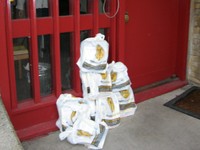
Phone books piled in doorways caught my attention while walking in my neighborhood one January weekend. Verizon yellow pages phone books, two per plastic bag, had recently been delivered to my own front porch.
This scene repeated itself over and over as I walked along the street. Phone books left in front of doors. Where several units shared a single locked entry, they were piled high.
Almost everywhere I looked, there was one bag of phone books for each apartment or condo. Ground-floor shops and small businesses, meanwhile, typically got two bags.
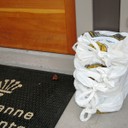

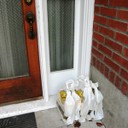
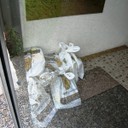
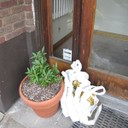

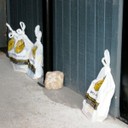
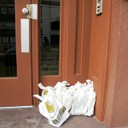
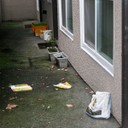
Did anyone want all these phone books?
I began asking residents and building managers. I spoke with eight people that morning. Only one in eight appreciated the books, telling me, “They’re recyclable. The people who deliver them need jobs. Some people are not in computer age.”
The other seven said:
- “I always have to recycle a lot of them.”
- “I have been the resident manager for three years, and I recycle all of them every time. No tenants want them. I’ve tried calling in the past to get them to stop, but they keep coming.”
- “About 1 out of 10 is wanted, the rest just sit there until someone gets rid of them.”
- “No one wants them.”
- “I use mine to prop up my computer.”
- “Don’t want them. That’s what the internet is for.”
- “I only keep one and throw out the rest.”


Opt Out?
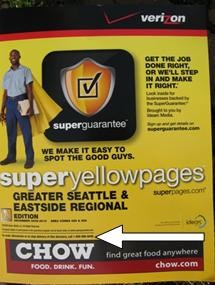
Not a single resident or building manager I spoke with knew how to—or that they could—opt out of getting phone books delivered. I opened a Verizon bag with one of the building managers and looked for the information. We found it in very small print on the cover, as shown at the right.
During my quick visual survey in my neighborhood, I counted 61 bags of phone books piled at nine buildings with a total of 66 units. I’d been told the phone books had arrived two or three days earlier, so the other five bags of phone books may have been claimed by residents. Or they may have been trashed already. At a minimum, 92 percent appeared to be unwanted.
Opt In?
Zero Waste Seattle, a grassroots citizens group has recently decided it’s time to do something about all this waste, as part of a larger waste reduction strategy in the city. They are pushing the City Council to adopt an Opt In ordinance, so that the phone book companies will be allowed to deliver only to the people who want the books. Opt In means people choose which phone books they want to receive. City Councilmember Mike O’Brien has been a champion for this effort, as reported in this local news clip and this Stranger article.
Phone book companies will likely fight this proposal, as they have in many other cities and states. The phone book companies will claim that their voluntary Opt Out program is the best solution because it’s only a small minority of people who don’t want paper phone books. They say that most people want phone books and that the program should be designed for the majority.
To their credit, phone book publishers’ Opt Out website has improved recently. Just enter your zip code and you’ll find all the companies that deliver to your neighborhood. From there, though, you’ll still have to follow the specific Opt Out instructions for each company. In Seattle, that means contacting four different companies.
Besides, Opt Out is optional for the phone companies. I opted out of phone books about three years ago, but the phone books keep coming. Once, I happened to be at home when I heard the thud of books landing on my front porch. I hurried outside and asked the delivery man to take back the books. What he told me was a symptom of why Opt Out has not worked: he said that following an opt-out list takes too long. It’s simpler to deliver to everyone, so that’s what he was doing.
There’s no penalty for delivering to people who don’t want phone books, so there’s no incentive for phone book companies to enforce Opt Out. Plus, many people don’t know about Opt Out, or don’t take the time sign up.
For all these reasons, an Opt In ordinance makes more sense.
Phone books are not the biggest pollution or waste problem we face, I’ll be the first to admit. But they are still an enormous waste of resources—if most people, like those in my neighborhood, don’t want them.
Photos: All photos by Jeanette Henderson. Used by permission.
