

Genius.
 If you’re not familiar with Walk Score, you should be. It’s become the de facto standard for measuring neighborhood walkability in the US, with both real estate marketers and serious researchers using neighborhood Walk Scores as a gauge of pedestrian friendly municipal design and zoning.
But now, one of the smartest web apps out there is getting even smarter. The good folks behind Walk Score are beta-testing a brand new algorithm—they call it “Street Smart Walk Score”—that takes their pedestrian-friendliness rankings to a whole new level.
Here are just a few of the upgrades in the new Street Smart algorithm
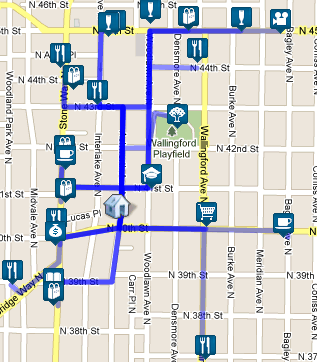
- Street smarts. For the first time ever, Walk Score is aware of the street network. The old version of Walk Score relied on the crow-flies distance between a given address and nearby stores and services. But sometimes that produced wacky results—say, when there was a super-highway or water body separating a home from a store or park. But Street Smart Walk Score calculates an actual walking route from a given address to nearby businesses. (See the image for an example.) I’ve tried it out, and despite a few foibles (e.g., suggesting that I walk across a street or two that I’d never try to cross in real life) it works really well.
- Better weightings. Street Smart Walk Score bases its rankings on real research about what people actually walk to — which means that it gives different amenities different weights. This weighting system not only boosts Walk Score’s academic rigor, it also makes neighborhood rankings more intuitive. Consider grocery stores: living within easy walking distance to a grocery store makes it much more likely that you’ll walk for some shopping trips; yet adding a second grocery store nearby doesn’t add much to the odds that you’ll walk to the store. On the flip side, a neighborhood with a bunch of different restaurants tends to attract more walking trips than a neighborhood with just one eatery. The Street Smart algorithm is tuned to recognize these quirks, generating a walkability metric that, well, just feels right.
- More transparency. Some folks used to complain that they didn’t understand why their home received a particular Walk Score. That’s not a problem anymore: the new system explains exactly how each score is generated. There’s even a methodology paper to explain the whole thing. And, in a special nod to walkability geeks, they even give you the data so that you can create your own pedestrian rankings.
If you haven’t tried it yet, give it a whirl. I learned an awful lot—both about neighborhood design and about myself—just by comparing the various places I’ve lived in over the years.

I tried it out. My neighborhood’s score dropped quite a bit. Several grocery stores, restaurants and coffee shops are missing, and the “Add a Place” option didn’t work. I sent them an email about it, hopefully the “Add a Place” link will be working soon.Still, much cooler than the original version!
There is still a serious disconnect with WalkScore and downtown Detroit. There are many bars and restaurants around Comerica Park and FoxTown. Type in 2211 Woodward Avenue, Detroit, MI 48201 (Fox Theater). It says the nearest restaurant is over 1/2 mile away and the nearest entertainment is Greektown Casino. So many restaurants, bars, and entertainment venues do not show up. Walk score of 12? This program is still way off the mark. Great concept, but much improvement needed.
Interesting articale, for more information on Walkability and LEED Certifications please visit us at: https://www.harriscompanyrec.com