
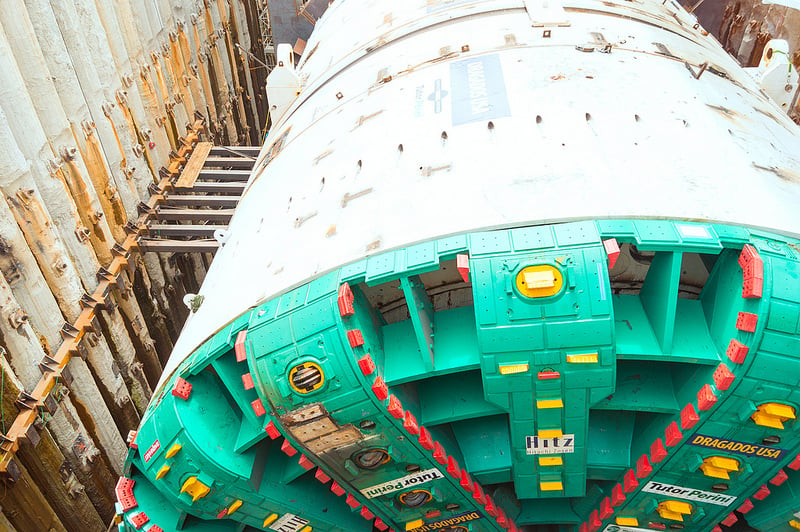


There are plenty of words to describe the ongoing drama over Seattle’s not-boring tunnel boring fiasco. Ironic, for one, given that the 8-inch pipe that brought the world’s largest tunneling machine to a halt was put in Bertha’s way by none other than the Washington State Department of Transportation, as part of the early feasibility studies for the very tunnel they’re now trying to build. Entertaining, because both WSDOT and Seattle Tunneling Partners, the private group that WSDOT hired to dig the tunnel, are busy pointing fingers at one another, positioning themselves for the inevitable battles in court and in the press. Exasperating, too, since it’s becoming increasingly unlikely that the tunnel will be completed on time, on scope, and on budget.
But unexpected? Not in the least.
Sure, nobody foresaw that Bertha would run aground on this particular well casing, any more than they predicted the machine’s “painfully slow start,” or prophesied the specific labor disputes and technical problems that halted work for four weeks in August and September.
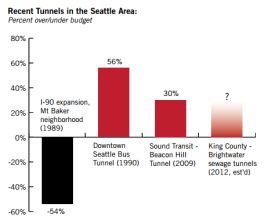
Still, anyone who is surprised that a mindbogglingly complex megaproject like the deep bore tunnel could go badly awry simply wasn’t paying attention. As our 2009 report on Seattle-area cost overruns highlighted, three out of four of greater Seattle’s four major tunneling projects went substantially over budget. And while the I-90 tunnel through Mt. Baker came in well under budget, Seattle’s experience suggests that tunnel troubles are the rule, not the exception.
But it’s not just Seattle. Oxford University researcher Bent Flyvbjerg has documented a worldwide tendency for megaprojects to go over budget.
Flyvbjerg’s work was widely discussed when the tunnel was being debated: see, for example, here, here, here, and here. And WSDOT itself was well aware of the risk of tunnel cost overruns; the agency’s own internal documents indicated a 40 percent chance that the deep bore would cost more than anticipated. In short, everybody involved with this project knew that the tunnel project could run into just the sort of trouble that is now dogging it.
Of course, it’s far too soon to know whether Bertha will bust her budget; and it’s still an open question who, precisely, will pay for any overruns. But what’s perfectly clear is that the risk that Bertha would be stopped in her tracks were anticipated, debated, and discussed. Nobody, particularly not WSDOT, can claim that Bertha’s woes come as a complete shock.
For more of Sightline’s writing on the Alaskan Way Viaduct replacement project, see:
- Report: Cost Overruns for Seattle-Area Tunnel Projects
- The Tunnel Won’t Be Boring
- WashDOT Says: 40% Chance of Tunnel Cost Overruns
- Report: Toll Avoidance and Transportation Funding
- Alaskan Way Viaduct: More Revenue Shortfalls Expected
- And our collection of Viaduct-related posts, Seattle’s Great Viaduct Debate

It’s worth noting that many extremely-desirable transit projects, locally and nationally, come in way over budget, too. Bashing the 99 tunnel because it’s a megaproject is not particularly interesting, and lays Sightline open to charges of hypocrisy when a megaproject Sightline and its donors like runs over budget, and Sightline fails to bash it.
Sound Transit will have to bore miles of tunnel for North Link; East Link will require non-trivial engineering to get rail over the I-90 floating bridge. Don’t get smug.
Hm.
I think it’s hard to argue that we’re being hypocritical. First, because our tunnel overrun report makes prominent mention of the transit tunnel overruns. And second, because Sightline hasn’t been big supporters of transit megaprojects. It’s just not clear to us that train transit qualifies as “extremely desirable” across the board. It’s a debatable point, one where we disagree with many of our supporters.
Finally, I’m sorry that you found my tone smug. My intention is only to remind readers that the possibility of a serious tunneling problem was thoroughly discussed before work began. This isn’t a surprise. It’s par for the course.
So Bruce: You think that Sound Transit’s light rail projects are “extremely-desirable transit projects”. On what basis?
Can you quantify “desirable” results in economic, social, aesthetic, environmental terms for the 99% of the people here who don’t use those trains with any regularity but are forced to pay the decades of high sales taxes?
I trust you understand the financing plan that entity employs relies on excessive amounts of sales tax impositions, and none of its peers pay for buses and trains that way.
A couple of comments:
1) The overrun on the Beacon Hill project was actually on the tunnel plus the station, and was closer to 10% rather than the number you provide. Additionally, ST overran the original cost estimate for the project, but they did not spend all the contingency funding. I.e., the project still came in within the total budget. The total project came in approx $100M under budget.
2) Not included in your data is the U-Link tunnel project, which is also about $100M under budget and about 6 months ahead of schedule.
Of course none of this excuses running Bertha into a pipe that WSDOT put there just a few short years…..
Thanks, lazarus.
The total price tag for Central Link is a subject for another time, but I think it’s hard to maintain that the project came in under budget if your baseline is the project’s initial budget (and length). As for the Beacon Hill tunneling portion, it was 17% percent by the time it went to bid. And then the cost went up from there.
The U-Link tunnel project is an apt comparison. I didn’t include it in my report because ST had hardly broken ground on it when I wrote my report. So it would not have a been a useful comparison then.
My impression was that this post was about the cost of tunnels in the PS area. As such, the price tag for Central Link is not just a “subject for another time,” it is in fact, a completely different subject all together.
Regarding the BH tunnel being 17% over at the time of bid, I wouldn’t consider this to be an “overrun” in any sort of commonly accepted sense. Generally speaking, increases in estimated cost during the project development phase or bid phase aren’t cost overruns since no budget has been committed until a contract has been signed.
Personally, I’d rather that the contracting agencies study these things in great detail and get the cost estimate right before committing any $$$ to construction. That, and good management, is how to avoid true cost overruns.
On total costs — I think that Eric just misunderstood your point about the “total project.” I’ll let him respond, though.
But in the original 2009 research on this, here’s what he wrote:
“Sound Transit’s Link Light Rail Beacon Hill Tunnel
Opened for light rail service in the summer of 2009, Sound Transit’s Beacon Hill Tunnel consists of twin tunnels, each about 1 mile in length and some 165 feet underground at the Beacon Hill Station. The tunnels were completed in 2008 after a 21 foot diameter boring machine passed beneath Beacon Hill.* When the tunnel project went out to bid, Sound Transit’s engineers estimated that the project would cost $238.6 million. But Obayashi Corporation won the contract with a low bid of $280 million, a 17 percent increase.** During construction, the project’s costs subsequently escalated the contract to $309 million for a total cost overrun of 30 percent.***”
The three citations are numbers 8, 9, and 10 in the original report.
Of course, there are real and legitimate questions about what counts as the baseline for an “overrun.” The tendency is for the baseline to migrate upwards gradually, in steps — which means that one person’s “overrun” is another person’s “on budget.” It’s often just a question of which baseline you choose, which is a reasonable thing to debate, since there’s not necessarily a single “right” answer.
I don’t have the background or expertise on this one to adjudicate where that baseline *should* be on Beacon Hill. But at least this explains where the overrun estimates came from.
lazarus,
As Clark indicated, I misunderstood what you were saying. I thought you meant “Central Link” when you said “total project.”
The baseline question is the really interesting one though. My report was an attempt to inform debate over the deep bore tunnel at a particular point in time, so I tried to identify comparable baselines for other tunneling projects. That is, not baseline costs of thorough design and engineering that are ready for bid, but baseline costs of partial design and estimates, which is where we were when the state legislature capped expenditures, etc.
Anyway, as I think history shows, final costs often exceed those early baseline figures. Whether that’s a knock on Sound Transit, I don’t know, but I think it is certainly a cautionary tale for the 99 tunnel.
A few years ago, I remember running into one of the engineers working on the SR99 tunnel project, and this person telling me in a fearful tone, “Roger, the risks on this project are just so enormous!”
The prediction I’ve made since early 2009 has never been addressed, ie, the finished bore tunnel will slowly undermine historic and modern building foundations above its entire length, and in even modest earthquakes bring buildings down suddenly with a death toll in the hundreds to thousands. The seawall replacement technique (Drill-Fill Sea Fence) compounds the problem posed by a bore tunnel in unstable waterfront soils. What-me-worry? City Council cohorts still divert attention in their eyes to more precious moneybags. Can we afford to bore a tunnel that will destroy Seattle? How it be financed and who will pay for the destruction? Say Good bye to The Underground and the entire Pioneer District. Condo towers on 1st will not survive a Big 9.0. Building collapse near the north portal is likely.
The FEIS Cut-Cover Tunnel/Seawall is still possible. Direct the bore tunnel to the Seawall/Cut-Cover route and finish at its north portal at Pike. It’s more disruptive, but forms a solid seawall and a long-lasting tunnel that manages traffic better than the bore tunnel which will not survive a major earthquake. Wsdot conservatives have found a final solution for Seattle liberalism. Mass Murder. Oh ho ho, that’s so funny, ha ha, you’re dead. Light up that doobie and let’s play “It’s all good, man,” then die.
R. Conlin’s resistance to realistically addressing this topic was the primary reason I voted against him.
It’s 5:03pm in Portland at this moment…
Six hours after the previous impassioned plea…
I am NOT kidding.
STOP BERTHA.
STOP whoever WANTS BERTHA to continue.
Revert to the Cut-Cover/Seawall in the 2009 FEIS.
And remember one thing: This most acceptable Cut-Cover,
was kept from voter attention in March 2007.
If one looks closely at the official Wsdot artist depiction,
of the ‘stacked’ Cut-Cover, water over-flow, AND
the 6-block TRENCH considered MOST DISRUPTIVE,
NOT the 1 or 2-block trench considered LEAST DISRUPTIVE.
Listen to Amy Goodman’s Friday tribute show to Emile Bo-racca.
And please, you goddamn cowards. How dare you!
Seattlers? You’ll be visited this year by many.
Try to put on a BETTER SHOW for them, for once?
Thank you. KILL BERTHA!
K I L L
B E R T H A
I’m becoming more proud of my letter to Governor Gregoire of August 15, 2011 as time passes and events unfold. It’s in the Record of Decision.
Bottom line is that neither a reinforced Viaduct nor the Bertha-tunnel are necessary in the long-run for sufficient north-south mobility in City of Seattle. As always, mobility demand will be shaped by available mobility options.
Nice letter, John!