

Advancing proportional representation
A democracy strategy update
By Alan Durning
April 2026
Portland, Oregon, councilor (then Council President) Elana Pirtle-Guiney (left) and councilor Tiffany Koyama Lane (right) celebrate a win at a Portland City Council hearing, October 2025. Portland is the largest jurisdiction in the United States to use proportional representation to elect its city council. Photo by Citizen Kepler, via Shutterstock.
Advancing proportional representation
A democracy strategy update
By Alan Durning
Summary
Proportional representation is the right destination for US democracy reformers because it is the best remedy for gerrymandering, gridlock, and polarization. Countries with proportional representation are better at managing conflict and solving hard problems.
Still, as much as its proponents may wish otherwise, proportional representation may remain a long way off. A well-planned, patient, stepwise strategy can bring us to it, if advocates coordinate, learn from their setbacks, and refuse to factionalize over election methods.
Making the path harder than it already was are some recent changes: President Trump’s escalating election denialism, shifting political coalitions, voters’ skepticism and polarization revealed by 2024 ballot measures, the advent of mid-decade gerrymandering, and the Supreme Court’s expected gutting of the Voting Rights Act. This last recent change could bring new opportunities too: a potential realignment of the civil rights movement and the emergence of new pro-proportional organizations.
Three branches of the election-reform movement focus on (1) all-candidate primaries, (2) ranked choice voting, and (3) party-based proportional representation. Branches 2 and 3 may differ less in outcomes than many reformers assume. The constitutional structure of the US Presidency, Senate, and House all favor two dominant parties; whether ranked choice or party-based models prevail, reform is unlikely to end two-party dominance. The weight of history reinforces these tendencies, and a society-wide retreat from membership may limit minor parties’ growth.
This analysis of present circumstances implies five strategies for the proportional representation movement, including targeted local, state, and federal initiatives; party outreach and party-strengthening reforms; and a cluster of near-term priorities that establish likely precursors to proportional representation, such as unified primaries and ranked choice voting.
Sightline’s plans, in an appendix, nest within these strategies and play to the organization’s strengths. They include defending, improving, and publicizing Portland, Oregon’s new proportional election system; legalizing and replicating the Portland model elsewhere in Cascadia; making the case for proportional representation and its precursors; charting routes to proportional representation through legal research and charter reforms; and opinion research.
Needed but distant
Proportional representation is essential for solving the hardest American political problems, from violent polarization to national debt, from gaping inequality to climate change. National and state proportional representation are going to be extremely hard to win, though. In short, we need proportional representation, but we can only have it by charting a careful, patient, stepwise route.
For these reasons, proportional representation is appropriately the ultimate destination for the democracy reform movement and also appropriately sequenced with other, near-term objectives. We reformers ought to be realistic about the journey, because we know, better than most, that the intervening obstacles are daunting and that intermediate reforms form the most plausible path.
In this memo, I describe the outlook for the reform movement in Part 1 and outline strategies in Part 2. In an appendix, I specify Sightline’s plans.
Part 1: The outlook
Long odds…
In 2024, I detailed the pinched and daunting path ahead in my article “Proportional representation in just three (brutally hard, agonizingly slow) steps.” This memo picks up where that article left off. I recommend reading it first. To summarize, I argued that the most likely path to proportional representation leads through the way station of unified, all-candidate primaries and ranked choice voting, as used in Alaska. I documented the extreme difficulty of winning proportional representation on this continent, recounting immense challenges and recurring failures. I described the intensity of public opposition to giving parties more power in elections, which makes party-based forms of proportional representation especially hard to win. I suggested that the best way forward is to enact local ranked choice voting bundles, as in Portland, Oregon, that include proportional ranked choice voting for council seats and single-winner ranked choice voting for executive offices. I maintained that after many localities have adopted this model, popular familiarity might allow victories for proportional representation in first one and then several state legislatures. From there, the leap to the US House might be conceivable. I projected at least a two-decade timeline for winning proportional representation in the US House.
…get longer
Since 2024, the path has grown still more arduous, because four changes have made victory harder. A fifth change, expected soon, will set us back further, at least temporarily. On the other hand, more actors are working for proportional representation, and the range of available strategies has expanded, creating new opportunities, as discussed in the next section.
- Election denialism. President Trump has ramped up election misinformation to a fever pitch in 2026, amplifying distrust of authorities among Republican voters. He may be creating a pretext for intimidating voters or election administrators with armed federal agents, seizing ballot boxes to disrupt the count, disavowing certified results, refusing to seat duly elected representatives or senators, or otherwise undermining the 2026 midterms or 2028 presidential elections. A January 6-style attempt to steal an election may be in the offing, and so far, few Republicans have objected. Far-right parties across the West have long displayed anti-democratic tendencies, and the dominant MAGA faction of the GOP has brought this trait to the United States in force. For many citizens, fundamental election reform is hard to contemplate in the context of rolling constitutional crises and the threat of a Götterdämmerung-level partisan clash over democracy itself.
- New coalitions. The major parties have continued sorting themselves into new coalitions since 2024. Reversing historic patterns, Democrats have become ever more the party of the educated and Republicans increasingly the party of the working class. Consequently, low-turnout elections now favor Democrats, and high-turnout elections favor Republicans. Proportional representation increases turnout, making it less appealing to Democrats in the future than it was in the past.
- Voter skepticism and partisanship. Revealing a profound lack of appetite for election reform, voters rejected all but one of the nine state ballot measures for unified, all-candidate primaries and/or ranked choice voting in November 2024. These reforms would have been modest, intermediate steps toward proportional representation, and no state opted to step forward, though thankfully, Alaska declined to step backward.1
Voters’ skepticism about changing voting methods proved deep—a sobering lesson, and the 2024 proposals did not change elections from winner-take-all to proportional representation, which arguably made them easier for voters to understand. Mostly, they consisted of putting all candidates into the same primary election and/or letting voters rank their favorite candidates, rather than picking just one. The campaigns’ after-action evaluations recorded as a key lesson that few voters see election reform as related to their top concerns, such as affordability, health care, or the economy.2
Worse, they found that electoral reform has fallen into the trap of partisan polarization. One confidential analysis by a well-placed reform organization estimated that Harris voters in six of the ballot-measure states supported reform more than Trump voters by an average of 45 percentage points. Republicans everywhere, already more cautious about change than Democrats, came to believe that reform was a liberal plot and voted “no” even when it arguably would have advanced their interests.3
Conspiracy theories about elections are now a major preoccupation of the American right. Witness the national Make Elections Great Again bill that would ban most election upgrades that reformers have promoted, including alternative voting methods such as ranked choice voting and open-list proportional representation.
Before November 2024, reformers understood the road to victory as usually requiring that they carry all the left, most of the center, and some of the right. Tragically, after an eight-state campaign for change that cost reformers more than $100 million, the right is now thoroughly mobilized against reform. The road ahead, already narrow, got narrower. - Biennial gerrymandering. In 2025, President Trump unleashed mid-decade redistricting for partisan advantage, triggering a state-by-state arms race of gerrymandering that is still afoot. No law prevents states from engaging in this escalating contest, and the internal logic of partisan competition could make it a biennial exercise. State legislatures adopt US House district maps, so legislatures’ importance to the national parties increases. And proportional representation for state legislatures would, in most states, be tantamount to unilateral disarmament for the majority party.
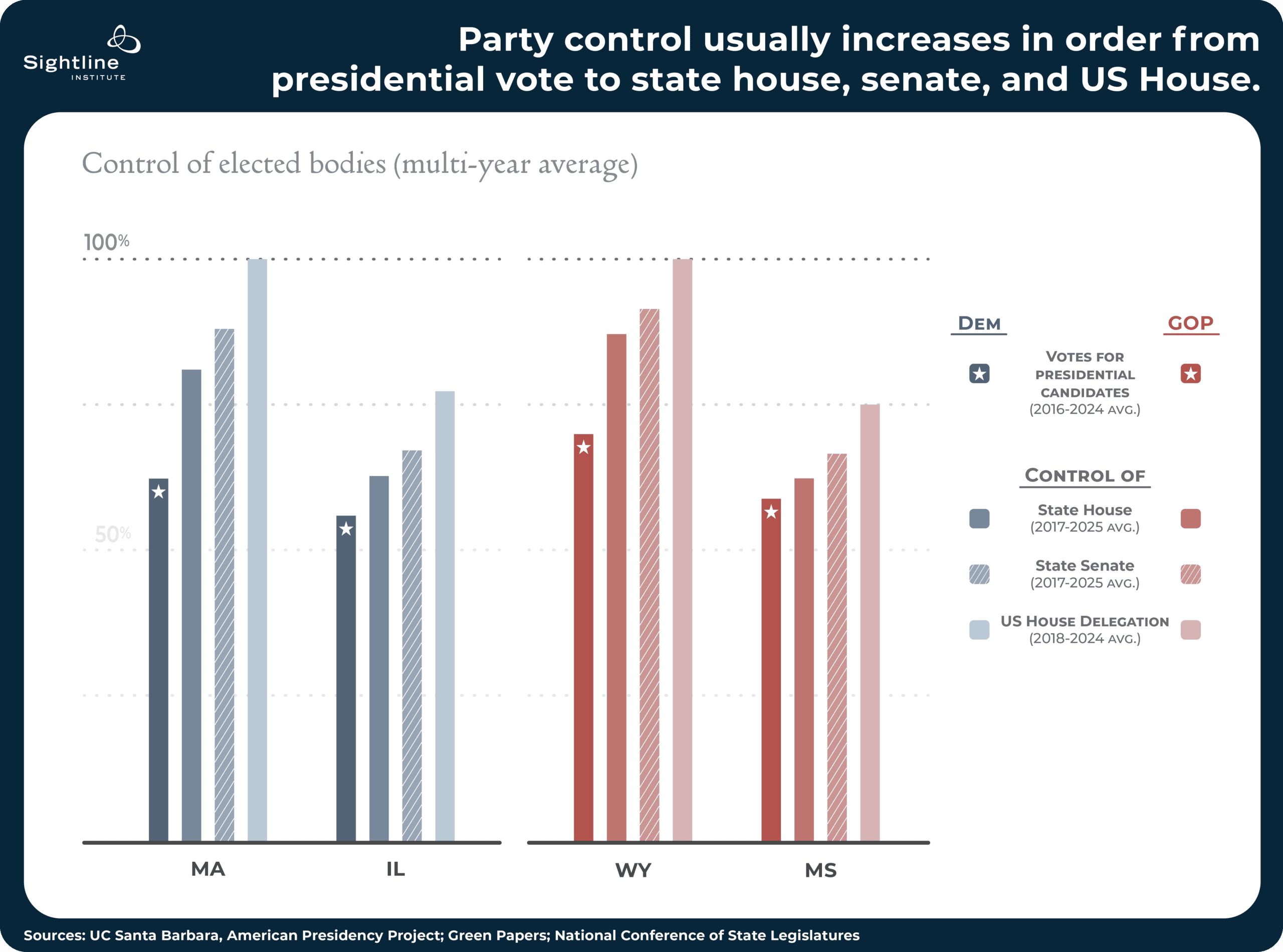
In Massachusetts, for example, Democrats have won majorities of 62 percent in recent presidential elections, as shown in Figure 1. The Democrats have leveraged this electoral majority into control of 81 percent of seats in the state house, 88 percent of seats in the state senate, and 100 percent of the state’s US House delegation. This pattern of escalating control is a function of intentional gerrymandering; it’s also a function of geometry. Just as the resolution improves on a screen as its pixels get ever more numerous and smaller, so too does representation improve as single-winner districts grow in number and shrink in size.
If you divide a state’s diverse electorate into fewer districts, the chances the state’s majority party will win go up. In the hundred-odd districts of the typical state house, minority parties usually do better than in the typical state senate, which has half as many districts. They do worst in the nine districts, on average, for a state’s US House delegation. The same pattern of leveraged Democratic control is evident in other blue states, such as Illinois, and for Republicans in red states, in Mississippi and Wyoming, as shown in figure 1.
This pattern of party control that grows in larger districts is evident not just in these four states. Figure 2 shows all the states.4 The figure’s blue-shaded area is the states’ average presidential vote share in the years 2016, 2020, and 2024 for Democrats, ranging from 25 percent in Wyoming on the left to 63 percent in Maryland on the right. The red-shaded area is the Republican vote share. As you click through the figure, you can see the Democratic share of state house seats, averaged over a similar period. It skews somewhat more strongly toward the majority party than does the presidential vote share. Next, you see the Democratic share of state senate seats, which skew still more strongly, and then Democratic control of states’ US House delegations, which is the most exaggerated of all.
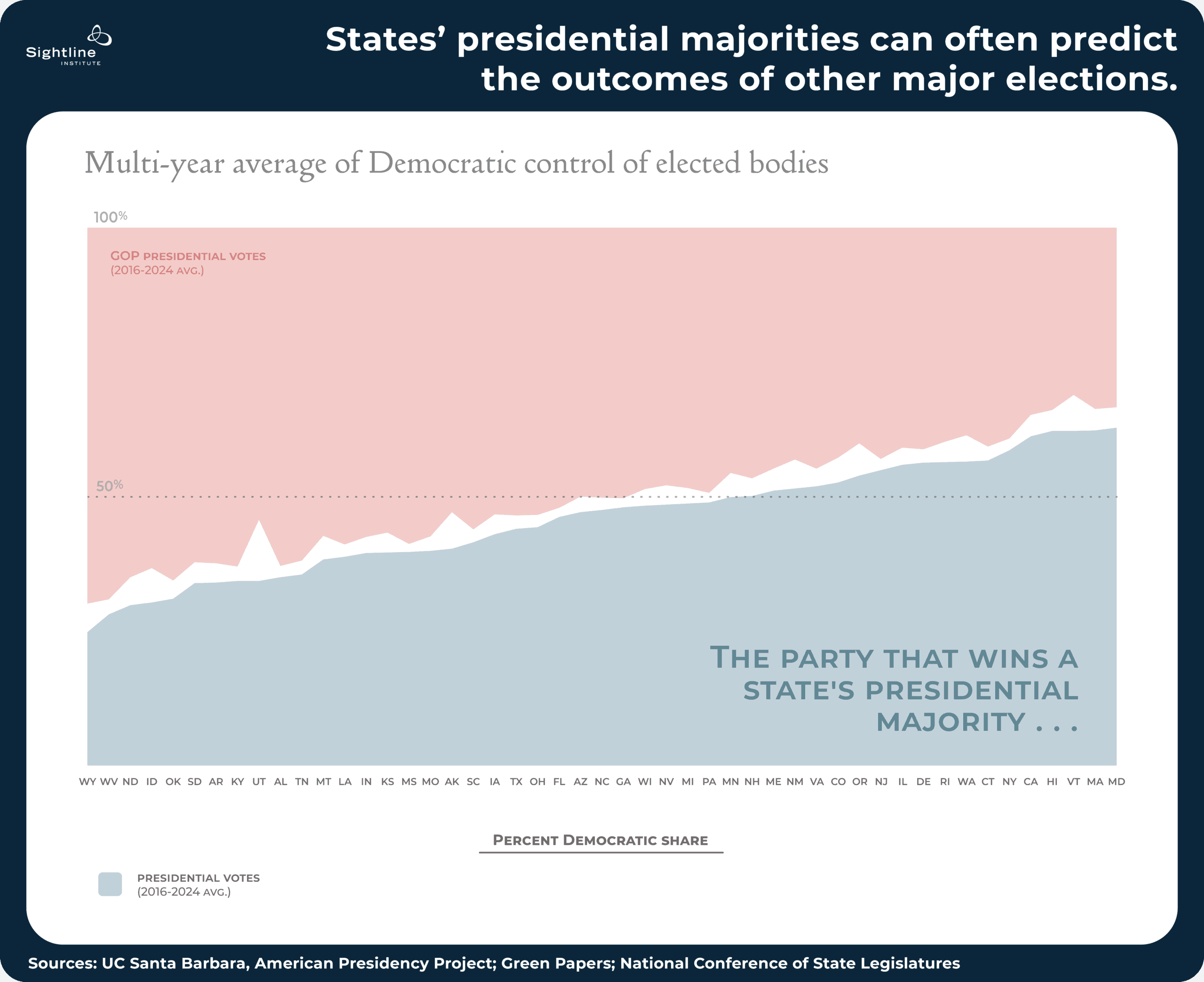
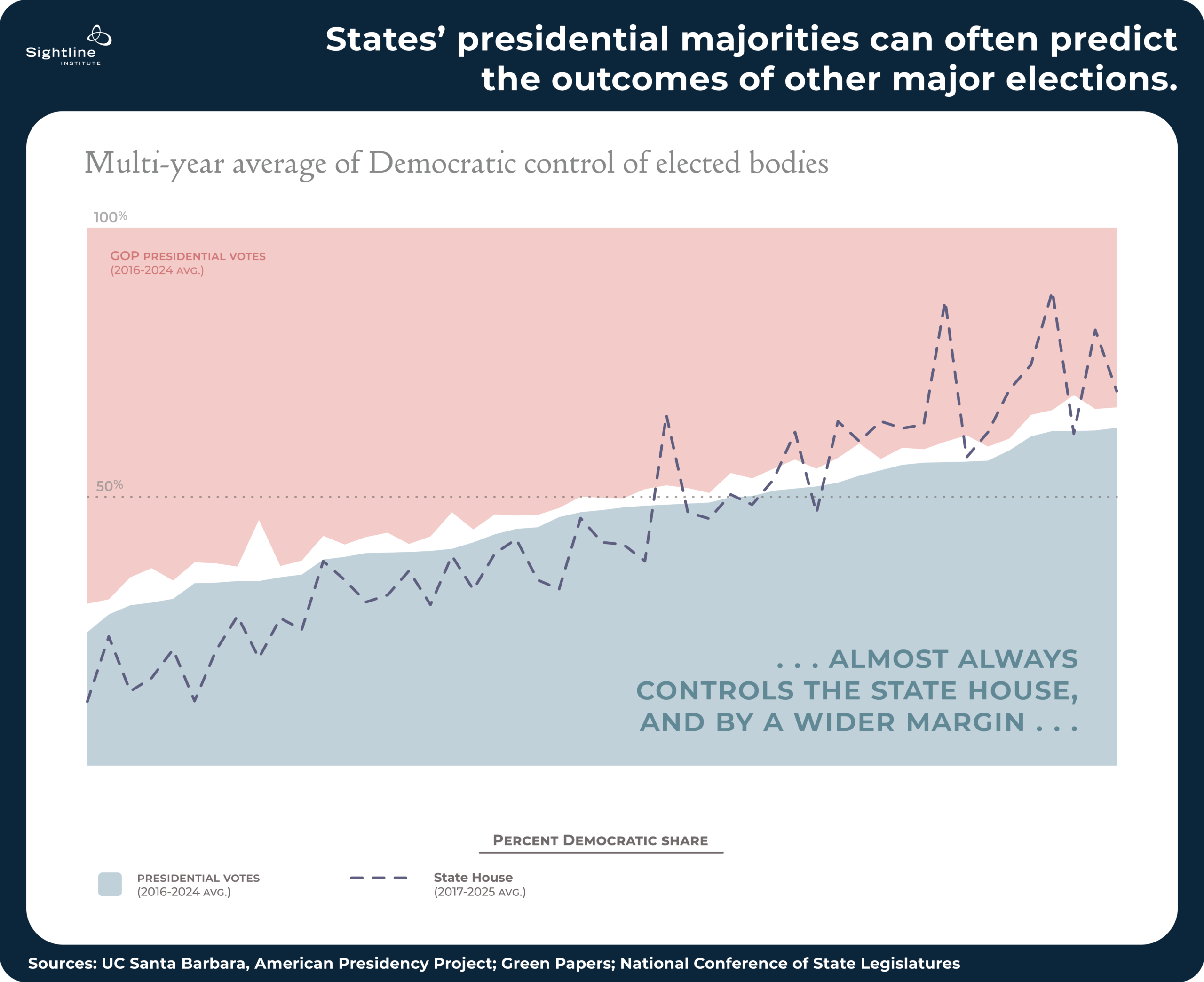
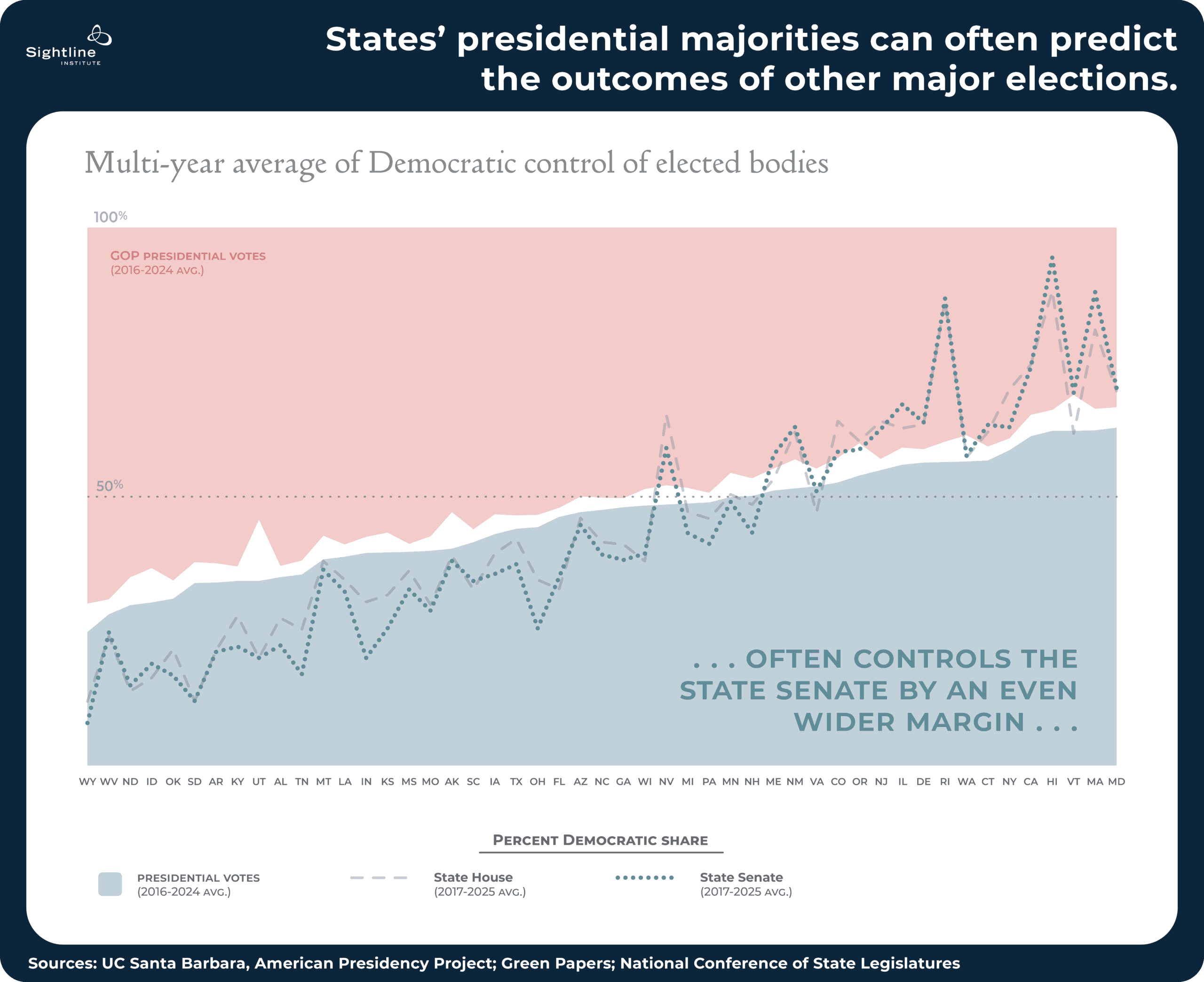
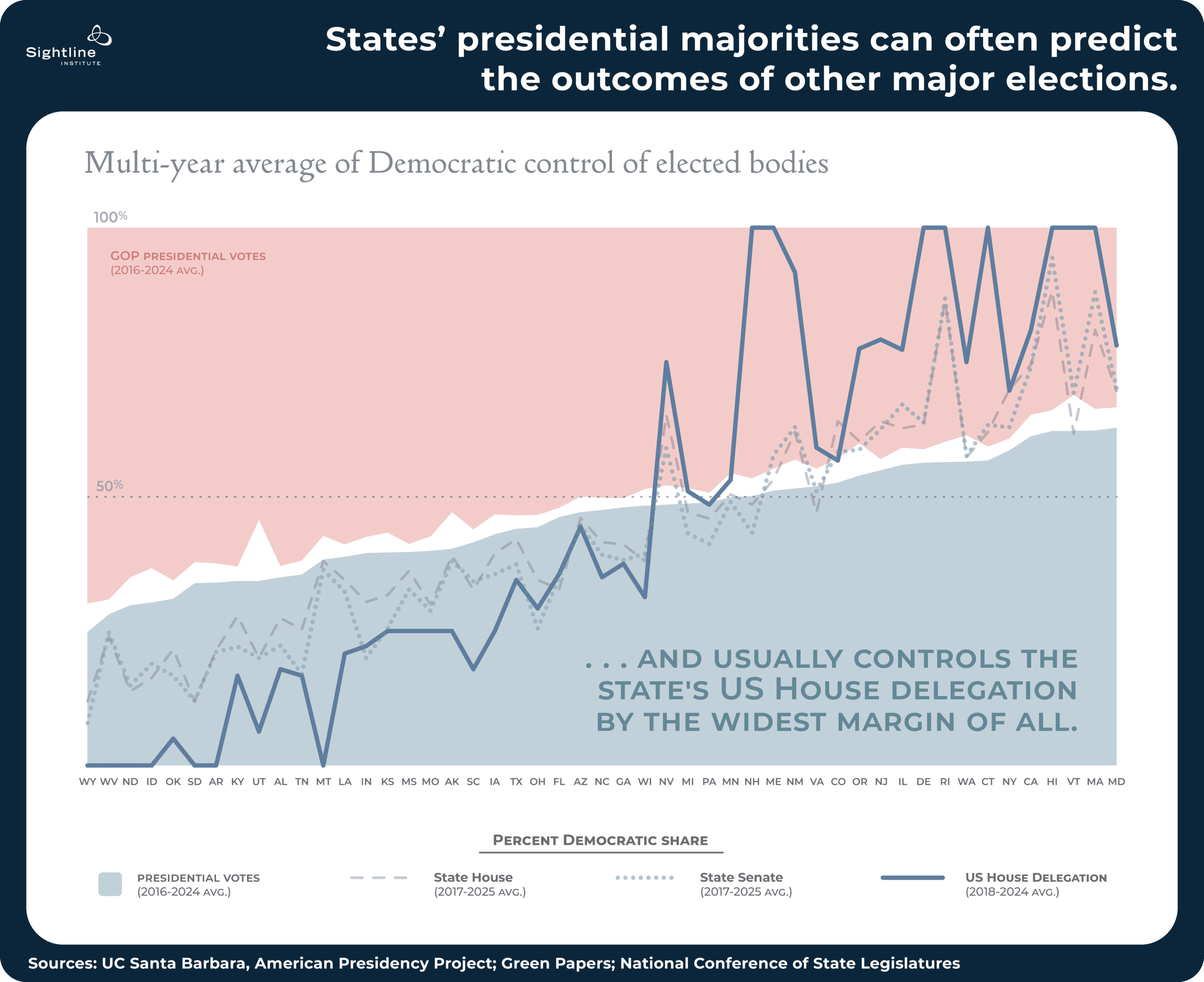
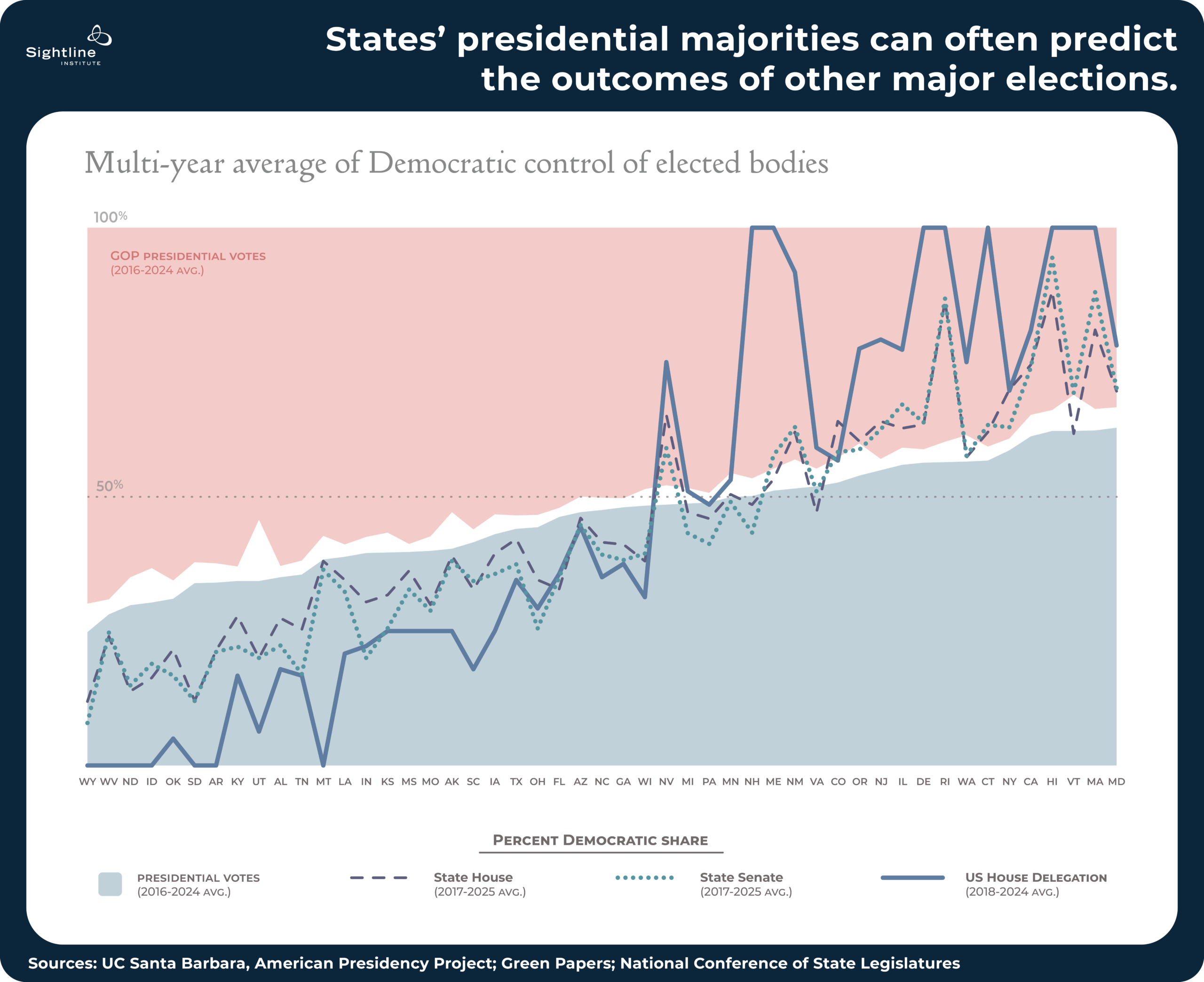
In almost every state, proportional representation in the legislature would move Democrats’ state house and senate lines much closer to their presidential line. In blue states, this means that Democrats’ control of the state legislature would wane, as would the party’s ability to gerrymander US House seats. In red states, conversely, Democrats’ representation in the legislature would increase, and Republican control over gerrymandering US House seats would diminish.
For example, if California’s state legislature were proportional to its 2024 presidential vote, the state would not have been able to neutralize Texas’s mid-decade redistricting in late 2025. A proportional California legislature would be 58 percent Democratic legislators, short of the two-thirds supermajority legally required to redistrict the Golden State mid-decade. At present, Sacramento’s two chambers are 75 percent Democratic. This example is not hypothetical. A movement is afoot in California for a ballot measure to adopt proportional representation in the legislature.
In a future of biennial gerrymandering, proportional representation of state legislatures would kneecap majority parties. Therefore, neither a state’s legislative majority nor its ballot-measure voters would likely support it; the national fight for control of the US House outranks other issues on legislators’ and voters’ priorities. A few exceptions stand out, including swing states with balanced delegations and, especially, deep red and deep blue states with small delegations. Still, in most states, proportional representation in state legislatures is dramatically less likely than it was two years ago.
But wait, some may object. Doesn’t this two-party analysis miss the point? Voters are exhausted with the Tweedle-dee/Tweedledum dynamic of the two-party status quo, sometimes called the duopoly. And won’t the worsening status quo increase the appetite for change? Won’t citizens eagerly vote for proportional representation if it brings them more parties? Wouldn’t the emergence of new parties change the game, ending the gerrymandering war in that state, draw emulation in other states, and spread reform across the nation?
It’s a hopeful scenario, but I’m dubious. More likely, the all-pervasive war between the parties will make most people interpret proposals for reform through a zero-sum two-party lens, as happened in 2024. “Does it help or hurt my team?” voters will ask. Survey-reported yearnings for more parties and better politics waver when confronted with actual ballot measures, and they tend to collapse under fire from voters’ preferred parties. I see no evidence from history that rising distrust of institutions or rising disgust at politics leads to positive change. In election reform campaigns that Sightline has worked on, people’s distrust of the establishment instantly transfers to proponents of reform.5
- Voting Rights Act. These four changes all make winning proportional representation more challenging. Another change will do the same in the short term but might have other effects in the long term. In the next few months, the US Supreme Court will probably gut Section 2 of the US Voting Rights Act, allowing states to eliminate majority-minority districts and tip up to 19 House seats from Democrats to Republicans by 2028. It might set in motion other cases that strike down majority-minority districts as a civil-rights remedy under the eight state voting rights acts. This change will turbocharge mid-decade gerrymandering, empowering the reform-averse Republican party to gain additional US House seats.
Eventually, the end of majority-minority districts as a civil rights remedy may bring racial justice advocates into the coalition for proportional representation. But the net effects for proportional representation are unpredictable and, in any event, would be delayed.
A three-branch movement
The movement for election reform in the United States now has three branches.
Branch 1 works to reform partisan primaries by promoting unified, all-candidate primaries, such as Alaska’s top-four system and California and Washington’s top-two systems.6
Branch 2 sees ranked choice voting and related reforms as steps on the path to proportional representation. While not opposed to other electoral methods, this branch of the movement has a common prescription, implemented now in Portland, Oregon: single-winner ranked choice voting for executive offices and multi-winner ranked choice voting for legislative offices.7
Branch 3 favors open list and mixed member proportional voting and, for some, fusion voting. Fast growing in the last two years and formed of newer entrants to the movement, this branch is pursuing party-based models of election reform.8
Branch 1 (primary reform) and Branch 2 (ranked choice voting) find common cause in supporting Alaska’s all-candidate, top-four primaries and ranked choice voting general elections.
Unfortunately, internecine competition is commonplace in the democracy movement, as in other realms of human affairs. Enthusiasts of each branch sometimes lapse into attacks on the other branches. If the three reform branches can refrain from factional warfare, though, the new branch will be a welcome development. In the end, the three branches are complementary.
To understand the strategic implications of this three-branch structure, some background helps.
Multi-winner ➡️ multiparty
The candidate-based Branch 2 of reformers understands proportionality of representation as making the legislature, in John Adams’ words, “an exact portrait, in miniature, of the people at large.” They focus on reflecting the traits and views of the public, including but not exclusively their party preferences. The party-based Branch 3 is fired by the same overarching goal but places special emphasis on nurturing a multiparty democracy, breaking what this branch’s leading theorist Lee Drutman of the New America Foundation calls the two-party doom loop.
This difference explains the branches’ preferred voting methods, ranked choice voting for Branch 2 and open list or mixed member proportional voting for Branch 3. In the former, people vote for candidates; in the latter, people vote for parties (or for candidates but in ways that allow their votes to transfer to other members of the same party). In practice, however, the likely results of adopting any of these methods may be more similar than reformers assume.
Specifically, adopting a proportional voting method for the US House, with multiple winners per district, is the main goal of both branches. Just how multiparty that chamber can become, however, is constrained by constitutional features of the Presidency, the Senate, and the House. The fundamental reason for these constraints is a canon of political science called Duverger’s Law. It holds that any system of democracy that relies on single-winner races with pick-one voting and plurality victors favors two-party dominance. Conversely, proportional voting methods nurture more parties, though not immediately.
Constitutional constraints
Presidency. The preeminent role of the president in American government and culture, and the method used to select him or her, puts a classic Duverger situation on the main stage of American politics. The internal logic of a separately elected president, chosen through state-by-state winner-take-all electoral college competitions, discourages voters from marking their ballots for anyone but the major party nominees.9 The presidency itself does not rule out multiparty democracy, but it constrains it.10
US Senate. Each state elects its Senators one at a time, in different years, by plurality, pick-one elections, which makes Senate elections classic Duverger terrain: as in presidential races, two parties naturally predominate. Because the Senate is the more powerful chamber of Congress, with power over treaties and appointments, the highest-stakes US elections, for president and Senate, both entrench the duopoly.
These commanding heights give the major parties the vast powers of these offices. They also confer other benefits of political importance: their candidates are automatically on almost every ballot they contest and are taken seriously by every voter. The presidency and Senate let the major parties build their war chests, institutions, and public brands; control media attention and public narratives; recruit promising candidates and operatives; and win entrée to virtually any audience they want to address.
50 States. The US House adds to this two-party entrenchment by virtue of its composition: half of states lack enough representatives to support a fully robust multi-party composition. That’s a matter of mathematics.
A panel of experts assembled by the American Academy of Arts and Sciences notes “something close to a law in political science. Knowing the average number of seats per district, along with the total number of seats in a legislature, will generate a remarkably accurate prediction of the number of nationally competitive political parties in any given country.” More seats per district equals more parties. To produce an American politics with more than two parties, the panel recommends multimember districts with a bare minimum of three and preferably as many as eight House seats in each.
If every House district has three representatives, three major parties become a mathematical possibility, but two major parties remain the most likely outcome. If the aim is a multiparty democracy with five or six parties (a sweet spot that Lee Drutman has suggested), districts of seven or eight seats would be best.11
Unfortunately for multiparty democracy, most states do not have seven or more seats.12 Some 26 of 50 states—and 18 percent of the House membership—are too small to reliably send five or six parties to Congress. These small-population states would provide a built-in advantage for the major parties, adding to the two-party inertia of presidential and Senate elections. Voters and other political actors will think hard about supporting parties that have no shot at the White House, the Senate, or the House seats from more than half the states.13
Other constraints
Beyond these constitutional features, the duopoly also survives thanks to the immense weight of the nation’s history, traditions, and culture. The United States has been dominated by two parties since parties emerged at the beginning of the republic. The last time that a new party ascended to the major league was 1860, when Abraham Lincoln won the presidency. The Populists made inroads late in the 1800s and the Progressives in the early 1900s, but both ultimately dissolved into the GOP or the Democratic Party.
Indeed, one Progressive victory was to inaugurate government-run primary elections to pick party nominees for most state and federal offices. By 1915, this system was in place in most states for offices other than the president, and thereafter, anti-establishment energy increasingly flowed into the major-party primaries rather than into minor parties. After the early 1970s, presidential primaries were the norm, and outsiders such as Bernie Sanders and Donald Trump could hope to capture rather than compete with the major parties.
Most recently, the rise of virulent anti-establishment populism and profound distrust of public institutions have had the perverse effect of further entrenching the duopoly. When voters believe everyone is corrupt and no one can be trusted, they default to negative partisanship: they may not love their own major party, but they hate the other one. Even most of the swelling numbers of self-proclaimed independents are closeted supporters of team red or team blue, voting reliably for the same party year after year. Any proposal to revise the system runs into this partisan buzzsaw.
Add to this skepticism a society-wide retreat from associations. The parties are now “more corporate brand than mass organization,” writes political analyst Anton Jäger, and that’s true not only in the United States. “Since the 1990s, political parties across the West have been hemorrhaging members amid a wider weakening of internal structures.” People becoming non-joiners is a long-standing cross-cultural trend, and it’s nearly universal. But it’s accelerated as bowling alone has become scrolling alone, and the most likely explanation of parties’ hollowing out now has less to do with election rules than with technology. It’s not the parties, in short; “it’s the phones.”
Implications
For the United States, therefore, a robust multiparty democracy with five or six main parties seems far-fetched. American proportional representation might get to three or four parties, though two would probably still predominate, leavened with more independent candidates and minor parties. That result would still be a vast improvement; indeed, it’d be much like the proportional systems of New Zealand and Australia. Both countries have two main parties and a few minor ones. The former employs mixed member proportional voting, the latter a version of proportional ranked choice voting.14
Proportional ranked choice voting, for its part, would also be a boon for multiparty democracy. It allows minor parties a viable path to power. It lets voters choose independent or third-party candidates first and still award a major-party candidate a back-up vote, reassuring them that voting for their favorite candidate will not accidentally help elect their least favorite. It reveals the full degree of support for runners-up and their parties, even when it does not elect them. Proportional ranked choice voting is also compatible with fusion voting in its aggregated form, in which candidates can list the endorsements of more than one party, as already practiced in Oregon and Vermont.
With the right policies in place, ranked choice voting, and even unified, all-candidate primaries, empower parties to express their nominations. While nominally candidate-based systems, they are not anti-party. They can weaken the duopoly, perhaps to the same degree as would open list or mixed member proportional voting. The island nations of Ireland and New Zealand illustrate this point well. The countries, both former British colonies, have about 5 million citizens each. Ireland has used proportional ranked choice voting since its independence in 1922, and New Zealand has used mixed member proportional voting since 1996. Both countries have two dominant parties, along with a few minor parties. Since 1996, Ireland has averaged ten parties in its legislature along with several independent legislators, while New Zealand has averaged around seven.15 In other words: different voting systems, similar party profiles, and the ranked choice voting system actually yielded more parties than the mixed member proportional one.
All these considerations contextualize arguments for candidate-based and party-based proportional voting for the US House. Open list or mixed member proportional voting might yield a similar number of parties as proportional ranked choice voting; all methods would weaken but not end the duopoly. The key question, therefore, is not which voting method is ideal but which voting method is achievable. The best way to find out is to try.
Part 2: Strategic Implications
From the vantage of today, proportional representation looks like a long road. The labor activist Nicholas Klein declared in 1918, “First they ignore you. Then they ridicule you… then they attack you… And then they build monuments to you.” In most of the United States, the movement for proportional representation is still in the ignoring stage.
At least five general strategies for advancing proportional representation follow from the foregoing analysis:
- Clear a path. Some changes make future changes easier, so reformers can sequence their priorities to take steps toward proportional representation.
- Unified, all-candidate primaries and single-winner ranked choice voting lower the temperature of partisanship, familiarize voters with better ballots, and make subsequent reforms easier to win. Municipal ranked choice voting bundles, as in Portland, are a near-term opportunity to win proportional representation.
- Fusion voting could strengthen minor parties. Disaggregated fusion proponents are pursuing legal strategies in states including Kansas and New Jersey, trying to win court challenges to mandate fusion ballots with separate lines for each party. The aggregated version of fusion voting, in which candidates can list more than one party nomination after their names, is easy for voters and election administrators. Proponents of unified primaries and/or ranked choice voting can add it to their proposals, as did the sponsors of an Oregon top-two ballot measure.
- A national anti-gerrymandering law, perhaps passed after a blue wave election, could end the mid-decade arms race of redistricting and put some limits on partisan line drawing, creating more space for proportional representation in state legislatures.
- Ending the Senate filibuster would make all other reforms easier to win.
- Familiarize voters. Making proportional representation commonplace through local adoption, as in Portland, and other means will make its adoption for legislatures and the US House less daunting to voters. At present, most voters have no idea what proportional representation is. So far, only six US localities, out of thousands, use it, and another half dozen have approved it, pending state permission. Winning it and implementing it well in many additional cities is a priority. Most localities use nonpartisan elections, making Portland-style proportional ranked choice voting the logical choice, but in the roughly 15 percent of cities with partisan elections, adoption of party-based methods would be instructive. Another fruitful approach is to pursue local proportional representation as a remedy for racial underrepresentation under state voting rights acts.
Beyond local adoptions, other familiarization strategies include popularizing web tools and apps that let people experience proportional voting in low-stakes, nongovernmental elections. Such tools would make it readily available for social media polls, audience prizes during award shows, fantasy sports leagues, meal planning for retreats and special occasions, book club title selection, and elections for student government, trade associations, homeowner associations, and membership organizations’ boards of directors. Familiarization would also advance with study tours to relevant jurisdictions; proportional representation’s insertion into video games, movies, and TV shows; and media treatments such as earned news coverage and videos, both short-form and documentary.
- Target special states. The few states with special circumstances where legislative proportional representation might not constitute unilateral disarmament in the national contest for control of Congress are the best candidates for early campaigns. Swing states with balanced delegations that allow citizens’ initiatives, such as Michigan, might be good candidates. A Colorado effort is already in an exploratory phase. Small states so lopsided as to have effectively one-party rule such as Wyoming are another (and at least a scintilla of interest is evident in that state). Reformers can consider citizens’ initiatives in any states that match these criteria, after carefully testing which voting method is most appealing to voters and vetting whether victory is a realistic possibility.
- Open federal doors. Because state reforms are so difficult in the context of continual gerrymandering and new party configurations, a straight-to-DC approach deserves attention.
Here’s one scenario: the gerrymandering wars appear likely to first benefit Republicans in the US House, especially if the Supreme Court guts the Voting Rights Act. The 2030 census and resulting reallocation of seats may further strengthen the GOP in the House. At the same time, the trend toward more-aggressive partisan districting makes the resulting districts less safe for their majority parties. That is, margins of victory shrink as map manipulators reach for extreme gerrymanders. When wave elections come, they may tip more seats, yielding larger House majorities. What’s more, the eventual death of the Senate filibuster seems likely. Every few years, Senators have eroded it further, and partisan brinksmanship seems sure to keep creating crises that lead to its erosion.
Imagine a future in which Democrats win repeated popular majorities in the House, Senate, and Electoral College but rarely control any of them, because of House gerrymandering, the Senate’s structure (essentially, a constitutional gerrymander in favor of small states), and the Electoral College. If a 2008-like blue wave election yields a Democratic trifecta, this new government might seize the moment to fix the system’s imbalances, enacting proportional representation through a law such as the Fair Representation Act.16
Or imagine another scenario. What if the MAGA coalition disintegrates after President Trump’s second term ends, ripped apart by its internal tensions? What if the Republican party breaks into factions and cannot unite behind candidates, setting it up to lose spates of elections? Might those factions start demanding proportional voting methods to each get their share of seats? Might civil rights activists, denied majority-minority districts, form unusual coalitions with them in that push?
Might constitutional crises multiply to the point where civil society mobilizes on a truly unprecedented scale, demanding a structural solution to the failings of American government? Might the states demand a new constitutional convention and, at the convention, look earnestly for better ways to design the election system?
Such scenarios are far-fetched, but so is the proposition of convincing multiple state majorities to unilaterally disarm. To make a straight-to-DC strategy viable, advocates can seek champions and nurture supportive factions among both Democrats and Republicans. They can also make the case as powerfully as possible to leaders in other key sectors, including the media, the academy, business, and labor.
- Strengthen minor parties. Certain reforms help parties thrive. Fusion voting, for example, might nurture minor parties that build the constituency for multiparty voting systems. Both the disaggregated version favored by its most prominent advocates and the aggregated version in place in Oregon and Vermont warrant support. Other party-strengthening reforms include on-ballot party labels where they are missing, official voter pamphlets, and ballot qualification rules that eliminate vanity candidates and remove barriers to third parties.
Rising Together
The path to proportional representation in the United States is daunting, but the rewards will be immense: a Congress no longer gridlocked or stuck in a doom loop; a government that can solve hard problems, from national debt to climate, from political violence to the fast-approaching social strains of an impending artificial intelligence revolution.
The challenge is to chart a path from our current reality to that hoped-for future—a route where each step helps us navigate the closest obstacles while also setting us up to circumvent subsequent ones. The temptation may be to rush forward, fired by the virtue of our cause, into noble but failing gestures, such as ballot measures in states where they cannot win.
The winning course is to proceed with not only urgency but also wisdom. To win, we will need to improve the case for proportional representation, strengthen the institutions that advance it, expand the constituency that supports it, and establish a track record of success, including in local government. We can succeed, but only if we adopt a well-planned, patient, stepwise strategy and if advocates coordinate, learn from their setbacks, and refuse to factionalize over election methods. We will rise together, or we will fail.
Appendix: Sightline’s Plans
Some aspects of these five strategies map well to Sightline’s strengths and regional home, so we plan to pursue them. Others do not, as summarized in this table.
| Strategy | Sightline’s Plans |
|---|---|
| Clear a path | Sightline is deeply involved across Cascadia in defending and advancing unified primaries, single-winner ranked choice voting, and other precursors to proportional representation. Defending Alaska’s system is our #1 priority, and we hope to win unified primaries in Oregon and Montana while improving them in Washington. |
| Familiarize voters | This is another major focus of our work, including defending, improving, and popularizing Portland’s reform, our #2 priority, and replicating it elsewhere. |
| Target special states | No Cascadian state or province is a good candidate for proportional representation at present. |
| Open federal doors | Federal campaigns are not Sightline’s strong suit, but we do maintain relationships with some of Cascadia’s Congressional delegation. We could do more to educate members of the delegation were a coordinated national strategy in place. Republican outreach is a Sightline priority in Alaska, Idaho, and Montana, often through other messengers. |
| Strengthen minor parties | Strengthening parties is a theme of some Sightline research, such as our proposal for on-ballot party nominations, including aggregated fusion. |
Reorganized by Sightline’s work plan and filtered specifically to proportional representation, our priorities include:
- Portland. The Oregon city’s new proportional representation city council is now a model for North America, and it needs defense, improvement, and popularization. Sightline will continue to study and tell the story of the Portland model both in the Northwest and beyond. Rapid replication of Portland’s system of proportional representation depends on success in Portland: if other communities see Portland turn itself around from poster child of urban dysfunction to thriving city again, thanks to proportional representation, our prospects for success elsewhere soar.
- Targeted advocacy. Oregon law allows cities and counties across the state to adopt proportional representation, and replicating Portland’s success in more Oregon cities is a promising path. Local activists in Bend are hoping to make their county of Deschutes an early adopter. British Columbia and Washington also offer prime targets for local-level adoption of proportional representation; before most localities can consider reform, however, the province and the state need to adopt “local option” laws. Sightline and allies have engaged in Washington for several years in promoting this legislative reform. Victories would open several good targets for reform, including Seattle and Vancouver. Early wins may also be possible in Anchorage and Juneau, Alaska, and Whatcom County, Washington, where local partners are already in the fight.
- Case making and communications. To advance proportional representation, Sightline will continue to perform its core function of policy research, publishing, and communications to make the case for change. We target opinion leaders in Cascadia and beyond. This work is the foundation of everything else we do and the reason we have a track record of substantial influence spanning decades. We will produce a steady stream of articles, reports, newsletters, infographics, videos, social media posts, speeches, media appearances, and briefings on the benefits of proportional representation, way stations toward it, and how to win both.
- What’s legal already? One needed piece of research we have begun is a top-to-bottom review of relevant state and local law and policy, from state constitutions to local ordinances, with respect to proportional representation throughout the Cascadia region. This research is cataloguing opportunities and obstacles, and in it, we are considering three possible paths to proportional representation: multi-winner ranked choice voting (often as part of an RCV Bundle), party-based proportional representation through methods such as open list and mixed-member proportional, and two-step processes that begin by expanding the use of unified primaries and/or fusion voting. Sightline is ecumenical; we belong to all three branches of the election reform movement.
- Charter review communities? Some localities in Cascadia appoint citizen panels to review their home rule charters—essentially, their local constitutions—on an occasional or periodic basis. Voters in Montana cities vote each decade on whether to review the form of their local government through a citizens’ commission. Such panels are premier opportunities to advance proportional representation, because they can spark local dialog and public education. Some panels are empowered to refer their proposals to the voters directly, without approval of local councils. Portland’s 2022 adoption of proportional representation emerged from such a panel, and Whatcom County, Washington, conducted a charter review in 2025 that came close to proposing a public vote on proportional representation. We are cataloguing such processes to inform a multiyear strategy.
- Voting Rights Act communities? We assume that the US Supreme Court will demolish Section 2 of the US Voting Rights Act, but it may not undo its state counterparts in Oregon and Washington. If so, a good strategy is to identify patterns of racially polarized voting in local jurisdictions. These patterns can justify court-ordered remedies including proportional representation. In Washington, the state Voting Rights Act allows cities to deploy this remedy voluntarily, without even a lawsuit, if they document a pattern of racially polarized voting. This option even overrules the state’s general ban on proportional representation. Sightline will identify eligible Cascadian communities by analyzing voting patterns geographically and by seeking jurisdictions where proportional representation is the best available solution—that is, where majority-minority districts are impossible because neighborhoods are racially or ethnically integrated. Portland was one such community, which Sightline first documented. We will search Cascadia for similar places.
- Messaging and opinion research. Sightline will conduct a program of opinion research to develop a messaging guide for proponents of proportional representation, much as we did for the 2018 proportional representation referendum in British Columbia and as we have done to great effect in our Housing and Cities program. The plan includes a media audit, in-person and online focus groups, surveys, and other techniques such as online controlled trials.
About the Author

Alan Durning, executive director, founded Northwest Environment Watch in 1993, which became Sightline Institute in 2006. Alan’s current topics of focus include housing affordability and democracy reform.
He has also written about parking, Making Sustainability Legal, car-free living, bike-friendliness, electric bikes, and climate fairness. Alan has written or contributed to nine Sightline books, including Unlocking Home: Three Keys to Affordable Communities, Cascadia Scorecard 2007, Tax Shift, Stuff: The Secret Lives of Everyday Things, and the award-winning This Place on Earth: Home and Practice of Permanence. Prior to founding Sightline, Alan was a senior researcher at Worldwatch Institute. There, he studied the human dimensions of sustainability and wrote the award-winning book How Much Is Enough?, as well as chapters in seven State of the World reports and articles in hundreds of other publications.
A sought-after speaker, he has lectured at the White House, major universities, and conferences on five continents. In addition to his passion for sustainability, Alan is a music fiend and a lover of outdoor pursuits, especially mountaineering and cycling.