

Takeaways
- A glitch in Washington’s top-two election system, in which top-two misfires and elects a less-popular candidate over a more-popular one, could elevate a Republican to Patty Murray’s US Senate seat in 2028, against the will of most voters.
- A Seattle plan to use ranked choice voting in top-two primaries (or ranked top-two) offers an easy statewide fix.
- Ranked top-two does not change the top-two general election. It simply uses ranked choice voting to select the top two finishers in primaries that attract crowded fields of candidates.
- Ranked top-two will roll out for the first time anywhere in Seattle’s 2027 municipal elections. The state legislature could adopt it in 2026 and phase it in, starting with congressional elections in 2028.
When six-term US Senator Patty Murray is up for reelection in 2028, the Washington state leader will be 78 years old. If she does not retire on her own, she may well find herself challenged by younger Democrats, as is now happening to 79-year-old Senator Ed Markey of Massachusetts. Gerontocracy is out of vogue among Democrats; many blame their party’s loss of the presidency on 81-year-old Joe Biden’s delay in stepping aside.
If Murray forgoes the race, expect a stampede of eager Democrats hoping to succeed her. Her seat has not been vacant since 1992, so every ambitious politician in the Evergreen State will be eyeing it. Indeed, during her 2022 run for reelection, when no other big-name Democrats entered the race, Murray still drew 17 primary challengers. In Alaska that same year, when a US House seat opened for the first time in decades upon the death of Rep. Don Young, who held the office for 49 years, some 48 candidates threw their hats into the ring. Imagine how many will file if (and when) Murray steps aside. The line of Democratic contenders could resemble the throngs of hikers on the trail to Camp Muir on a summer weekend. In other words, it will practically be a mob scene.
Unlike in Alaska’s pioneering election system, though, platoons of candidates can be a problem in Washington—a big problem. That’s because Washington’s unusual top-two elections are haunted by a mathematical anomaly that could hand Murray’s seat to a Republican, even in deep-blue Washington.1
Fortunately there are fixes, and one of them is about to debut in Seattle: unaltered top-two in general elections combined with a targeted occasional use of ranked choice voting in certain overcrowded primary elections. (For brevity, we’ll call it “ranked top-two.”) If the state legislature adopts this Seattle plan in 2026, it could be up and running statewide in time for the August 2028 US Senate primary.
A glitch in top-two
To understand ranked top-two, you need to understand the anomaly, in which top-two misfires and elects a less-popular candidate over a more-popular one. The easiest way to understand it is through the 2024 election of Dave Upthegrove, a veteran Democrat, to the state’s public lands commissioner post.
In that race, Upthegrove came within a hair’s breadth of losing the primary, in which two Republicans and five Democrats faced off (see figure). The five Democrats gained 57 percent of the 1.9 million votes cast, but they divided their share many ways. During most of the vote-counting process, the two Republicans led, with 22 percent for Jaime Herrera Beutler and 21 percent for Sue Kuehl Pederson.
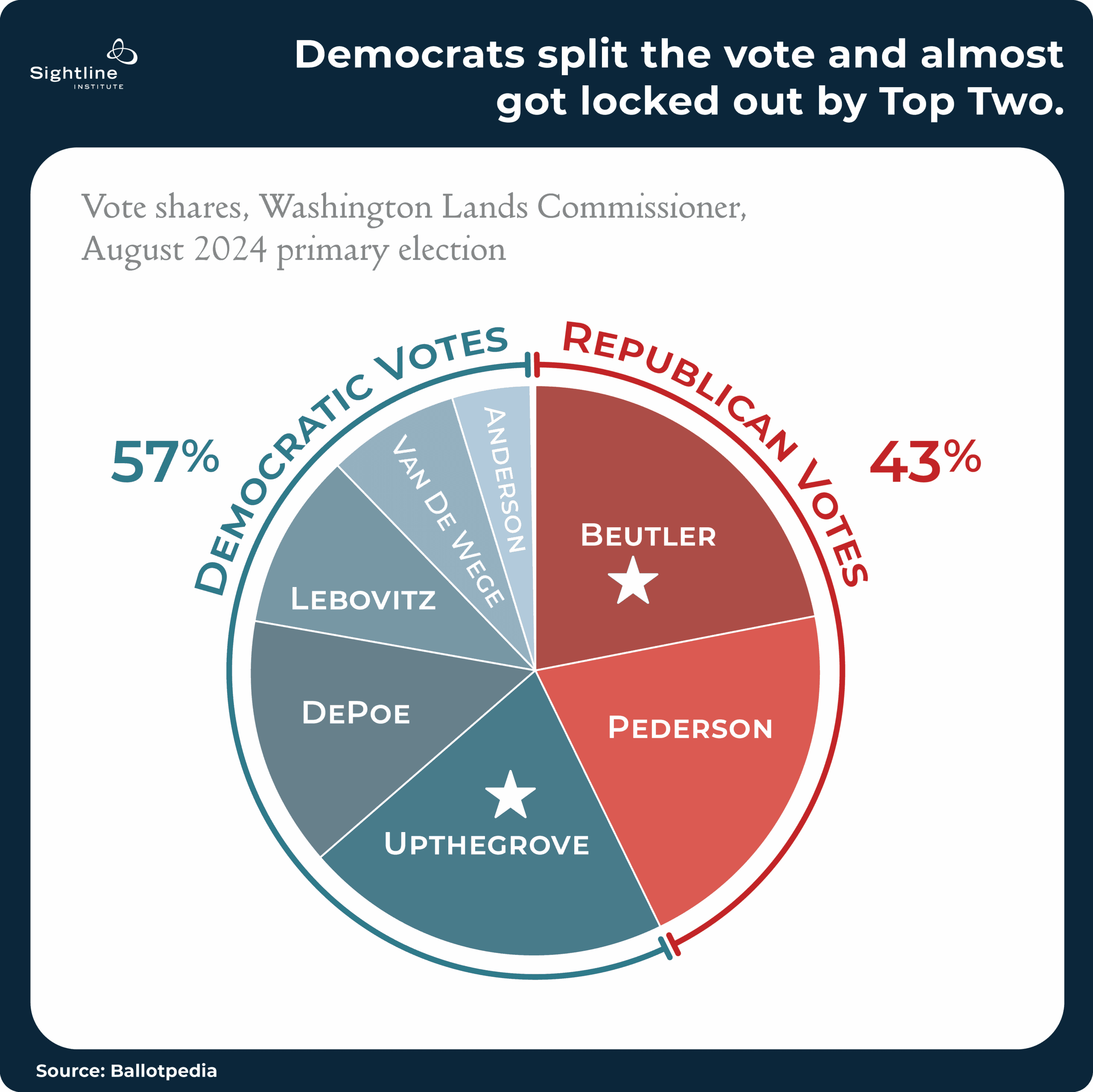
Only when the final batch of ballots was tallied, days after the election, did Upthegrove’s count exceed Pederson’s—and by only 49 votes. Had he fallen short, the general election would have been between Republicans Beutler and Pederson, and one of them would be holding the office now. Instead, after clearing the primary, Upthegrove quickly consolidated Democrats’ support and won the general with a five-point margin.
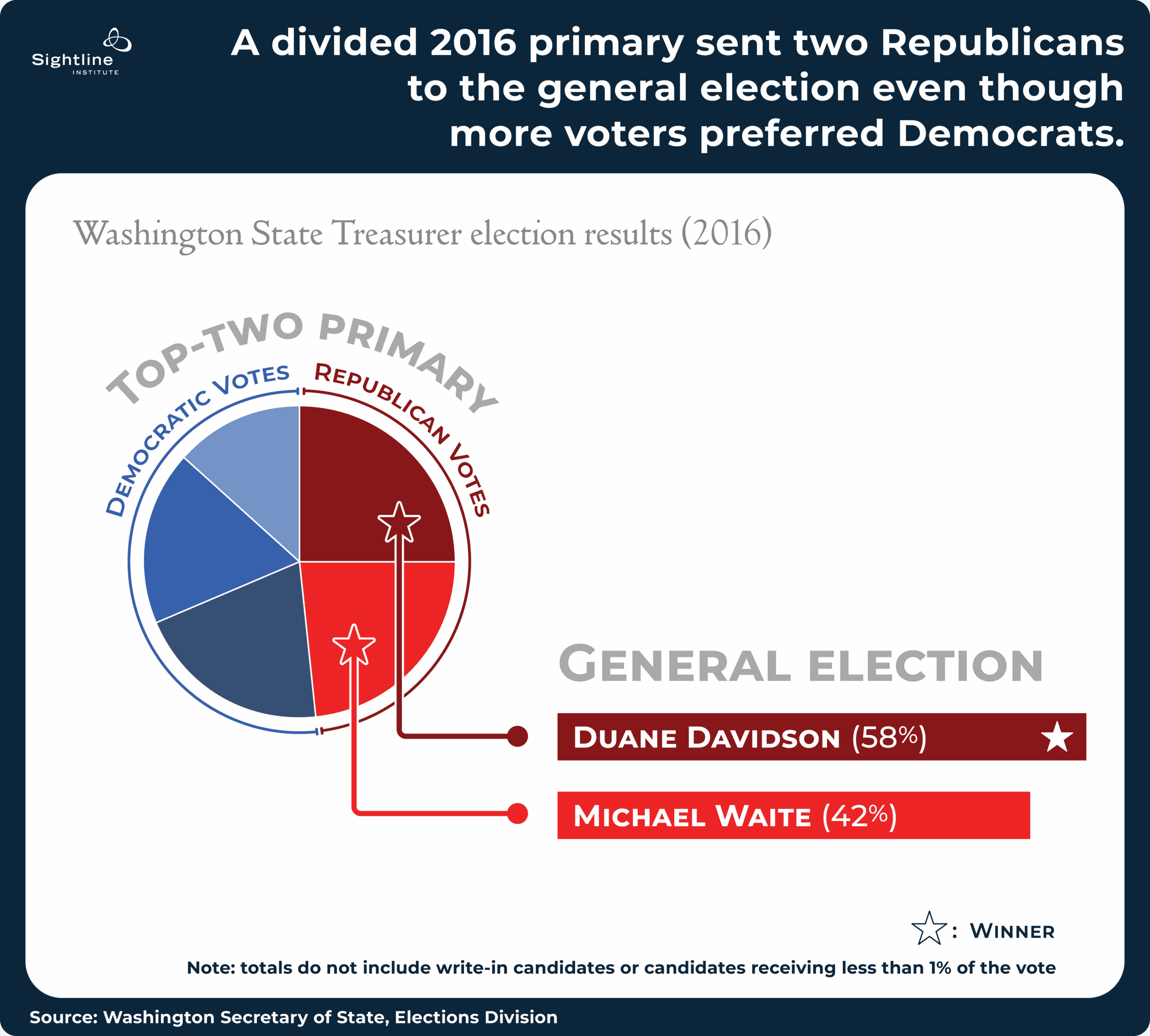
A similar scenario unfolded in 2016, when three Democrats split the field for state treasurer, two Republicans advanced to the general election, and the state elected one of them, Duane Davidson, (see below). What’s more, Davidson, who ended up being a one-term office holder, was the only Republican in that seat in six decades.
The same thing could happen in an open US Senate race in 2028: a huge field of Democrats could hand the race to two Republicans.
The Upthegrove anomaly
The Upthegrove anomaly in top-two is specific and mathematical. It’s not just that both finalists are from the same party. That’s normal in districts that lean red or blue. For instance, of the nine races for open congressional seats in Washington since the advent of top-two in 2008, three of them have paired two members of the same party. Most recently, in 2020, Marilyn Strickland and Beth Doglio, both Democrats, competed for the US House seat in District 10. Indeed, such same-party runoffs are a feature of top-two, not a bug. This system gives general-election voters real choices in districts that are safe for one party or the other.
The anomaly is something else. It is an election in which one party’s collective primary vote share is a clear majority, yet the other party wins both top-two slots because of a fragmented field of majority-party candidates. Purely as a matter of arithmetic, it can only happen when five or more candidates enter the race, of whom at least two are not from the majority party.2 By definition, the anomaly always hurts majority parties. In Washington, that means Democrats in statewide races, but it can also strike Republicans in red districts.
The Upthegrove anomaly is neither common nor rare. Since the implementation of top-two in 2008, Washington has had 23 open statewide or congressional partisan races (that is, races in which no incumbent sought reelection). Such races are most vulnerable to the anomaly because they tend to attract many candidates and lack a clear frontrunner. In these 23 races, the anomaly happened once (electing Duane Davidson in 2016) and nearly happened a second time (almost eliminating Dave Upthegrove in 2024).3 That’s a 4.4 percent glitch rate and a 4.4 percent near-glitch rate. It’s certainly not pervasive but still worrisome when control of the US Senate is up for grabs.
Is the anomaly curable?
Fortunately, a cure for the Upthegrove anomaly is at hand. In fact, two cures are at hand.
The elegant and comprehensive one is to adopt Alaska’s election system of top-four primaries with ranked choice voting general elections, as Sightline has recommended. The Alaska model not only mends the glitch and emulates top-two in letting every voter participate in every taxpayer-funded election, but also tamps down extremism, favors pragmatism, turns down the dial on negative campaigning, encourages cross-aisle compromise, and ends the risk of spoilers in most elections.
Unfortunately, the Alaska solution is also a giant political lift that will probably require a multiyear, multimillion-dollar statewide citizens’ initiative campaign. Such an initiative would be no gimme. Washington voters have given little indication of discontent with top-two since they adopted it in 2004. And why would they? It is a step up from the partisan primaries of 47 other states.
Ranked top-two
That’s why, given the 2028 date of a possible free-for-all for the US Senate, the second cure for the Upthegrove anomaly is intriguing. This cure does not throw out top-two. In fact, it does not change the top-two general election one iota. It just uses ranked choice voting instead of pick-one voting to select the top two finishers, and it does that only in primaries that attract crowded fields of candidates. This limited application of ranked choice voting does not bring all the upsides of the Alaska model but it does zero out the risk of the Upthegrove anomaly.
How would it work? Consider the Upthegrove race again. Ranked choice ballots in that primary would have invited voters to list their second, third, and subsequent choices. Election officials would have eliminated last-place candidate Anderson, redistributing Anderson voters’ ballots to their second choices. Official would have then repeated the process for Van De Wege, then Lebovitz, then DePoe. (This video explains it well, except imagine stopping the process when two candidates, rather than one, remain standing.)4
Just as Democrats consolidated for Upthegrove in the 2024 general election, they would have presumably placed him higher than the Republicans did on their ballot rankings. He would have surged into the top two during the elimination rounds. And in the 2016 state treasurer race, eliminating the trailing Democrats would have shifted support to push a Democrat into the top two.
Ranked top-two would prevent Democrats statewide—and Republicans in red districts—from getting locked out when many of them run for open seats.
Serendipitously, ranked top-two will roll out for the first time anywhere in Seattle’s 2027 municipal elections. A 2022 Seattle citizens’ initiative put approval voting for primaries on the ballot. The city council, curious if its constituents would prefer well-tested ranked choice voting to the novel approval voting, gave Seattleites an alternative, and voters picked ranked choice.5 King County Elections will launch the new Seattle system for district city council races in 2027, just in time to be a test run for 2028.
It’s time
Ranked top-two is clearly how to fix the Upthegrove anomaly. It builds on the state’s popular and effective top-two system. Upgrading top-two keeps all the good things about the system while solving its glitch. What’s more, it does so in a way that is easy, inexpensive, nondisruptive, targeted, and phased-in, as detailed in the appendix.
Just as important as how is when: When is the right time to fix this problem? The answer is now. The clock is ticking toward 2028, when top-two’s anomaly will be most likely and consequential with aging Senator Murray under intense pressure to retire and the field of Democratic contenders to fill her seat possibly being scores thick, like tourists at the original Starbucks. This is the exact recipe for fragmenting their voter base into irrelevance and electing a Republican to the US Senate. The short 2026 legislative session in Olympia is the perfect opportunity for a modest bill for ranked top-two.
Appendix: Supplemental benefits of ranked top-two
Beyond solving the Upthegrove anomaly, ranked top-two elections have other merits: they’re (1) easy to target and phase in, and (2) quick to implement.
Although lawmakers could apply ranked top-two to many election categories, they could begin by targeting it narrowly to races that are
- partisan (Because the Upthegrove anomaly only strikes partisan races, judicial, local, and all other nonpartisan races [most races in the state] could be exempt.); or
- crowded (Ranked choice ballots are extraneous unless four or more candidates run, and the anomaly only happens with five or more candidates. Therefore, legislators could implement ranked choice ballots only in races with more than three [or even more than four] candidates. That exemption would dramatically trim the scope. In recent primary elections [2020, 2022, and 2024], for example, congressional, legislative, and statewide partisan races in Washington involved more than four candidates only 14 percent of the time.6).
Likewise, lawmakers could phase in ranked top-two in the following races:
- Congressional: Ranked top-two could begin in US Senate and House races in 2028. (There are just two congressional contests on that year’s primary ballot.) These races are priorities because five or more candidates filed for these offices 81 percent of the time in recent Washington primary elections.
- State executive: Next, legislators could apply ranked top-two to governor, attorney general, and other statewide partisan races when they come up in 2032. Such races involve five or more candidates in 50 percent of the state’s recent primary elections.
- Legislative: Finally, legislators could apply ranked top-two to their own campaigns. Doing so is less important, though, as races with five or more candidates accounted for only 4 percent of Washington’s recent legislative primaries.
Ranked top-two is easier and faster to implement than you might imagine. Election administrators have executed almost all US implementations of ranked choice voting (full-scale uses, not the extremely limited version in ranked top-two) in less than two years, from adoption to first ballots cast, including statewide in Alaska and Maine.
Washington may have implementation especially easy because King County, which is on the verge of launching ranked top-two thanks to Seattle’s adoption, holds 28 percent of Washington’s voters.
What’s more, some counties use the same Clear Ballot scanners and software as King County, while some use different tools that are already ranked-choice-voting ready. Others will be ready for ranked choice voting as soon as they complete their next planned software upgrade or scanner replacement. In a pinch, counties might need to get creative, as Portland did in 2024. Portland puts its ranked choice voting races on one ballot page (election officials call it a card) and its pick-one races are on another. The city is mostly in Multnomah County, but small areas are part of two other counties. For tallying, the ranked choice cards from all three counties go to Multnomah County Elections Division, which, like King County Elections, is large and thoroughly tooled up for ranked choice voting. Small counties in Washington could consider doing the same: collecting ranked votes on separate cards, bundling them at county headquarters, and letting neighboring counties do the tallying—at least for the first year of ranked top-two.
Thanks to Sightline Fellow Todd Newman for data gathering and analysis.

