Donate Newsletters

Climate Policy Wins Minds. Hearts Needed.

Today the Yale Project on Climate Change Communication and the George Mason University Center for Climate Change Communication released the second report from their latest national survey. Reinforcing several polls that show a recent uptick in American concern about climate change, this study (fielded in March) shows that despite more immediately pressing priorities—namely economic ones—Americans are surprisingly open to climate solutions—across party lines.

In fact, Yale/George Mason found that “majorities of Americans say that global warming and clean energy should be among the nation’s priorities.” Americans also say they want more action by elected officials, corporations and citizens themselves. Three quarters—including majorities of Independents, Democrats, and Republicans—support regulating carbon dioxide as a pollutant. And a majority says we should hold fossil fuel companies responsible for all the ‘hidden costs’ of their products.

Of particular note for Sightline audiences and fellow climate hawks, a “majority also say they would be more likely to vote for a candidate who supports a ‘revenue neutral’ tax shift from income taxes to fossil fuels.”

Of course we’ve seen Americans support policy solutions before—at least in their minds. The question now is whether our hearts are really in it—and more importantly, whether our leaders’ hearts are in it too.
Read more

Freeing Food Carts: Vancouver Update

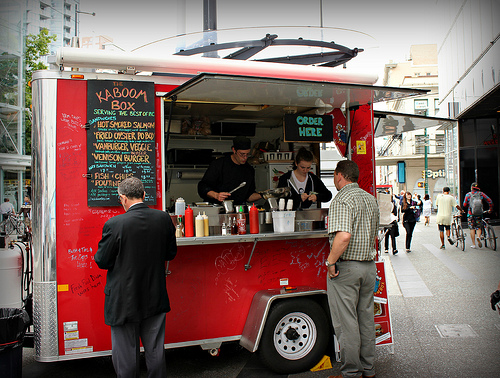
The Vancouver, BC, City Council just gave the nod to expand the city’s street food program by allowing a dozen new carts to set up shop this year—bringing the grand total to 103 carts operating in the city. And the people rejoiced: Yay. But those 12 carts were selected from 59 applicants. Despite all-around success for … Read more

Thoughts On Seeing My First Coal Train

Finally. Despite more than a year of research and writing on coal exports it wasn’t until yesterday that I saw my first loaded coal train. Here it is:

I snapped this photo while standing on Seattle’s Wall Street looking west toward the waterfront. Behind the coal train, you can see the Edgewater Hotel.

My first thought was should I stop breathing? Fortunately, coal dust was not visibly blowing off the tops of the coal cars. Unfortunately, however, the lopsided shape of the coal piles suggested that wind and rain had already taken their withdrawals somewhere along the tracks.

My second thought was: wow, global logistics are amazing. Although I think large-scale coal exports are a bad idea, there’s something undeniably gee-whiz about the path that coal was taking.

The coal almost certainly originated at the Spring Creek Mine, owned and operated by Cloud Peak Energy in southeastern Montana, not far from Sheridan, Wyoming. A few of the 230 workers there mined the coal using a “drag line open-pit” technique, similar to strip mining, that deploys a giant crane-like machine with a bucket for excavations. For a Powder River Basin deposit, the coal in my train was relatively high-energy and therefore relatively valuable. A typical pound of Spring Creek coal will yield an estimated 9,350 BTUs of heat when burned, about 9 percent more than average deposits in the Basin.

At the mine, the coal was loaded into open top hopper-style railcars on a BNSF train. If my train was a typical one, it was at least 100 cars long each of which carried perhaps 110 tons of coal. At the mine, the coal wasn’t worth much. Almost certainly priced at less than $15 per ton, the entire train’s worth of coal was worth less than $200,000 when it was loaded, though it would ultimately sell for much more than that in Asia.

Read more

The Northwest’s Latino Residents

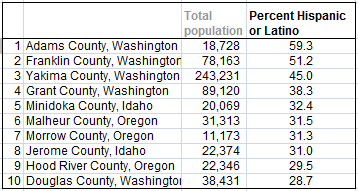
The Northwest is home to more than 1.4 million people who self-identify as Hispanic or Latino. In this installment of my ongoing analysis of the region’s demographics we’ll take a closer look at the geography associated with Northwest Latinos. (Past examinations have included Chinese American and black residents.)

Overall, the three Northwest states have remarkably similar shares of Latino residents. Oregon’s population is 11.7 percent Hispanic, compared with 11.2 percent in both Idaho and Washington. In British Columbia, by contrast, less than 1 percent of residents claim Latino heritage.

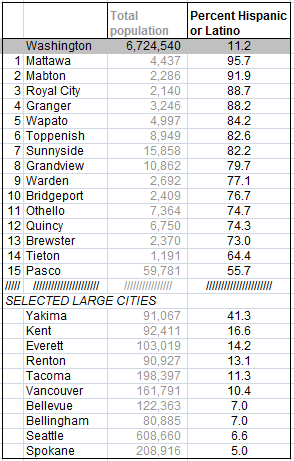
Uniquely among Northwest jurisdictions, Washington has more than a dozen municipalities with overwhelmingly Hispanic populations.

All of Washington’s majority-Latino cities and towns lie to the east of the Cascade Mountains. Cities on the western Columbia Plateau (Mattawa, Royal City, Warden, Othello, and Quincy) and cities in the lower Yakima Valley (Mabton, Granger, Wapato, Toppenish, Sunnyside, and Grandview) dominate the rankings. With the exception of Pasco, all of Washington’s majority-Latino places are small towns.

Read more

Freeing Food Carts

Editor’s note: Eric posted Seattle and Vancouver follow ups to this piece.

Whatever you’re craving, you can probably find it on sale at a parking lot in Portland. Barbecue jackfruit fried pie? Try Whiffies on Hawthorne. Foie gras over potato chips? Eurotrash on Belmont. Kimchi quesadilla? Koi Fusion on Mississippi. It’s no wonder Portland has been heralded as a world-class purveyor of street food.

But North American attention to the Rose City’s food cart scene has cities to the north green with envy.

For decades, Seattle and Vancouver, BC, had draconian laws limiting food cart cuisine. In the last few years, however, both have tossed old rules in the dumpster, hoping to unleash legions of carts.

Street food is smart for sustainability: it makes urban living more desirable to many, improves neighborhood walkability, provides affordable dining options, and opens doors for diverse entrepreneurs.

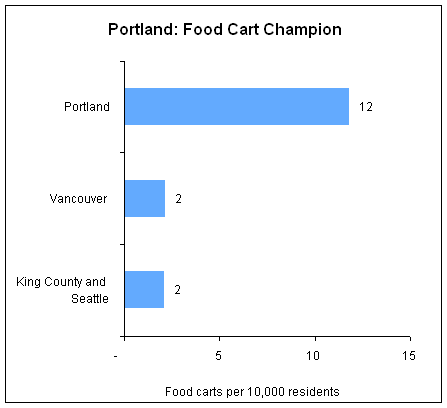
So far, though, neither Seattle nor Vancouver, BC, has cleared the way for street food to the same extent as Portland.

Portland: Ground Zero

Read more

Recipe for a Rice Crispy Road

Rice Crispy close up

Water is the enemy of pavement. It gets into cracks, freezes, expands, and makes bigger cracks. It makes the ground beneath roads soggy and soft. Drive some heavy trucks over those roads and they can give way, forming potholes and ruts. Even when it’s not destroying the road, water pools on the surface, turning cars into dangerous hydroplanes and splashing buckets of filthy water onto windshields and pedestrians.

Water is the enemy of pavement—unless that pavement is permeable.

Permeable pavement is pocked with pores that allow the water to trickle through it like a rock-based rice crispy treat. In freezing temperatures the water has room to expand inside the pores without cracking the material. Potholes are less of a problem because the pavement is laid on top of a bed of gravel, which allows water to drain through to the absorbent soil below while maintaining a firm foundation under the road surface. There’s no standing water puddling on top of the road causing sliding and splashing.

And permeable pavement helps solve the top two problems created by polluted runoff: dirty stormwater that poisons streams and lakes, and the tsunamis of water that gush through creeks and flood buildings. Permeable pavement cleans the water as it trickles through it into the soil, and it helps the dirt soak up the water, recharging pockets of buried groundwater.

But just how does a simple roadway shrink our stormwater woes and make streets safer to drive, bike, and walk on? Here’s how.

Read more

The Northwest’s Black Residents

I’m a number cruncher, so one way I’m observing Black History Month is by examining census figures for the Northwest’s African-American and African-Canadian populations. (Another way is here.) Although the Northwest does not have a large black population relative to many places in the United States, the region is home to nearly 340,00 residents who self-identify as black, representing 2.1 percent of the population. Among Cascadia’s African-descended people the vast majority, 71 percent, make their homes in western Washington.

It’s often forgotten that Washington’s black communities can trace roots to the years when the area was still contested by Britain and the United States, nearly a decade before the Washington Territory was created. Today, a portion of the relatively large black population in Washington can be explained by the state’s numerous military bases and the strong tradition of military service among African Americans.

The Northwest’s black population is so centered on Puget Sound that Sound-area locales claim all but one of the top 30 spots in the region for shares of people of African descent. In fact, a rank-ordered list for the Northwest turns out to be simply a list of places in Washington, 29 around the Puget Sound and one in eastern Washington. Here it is:

Read more

Toxic Money

Clausewitz said that war is politics by other means. Big Chem knows that politics can be business by other means. You’ve got to hand it to them: they’ve used politics with astounding effectiveness to secure their bottom line. The result is literally toxic for the rest of us.

The chemical industry spent nearly $5 million a year over the past five years on lobbying and campaign contributions in California. That’s a lot of money for one industry and one state. On the other hand, it’s a pittance, considering the payback: by defending an obscure and ineffective fire-safety regulation, the industry extends its North American stronghold in a market worth billions of dollar of sales each year. That’s one of the best returns-on-investment imaginable.

(If you’re familiar with this saga, skip this paragraph. If you’re just tuning in, here’s a quick catch-up: California’s flammability standard is a scientifically discredited rule that requires all foam furniture sold in the state to withstand 12 seconds exposed to a candle flame. Because of the scale of California’s market, the rule effectively governs North America’s furniture industry. The cheap way to pass the 12-second test is to blend flame retardant chemicals into foam. The retardants include all manner of health-harming compounds, which leak out of furniture and into our homes, our bodies, and our natural environments. Ostensibly, these chemicals are put into furniture to protect us from fire, but 35 years of fire safety science shows they don’t do their job. Still, policymakers have defended the rule, most recently by a vote of eight to one in a California senate committee. Last time, we deconstructed the illogical and unscientific testimony of the chemical industry’s star witness. So what’s the real reason policymakers refuse to change the rule? We fear the answer is simple: money.)

Read more

×
Privacy Overview
Sightline Institute

More information about our privacy notice

Strictly Necessary Cookies

Strictly Necessary Cookie should be enabled at all times so that we can save your preferences for cookie settings.

3rd Party Cookies

This website uses Google Analytics to collect anonymous information such as the number of visitors to the site, and the most popular pages.

Keeping this cookie enabled helps us to improve our website.

Additional Cookies

This website uses social media to collect anonymous information such as which platform are our users coming from.

Keeping this cookie enabled helps us better reach our audiences.