A purely regulatory approach to cutting carbon is like Thanksgiving dinner without the turkey. But just charging polluters without any other policies is like eating turkey by itself with no cranberry sauce or stuffing to make it delicious, no mashed potatoes, green beans and yams to round out the meal, and no pie to sweeten the experience. In Oregon and Washington, we want the full dinner. Here’s how serving up a carbon price carefully paired with other policies makes for a delicious meal.
Policies can complement making polluters pay in the following ways:
Keep costs down by slashing carbon that a price can’t reach because of market barriers
Achieve other benefits—cleaning the air, developing new clean tech industries—in addition to trimming carbon pollution
By doing both of the above, complementary policies can pick the low-hanging fruit as well as the exotic fruit and put them all together in one reasonably priced basket.
Carbon Tax vs. Cap and Trade? Can Oregon make polluters pay and grow jobs? How will low-income communities be affected? Where should the revenue go? This Monday, join our senior researcher Kristin Eberhard to talk about carbon pricing options for Oregon. A wonderful panel of speakers will lay out smart climate policy solutions towards reducing … Read more
We are already paying a high price for fossil fuels: strange and severe weather, asthma and cancer cases, a Northwest economy weakened by huge bills for importing coal, oil, and gas, and the political vice grip that Big Oil has on our democracy. Last year, Portland State University (PSU) gave the Oregon legislature a teaser about how to face those problems with a carbon tax. Intrigued by the possibility of holding big polluters accountable and generating revenue for Oregonians, the legislature asked for more information, and this week PSU’s Northwest Economic Research Center (NERC) delivered. The new and expanded analysis concludes that charging carbon polluters would cut pollution and it could create jobs and raise wages. If Oregon spends the money right.
What scenarios did NERC model?
NERC modeled carbon taxes ranging from $10 to $150 per ton of greenhouse gas pollution. The tax would apply to pollution from burning fossil fuels, such as coal, petroleum, and natural gas. It would tax pollution from coal burned outside the state to generate electricity used by Oregonians. In each scenario, the tax starts at $10 per ton in 2014, and then goes up slowly and smoothly, rising just $5 or $10 each year. Knowing that the price to pollute is slowly rising over time gives dirty energy producers the time and the motivation to start investing in clean energy. NERC ran scenarios with prices that maxed out at $10, $30, $45, $60, $100, $125, and $150.
Most Americans—including most Republicans—want to regulate carbon pollution. Oregon and Washington have already set legally binding limits on the climate-changing gas. Next, climate change warriors in Olympia and Salem are trying to make those limits enforceable. They’re considering hard emissions caps enforced through limited permits and complemented by an array of targeted policies.
But what if Oregon and Washington’s lawmakers fail to insert sharp incisors in their beyond-carbon rules? Desperate for revenue to fulfill its McCleary obligations, Washington might pass a modest carbon tax not designed to slash pollution. Oregon might do the same, for its own revenue reasons. Such taxes would nudge the states’ economies toward a clean-energy transition, it’s true, but they would not guarantee that emissions drop to the statutory goals.
And, I shudder to ponder it, but the legislatures might simply refuse to price carbon at all, at least not yet.
In fact, a few state legislators, briefed on the fine points of carbon pricing, have rolled their eyes at the political challenges and said, “Why do we have to price it? Can’t we just regulate it?” Polls suggest some voters would actually prefer direct regulation. The logic is seductive: Polluting is irresponsible behavior. Polluters should knock it off. If they don’t, authorities should make them.
This article describes that scenario: what would it look like if we just make polluters emit less carbon?
Twenty-one Washingtonian leaders from business, labor, public interest, and public health communities and federal, tribal, and local governments walk into a room to discuss the best way to price carbon in the Evergreen State. What comes out after several months? A unanimous report that says: we should do this. With caveats and cautions and needs for more research of course, but the bottom line is that Washington will not achieve its statutory carbon targets without a price, and Washington can design a price—whether a cap or a tax—to protect public health and the economy and make the transition to a post-carbon world.
In April, Governor Inslee established a Carbon Emissions Reduction Taskforce (CERT) to provide recommendations about the design and implementation of carbon pricing in Washington. Today, the 21-member panel—with individuals drawn from business, labor, public interest, and public health communities and federal, tribal, and governments—released its unanimous recommendations. Here is my summary and commentary on their findings.
CERT’s Findings
CERT members unanimously agreed on four findings. Stripping away the cautious consensus wording and hedging (the report says “thoughtful” 15 times in 27 pages), here is my interpretation of those findings, found more in the small print than in the bold headlines:
There isn’t a meaningful difference between a cap and a tax. But if we do either one and do it well, we can inspire other jurisdictions to take action too, making it easier for everyone to go post-carbon.
On the topic of doing it well, Washington needs to carefully design its price to meet the criteria discussed below.
The price should work with complementary policies. In particular, the transportation sector needs an integrated approach with land-use policies, transit oriented development, and alternatives to current single occupancy vehicles such as adequate transit, zero emissions vehicles, and alternative fuel infrastructure. Washington could invest carbon revenue in clean energy and transportation options for a smooth transition to a post-carbon economy.
More analysis is needed, particularly around impacts on businesses and low-income communities.
[button link='{“url”:”https://www.sightline.org/2017/06/06/map-the-future-is-carbon-priced-and-the-us-is-getting-left-behind/”,”title”:”Click here for an updated version of this map”}’]
Oregon and Washington leaders are contemplating turbocharging their clean energy transition by instituting carbon pricing here in the Pacific Northwest. Will a cap or tax on carbon work? Has anyone else ever done this before? Why, yes. Since you ask: Scandinavian countries have been pricing carbon for more than two decades. The European Union Emissions Trading System (EU ETS) has been pricing carbon for almost a decade. US states and Canadian provinces have been pricing for years. Today, there are 39 (1) different programs that collectively put a price on 12 percent of all the greenhouse gas (GHG) emissions in the world. And when China’s national program starts in 2016, almost a quarter of global GHG pollution will carry a price tag to speed the changeover to clean energy. The animated map below shows carbon pricing programs around the world, with the size of the bubbles indicating the amount of pollution priced.
Carbon pricing programs come in many flavors: tax, cap-and-trade, or hybrids, and implemented at the level of country, region, state, or even city. (A fully sort-able table of the programs is at the bottom of this article.) The biggest program is the EU ETS, covering a little less than 2,000 million metric tons (MMT) of GHG emissions, or about 45 percent of all the emissions in the European Union. Japan’s carbon tax is the next biggest player, covering about 800 MMT, or 70 percent of Japan’s emissions. China, with several years of pilot project experience under its belt, is now committed to rolling out a cap-and-trade program in 2016 that will dwarf both the EU and Japan’s programs, probably covering about 5,000 MMT of pollution. For reference: the entire world emits about 36,000 MMT, so China’s program alone will price about 13 percent of global emissions. To get a sense of how the carbon pricing programs relate to global emissions, the map below shows the world’s biggest polluters. (You can also see countries re-sized by emissions here.) The US has a conspicuous mismatch between its large red pollution bubble and the lack of a green price bubble. President Obama, not to be outdone by the Chinese, has announced an agreement with China to cut carbon pollution. However, new Congressional leadership has vowed to move in the opposite direction by delaying and undermining federal efforts to cut pollution.
Original Sightline Institute graphic, available under our free use policy.
Here are a few questions about global carbon pricing programs that Pacific Northwest leaders might want answered:
Next Thursday, join our senior researcher Kristin Eberhard to talk about carbon pricing possibilities for Oregon. The League of Women Voters of Corvallis is hosting a public forum with a great panel of speakers to lay out some smart climate policy for the Beaver State. Joining Kristin will be Jeff Renfro, senior economist at Portland State University’s Northwest Economic Research Center (NERC); … Read more
In Indiana Jones and the Last Crusade, Indie finds himself on a ledge before a chasm, with no obvious way across. Ignoring the evidence of his senses, he follows a clue he’s been given, takes a leap of faith and lands on an invisible plank. The proposed US Clean Power Rule puts Oregon and Washington, along with other Western states, on a ledge, too. Oregon and Washington are on a quest to meet their own self-imposed climate targets, but the federal rule seems to lead them astray, requiring different goals and tangential negotiations that will sap their energy and make it harder for them to reach their goal. What may not be apparent is that the rule also provides a plank: adopting a regional carbon price can substitute for complicated and ineffective power-rule compliance plans and let Oregon and Washington meet their own targets. It can also carry the West to a clean energy economy.
Backstory
The US Environmental Protection Agency (EPA), fulfilling its duty under the federal Clean Air Act to regulate CO2 emissions, has issued a proposed Clean Power Rule that would reduce CO2 pollution from power plants nationwide 30 percent below 2005 levels by 2030. Although Republicans think even this relatively modest goal is too much, Oregon and Washington already have more ambitious climate laws on the books. If Oregon follows a smooth line to its goal to cut pollution 75 percent below 1990 levels by 2050, it will cut pollution approximately 50 percent below 2005 levels by 2030. A straight line to Washington’s goal to cut pollution 50 percent below 1990 by 2050 will cut approximately 22 percent below 2005 levels by 2030, but the electricity sector will likely make deeper cuts than the state average. Both states aim to squeeze out much more pollution by 2050.
Original Sightline Institute graphic, available under our Free Use Policy.
How do you know it’s going to stay revenue-neutral?
This time I’d like to share with you the #1 question from progressives about revenue-neutral carbon taxes:
How do you know it’s going to stay revenue-neutral?
It’s the same question! The motivations for asking the question, of course, are different. Conservatives ask because they’re worried about government getting bigger, that is, when we compare revenues from the existing tax system X with revenues from a potential new tax system Y, they want to make sure that X ≥ Y. Progressives ask because they’re worried about government getting smaller, that is, they want to make sure that X ≤ Y.
I give a lot of talks about revenue-neutral carbon taxes—especially the Carbon Washington proposal to implement a BC-style carbon tax and use the revenue to cut sales taxes and business taxes. The question that is far and away the #1 question asked by conservatives is:
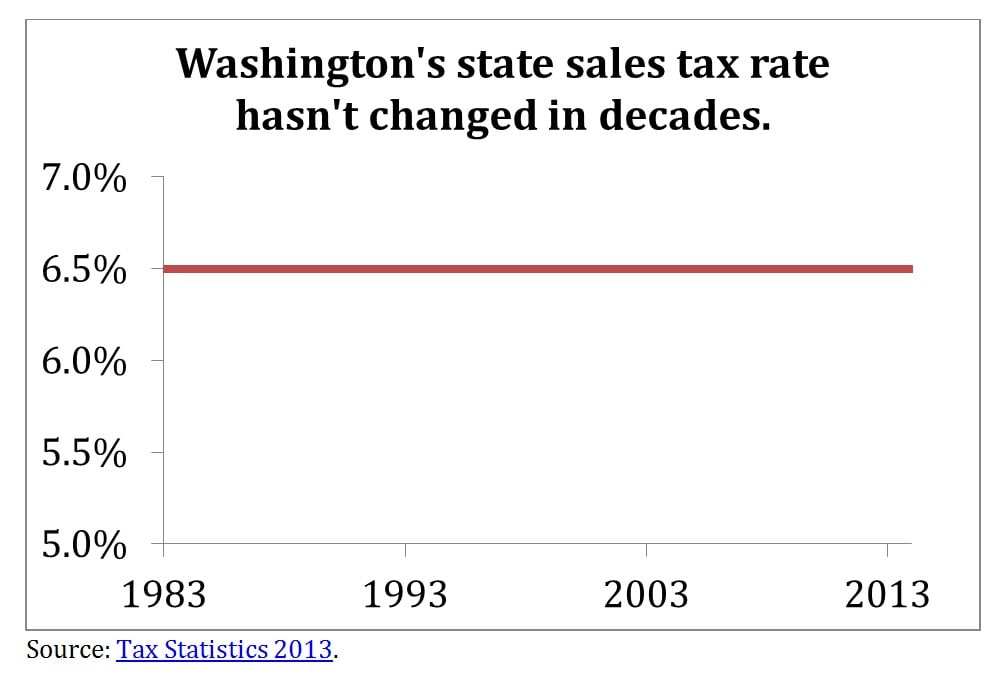
How do you know it’s going to stay revenue-neutral? It sounds all well and good to combine a carbon tax with dollar-for-dollar reductions in sales taxes and business taxes, but the legislature will just raise the sales tax back up, so pretty soon we’ll get stuck with both taxes.
I have two responses, one for realists and one for cynics.