Donate Newsletters

What If Polluters Paid and You Got the Money?

What if we could click our ruby slippers and transport ourselves to a magical place where polluters pay and we all get checks in the mail? The Oregon legislature is considering two bills that would take us there.

When designing a program to make climate polluters pay, one of the most important decisions is what to do with the money. Northeast states and California invest in energy efficiency and transportation. British Columbia gives tax cuts to people and businesses. Two Oregon bills contemplate mailing out dividend checks. If Oregon passed a polluters-pay-plus-dividend bill, the air would no longer be a free dumping ground for pollution, clean energy would be on an even playing field with fossil fuels, and each Oregonian would get a check for $500-$1,500 every year. Sound too good to be true? It’s not. Here are the details, Q & A style.

1. What are these Oregon dividend bills and what do they do?

HB 3176 would charge fossil fuel sellers a fee for each ton of pollution, starting at $30 per ton and increasing by inflation plus $10 per ton every year. All the money would go into a Trust Fund. Each September, the Department of Revenue would mail every Oregon taxpayer and taxpayer dependent a check for an equal share of the money.

HB 3250 would do roughly the same thing, but instead of creating a set fee schedule it would create a set number of pollution permits that fossil fuel sellers could buy in an auction. Each year, less pollution would be allowed and fewer permits would be available. By 2050, Oregon’s climate pollution would be 85 percent below 1990 levels. As permits become scarce, the price would go up.

2. Why are there two bills? Is one better than the other?

Both bills lead to the Emerald City, but they encounter different lions, tigers, and bears along the way.

Read more

Four Charts Show Carbon Pollution Accountability Act is Still Awesome

As the Carbon Pollution Accountability Act, now HB 1314, wends its way through committee hearings, new economic analysis and revised revenue estimates are popping up. It’s still the same pollution-cutting, clean-energy-spurring bill you know and love, but the new numbers show it will send even more money to Washington public schools, and it will also grow jobs. Less pollution, more clean energy, better schools, and more jobs. I think that qualifies as awesome.

Less pollution means more GDP and more jobs, especially construction jobs.

Last week, the Office of Financial Management (OFM) and the Governor’s office presented findings from OFM’s new economic analysis of the Carbon Pollution Accountability Act, Washington HB 1314. The OFM economic modeling, unsurprisingly, showed results similar to Oregon’s recent modeling of a potential state carbon tax: GDP and jobs grow slightly faster in a future where Washington transitions from fossil fuels to clean energy than in a future where we continue with pollution-as-usual. The differences are small, because the pollution-limiting program would be a minuscule 0.3 percent of Washington’s gross state product of $381 billion. But GDP and jobs are a little higher with the polluters-pay than without, due to investments in schools and roads. The biggest job gains between 2016 and 2035 would be in the construction sector (see OFM graph below), since a large chunk of the pollution revenue would go to building and maintaining Washington’s roads.

Job Gains and Losses by OFM
Jobs Gains and Losses by OFM

Read more

Event: Curious About Carbon Pricing?

Do you wonder what carbon pricing means and what the differences are between fees, taxes, shifts, offsets, and caps? Next Thursday, join Sightline Institute’s senior researcher, Kristin Eberhard, along with Oregon Climate’s executive director, Camila Thorndike, to discuss what it would mean for Oregon to put a price on carbon. What: Curious About Carbon Pricing? Where: Friendly House, Portland, … Read more

10 Key Takeaways from BC’s Polluters-Pay Model

British Columbia has a world-class carbon tax. It’s been working for almost seven years, cutting pollution and pumping money into other parts of the economy, like the pockets of businesses and households who now pay lower taxes. Jealous decision-makers down here in Oregon and Washington might be asking “Yes, but how how did they start taxing pollution and helping businesses and residents? How did they do it?” Clean Energy Canada set out to answer your anguished questions by interviewing 13 of the architects of British Columbia’s carbon tax. Below are their 10 takeaways about a carbon tax, along with a little explanation and my take.

1. A carbon tax and a thriving economy can co-exist.

[prettyquote align = “right”]“The numbers speak for themselves. In the last five or six years, B.C. has outgrown most of the rest of Canada, and has had significantly less emissions than the rest of Canada.” —Ross Beaty, Executive Chairman, Alterra Power[/prettyquote]

True, that.

Every single interviewee agreed that the carbon tax has not harmed the economy. Some interviewees noted that carbon-funded corporate tax cuts have helped attract businesses to the province.

Hear that, Oregon and Washington? Making prices tell the truth about the cost of pollution is at worst neutral for the economy and at best good for business.

Read more

VIDEO: The Pacific Northwest Can End the Free Lunch for Carbon Polluters

Have you ever tried to briefly explain to someone why we need to hold carbon polluters accountable? Here’s a 60-second explanation. This is the first in a series of short videos about how the Pacific Northwest can use a carbon price to protect our communities and accelerate our transition to clean energy.

Key takeaways:

  • The biggest polluters are getting a free lunch. Oil and coal companies profit while they pollute our atmosphere for free.
  • Our families and communities are picking up their tab. In the Pacific Northwest, we are seeing more kids with asthma, damages to the shellfish industry, dwindling water supplies, and record wildfires.
  • We can fix this by making polluters pay for their pollution.

How the Oil Industry Will Try to Kill Carbon Pricing

As Oregon and Washington contemplate a carbon tax or carbon cap, the oil industry is revving the engines for an astro-turf scare campaign here. The oil lobby spends a million dollars a month in California. As Oregon and Washington start thinking about holding them accountable, the oil lobby is turning its scare machine our way.

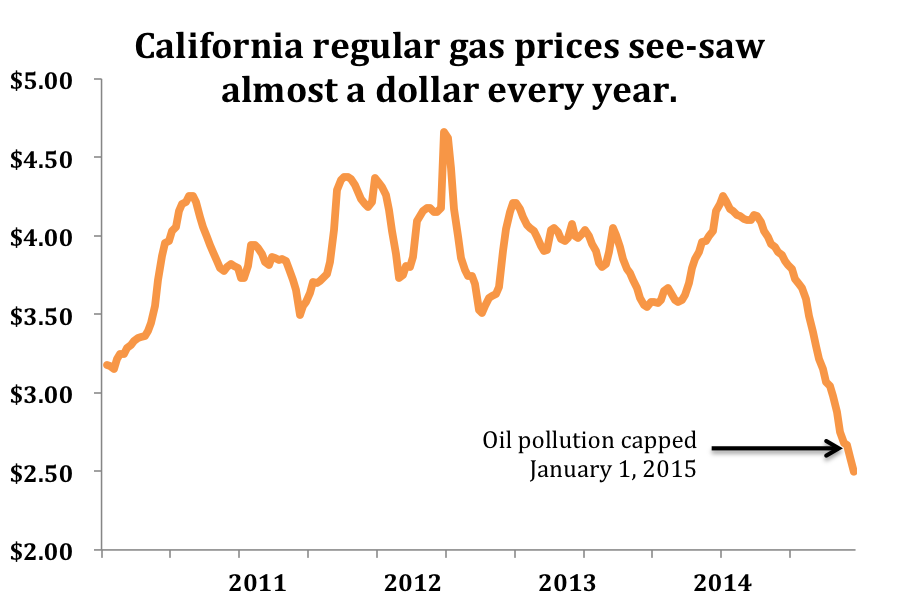
Governor Inslee has proposed a plan that would cap carbon pollution in Washington and move the state slowly but surely away from fossil fuels—away from what oil and coal companies sell—and onto clean energy. California has capped pollution from power plants and industrial facilities since 2013; when gas and diesel came under the cap this year, most economists estimated it would cost customers about a dime a gallon. But the powerful Western States Petroleum Association warned voters and legislators about a “hidden gas tax” that could cost families 76 cents a gallon of gas. Now that California has been holding polluters accountable for a few weeks, what has the price impact been? The price tag for clean air—maybe a few cents a gallon—was lost in the noise of gas prices that rise and fall ten times that amount every few months.

Original Sightline Institute graphic, available under our free use policy.

There are two things that Oregon and Washington can learn from Western States Petroleum Association’s “Wolf!”:

Read more

Event: Putting a Price on Carbon

This Thursday, join our executive director Alan Durning to discuss carbon pricing in Washington. This roundtable will explore several different approaches for “putting a price” on climate pollution and explore how counties and cities can directly engage on and benefit from what can seem like a complex solution. The roundtable will also showcase King County’s Department of Natural Resources … Read more

All I got for Christmas Was the Washington State Carbon Tax Swap Calculator

Congressman Tip O’Neill famously said that “All politics is local.” Climate politics is no different. So it is with great enthusiasm that I link to the Washington State carbon tax swap calculator, a snazzy tool that allows you to evaluate how one particular carbon pricing policy—the revenue-neutral Carbon Washington tax shift—will affect your own individual household. The Carbon Washington proposal uses carbon tax revenues to reduce sales taxes and B&O business taxes. The calculator tool estimates your household’s carbon tax payments and your sales tax savings and boils it all down to a single dollar amount: an estimate of how much more or less your specific household will pay annually in state taxes with a $25 carbon tax shift. (As noted below, you can also tweak the calculator to see how Governor Inslee’s proposal will affect your household.)

Read on for a few of my observations, but the main point of this post is to encourage you to try it out yourself and post your results in the comments!

Full disclosure: I am a leader of the Carbon Washington group and helped create the calculator, with research assistance from Summer Hanson and Akua Konadu. Ultimately, however, the calculator is a project of UW computer science graduate student Justin Bare and is intended to be an impartial informational tool to allow Washington State households to evaluate the impact of a carbon tax on their household. The detailed methodology behind the calculator is available for your analysis and feedback.

Observation #1: For most households, the tax swap is pretty close to a wash.

Odds are that your household will pay a few hundred dollars a year more for fossil fuels (roughly split between transportation fuels and home energy use) and a few hundred dollars a year less for everything else. You could easily end up plus or minus $100 or $200, but results outside those bounds would be pretty unusual. (See below for a caveat about home energy use, and note one exception: low-income households with children who qualify for the federal Earned Income Tax Credit could end up ahead by a more substantial amount—about $1000—because they’d qualify for a Working Families Rebate that boosts their EITC by 25 percent.)

Read more

How much do we spend on fossil fuels?

If you could choose how much of your money to spend on fossil fuels compared to K-12 public schools, how would you divvy up your dollars?

Here’s where your money actually goes:

  • If you live in Oregon, you spend around $1,300 per year on K-12 education and around $2,800 per year on fossil fuels.
  • If you live in Washington, you spend around $1,500 per year on K-12 education and around $3,200 per year on fossil fuels.
Original Sightline Institute graphic, available under our free use policy.

Read more

Why the Carbon Pollution Accountability Act Is a Big, Awesome Deal

In Washington and across the Northwest, we are already seeing devastating impacts of climate change. In Hood Canal and Puget Sound, shellfish are being destroyed by an acidifying ocean, declining snowpack threatens water supply on both sides of the Cascades, and record-setting wildfires have ravaged Eastern Washington communities.

The good news is that we can do something about it. We at Sightline are always saying that a well-designed program can hold polluters accountable while transitioning the Pacific Northwest to a clean and prosperous future. Yesterday, Washington Governor Jay Inslee unveiled a package of climate policies, including the Carbon Pollution Accountability Act. So the big question: Is the Governor’s proposed program well-designed?

Here’s the one-word answer: Yes!

Seriously. It’s killer.

Read more

×
Privacy Overview
Sightline Institute

More information about our privacy notice

Strictly Necessary Cookies

Strictly Necessary Cookie should be enabled at all times so that we can save your preferences for cookie settings.

3rd Party Cookies

This website uses Google Analytics to collect anonymous information such as the number of visitors to the site, and the most popular pages.

Keeping this cookie enabled helps us to improve our website.

Additional Cookies

This website uses social media to collect anonymous information such as which platform are our users coming from.

Keeping this cookie enabled helps us better reach our audiences.