How updating a few musty housing laws can promote the smart, affordable housing options we need across fast-growing Northwest towns and cities.
[long]
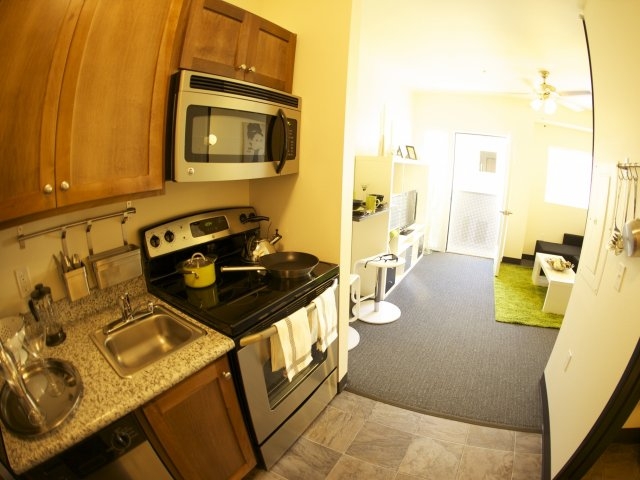
Studio apartment at Freedom Center, Portland. Photo courtesy of Freedom Center.
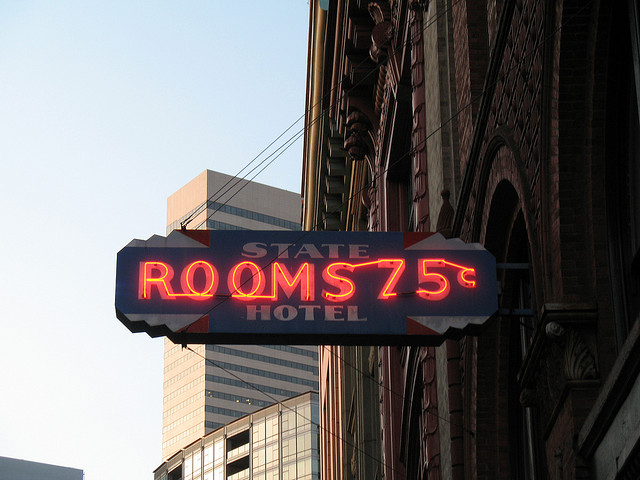
Affordable housing is lacking across the Northwest, with housing policy here effectively excluding from the market many lower-cost options for low-income families and individuals. A raft of outdated laws bans the types of residential arrangements that once housed most of the North American working class and prohibits modest home options near jobs, transit, schools, and neighborhood centers—from mother-in-law apartments and triplexes to rooms that were safe, comfortable, and convenient but small and basic.
As a result, families may scrimp on food or heat to be sure they can pay rent each month; they may opt for black-market housing; or they may even go homeless. Everyone deserves a clean, safe place to live; but beyond safety regulations, the floor plans mandated by current housing rules aren’t affordable for everyone. In this series, Sightline researchers explore the key laws that prevent smart, affordable housing arrangements of the past from getting to market today, and look to a Northwest revival of inexpensive housing options.
I have written in recent months about some of the land-use rules that make inexpensive housing uncommon or illegal: roommate caps, accessory dwelling unit rules, minimum apartment sizes and other rooming-house restrictions. What I haven’t discussed is the towering central obstacle to inexpensive housing—the elephant in the living room.
Fortunately, Slate blogger Matt Yglesias has done the job well. His concise e-book The Rent Is Too Damn Highexplains how tight land-use restrictions on urban density are a major ill of the contemporary United States. Enforced single-family and other low-rise neighborhoods in close-in urban zones jacks up real-estate prices, hobbles service economies’ prosperity, and turbocharges sprawl, which multiplies driving and oil consumption and carbon pollution.
Last time, we reviewed accessory dwelling units’ (ADUs’) paucity and slow pace of development in most of the Northwest outside of Vancouver, BC. This time: the constraints that bind them.
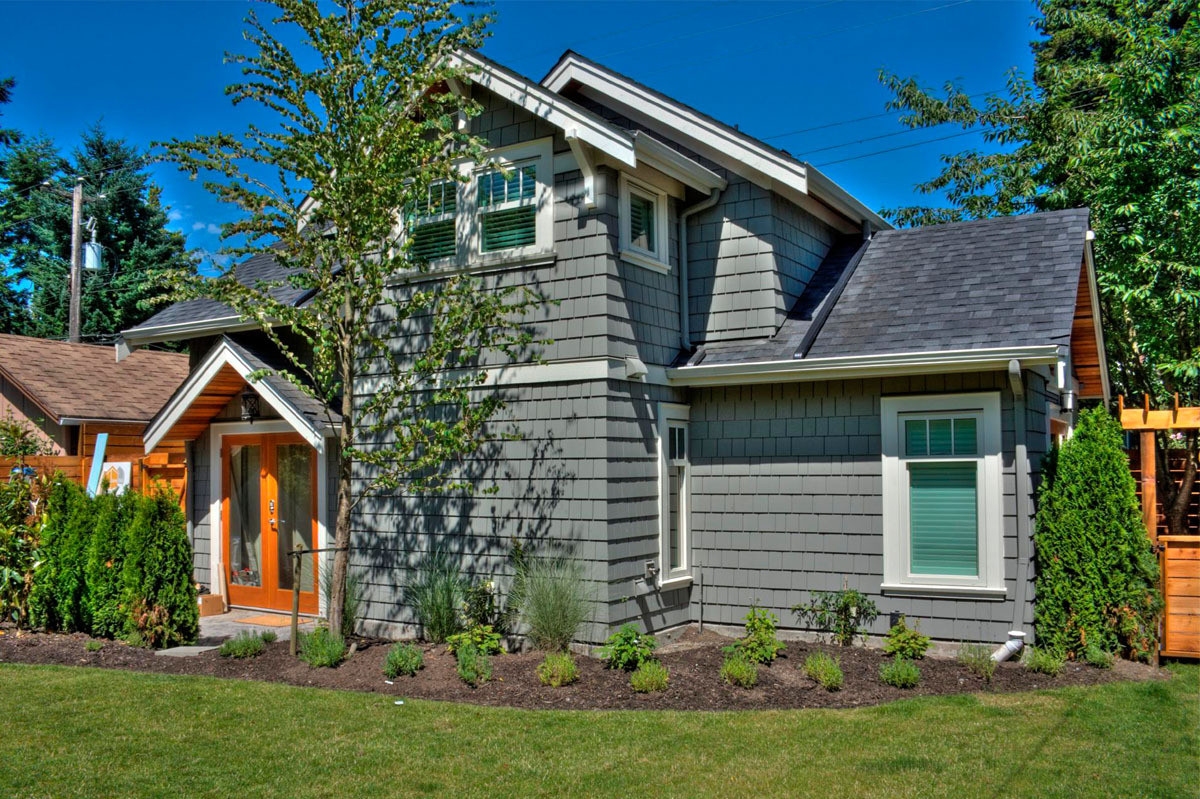
Why are accessory apartments and cottages so rare? One reason, no doubt, is that many homeowners do not want to host an ADU. But a more pernicious reason is that winning approval to rent out an ADU in most cities requires running a harrowing gauntlet of rules. For every decision that Vancouver, BC, has made to welcome secondary suites and laneway houses, other cities have made the opposite decision.
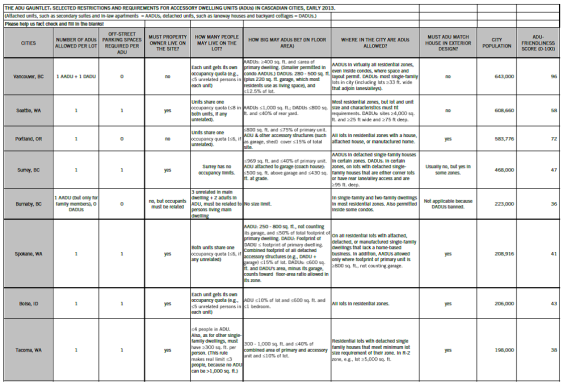
To map the restrictions on ADUs, Sightline assembled a table of ADU rules called The ADU Gauntlet that you can download and review here (or by clicking below).
Scraped clean of rationalizations, roommate caps are simple. They are tools that privileged people use to exclude from their neighborhoods people without much money, such as immigrants and students. To reveal this elitist reality fully will require this full article, but one example shines a bright light on part of it: how land-use codes treat servants.
At least six Cascadian cities specifically exempt live-in servants from the residential caps they impose on everyone else. For example, in the region’s fifth largest city, Burnaby, BC, a house may hold only five unrelated people. As everywhere in the region, families may pack as many members as they like into their residences, but for unrelated people, Burnaby allows no more dwellers in its tens of thousands of single-family homes, condos, and apartments than five. Regardless of the size of the home, no extras may move in: no friends in need, no additional roommates to help cover the rent, not even a parent or child.
But if you can afford servants? Well, by all means, invite them! All the butlers, housekeepers, gardeners, cooks, chauffeurs, and nannies you can afford are welcome to share your roof in Burnaby…
When The Real World filmed its 2013 seasonnear downtown Portland recently, it did so in apparent violation of city law, which forbids more than six unrelated people from sharing a dwelling. The Real World puts seven young adults with outsized personalities together in a house and films the resulting train wrecks for television. It’s not just Portland. In fact, Seattle and Spokane are the only big Cascadian cities where TRW could have filmed without breaking local laws on roommates. TRW did film its 1998 season in Seattle. Everywhere else, The Real World would break the law, as it did when it filmed in New York (occupancy limit for unrelated roommates: three).
Most northwesterners are well provided with housing. In fact, northwesterners near or above the median income are among the best-housed people of all time: we have a lot of private indoor space.
Consider bedrooms, for example. Through most of history, most people shared bedrooms. Many even shared beds. I’m not just talking about couples. When Abraham Lincoln was a lawyer riding the circuit in Illinois, he routinely shared a bed with others in his business. The future president of the United States did not think twice about crawling into bed at the end of the day with a fellow attorney. That’s how people lived.
A friend of mine lives in a nine-bedroom, century-old house tucked among the wooden mansions of Seattle’s north Capitol Hill neighborhood. In some ways, it’s the quintessential home of the fortunate and green-minded in the urban Northwest: it has a hybrid car, an electric car, and bicycles in the drive and chickens in the yard. In another way, it’s unusual. The dwelling’s 5,000 square feet of indoor space are home to nine people: my friend and her husband, their two daughters, and five housemates. This living arrangement is in flagrant violation of city code.
Under Seattle law, as in almost every city in Cascadia and beyond, the number of people who may share a house or apartment is strictly limited, regardless of the dwelling’s size, unless all occupants are members of the same family. In Seattle, the limit is eight people (see Seattle Municipal Code 23.84A.016 “household” definition). With nine (and in the past up to eleven people) occupying her house, my friend is a law breaker. A city housing inspector could fine her and kick someone out.
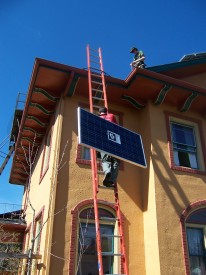
Photovoltaic panel installation at the Duma Community, Eugene OR. Photo courtesy of Allen Hancock.
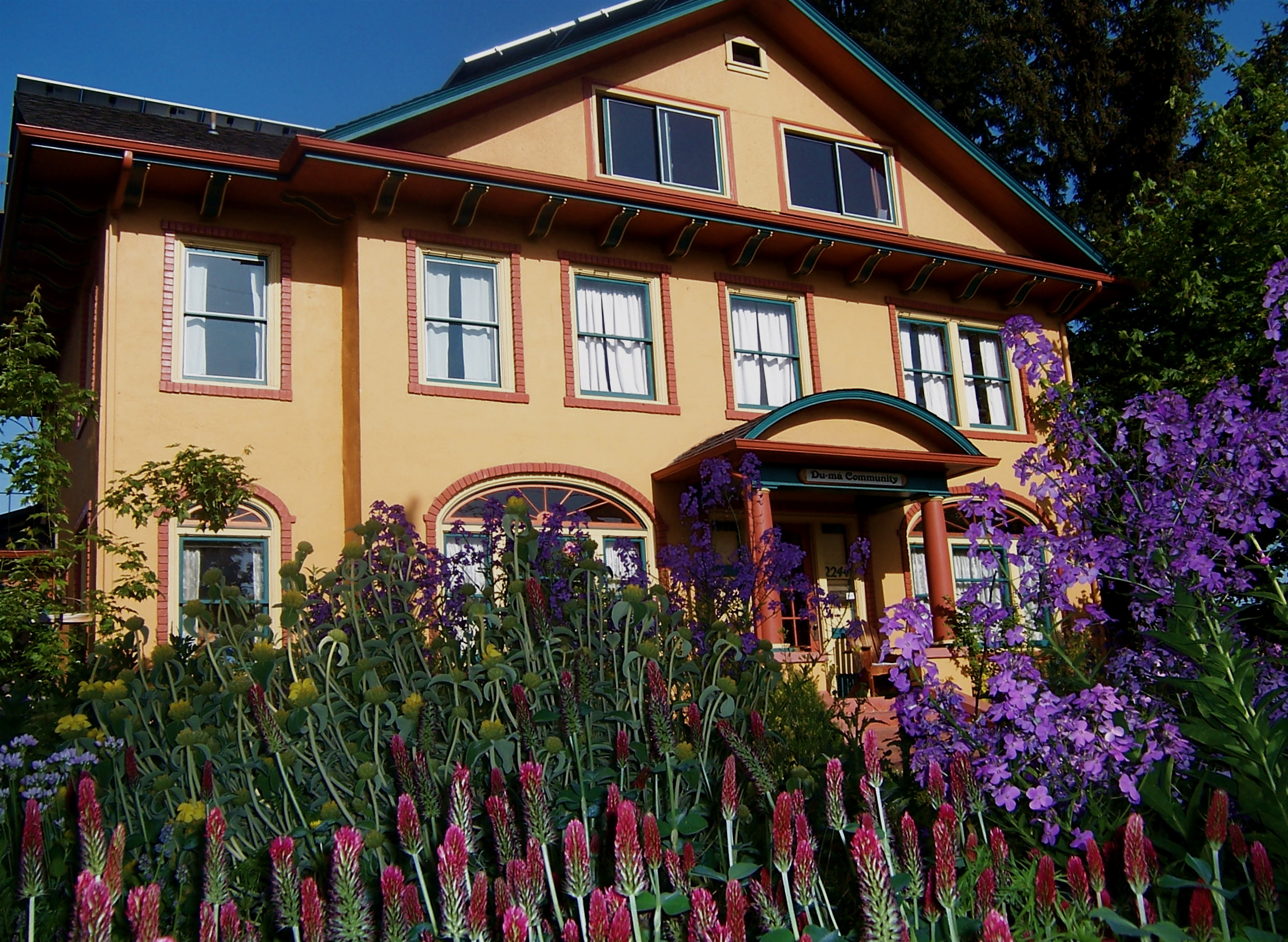
Another friend of mine, Allen Hancock, owns a similarly spacious house near the University of Oregon in Eugene. A Christian college built the house in 1926 as a home for a dozen or more “wayward girls.” By the time Allen moved in, in 1990, someone had divided the 4,400-square-foot structure into six apartments and let it run down. He restored, remodeled and retrofitted the house. Today, it has 10 bedrooms plus a guest room and, usually, nine residents. Allen has personally devoted two decades of labor to turning Duma, as he calls the house, into a model of green living, with reused building materials throughout, extreme insulation and energy efficiency upgrades, photovoltaics on the roof, edible landscaping, and a rainwater catchment system, all located on one of Eugene’s main bicycle routes.
They may not be for you, but rooming houses and other small, basic dwellings should not be against the law. Some people want them — need them, in fact — and they provide housing affordably, with a tiny ecological footprint, and in walkable neighborhoods. Yet across most of the metropolitan Northwest, these basic homes are currently forbidden or rendered unprofitable by local codes.
My last article recounted how we arrived at this confounding pass, where the law has vacated the lower rungs of the historic housing ladder. This article describes nascent efforts to repopulate those rungs, by building neo-rooming houses and micro-apartments…