Donate Newsletters

Coal, Oil, and Gas Spent $2 Million on Oregon Politics in 2014

The last few months have been a wild ride in Oregon politics. Governor Kitzhaber, the state’s only Governor to serve four terms, resigned amid allegations of ethical violations. Then, over vociferous opposition from the oil industry, the state legislature almost immediately lifted a sunset provision on the state’s first clean fuels standard, one of the first bills signed by newly inaugurated Governor Kate Brown.

Many observers now believe that Oregon’s lopsided Democratic majority is positioned to ramp up renewable electricity standards and perhaps even enact a price on carbon emissions in the next legislative session. These are meaningful changes to law that would have a tremendous impact on the state’s pollution levels for decades to come by reducing fossil fuel consumption.

Needless to say, these reforms are not well liked by the coal, oil, and gas industries that benefit from business as usual. In an attempt to tip the scales in their favor, they injected nearly $2 million—$1,972,783, to be precise—into Oregon’s political system in the most recent election cycle. This money came from the usual oil suspects like Shell, Tesoro, and Chevron as well as related organizations like the Western States Petroleum Association. A hefty portion also came from major movers of fossil fuels, including railroads like BNSF and Union Pacific, and Global Partners, which owns of the oil terminal at Port Westward.

Read more

Northwest Democracy and Fossil Fuel Money

For those interested in Sightline’s work on the influence of fossil fuel money in Northwest politics, you may enjoy listening to this 45-minute interview I did recently on KBOO, a community radio station in Portland. Host Barbara Bernstein and I explored some of the recent media reporting on the activities of billionaire brothers David and Charles Koch, as well as Sightline’s research into Tesoro, key state electoral campaigns, and overall coal, oil, and gas spending in Washington.

Read more

Coal, Oil, and Gas Spent $3 Million on Washington Politics in 2014

Washington state legislators have a lot on their plates. A state Supreme Court mandate to increase education funding dramatically hangs like an ominous black cloud over this year’s session. It’s a problem that is only compounded by dire transportation system maintenance needs—the state transportation commission calls for a mind-boggling $175 billion in transportation funding over the next 20 years.

Governor Inslee’s flagship bill, the Carbon Pollution Accountability Act, aims to address both budgeting issues. By capping emissions statewide and charging polluters for what they release, the law would generate just under a $1 billion the first year. (For a full breakdown of the bill check out Kristin Eberhard’s excellent piece.) The funds would then go directly to transportation and education funding, as well as low income tax relief.

For many, it’s a win-win. But polluting fossil fuel interests are anything but excited about the prospect of paying for the free lunch they’re getting now. They are accustomed to getting their way, and they spend millions each election cycle to specifically influence the state’s political process. In fact, tallying funds from major oil companies like BP and Chevron, from industry associations like the Western State Petroleum Association, and from would-be coal exporters like Pacific International Terminals, we calculate that during the last election cycle, fossil fuel interests injected more than $3 million of political spending into Washington.

It worked out to $3,055,929.28 to be exact. Here’s how it breaks down.

Read more

How the Oil Industry Will Try to Kill Carbon Pricing

As Oregon and Washington contemplate a carbon tax or carbon cap, the oil industry is revving the engines for an astro-turf scare campaign here. The oil lobby spends a million dollars a month in California. As Oregon and Washington start thinking about holding them accountable, the oil lobby is turning its scare machine our way.

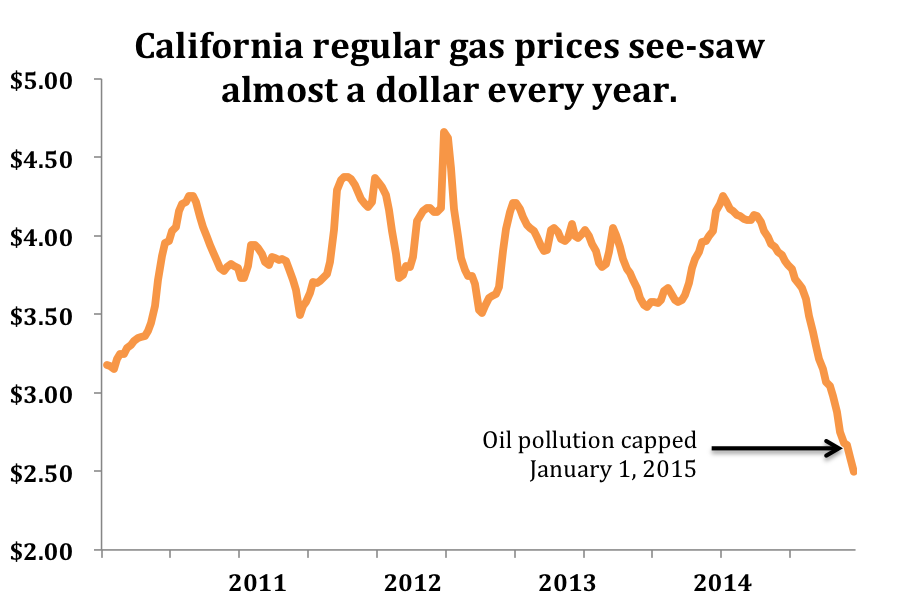
Governor Inslee has proposed a plan that would cap carbon pollution in Washington and move the state slowly but surely away from fossil fuels—away from what oil and coal companies sell—and onto clean energy. California has capped pollution from power plants and industrial facilities since 2013; when gas and diesel came under the cap this year, most economists estimated it would cost customers about a dime a gallon. But the powerful Western States Petroleum Association warned voters and legislators about a “hidden gas tax” that could cost families 76 cents a gallon of gas. Now that California has been holding polluters accountable for a few weeks, what has the price impact been? The price tag for clean air—maybe a few cents a gallon—was lost in the noise of gas prices that rise and fall ten times that amount every few months.

Original Sightline Institute graphic, available under our free use policy.

There are two things that Oregon and Washington can learn from Western States Petroleum Association’s “Wolf!”:

Read more

Which Washington Legislators Take the Most Coal, Oil, and Gas Money?

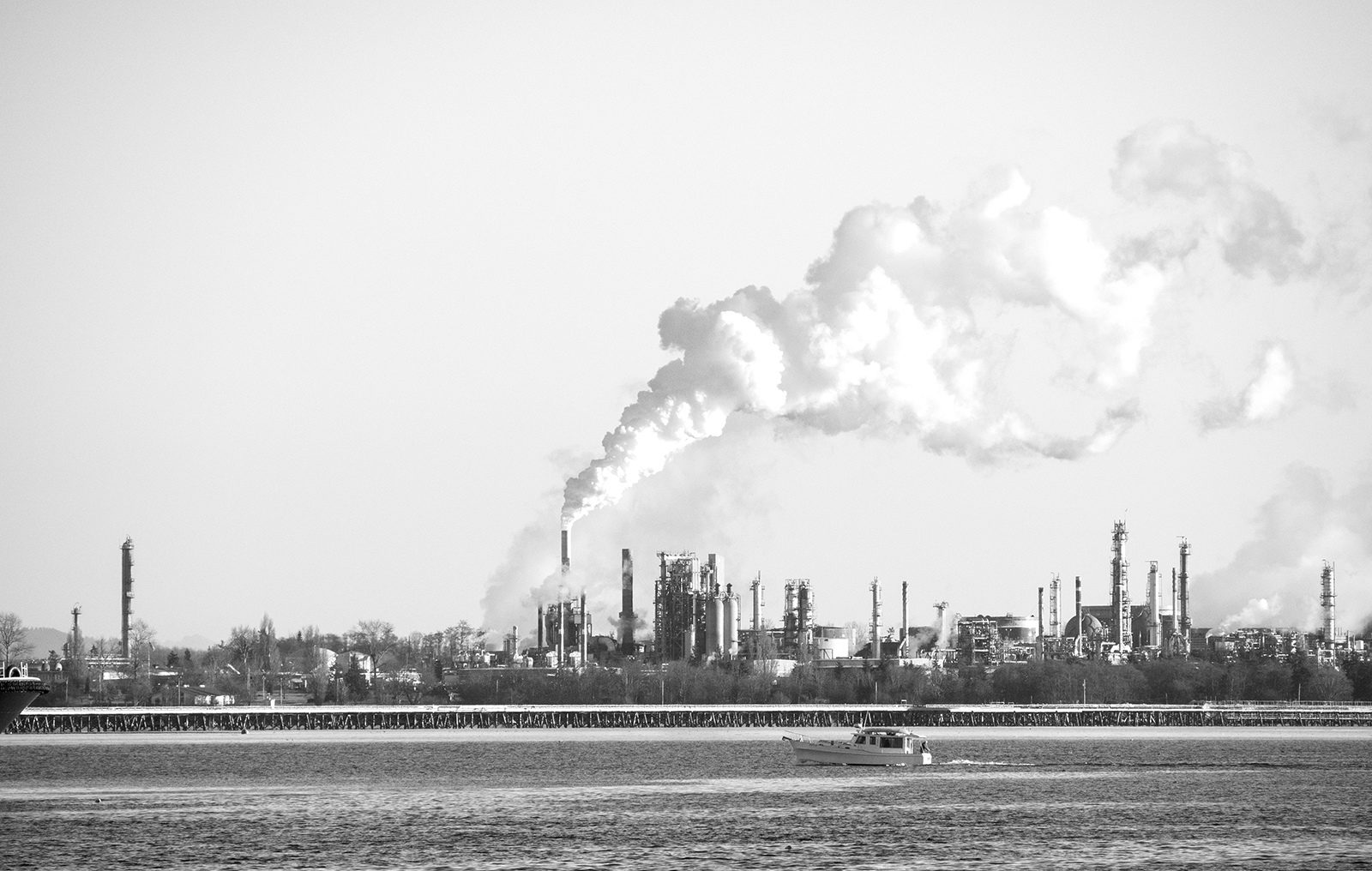
Tesoro refinery in Anacortes, WA. Photo by Dana, cc.
Tesoro refinery in Anacortes, WA. by Dana used under CC BY-ND 2.0

The 2015 Washington legislative session promises to be one of the more contentious in recent memory. Governor Inslee is advancing bills to reduce carbon emissions and better regulate oil transport, while the Republican-dominated Senate vows to obstruct his agenda. Both issues will pit fossil fuel companies—and especially Big Oil—against the governor.

It is, then, an opportune time to daylight the fact that the major opponents of the proposed legislation are also the state’s biggest recipients of dirty energy money. We analyzed records from the Washington Public Disclosure Commission, as well as several national political funding online databases, to track campaign contributions from the fossil fuel industry to every elected official in the state during the last election cycle.

Direct donations

The top three recipients are all members of the state Senate, the chamber best positioned to block the governor’s bills. They are:

  1. Democrat Timothy Sheldon (District 35) – $19,300
  2. Republican Andrew Hill (District 45) – $19,100
  3. Republican Douglas Ericksen (District 42) – $17,600

Read more

How Tesoro Manipulates Washington State Politics

The Texas oil company Tesoro has big plans for Washington. Long an operator of a refinery near Anacortes, Tesoro recently unveiled plans for the biggest oil-by-rail facility in the US on the Columbia River at Vancouver. The scheme, which has become a lightning rod in the region, has already run into severe delays and cost increases and the company is scrambling to rebrand its proposal.

In a recent interview with the local newspaper’s editorial board, Tesoro executives tried to argue that the project is consistent with Governor Inslee’s agenda.

Inslee “has every reason to say yes… “I think (the oil terminal) fits into what he wants to accomplish,” said one VP.

That’s a Texas tall tale if we’ve ever heard one. In truth, it would be hard to find any company anywhere with a record more diametrically opposed to Governor Inslee’s agenda.

The fact is that Tesoro has a well-documented track record in Washington of meddling at the ballot box, funneling money to shadowy Republican groups, and financing anticlimate campaigns. In 2010, Tesoro started bankrolling Tim Eyman initiatives to the tune of $90,000. In the last two election cycles, the firm doubled-down on its political activities in the state, spending an additional $577,673 on candidate donations, lobbying, and funding political action committees.

Original Sightline Institute graphic, available under our free use policy.

A review of public records shows that Tesoro delivers not only petroleum products, but also a heavy dose of dirty energy money into Evergreen State politics. To better understand how Tesoro cultivates influence in Washington State, let’s follow the money.

Read more

How much do we spend on fossil fuels?

If you could choose how much of your money to spend on fossil fuels compared to K-12 public schools, how would you divvy up your dollars?

Here’s where your money actually goes:

  • If you live in Oregon, you spend around $1,300 per year on K-12 education and around $2,800 per year on fossil fuels.
  • If you live in Washington, you spend around $1,500 per year on K-12 education and around $3,200 per year on fossil fuels.
Original Sightline Institute graphic, available under our free use policy.

Read more

How Fossil Fuel Money Plays in Northwest Elections

Over the last few years, the Northwest has been embroiled in an increasingly heated debate over its participation in fossil fuel exports. Energy companies’ plans to build coal terminals, oil depots, and gas pipelines are drawing out protestors, grabbing headlines, and earning plenty of attention from elected officials.

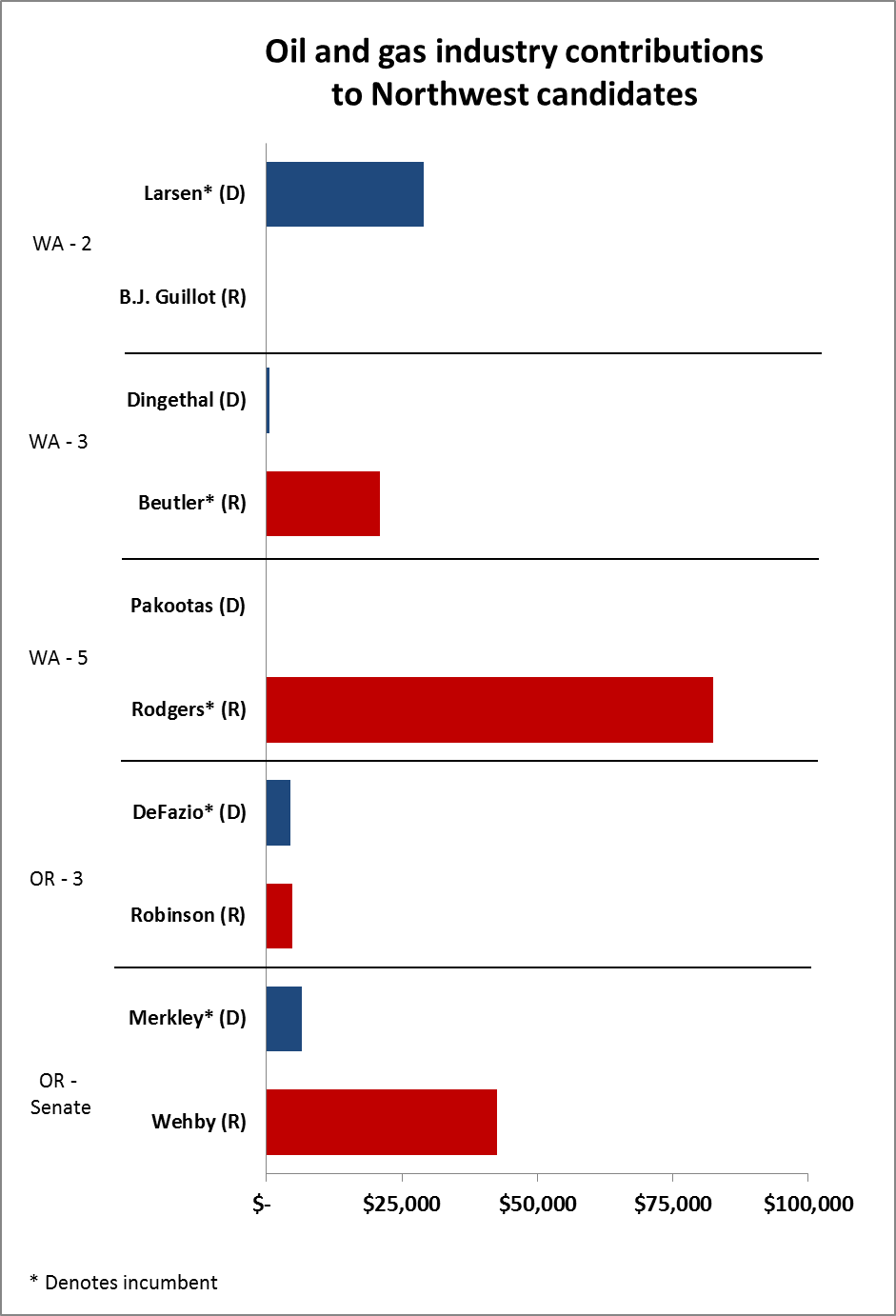
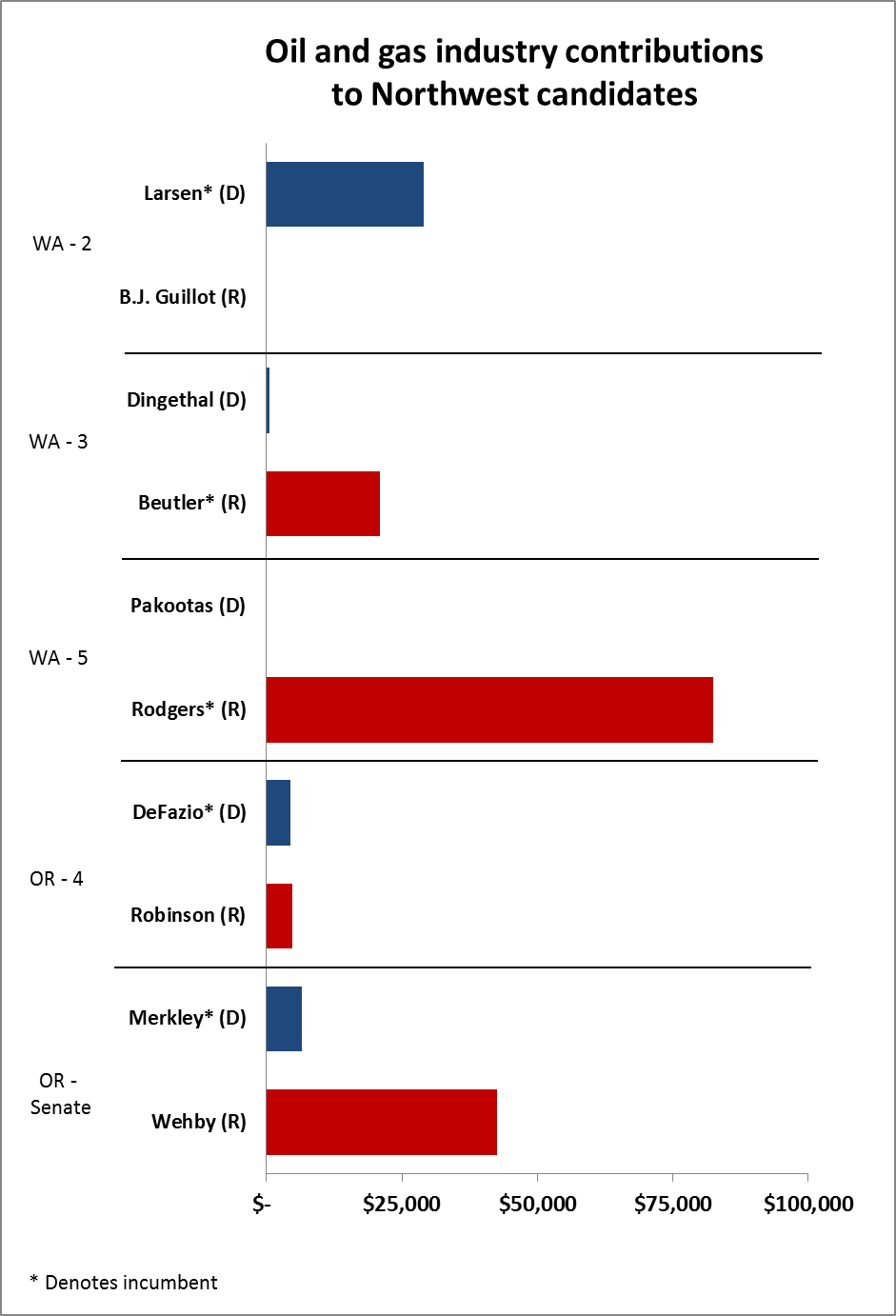
So to get a better sense for how these companies are playing the political game, we combed through campaign contribution data published by the Center for Responsive Politics in the OpenSecrets’ online database. To our surprise, we could identify very little money coming from the coal companies with a stake in Northwest export proposals. Yet we did find that the well-heeled oil and gas industry pumps plenty of money in the coffers of the region’s candidates for federal office.

We picked five electoral contests that we believe illustrate the breadth and depth of fossil fuel money in Northwest politics. Whether in highly contentious well-publicized races or predictable landslides, fossil fuel interests can be major players.

Original Sightline Institute graphic, available under our Free Use Policy.
Original Sightline Institute graphic, available under our Free Use Policy. fossil fuel money (Data from OpenSecrets.org.)

Here’s a closer look at how fossil fuel interests spent money on each of these races.

Read more

Leader of Conservation Group to Become Coal Export President

The board president of an environmental group, who is on the board of a second, will soon leave his partnership with a major law firm to go to work full time in support of coal exports, according to knowledgeable sources in the legal community.

Bill Chapman, a longtime partner at the law firm K&L Gates, will become president of Millennium Bulk Terminals, the firm that aims to ship 44 million tons of coal annually from a site on the Columbia River to markets in Asia. Chapman currently boasts at least two high-profile positions in the Northwest conservation community: he is president of the board of Mountains to Sound Greenway, a land trust dedicated to preserving natural areas along the I-90 corridor, and he sits on the board of directors of Washington Wildlife and Recreation Coalition, an organization that promotes public funding for parks and wildlife habitat.

Both are fine organizations that deserve support. Neither deserves to be tarred by association to the nasty business of large-scale coal export.

Although his biography has already been removed from K&L Gates’ website, reports he filed with the Washington Public Disclosure Commission show that Chapman has been doing legal work on behalf of Millennium Bulk Terminals’ coal export scheme for several years. (In 2013, Sightline outed K&L Gates work on behalf of big coal corporations.)

Read more

PR Firm WA2 Advocates Takes Coal Money

The time is ripe for divestment from the fossil fuel industry. Although we usually think about divestment as reallocating long-term financial holdings, it can take a much more direct form. If your business or organization objects to the outrageous harm caused by coal, you can vote with your pocketbook: you can choose not to do business with coal agents in the Northwest.

Among those agents is WA2 Advocates, a Northwest-focused public relations firm with offices in Bellevue, Portland, and Washington, DC. On its website, the company says that one of its core values is making the Northwest a wonderful place to live and work” and it prominently features their work with renewable energy projects, shellfish growers, and Puget Sound tribes.

It’s an ideal that the firm apparently thinks plays well with the public, but it is inconsistent with their work supporting large-scale coal exports on Puget Sound.

Scarcely mentioned is its work promoting Cloud Peak Energy, a major player in Northwest coal exports. Cloud Peak is the largest US coal company moving their commodity out of British Columbia ports; they have secured a 16 million ton annual option at the proposed Gateway Pacific Terminal near Bellingham; and the firm was the single largest contributor to pro-coal candidates in Whatcom County’s recent election.

Read more

×
Privacy Overview
Sightline Institute

More information about our privacy notice

Strictly Necessary Cookies

Strictly Necessary Cookie should be enabled at all times so that we can save your preferences for cookie settings.

3rd Party Cookies

This website uses Google Analytics to collect anonymous information such as the number of visitors to the site, and the most popular pages.

Keeping this cookie enabled helps us to improve our website.

Additional Cookies

This website uses social media to collect anonymous information such as which platform are our users coming from.

Keeping this cookie enabled helps us better reach our audiences.