Donate Newsletters

Event: Oil Trains in Anacortes

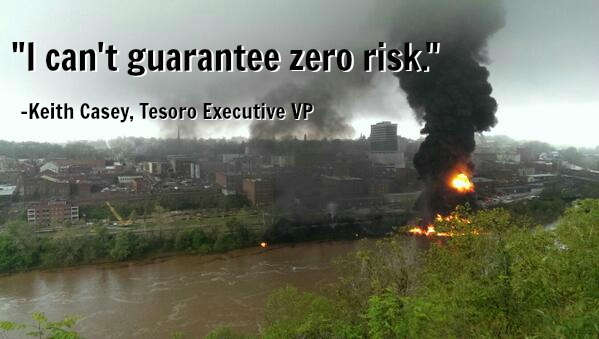
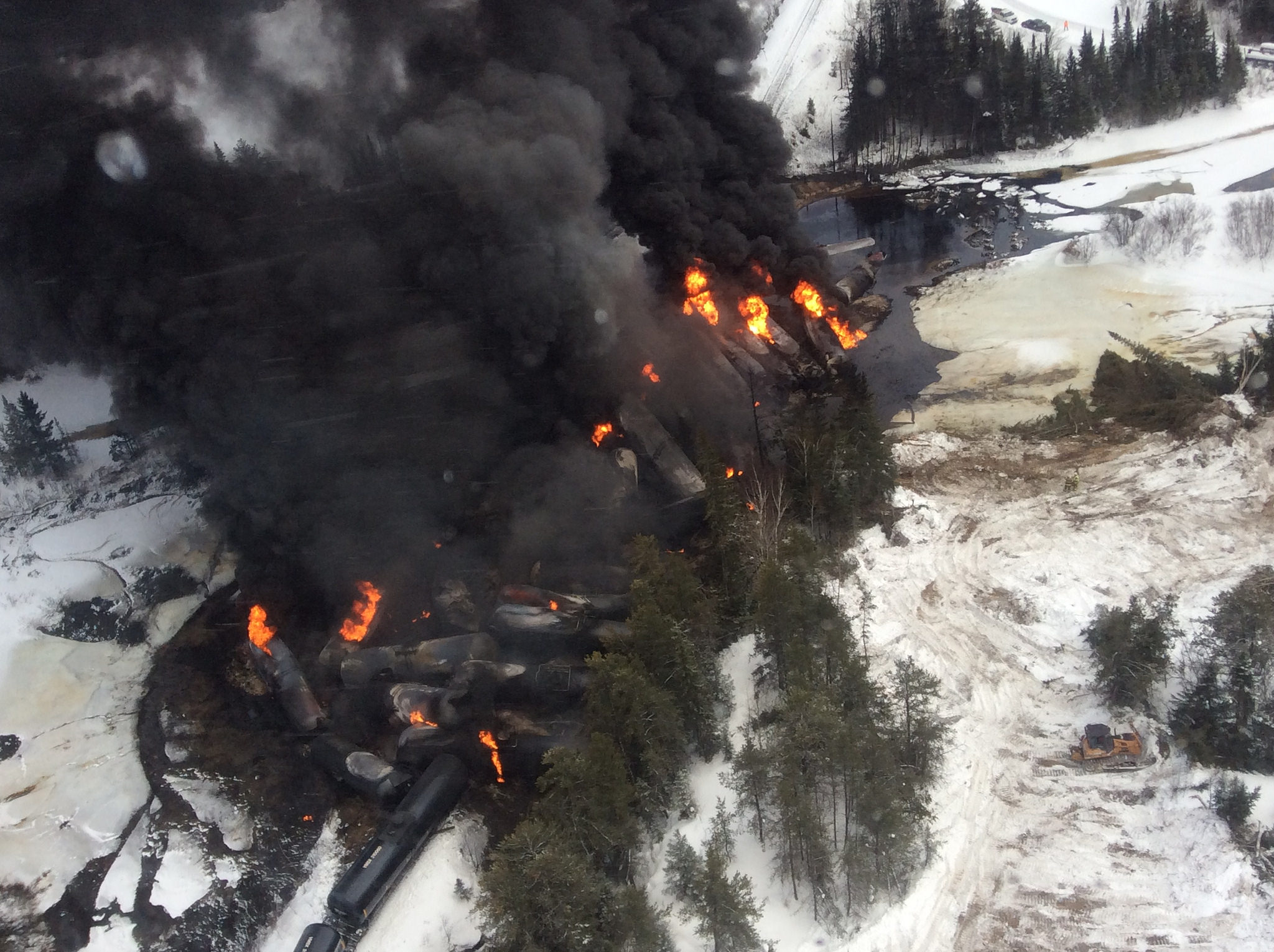
Lynchburg, VA, Derailment by Michael Cover
Lynchburg, VA, Derailment by Michael Cover (All rights reserved, used with permission.)

In the past several months alone, North America has seen five major oil train derailments and explosions. Communities across the country, including along the West Coast, are scrambling to cope with the threats these “bomb trains” pose—from their radically under-insured collision and damage risks to the delays they cause for local traffic to, of course, their potential to violently explode along tracks running past schools, downtowns, homes, and local businesses.

Early next month, I’ll be speaking on the costs and consequences of increased oil train traffic for the city of Anacortes, Washington, home to the Tesoro and Shell refineries, where millions of gallons of volatile crude oil arrive daily by train. I’ll also be exploring the larger regional picture of the Northwest grappling with an unprecedented influx of coal, oil, and gas export schemes. As  community and local leaders contemplate the possibility of a massively larger fossil fuel sector, they deserve the facts on what this industry means.
Read more

Oil Train Explosions: A Timeline in Pictures

At 7:15 this morning, yet another crude oil train erupted into an inferno, this time near a small town in central North Dakota. As these wildly dangerous trains continue to explode—at least 10 in the last two years—it’s become challenging to keep track of them all. So, for the record, we’ve assembled here a pictorial timeline of North America’s bomb trains.

Last week, the Obama administration adopted new regulations that will phase out many of the most hazardous tank cars over the next five to six years. The regulations also substantially reduce public oversight of train movements and industry behavior.

We will update this post as new explosions occur.

The Thin Green Line Grows Stronger

Important update 5/8/15: The news just keeps getting better. In a stunning reversal, Portland Mayor Charlie Hales withdrew his support for a large propane-by-rail terminal in the city. The Willamette Weekly calls it a “death sentence” for the project. As the Oregonian reported, “At some point, those of us in power have to listen to those who put us there,” Hales said in an interview. It’s a huge—and hugely surprising—win for the opposition movement to Northwest fossil fuel exports.

Yesterday at the annual Climate Solutions breakfast, Seattle Mayor Ed Murray demonstrated what the Northwest means for big fossil fuel expansion plans. Expense. Delay. And ultimately, failure.

In February, the Port of Seattle surprised everyone by rushing through a secretive lease arrangement to host Shell Oil’s Arctic drilling fleet for maintenance in preparation for a summer of drilling the Chukchi Sea bed off Alaska’s North Slope. The move earned bracing admonitions from nearly every environmental group in the state. Local activists are turning out more than a thousand people at opposition rallies, submitting more than 8,000 critical comments, and generating national media attention as they take on the most profitable industry on the planet.

On stage yesterday, the mayor revealed that he had a surprise of his own in store. He announced that the city’s planning department had found that hosting the drilling fleet would violate the Port’s existing land use permits. If the Port wants to proceed with its unpopular and environmentally destructive plans, it must apply for a new permit. In a way, the mayor was actually handing the Seattle Port Commission a huge opportunity: a second chance to do the right thing.

Read more

Six Pictures that Illustrate the Staggering Growth in Oil by Rail

Trains have come to play an increasingly large role in North American oil transport over the last several years. Now, with a recent flurry of online publications from the US Energy Information Administration, we have data that illustrate just how profound the shift has been in the United States.

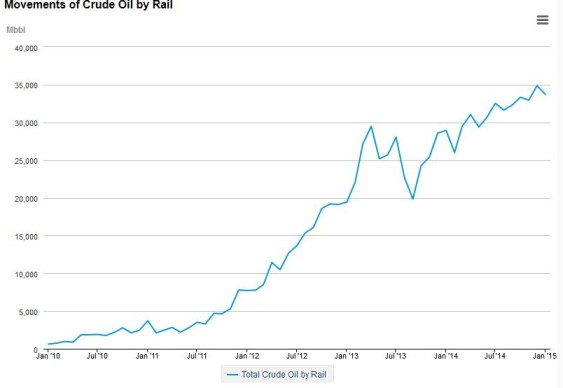
Crude oil by rail shipments have skyrocketed from just over 20 million barrels in 2010 to more than 373 million barrels transported in 2014.

Total crude by rail (thousands of barrels per month). Source - US EIA.
Total crude by rail (thousands of barrels per month), by US EIA

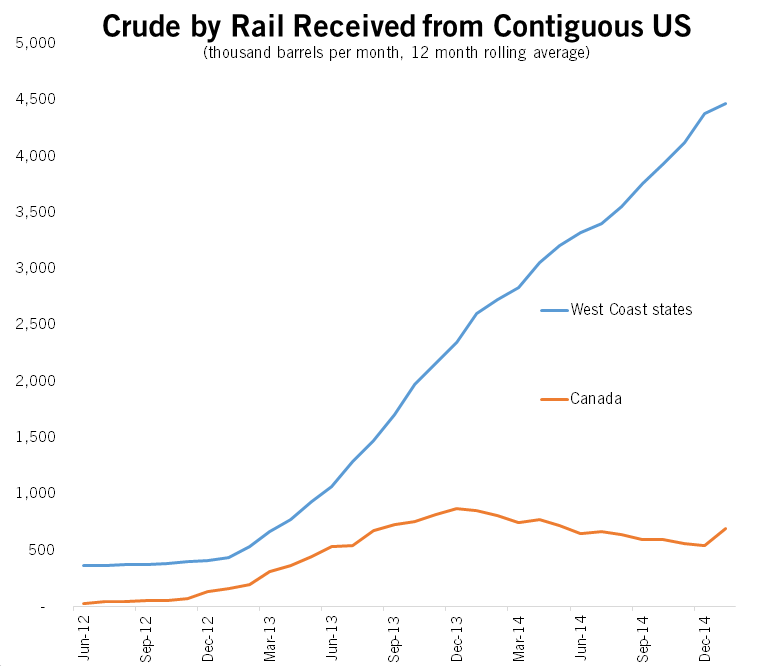
The growth in crude by rail has been, so far, mostly a US domestic phenomenon. The volume of crude transferred by rail from destinations and to origins within the contiguous United States has been on a steep ascent, while imports from and exports to Canada have grown more modestly.

Read more

More Headwinds for Coal Exports

Coal
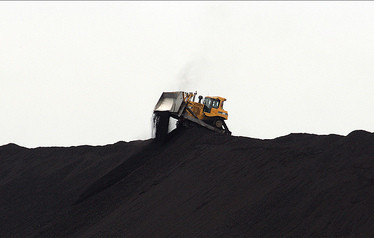
Coal by Kentucky Photo File used under CC BY-NC-ND 2.0

It’s been a fast and furious few months on the Northwest coal export front—and almost all of the news has been bad for the coal industry’s hopes to ship coal from the Northwest to Asia:

  • International coal prices remain near multi-year lows. After a slight uptick earlier in the year, benchmark thermal coal prices have fallen back to where they were in the depths of the global recession. Adjusted for inflation, they’re the lowest they’ve been since early 2007. And the future market holds out little hope for a rebound: prices for the Pacific Rim key coal market benchmark remain below $60 per ton through 2021.
  • Chinese coal demand continues to shrink. Five years ago, market analysts believed that China’s boundless coal demand would buoy coal prices for decades. But Chinese policymakers, increasingly concerned about air pollution and industrial overproduction, have enacted a variety of policies to curb coal consumption—from coal import tariffs to provincial coal reduction targets to a nascent cap-and-trade system. Those policies appear to be working: total coal consumption in China fell nearly 3 percent in 2014 compared with the prior year, and first quarter results from 2015 suggest a year-over-year sales decline of nearly 5 percent. Coal consumption in electric power plants fell 10 percent year-over-year in the first quarter of 2015, even as Beijing announced that it would be closing all of its major coal-fired power plants by the end of 2016.[prettyquote align = “right”]”90% of US #coal production is uneconomical at today’s prices”[/prettyquote]
  • Chinese coal imports are plummeting. A large share of the decline in China’s coal consumption comes from falling imports: total coal imports into the country fell 41.5 percent, year-over-year, in the first quarter of 2015. That’s roughly equal to all of South Korea’s coal demand simply disappearing from the Asian seaborne coal market.
  • A strong dollar hurts US exporters, but bolsters competitors. Long-term declines in the Indonesian rupiah, the Australian dollar, and the Russian ruble have bolstered the competitive financial position of key US coal export competitors.
  • Key US coal exporters are losing money on exports. Coal exporter Cloud Peak Energy—the Powder River Basin producer best situated to benefit from the coal trade—recently announced that it expected its export division to suffer $35 million in export losses in 2015. Last year, the company’s CEO said that it needs to see Newcastle prices in the $80-90/ton range to break even on exports. The combination of weak demand, oversupply, unfavorable policies, and a strong dollar have made it virtually impossible for US thermal coal producers to compete in Asian markets.
  • North American coal exporters are feeling the heat. Teck coal—a major metallurgical and thermal coal exporter operating in BC and Alberta—announced that it had missed earnings targets and is now trimming dividends to conserve cash. China’s sagging coal demand weighed heavily on Teck’s disappointing earnings. Meanwhile Arch Coal, co-owner of the Millennium Bulk Terminals export project in Longview, Washington, posted a $113 million loss for the first quarter, again weighed down by poor international prices—news that sent its shares tumbling.

Read more

Coal, Oil, and Gas Spent $2 Million on Oregon Politics in 2014

The last few months have been a wild ride in Oregon politics. Governor Kitzhaber, the state’s only Governor to serve four terms, resigned amid allegations of ethical violations. Then, over vociferous opposition from the oil industry, the state legislature almost immediately lifted a sunset provision on the state’s first clean fuels standard, one of the first bills signed by newly inaugurated Governor Kate Brown.

Many observers now believe that Oregon’s lopsided Democratic majority is positioned to ramp up renewable electricity standards and perhaps even enact a price on carbon emissions in the next legislative session. These are meaningful changes to law that would have a tremendous impact on the state’s pollution levels for decades to come by reducing fossil fuel consumption.

Needless to say, these reforms are not well liked by the coal, oil, and gas industries that benefit from business as usual. In an attempt to tip the scales in their favor, they injected nearly $2 million—$1,972,783, to be precise—into Oregon’s political system in the most recent election cycle. This money came from the usual oil suspects like Shell, Tesoro, and Chevron as well as related organizations like the Western States Petroleum Association. A hefty portion also came from major movers of fossil fuels, including railroads like BNSF and Union Pacific, and Global Partners, which owns of the oil terminal at Port Westward.

Read more

Failure to Report

Editor’s Note 7/24/15: One year ago today, a train carrying crude oil derailed in Seattle. Luckily, no damage occurred, but this close call is a reminder that dangerous oil trains come close to home. An explosion could result in a terrible loss of human life and take millions of dollars to clean up.

The first commuters were just beginning to trickle over the Magnolia Bridge near downtown Seattle as the short summer night was warming to gray. Probably none of them realized just how narrowly they escaped disaster that morning.

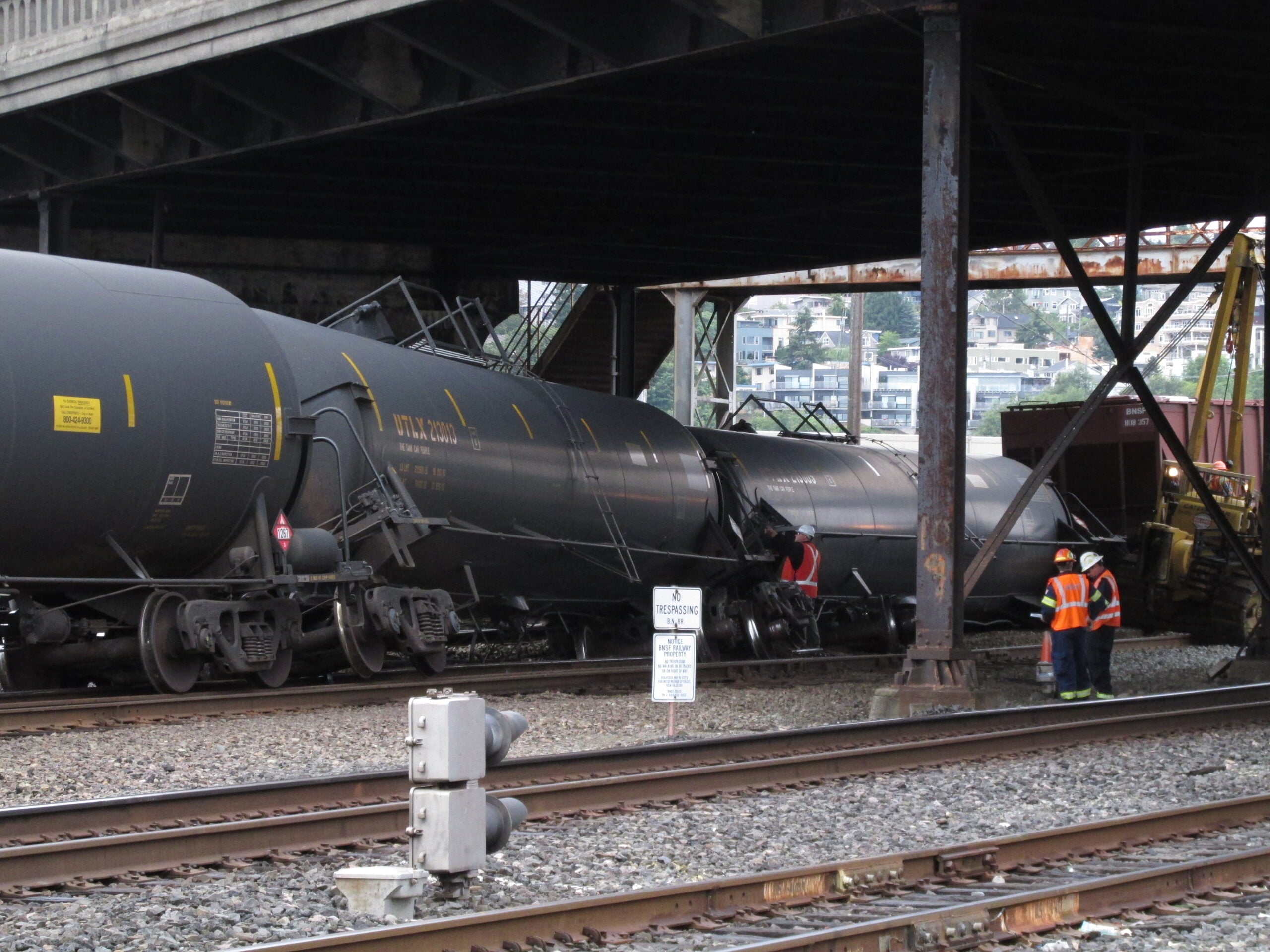
Below them, a BNSF locomotive pulling 97 tank cars—each laden with at least 27,000 gallons of crude oil from the Bakken formation of North Dakota—came to a halt under the Magnolia Bridge in Seattle. Three cars had derailed. It was July 24th of 2014.

The time was 1:50 AM.

What happened next—or more precisely, what didn’t happen—has come to define what appears to be a pattern of secrecy and poor communication by BNSF, troubling habits that put lives in the Northwest at risk. For example, three years earlier when a BNSF hazardous substance train derailed on a Puget Sound beach near Tacoma, the railroad was unresponsive to emergency officials for nearly four hours. Even then, communication lines were so poor that the railroad’s subsequent actions put the first responding firefighters directly into harm’s way for no purpose.

Read more

What the Oso Landslide Teaches Us About Oil Trains

March 22 marked the first anniversary of the landslide in Oso, Washington. A water-logged mountain slope gave way, unleashing staggering volumes of earth and debris that swept across a small community and killed 43 people. Oso was an awful lesson in the destructive power of slides.

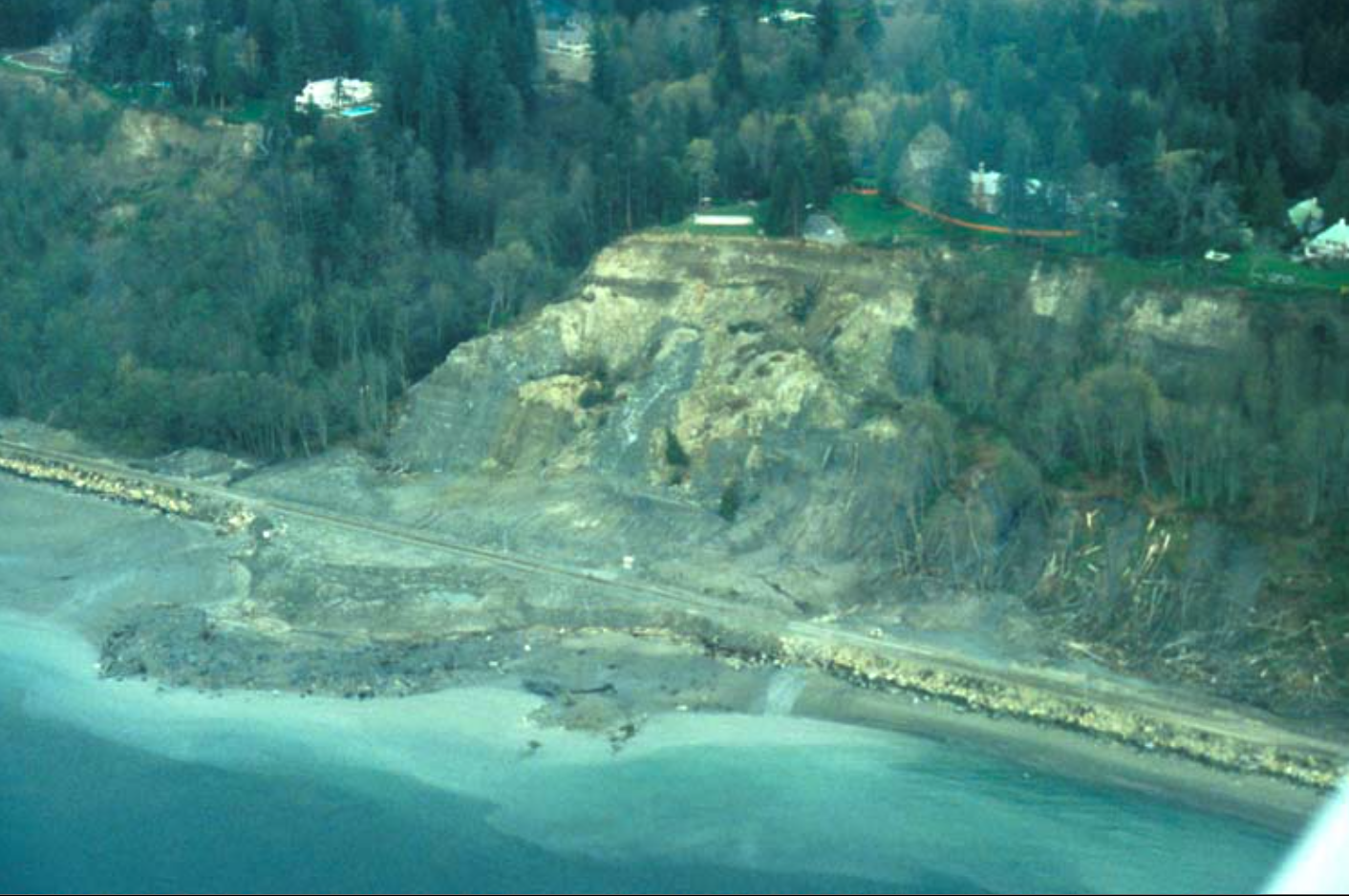
It’s a lesson that bears special consideration as the Northwest considers proposals to add dozens of hazardous coal and oil trains to coastal rail lines that are routinely plagued by slides.

We know that when oil trains derail they are prone to spills and catastrophic fires, mishaps that would be very challenging to address in many of the remote locations traversed by the main rail route along the northern shores of Puget Sound. Although the dry winter of 2014-15 maintained mostly stable earth along the rail lines, the region is not always so fortunate. During the wetter winter of 2012-13, for example, hillsides collapsed repeatedly over the tracks, forcing officials to cancel 206 passenger trains over 28 days. Prior winters had also yielded meaningful delays due to landslides.

Read more

Debating Coal and Oil Exports

If you haven’t yet gotten your fill of Sightline on Northwest coal and oil plans, then I have good news for you: I was featured recently on a UWTV program, Inside Outlook.

Host Gavin P. Sullivan moderated a discussion with me, Ross Macfarlane from Climate Solutions, and Frank Holmes from the Western States Petroleum Association. The program also includes some time with me—standing track-side in Seattle’s SoDo neighborhood—providing additional context and explanation.

Washington Senate Endorses Socialism for Coal

First Wyoming, now Washington: the state Senate has endorsed an $85 million handout to the coal industry, in the form of a rail project whose sole identifiable beneficiary is the proposed and highly controversial Millennium Bulk Terminals coal export project in Longview, Washington.

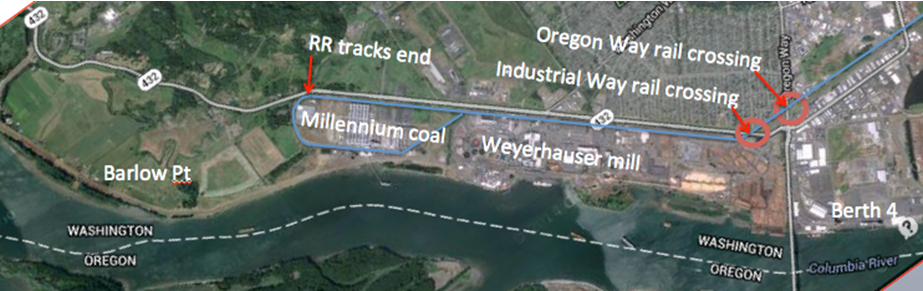
The rail crossing project, innocuously labeled in the legislative record as the “SR 432 Longview Grade Crossing,” would build a massive vehicle overpass over a rail line near the banks of the Columbia, just south of Longview, Washington. The project would lift the entire Oregon Way and Industrial Way intersection, including the rail crossings circled in red, to let trains pass underneath.

The county projects rapid growth in train traffic at these rail crossings through 2035. But nearly three quarters of that projected growth is for the Millennium terminal. The remaining quarter would go to Barlow Point to the west of Millennium—an undeveloped site that, at present, has no known prospects for a tenant.

That means that the only known project that could boost traffic delays at Oregon Way and Industrial Way is the Millennium Bulk Terminals, a project whose principal proponent is wholly owned by a private equity fund based in the Cayman Islands.

×