If you put your money in a vending machine and punched in the number for trail mix, but it instead gave you a pack of gum, would you use that vending machine again? Unfortunately, voting in North America is often not so different from this vending machine. In the United States, most voters vote Democrat, yet the Republicans control Congress. Voters ask for trail mix but keep getting gum. In Canada, about 35,000 Conservative voters can elect a Conservative Member of Parliament (MP) to represent them, but it takes more than ten times as many—over half a million—Green voters to elect a single Green MP.
This is not how it’s supposed to work. Second US President John Adams believed the legislature “should be in miniature, an exact portrait of the people at large. It should think, feel, reason, and act like them. … [E]qual interest among the people should have equal interest in it.” In other words, the legislature should proportionally represent the people.
“Winner-take-all elections give the biggest bloc of voters 100 percent of the representation, and all the other voters get none.”
Here’s what an “exact portrait,” proportional representation, would look like: imagine people of different ideological stripes are different fruits and vegetables on a spectrum from orange to green. In Foodtown, 17 percent of voters are oranges, 20 percent peaches, 20 percent apples, 20 percent cucumbers, and 23 percent broccoli. If Foodtown elects a five-member legislature that is “an exact portrait of the people,” it would be one orange, one peach, one apple, one cucumber, and one broccoli.
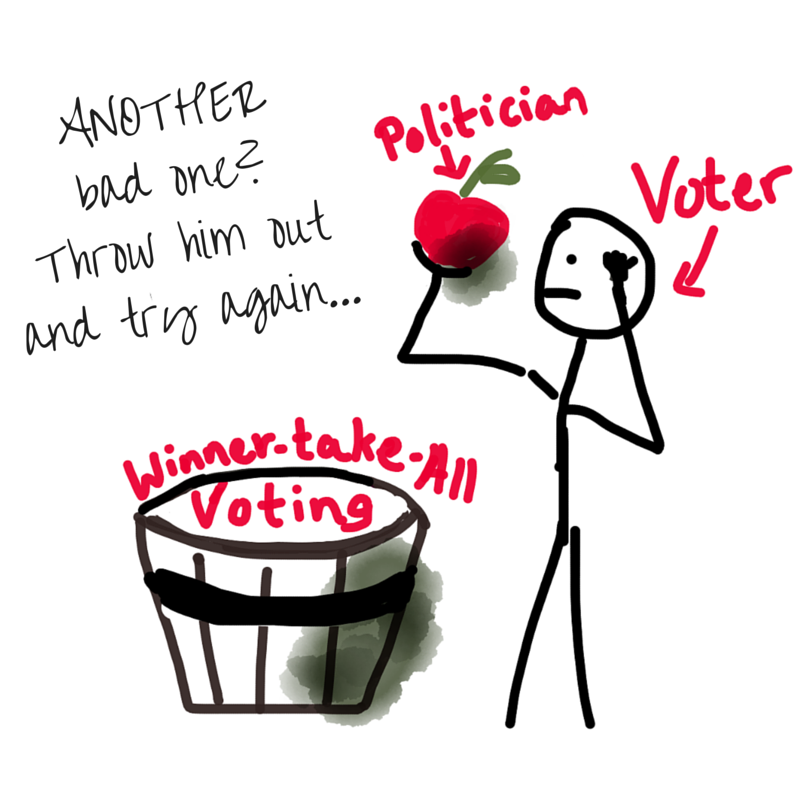
Unfortunately, in Canada and the United States, winner-take-all elections give the biggest bloc of voters 100 percent of the representation, and all the other voters get none. In winner-take-all, also known as “first-past-the-post” or “plurality” voting, the candidate with the most votes wins, regardless of how many votes he or she gets. In an election with only two candidates, the winner will need a majority—half plus one—of the votes to win. With three candidates, the winner only needs a plurality of votes to win: one-third of the votes plus one; with four candidates, one-fourth of the votes plus one; etc.
If Foodtown was split into five single-member districts with winner-take-all voting, the biggest voting blocs would win all the seats, so Foodtown might elect five broccolis. Or, likely, Foodtown would get four peaches and one broccoli. In Oregon, 55 percent of voters are Democrats, yet Democrats hold 4 out of 5 Congressional House seats. In 2012, Americans voted for Democratic candidates by a 52-48 margin, yet gerrymandered single-member districts resulted in Republicans winning 57 percent of the House seats.
Read more