
Here’s a quick note on recent polling about wind energy among Northwest voters.
We’ve all heard loud opposition to wind farms—the most ardent critics are usually neighbors who dislike the idea of seeing wind turbines out their windows, but overall, public opinion in the Northwest is looking pretty good for wind energy development.
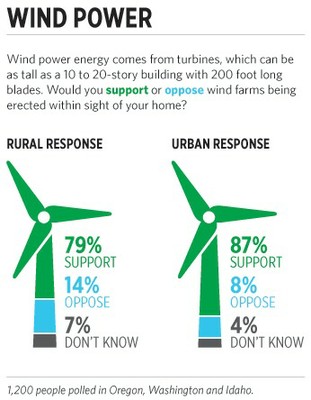
That’s right. A recent public radio poll of voters in Washington, Oregon, and Idaho, found broad support for wind energy among both urban and rural Northwest residents—even if the turbines would be visible from their homes.
Of course, anyone who answered in the hypothetical could go the other way if a wind farm was proposed that would actually be visible from their home!
For my part, I hope these findings signal an emerging clean-energy aesthetic, where clean energy technologies look more and more beautiful to us because they represent good stuff: progress, health, and economic strength.
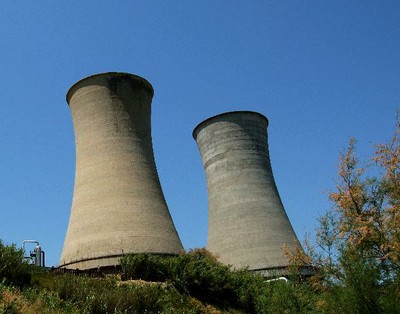 There are some who claim that nuclear technology is a necessary wedge of the clean energy pie. I’m not so sure. Nuclear power is really expensive to get online. It’s hard to say whether the risks of nuclear energy are worth the benefits of reduced carbon emissions. Energy efficiency makes a lot more sense—affordable efficiencies are all around us.
 “Conservatives create moral messages. The Democrats create policy messages, and policy messages either go over people’s heads or bore them.”
 There are breakthrough moments along the way, laws enacted and whatnot, but big cultural shifts often happen incrementally, slowly enough that they seep into mainstream attitudes rather than changing them overnight. Looking back over the recent past, it’s clear that attitudes and behaviors that may have once seemed radical or impossible have become perfectly natural to us in a few decades’ time. Take our attitudes about smoking, seat belt use, and recycling. They’ve become second nature for us.