


Here’s a quick note on recent polling about wind energy among Northwest voters.
We’ve all heard loud opposition to wind farms—the most ardent critics are usually neighbors who dislike the idea of seeing wind turbines out their windows, but overall, public opinion in the Northwest is looking pretty good for wind energy development.
That’s right. A recent public radio poll of voters in Washington, Oregon, and Idaho, found broad support for wind energy among both urban and rural Northwest residents—even if the turbines would be visible from their homes.
Of course, anyone who answered in the hypothetical could go the other way if a wind farm was proposed that would actually be visible from their home!
For my part, I hope these findings signal an emerging clean-energy aesthetic, where clean energy technologies look more and more beautiful to us because they represent good stuff: progress, health, and economic strength.
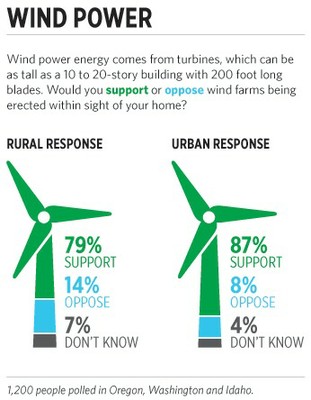
The survey asked 1,200 people across Oregon, Idaho and Washington how they would feel if the enormous turbines were erected near their homes. Pollster Su Midghall seemed surprised by the high levels of support:
An overwhelming percentage—80 percent of residents of rural areas of the Northwest—support wind farms being developed within sight of their homes. What’s more interesting is that 50 percent strongly—not just somewhat—but strongly support this.
Not surprisingly, support is even greater in urban areas.
Hopefully this kind of thing is a sign, not only that clean energy technologies are becoming mainstream, but also that we’ve begun embrace the health, security, power, and economic advancement represented by technologies that harness clean, homegrown energy sources that can never run out—and to see the grace in them—even in our own back yards.
The opinion survey was a collaboration of the Northwest Health Foundation, the polling firm Davis, Hibbitts and Midghall and public radio stations across the Northwest.
Image courtesy: NPR.


The New York Times article from Jan 20, shows that siting of turbines is only the first step and that people who don’t mind the turbines themselves DO mind the transmission lines. “Texas is in the midst of a wind-power boom, and at the heart of it lies a conundrum: While plenty of ranchers are eager to host wind turbines, few want the unsightly high-voltage transmission lines needed to carry the power to distant cities running through their property.”There are so many turbines in West Texas that some need to be shut down during windy periods because there aren’t enough transmission lines. And the same limitations are being felt in the Goldendale WA region, where there are enough turbines to overload the available transmission lines and plans to build more. A Jan 21 article in the Yakima Herald shows that no route will be able to please everyone. “Driven by the growing generation of wind power, the Bonneville Power Administration is proposing a 500-kilovolt transmission line spanning the Columbia River and Klickitat County. “The 28-mile line, called the Big Eddy-Knight, would run from The Dalles, Ore., to a new substation about four miles northwest of Goldendale. The right-of-way would be 150 feet wide with towers up to 250 feet high.”The federal agency has suggested three routes, all of which traverse swaths of private property, make some use of existing routes and cross the Columbia River Gorge National Scenic Area.”Although the agency is attempting to limit the environmental impact, no matter where the line is built somebody will be unhappy about what it will do to the scenery.”