Donate Newsletters

What Washington’s New Oil-by-Rail Rules Will Tell Us

Shipping crude oil by train is an extraordinarily dangerous enterprise. Notoriously prone to leaks and spills, recent history has shown that railcars can explode catastrophically when the fuel comes in contact with an ignition source. The damages can be profound. To make matters worse, the railroads that run the oil trains—and that are legally liable … Read more

Tesoro’s New Oil Train Cars: Too Few and Still Too Dangerous

One of the biggest players in oil by rail is trying to build more capacity in Washington State. Tesoro, an oil company with a checkered past, already receives loaded crude oil trains at its Anacortes refinery. Now the firm aims to build North America’s largest oil train unloading facility on the banks of the Columbia … Read more

Setting the Record Straight on Oil Trains

Editor’s note: The Seattle Times recently published a guest opinion regarding oil trains. It contained some unfortunate errors. Sightline Policy Director Eric de Place and Spokane City Council President Ben Stuckart penned this response.

On September 13, the Seattle Times published an opinion piece by Richard Berkowitz attacking, among other things, advocacy groups, communities worried about oil trains, and research published by Sightline Institute. Unfortunately, his article dismisses the threats that oil trains pose to Northwest cities—and it fails to confront the facts about a rickety, born-yesterday industry.

Here’s a fact: new projects could induce as many as 100 loaded crude oil trains per week to transit Washington. That number, first published by Sightline Institute, comes directly from adding up the industry’s own figures in publicly available permitting documents.
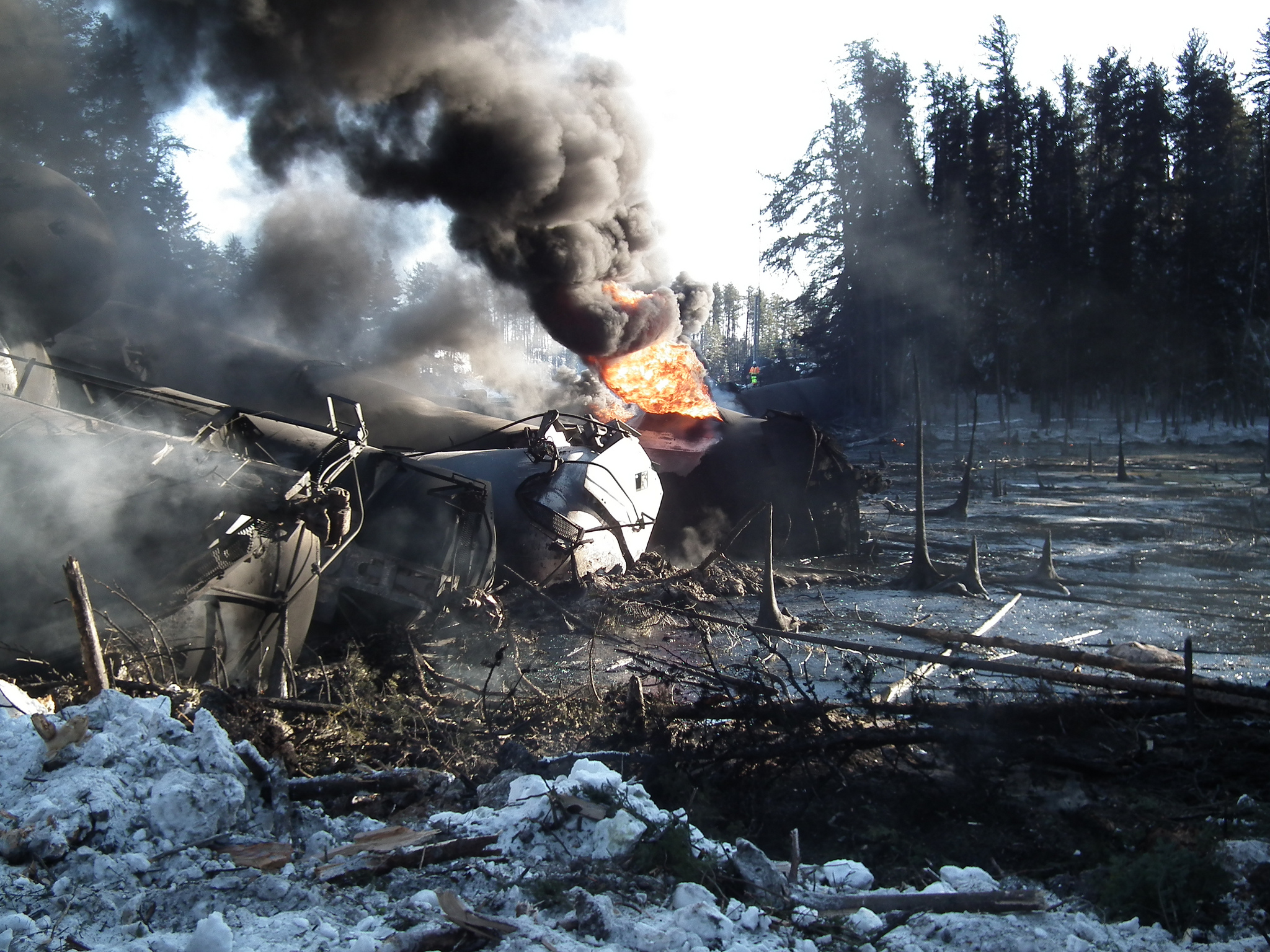
Read more

Tacoma’s Ticking Time Bomb

[prettyquote align=right]”Tacoma, WA, is now the Northwest city most threatened by #oiltrains.”[/prettyquote]

With no fanfare whatsoever, Tacoma has claimed a new, though dubious, distinction: it is now the Northwest city most threatened by oil trains.  As new research by Sightline reveals, a combined 80,000 barrels per day of crude oil—about 8 loaded trains per week—are permitted to travel on a publicly owned railway into the heart of Tacoma’s industrial area. In addition, another 15 loaded trains bound for north Puget Sound refineries can also pass through the city each week.

No other urban center in the region plays host to so much oil train capacity inside city limits.

The risks of oil trains have been made plain by the 10 catastrophic explosions that North America has seen in the last two years, to say nothing of the billion-dollar risk to the public that is virtually uninsured. The two terminals put the people of Tacoma directly in harm’s way of a fiery derailment, the likes of which have become all-too-common in the news.

Uncommonly, though, Tacoma’s local rail system is publicly owned, so unlike other places that see oil trains, the City of Destiny also bears the risk of financial catastrophe from an oil train derailment. It’s a risk so severe that even a single accident might bankrupt the city.

Read more

Failure to Report

Editor’s Note 7/24/15: One year ago today, a train carrying crude oil derailed in Seattle. Luckily, no damage occurred, but this close call is a reminder that dangerous oil trains come close to home. An explosion could result in a terrible loss of human life and take millions of dollars to clean up.

The first commuters were just beginning to trickle over the Magnolia Bridge near downtown Seattle as the short summer night was warming to gray. Probably none of them realized just how narrowly they escaped disaster that morning.

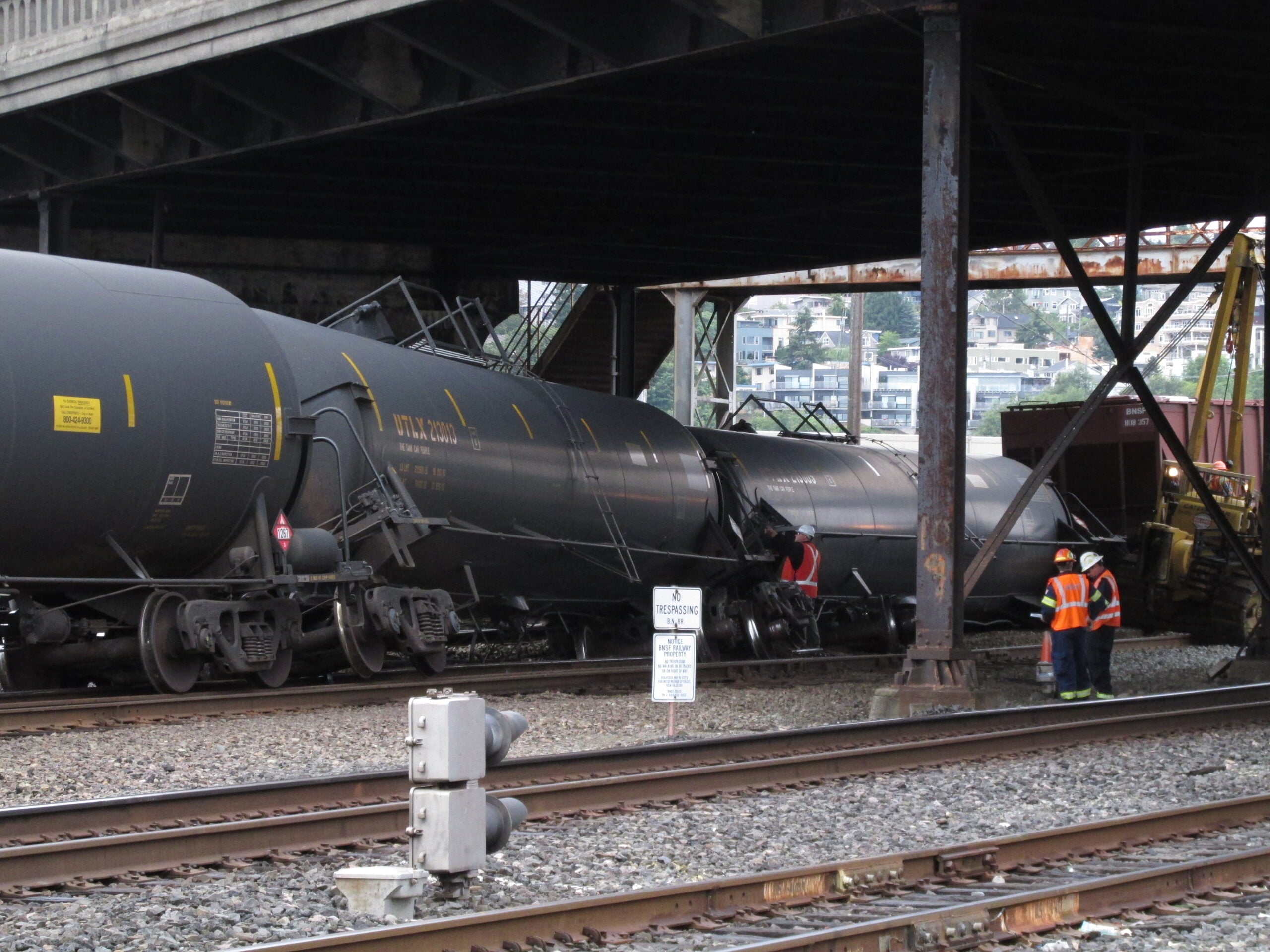
Below them, a BNSF locomotive pulling 97 tank cars—each laden with at least 27,000 gallons of crude oil from the Bakken formation of North Dakota—came to a halt under the Magnolia Bridge in Seattle. Three cars had derailed. It was July 24th of 2014.

The time was 1:50 AM.

What happened next—or more precisely, what didn’t happen—has come to define what appears to be a pattern of secrecy and poor communication by BNSF, troubling habits that put lives in the Northwest at risk. For example, three years earlier when a BNSF hazardous substance train derailed on a Puget Sound beach near Tacoma, the railroad was unresponsive to emergency officials for nearly four hours. Even then, communication lines were so poor that the railroad’s subsequent actions put the first responding firefighters directly into harm’s way for no purpose.

Read more

How Ronald Reagan and Bill Clinton Made Oil Trains Less Safe

Oil trains are not safe—a string of cinematic explosions has made that clear—and they’re not nearly as tightly regulated as they should be. This regulatory lapse isn’t just a one-off failure of the federal agencies charged with oversight; we’re in a jam that’s been decades in the making. Since Ronald Reagan, in fact.

When the feds released draft rules for oil trains this past July, they also published a draft Regulatory Impact Analysis (RIA). Though it’s technical and often-overlooked, the RIA is a hugely important document that weighs the benefits to the public against the costs to the private sector of new rules—rules that might require tank car upgrades, train braking improvements, safer rail routing, and speed restrictions. This cost-benefit analysis for federal rules designed to protect people and the environment has long been a tactic favored business conservatives, and it’s been the law of the land since 1982 when then-President Reagan required by executive order that federal rules pass a cost-benefit test.

In 1993, President Bill Clinton affirmed and expanded Reagan’s regulatory legacy with Executive Order 12866, so that nowadays agencies must quantify the anticipated present and future benefits and costs as accurately as possible—and then proceed with a new rule only if the benefits justify the costs. All of which may sound sensible enough, but consider this: that means the benefit of you being alive is evaluated in the same equation that measures the oil industry’s profit margin. And with exploding trains, that’s not just hyperbole.

Read more

What Do Oil Train Explosions Cost?

Given the nasty tendency for oil trains to explode when they derail, it’s probably worth asking what a catastrophic accident might cost. No doubt, the thousands of communities visited daily by oil trains would like to know what sort of financial risks they are exposed to. Unfortunately for these governments, the available data suggest that a reasonable worst-case-scenario explosion could do several billion dollars of damage—sums far in excess of railroad insurance coverage.

But how many billions are we talking about?

Proposed Oil Train Rules: The Good, The Bad and The Ugly

On July 23, the federal regulatory agencies in charge of oil trains released the details of a rulemaking proposal to improve the safety of moving large quantities of flammable materials by rail, particularly crude oil and ethanol. Oil trains have been the subject of increasing worry after five separate derailments in the past year unleashed towering infernos. The recent announcement opened up a sixty-day comment period after which the US Pipeline and Hazardous Materials Safety Administration (PHMSA) will issue a set of final rules.

In our judgment most media coverage of the proposed regulations has been rather credulous, overlooking several important dimensions and ignoring some glaring flaws. (One counterexample is Joel Connelly’s coverage at Seattle P-I.) So to correct the record, here is Sightline’s take on the good, the bad, and the ugly in the new proposed tank car standards.

The Good

  • The proposed rules have been released sooner than expected. Many industry observers speculated that this rulemaking process, which started in September 2013, would drag on much longer.
  • The draft rules are fairly comprehensive, addressing many of the unique safety issues of unit trains carrying oil or ethanol, including questions about how oil producers classify their crude, how train braking systems operate, how emergency responders are to be notified, emergency response planning, rail routing, and train speeds. Among the most closely watched issues are rules that will set standards for new-built and retrofitted tank cars.
  • PHMSA concurrently released a report summarizing an analysis of Bakken crude oil. Unsurprisingly, the federal data show that crude oil from the Bakken region in North Dakota tends to be more volatile and flammable than other crude oils. The new findings contradict recent assertions by the American Petroleum Institute that, based on their private studies, Bakken oil is no different from other flammable liquids commonly shipped in DOT-111s and that therefore there is no need to change tank car standards, which incidentally would increase their costs.
  • The feds propose to create a new improved tank car classification, DOT-117, for transporting Class 3 flammable liquids in unit trains.

Read more

A Move to Ban the Most Dangerous Oil Trains

Yesterday, EarthJustice announced that it was filing a formal legal petition to compel the Secretary of the US Department of Transportation to issue an Emergency Order within thirty days to ban the use of unsafe legacy DOT-111 tank cars for transporting Bakken and other dangerous crude oils. In what appears to be a case of … Read more

Industry To Feds: We Will Keep Using Old Unsafe Tank Cars For Three More Years, or Longer If We Feel Like It

This is the kind of oil industry-friendly approach to regulation that should make you want to bang your head on your desk. Bloomberg has the story:

The oil industry and the railroads that haul its crude have offered U.S. regulators a joint plan to phase out a type of older tank car tied to a spate of fiery accidents… The parties agreed to scrap a fleet of thousands of DOT-111s within three years if manufacturers agree they can replace or retrofit the tank cars in that period. [emphasis added]

What happened here is that the American Petroleum Institute and the Association of American Railroads met privately with federal regulators to offer this proposal in lieu of more stringent safety rules, such as those recommended by the National Transportation Safety Board.

Keep in mind that the DOT-111 tank cars in question are notoriously and obviously unsafe. Four times in the last year they have derailed and unleashed towering infernos, killing 47 people in one case. Yet the industry wants to keep them rolling on a daily basis through the heart of big cities, past major league baseball games, schools, cruise ship terminals, you name it. Even though these shipments expose taxpayers to enormous liability risks because the industry is radically under-insured against catastrophic accidents.

And even though these shipments are so dangerous that the slow federal regulatory response earned the ire of the top US transportation safety official who called it, “a tombstone mentality” and said, “we don’t need a higher body count before they move forward.”

Read more

×