


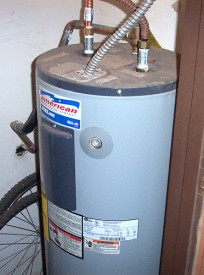
Of course, if you’re like most people, you don’t give your water heater a moment’s thought…at least, not until it stops working. And if your water heater does happen to fail, you’re faced with a quick purchasing decision—one that you don’t have time to research or think through.
Which is a shame. A water heater purchase can affect your family’s utility bills for a decade or more. Choosing an efficient model can help you save money and take control over your utility bills; after all, water heating ranks just behind space heating and cooling in overall residential utility costs. (On average, a residential hot water costs more to run each year than a refrigerator, dish washer, washing machine, and dryer combined.) And if you use electricity to heat your water—as about two thirds of households in the Northwest do—there are new models that can cut your hot water bills in half. The efficient models cost more up front, but can pay for themselves in just a few years of operation.
The biggest problem, though, is simply getting consumers to pay attention to their water heaters. And to do that, we have to know how people think about water heaters in the first place. Thus, the survey. Which you should really fill out.


Careful, you’re going to skew your results. The people that read here are probably more likely to spend more on high efficiency equipment than the average person.
I do wish heat pump units were on the market (and I mean at my local Sears or hardware store) when my hot water heater failed last year. I bought the unit with the most insulation possible (it barely fit in space I had for it), but in our cheap sustainable electricity region a heat pump really makes sense for hot water heaters.
Of course, now heat pump hot water heaters are not only available (3 in stock), but they’re on sale for $999 before rebates, and with free shipping.
Good point. For this survey, we don’t mind oversampling early adopters.
Question 31 was required, but didn’t provide an answer that was valid for me. I wasn’t aware of ANY rebates on my water heater. I had to choose one though. Also, the survey was way too long. I powered through it but would have appreciated a survey half as long.
I live in a 2BR condo, and I will replace my HWH very soon as it is 22 years old!
My understanding based on prior research is that the heat pump technology is only going to work if you have a stand-alone home, so it’s not going to work for me, unfortunately. The same goes for tankless systems, which will NOT run on electricity, as I don’t have natural gas available.
When I moved in 13 years ago, I immediately set the temperature controls to the lowest possible level on the 50gal tank. Furthermore, I only manually throw the breaker switch to “on” a few hours before taking a shower, and then turn it off. This leaves enough hot water for my other needs throughout the day.
I plan to install a 40gal heater to replace the 50gal heater, since I live alone. The closet in which the tank is located is too narrow to support a new 50gal tank anyway, due to my city’s (relatively recent) requirements for earthquake straps and studs to secure the tank in an upright position.
Your survey didn’t take into account such possibilities.
It would have been helpful to have an entry that would have allowed for comments by the survey taker.
Our condo board issued a survey a month ago and is pushing owners to replace their tanks if they are old, and is offering its own rebate as an inducement. Did you know that damage caused by failed water heaters is one of the biggest insurance expenses for condo associations? I learned that fact from Community Assn Underwriters, when I was formerly president of our board.
John,
Electric on demands are available and probably a better choice for you. Most on demand gas heaters require both a larger line than is available to most Seattle homes and need an external wall to mount to for venting. They’re also fairly smelly (I have one.)
However, small point of use water heaters may be an adequate option for your bathroom sinks and such. Larger ones are available but the wiring needs to be very heavy and is difficult to pull through existing walls.
I work at a local hardware store on Phinney Ridge and we install and repair water heaters. We often ask where a water heater is for install, but it also lets us know if you might have a situation where you can put in a heat pump water heater.
They all require at least 700 cubic feet (not possible in closets, utility rooms, etc) and should be installed in an unconditioned space. Otherwise your water heater is using your furnace as your heat source. There go your savings.
For many people that doesn’t work. However, the “standard” hot water heaters are still much more efficient than they used to be. Another reason to change is that water heaters are often warrantied for 6-12 years. They fail so frequently around 12 years that if it’s over 10 years old we will not perform service and will only recommend a new water heater. (https://www.disastersafety.org/research/article?articleId=4426)
Glad you’re calling attention to what most people ignore until its too late!