


Hey gang! We’ve got a new report out today: a literature review on the accuracy of tolling revenue forecasts. In a nutshell, both national and international experience shows that official tolling forecasts tend to overestimate real-world toll road revenue—particularly where drivers can choose alternative, toll-free routes. If the research holds true for our part of the world, there could be lots of implications for highway finance. Read on for more…
It seems like everywhere I look, there’s another story in the news about road tolls. Which shouldn’t be too surprising: every highway megaproject on the books in the states of Washington and Oregon—the Columbia River Crossing, Washington’s SR 520 floating bridge, Seattle’s deep bore tunnel—is counting on robust tolling revenue to help pay for the project costs.
The first up will be SR 520: the state plans to begin tolling the span in December, as part of a bid to raise $1 billion in revenue (about a quarter of the project’s costs) from the drivers who use the facility. To raise that much money, the state is planning to charge $3.50 for a rush-hour trip—or more, if you don’t pay electronically—and up to $2.20 each way on weekends. For a regular rush-hour commuter, the tolls will add about $1,750 to the cost of a year’s trips to and from work. It’s enough money to make many drivers look for other ways across the lake—other routes, other times of day, or even switching to transit. And it’s also enough to convince lots of occasional drivers that a trip on SR 520 across the lake just isn’t worth it.
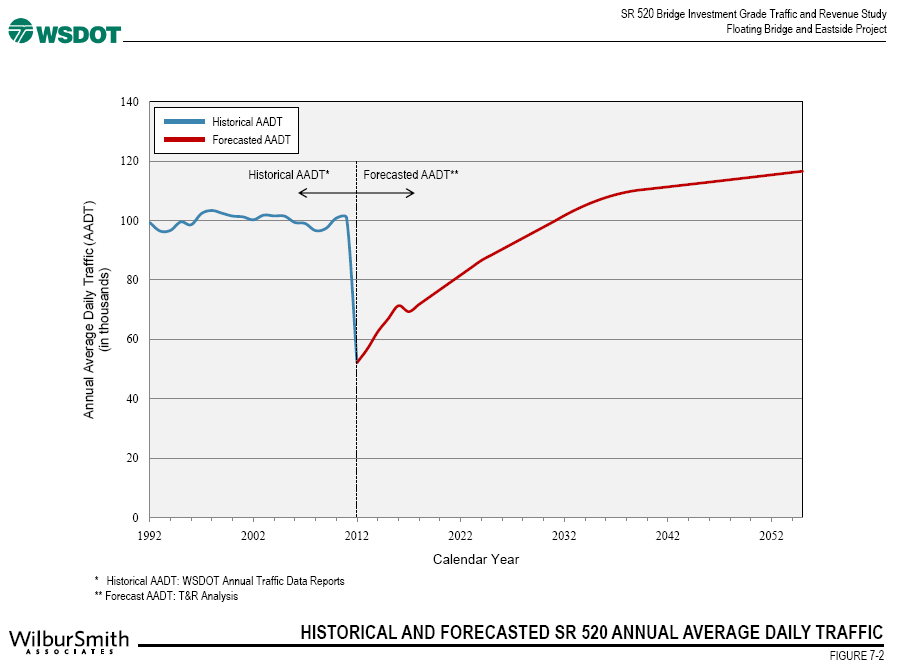
The state seems to agree. As the chart shows, from a recent analysis released by WSDOT, shows that the tolls could cut SR 520 traffic by nearly 50 percent overnight, and slowly creep back to today’s levels by 2032. (Note that traffic declines on a tolled SR 99 tunnel are expected to be even steeper!)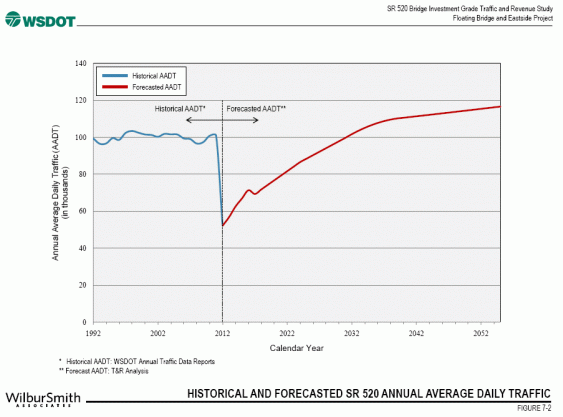
Still, even with steep declines in traffic, the state is confident that the SR 520 tolls will easily pay off a cool billion in bonds. One WSDOT official called the study’s findings “ultraconservative.”
But should the public share WSDOT’s confidence? If history is any guide…maybe not so much. We just finished reviewing the national and international literature on road tolling, and the conclusion is clear: official forecasts systematically overestimate both traffic volumes and revenue on tolled facilities.
More troublingly, the tendency to overestimate is greatest where there are alternative, toll-free routes nearby. So if SR 520 gets steep tolls, and I-90 to the south and SR 522 to the north have no tolls, it’s reasonable to expect to see massive, long-term traffic diversion—diversion that could put WSDOT at risk of substantial toll revenue shortfalls.
It’s all in our new report: Toll Avoidance and Transportation Revenue.
It’s interesting to consider all this in the context of Washington’s Initiative 1125, on this fall’s ballot. In effect, I-1125 would prohibit corridor-wide tolling: for SR 520 the state would have no choice but to leave parallel routes toll-free. That would put the funding stream for SR 520 in even greater danger, while boosting congestion on I-90 and SR 522. I’ll leave it to others to decide whether, from the standpoint of the authors of I-1125, these effects are “bugs” or “features.”

There are several fundamental differences between SR 520 and other U.S. toll facilities; most notably, SR 520 is an existing roadway and has a well-established group of users. The “overestimation” of traffic and revenue noted in this article refers to new projects that don’t have a history of demand for the corridor, which is significantly more difficult to predict. As such, they are not directly comparable to SR 520.
This post also suggests that diversion is significantly worse when a “free” alternative is available. In the case of SR 520, the best free alternative is I-90. But to suggest this alternative is “free” is extremely misleading, given that time is money and in many cases it would take significantly longer to use I-90 as opposed to SR 520. Not to mention, many people using 520 are trying to access the Microsoft campus or the University of Washington… using I-90 to go to either of these places is not convenient, especially during peak travel periods.
Another reason the 520 projections aren’t comparable to other toll facilities is that househould income is significantly higher in the SR 520 corridor relative to the U.S. average (20% to 64% higher according to the WSDOT report). This suggests that an individual’s willingness to pay a toll is also significantly greater.
Only time will tell whether the projections are accurate, but I think there needs to be some acknowledgement in this article that SR 520 is a different type of roadway and should only be compared to other toll facilities with similar characteristics (of which there are none in the U.S.).
Agreed, time will tell. It could be that the state’s forecasts turn out to be, as they say, ultraconservative.
And it’s very true that most of the literature on tolling is based on studies of new toll roads, not existing toll roads.
However, the real point here is this: the folks who will wind up paying for these projects (ie., everyone) ought to understand that official forecasts typically overstate ultimate traffic volumes and toll revenue. Just because the state has “done a study” doesn’t mean that the study is accurate.
This shouldn’t be taken as a critique of the 520 investment-grade study per se; I’m sure that it was done in compliance with all the right standards. It’s just a recognition that other toll-road studies (including others performed by the same consultants) done to the same standards have, more often than not, overstated ultimate revenues.
There’s a bit of a chicken and egg here, though. Projects with studies that are erroneously low may not get built, while projects with studies that are erroneously high do get built. That could skew the sample.
Matt,
I’d just add that 522 is also a free (or at least untolled) alternative to 520 for a good number of people. Trips to/from places like UW’s Bothell campus, Bastyr, and much of the northern Eastside suburbs can easily alter between those two routes.
It’s certainly an alternative, though I don’t think I would characterize it as a good alternative. The number of traffic lights along SR 522–not to mention the limited capacity–creates a huge disincentive to use 522 compared to 520. It’s not to say that people won’t use 522 as an alternative initially, but I think a lot of travelers will quickly realize the benefits of 520 (once it’s tolled) and switch back.
One of the major issues you ignore when you say that SR520 has a track record already is the anger lots of people who are currently using SR520 have about the tolls. Many will avoid the tolls as a revenge against the tolls. Some have promised to be obstructive and slow down traffic if they have to use the road. And of course there is the economic impact of paying a new tax between $2500 and $7,000
It is not true that there is no other roads that where free and then converted into toll roads. Even in this State the Tacoma Narrows Bridge (TNB) was an existing major highway that is now tolled. On the TNB the level of anger about the toll bridge does not exist as many see it as direct user fee for the new bridge. This is not the case on the SR520 where the cars are being forced to pay for bus lanes and they get no direct benefit. Traffic on that road has not meet the predictions and is still falling.
There are other roads in Texas and Florida that where converted into toll roads as well with revenues and traffic falling far short of predications.
Here is an link to the article: Do not dig your own grave with Good to Go. https://www.tollrunner.org/14101.html?entryId=6a2b0f2df49510a70a0e36de9392a45c
Jim McGraw
Tollrunner.ORG
An initially lower toll may solve some of the problems a toll generates. If traffic falls 50% initially with $3.50 toll, maybe a $2.00 toll would cause the traffic volume to decrease insignificantly and therefore generate the same revenue. The toll could then be raised gradually to generate the same total revenue over time. Commuters that get used to taking the toll road would probably not change their route if the toll were increased moderately.