


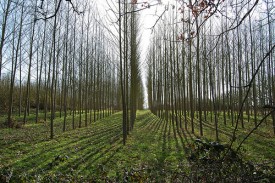
In some cool news from yesterday, the University of Washington and Washington State University got $80 million from the USDA to study wood-based biofuels. Congrats to both institutions—and hooray for research!! We need lots of fresh ideas and smart thinking about all sorts of energy technologies if we’re going to deal with the looming double-threat of global climate change and increasingly costly fossil fuels.
But of course, I’m quoted in a Seattle Times article today expressing some words of caution—and I think I owe a few clarifying remarks. What I’m cautious about is NOT the research itself. Instead, what I’m cautious about is hype.
I think a quote by the US Secretary of Agriculture sums up my fears:
In a phone interview Tuesday, Vilsack said he was confident that at the end of the five-year grant, a new industry would be churning out fuel from trees. “I’d bet my life on it,” he said.
Really? His life?? Needless to say, going from some fairly basic research to broad-scale commercialization in 5 years is a tall order. I’m old enough now to have seen these sorts of predictions before, and mostly they haven’t panned out. (Sigh.)
In the context of today’s federal budget controversies, I worry about how these sorts of sunny optimism affect the way ordinary folks think about energy research. In particular: could raising people’s expectations actually undermine public support for a valuable project?
Imagine, for a second, what happens if the research doesn’t pan out as Vilsack hopes. What then? From my perspective, that’d be just fine!! The research won’t have “failed,” it will just have taught us something other than what we hoped we’d learn. You never know how research will turn out: sometimes it leads to commercial-scale technologies, sometimes it just adds to our understanding of the world. Both are valuable, and well worth the public investment.
But if the public has been told that this kind of research is a sure-fire path to a commercial biofuels industry within 5 years, and the predictions don’t pan out, we run the risk of undermining their support for alternative energy research more generally. Given the ongoing federal budget controversies, folks may conclude that federal energy research is simply a waste of money—that it doesn’t “work” as promised.
To guard against that risk, folks in high places (cough***Vilsack***cough) should be very wary of treating research possibilities as near-certainties.
I feel much the same way about projections for 400,000 acres of fast-growing poplar plantations. That’s an area nearly twice the size of Mt. Rainier National Park. Until we really understand the implications—environmentally and practically—of that kind of major land use shift, I think it’s a smart idea to curb the enthusiasm.
So just to reiterate: the fact that UW and WSU got big research grants for biofuels is great news, and a real credit to both institutions. But hype—particularly from the top—carries some long-term risks. We should definitely go forward with the research…but dial back the hype.


I would like to know if these hybrid poplars are genetically engineered/modified. The article linked to below indicates that higher production of biofuels is achieved from the GM/GE populars, so one must assume that this is the direction they are going.
https://climate-connections.org/2011/05/23/gm-poplars-for-biofuels-in-the-eu-risk-assessment-lacking/