Donate Newsletters
Home » Climate + Energy » Where Cascadians Come and Go

Where Cascadians Come and Go

SwatchJunkies

November 21, 2011

I just extracted myself from this time warp of an interactive map at Forbes. It lets you analyze domestic migration in recent years for every county in the US. Not only can you see population and income summaries for each place, but you can get specific information about the counties that are donating or receiving residents.

Here’s a look at how domestic migration plays out in Curry County, Oregon, population 22,364.
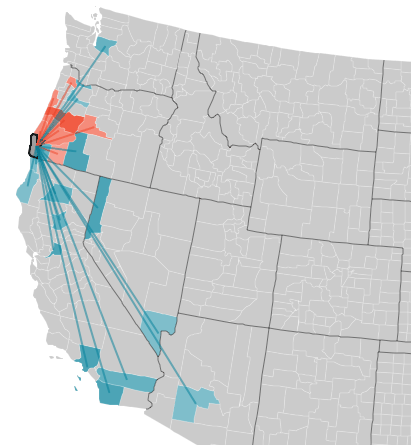
The blue indicates counties that are sending net population to Curry County, while the red shows places that are, on net, taking residents away from the county. (Darker colors indicate larger net migration.) Curry attracted an influx of residents from Seattle, Los Angeles, Las Vegas, Sacramento, and Phoenix. But Curry County lost about 400 people overall from 2005 to 2009, with a net departure of folks into nearby southwest Oregon.

Here’s what Yakima County, Washington looks like.
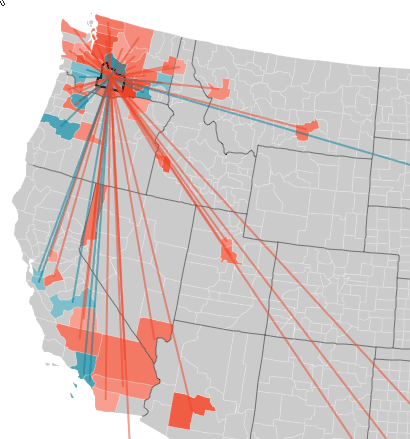
Although Yakima County is dispering residents to a fairly large number of places, it also added about 15,000 people overall from 2005 to 2009. If you mouse over the counties connected to Yakima by migration, you can find fun facts like this: King County traded 564 people to Yakima County for 636 Yakima residents to the big city. Or this: Yakima County sent 32 people to Orange County, California with a per capita income of $17,800, while Orange County sent 57 people to Yakima with a per capita income of just $8,000.

Finally, here’s a look at Ada County, Idaho, home of Boise and a big net gainer of population in recent years.
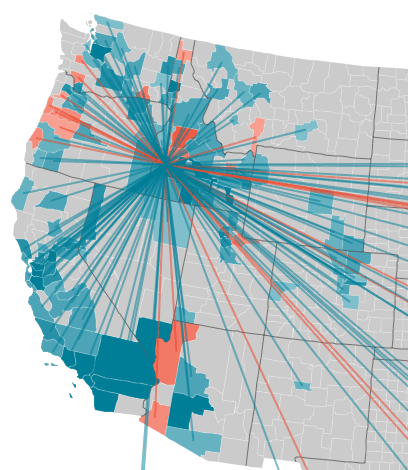
Ada grew by about 45,000 domestic migrants, picking up large numbers of people from southern California, Puget Sound, and much of the rest of Idaho.

I know there’s lots of stuff like this on the web these days, but I found this particular information display to be unusually easy on the eyes. Get over there and play around with it.

Talk to the Author

SwatchJunkies

Talk to the Author

Eric de Place

Eric de Place spearheaded Sightline’s work on energy policy for two decades. A leading expert on coal, oil, and gas export plans in the Pacific Northwest, he is an authority on a range of issues connected to fossil fuel transport, including carbon emissions, local pollution, transportation system impacts, rail policy, and economics.

About Sightline

Sightline Institute is an independent, nonpartisan, nonprofit think tank providing leading original analysis of democracy, energy, and housing policy in the Pacific Northwest, Alaska, British Columbia, and beyond.

For press inquiries and interview requests, please contact Martina Pansze.

Sightline Institute is a 501(c)3 non-profit organization and does not support, endorse, or oppose any candidate or political party.

See an error? Have a question?

Find the author's contact information on our staff page to reach out to them, or send a message to editor@sightline.org.

Thanks to Ralph U. Klose for supporting a sustainable Cascadia.

Our work is made possible by the generosity of people like you.

×
Privacy Overview
Sightline Institute

More information about our privacy notice

Strictly Necessary Cookies

Strictly Necessary Cookie should be enabled at all times so that we can save your preferences for cookie settings.

3rd Party Cookies

This website uses Google Analytics to collect anonymous information such as the number of visitors to the site, and the most popular pages.

Keeping this cookie enabled helps us to improve our website.

Additional Cookies

This website uses social media to collect anonymous information such as which platform are our users coming from.

Keeping this cookie enabled helps us better reach our audiences.