


As I mentioned in my last post, Seattle and Portland have very similar commuting patterns. The biggest difference between the two cities is that Seattle has higher rates of transit commuting, and lower shares of drive-alone commuters, than Portland.
But there are plenty of interesting tidbits about the demographics of transit buried in the commuting data.
Transit and Gender
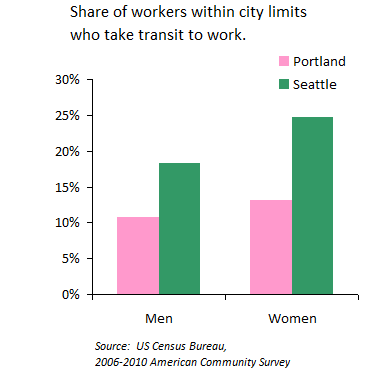
In both Seattle and Portland, women are more likely than men to commute by transit.
Just to be a numbers geek for a moment: in both Portland and Seattle, women represent just under half of all workers, but slightly more than half of all transit commuters.
Transit and Race
In both Portland and Seattle, people of color are more likely than Whites to take transit to work. Native American, Black, and Asian commuters all have higher rates of transit commuting than Whites.
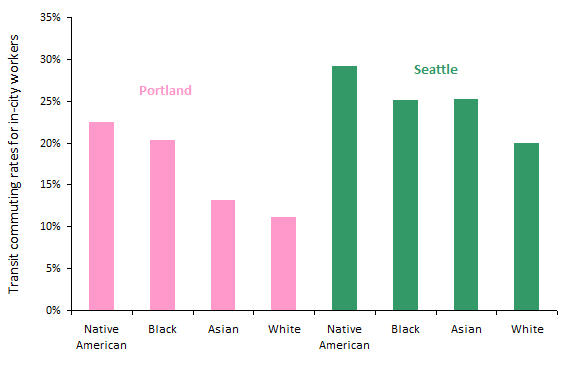
(I should note that I excluded a few categories from the chart above, because the numbers were too small to be reliable. And the chart only shows people who claimed only one race on the census forms. In both cities, respondents with “two or more races” are 2-3 percentage points more likely than Whites to commute by transit.)
Transit Commuting and Age
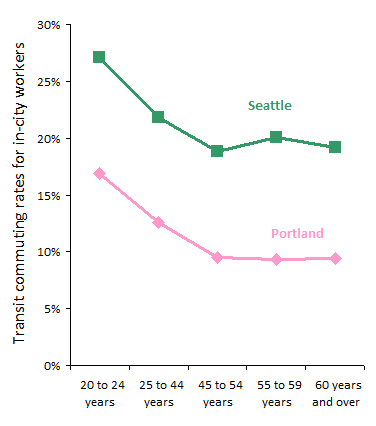
In both Portland and Seattle, young people are more likely than older people to take transit to work. Transit commuting declines through middle age, then flattens out.
Transit and Renting
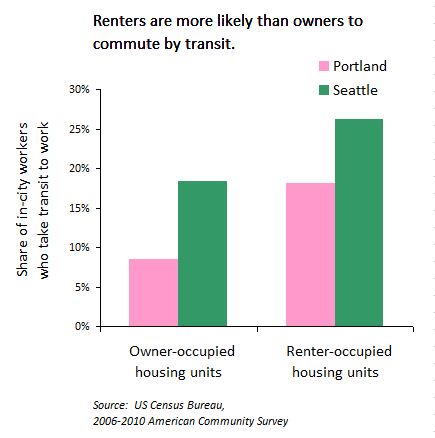
In both Portland and Seattle, renters—or, in census terminology, people who live in “renter-occupied housing units”—are substantially more likely than homeowners to use transit to get to work.
Transit Commuting and Income
One chart to rule them all: the relationship between income and transit commuting offers a potential (though partial) explanation for all of the trends above. In both cities, transit commuting rates fall as annual income increases, though the effect is more marked and more uniform in Portland than in Seattle.
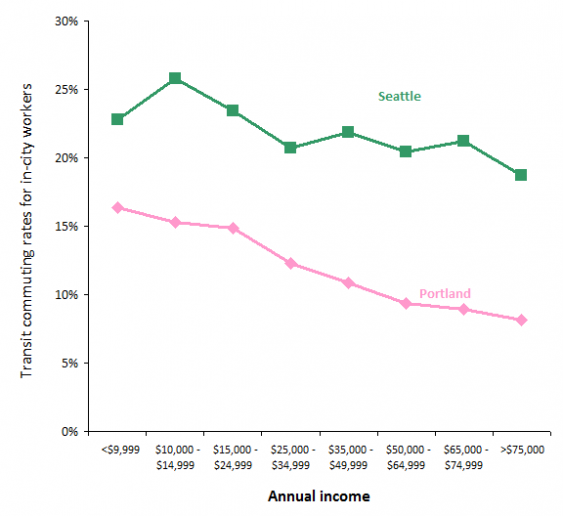
The Upshot
In both Portland and Seattle, being low-income, young, a woman, non-white, and/or a renter increases the odds that you’ll commute by transit.
I don’t want to read too much into the political implications. But looking at the numbers, you might be forgiven for wondering if certain folks who think that we spend too much on transit don’t run in the same sorts of social circles as people who rely on transit to get to work.

good study,
confirms what one would have assumed before the study.
what are the applications of the study?
would Vancouver, bc. study yield the same results?
Okay, I love “one chart to rule them all”. I just had to say it.
Dear friends–great work! I agree with your observation that many of those who make the decisions are living in a separate universe from those of us who rely on transit and bikes. That suggests it would be useful to measure 1) the percentage of transit users who are registered to vote compared to drivers; 2) the frequency at which they vote; 3) what kinds of transit-improvement measures would make them more likely to participate at the polls. If transit users became something of an identified voting bloc, things would start to change in a new york heartbeat!
i bike. It would be interesting to see this study include bikesters. my guess is that white males would be the leading bike commuters. Good study.
Eric Place looked at some of this a while back – but I don’t think he included gender, just race/ethnicity and income.
https://sightline.wpenginepowered.com/2011/04/04/who-bikes/
Nice work. Interesting that Portland with its much ballyhooed transit system and land use laws has substantially less work transit use than Seattle. I suspect it has to do with parking costs and availability and perhaps transit coverage. Seattle Transit, whose operations were assumed by Metro in 1972, had very extensive coverage which was improved and continues to this day.
Unfortunately the Metro service has been degraded in the Link corridor wherein the light rail operation forces many of the former one-seat bus riders into a transfer ride on the trains — recently attended a Hopelink conference and heard of the problems for some of the low income riders in that corridor. But this is perhaps another topic for future discussion.
On the point of “wondering if certain folks who think that we spend too much on transit don’t run in the same sorts of social circles as people who rely on transit to get to work”, you hit upon a sore point. Some of us older transportation planners believe that transit fares should be set much closer to actual cost with income adjustment of fares using the Orca card or other methods. Why should my attorney who bills at outrageous rates have his pittance transit fare be taxpayer subsidized to the tune of 75%.
And another untapped major benefactor of subsidized transit is the downtown property owner since almost all routes serve that major destination. I realize this is a political third rail but why not a CBD transit property tax — seems like fair play to me. Then Metro may have enough money to restore some of its past and future service cuts.
In all seriousness, “young, a woman, non-white, and/or a renter” statistically implies “low-income”.
Can the numbers be normalized to determine if income alone is the main factor? For example, is there enough detailed data to compare wealthy young women versus poor old men?
Sorry, I reread your final graph comment, and you’re asking the same question.
Not with the ACS summary data. I think it might be possible to figure that sort of thing out if the microdata were avaiable. I’d have to look into it.
So for the moment, my hunch that income is “the one trend to rule them all” remains only a hunch — not a confirmed fact.