


The average price that Northwesterners paid for a barrel of crude oil topped $104 last year—even higher than 2008, when global oil price spikes regularly made front page news. Yet at the same time, residents of Oregon, Idaho, and Washington have trimmed back on their oil consumption over the last few years—not only by easing back at the gas pump, but by using petroleum products more sparingly throughout the economy. The best numbers that I could find suggest that as of 2011, total consumption of oil products in the Northwest states had fallen back to about where it was in 2004, give or take.
So which trend had the bigger impact on overall spending: the rise in the price of crude, or the fall in oil consumption?
Well, if you read the headline, you can probably guess: total spending on oil in the Northwest states hit an all-time, inflation-adjusted high in 2011. By my estimates, the Northwest states spent over $24.6 billion on oil in 2011, topping the 2008 high by about $300 million.
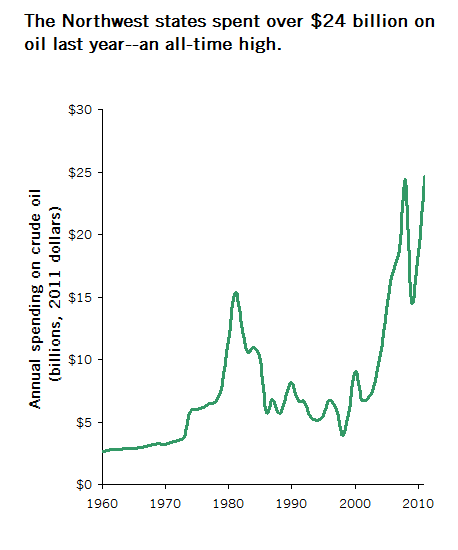 Remember that this is the total money businesses and residents in the Northwest states spent on oil imports. When you look at the prices consumers paid at the pump, our total petroleum spending far exceeded $24.6 billion—but some of that money stayed inside the region, either as gas tax receipts, refinery expenses, or retail margins. The chart above shows only the money that has been exported from the region to pay to import crude oil that was produced in other parts of the country, or the world.
On the one hand, the chart shows that we put a high value on oil—and that we’re willing to buy a lot of it, even when the price is high. On the other hand, it shows what an incredible price we pay—and that we’ll keep paying—for a transportation system that’s reliant on a volatile, increasingly scarce commodity of which we don’t produce a single drop.


How much money per PNW resident do we spend annually on oil and/or all fossil fuels?
And/or how much do we spend just on the “import” of oil you present here?
This would be a useful stat to be able to use.
Thanks!
Measured per person, for ALL fossil fuels (not just oil) I get:
Washington = $2,400
Oregon = $2,093
Idaho = $2,222
NW states overall = $2,276
Looking at the numbers — it looks to me that Washington is a bit high on oil spending than the other 2 states, largely because of higher use of jet fuel and possibly higher consumption of oil in the state’s refineries.