
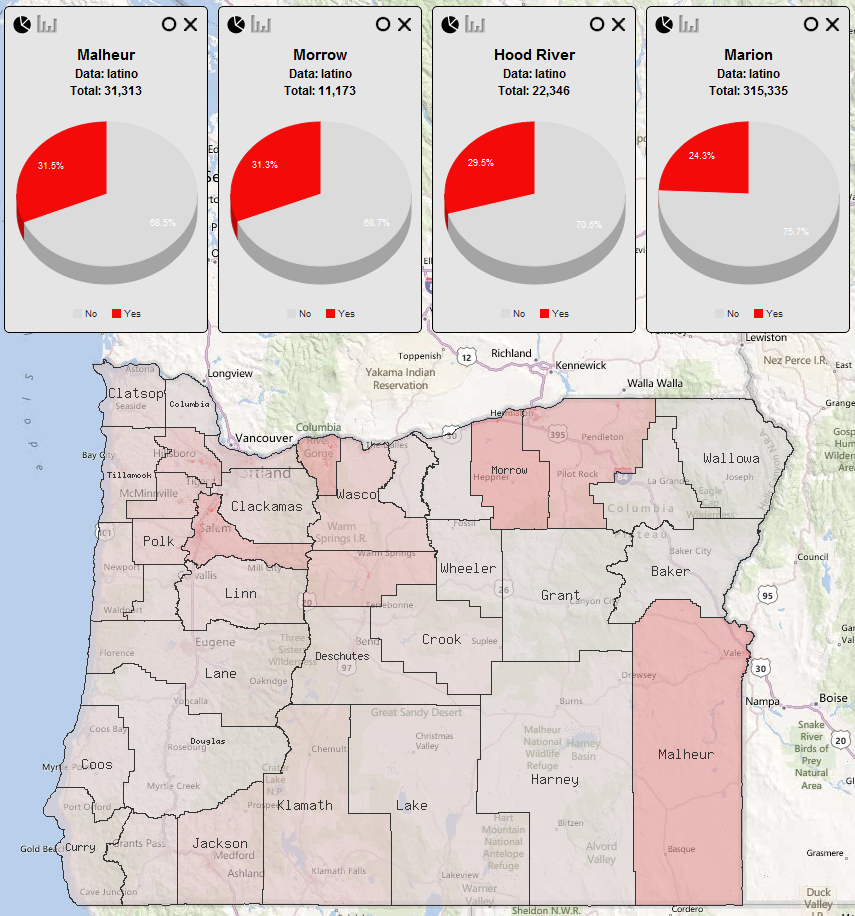


Sightline’s pals at Moonshadow Mobile, down in Eugene, OR, have just developed a nifty tool for visualizing data from the US Census. Here’s a look at the county-level distribution of Oregon’s Latino residents:
Today, more than one out of nine Oregon residents self-identify as Latino. And Oregon’s Latinos don’t just live in isolated pockets, or in one part of the state. Latino families reside in big cities, small towns, and rural areas; on both sides of the Cascades; and in both the north and the south of the state.
There are, of course, communities with a high concentration of Latino residents. In four counties—Malheur, Morrow, Hood River, and Marion—Latinos represent a quarter or more of all residents. But even there, there’s geographic diversity. Marion County, just to the south of Portland, is a comparatively high-population county: many of the county’s Latinos live in Salem, the state’s third-largest city, and a substantial number live in the town of Woodburn (population 24,080, nearly 60 percent of whom are Latino). In contrast, Malheur, Morrow, and Hood River are all small and predominantly rural counties; Malheur in particular is a highly rural, low-density, sparsely populated place.
In short, there is no geographic location that’s “typical” for Oregon Latinos. Latinos are urban, suburban, and rural. In Oregon, the Latino geography looks a lot like…well, like Oregon itself.

Would you happen to have current Hispanic population numbers for Jackson County Oregon? And if you have a percentage for White City that would be great.
Thank you.
The Census Bureau has estimates for 2013:
https://quickfacts.census.gov/qfd/states/41/41029.html
https://quickfacts.census.gov/qfd/states/41/4181450.html
Oregon: 12.3% Hispanic or Latino
Jackson County: 11.7% Hispanic or Latino
White City: 28.8% Hispanic or Latino