


Following up on a recent post on race and driving, here’s data from the American Community Survey on Northwest commuting patterns by race and ethnicity—showing that both Hispanics and Blacks are more likely than the Northwest’s white residents to seek an alternative to solo driving for their daily commute. (Just to be clear, I’m using the census term “Hispanic” interchangeably with the word “Latino,” the census term “Black” interchangeably with “African American,” and the census term “White alone” interchangeably with “white.”)
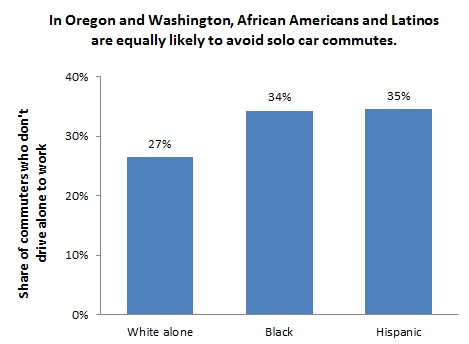
But despite the superficial similarities there are some major differences in Black and Hispanic commuting patterns.
African Americans and Latinos are about equally likely to work from home, and to bike or walk to work—and do so at rates that are almost identical to whites. But for other modes, there are striking differences: Latinos are far more likely to carpool, and far less likely to take transit, than African Americans.
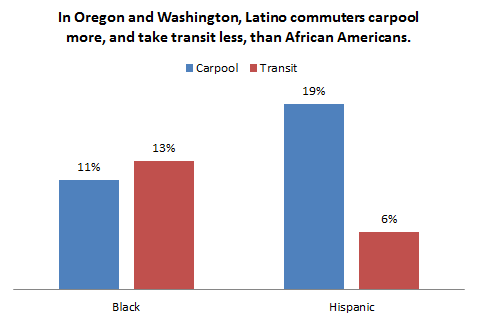
As I mentioned before, it’s tempting to see these differences as evidence of some sort of “cultural preference” for carpooling, or perhaps a “cultural aversion” to transit, among Latinos. But simpler explanations probably suffice: the northwest’s African American population is concentrated in urban areas, where transit service is more readily available; while the Latino population is in more dispersed rural areas, where transit is sparse.
As the Northwest’s Latino population grows, we may see a short-term increase in carpooling as well. Yet there’s no way to tell how long that increase will persist. If Latinos find pathways to high-paying jobs, or if they tend to move from rural areas to cities and suburbs, we could see a gradual shift away from carpooling among Latinos—a shift that will gradually put more pressure on city and suburban policymakers to help more people of all races to get around in something other than a single-occupancy car.
