


Preliminary data from the US Energy Information Administration suggests that total oil consumption in the United States fell by about 1.5 percent last year—meaning that the country as a whole used about as much oil in 2012 as it did in 1994.
But meanwhile, the nation’s population grew by 19 percent. And falling consumption coupled with a rising population has led to a striking decline in per capita consumption. Just take a look…
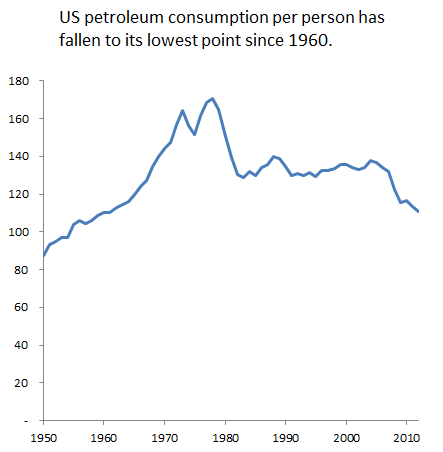
Don’t you dare attribute that trend just to “the recession.” No siree: the sharp decline in per capita oil consumption started in roughly 2004, when the economy seemed to be humming along quite nicely. That’s when oil prices started rising sharply—leading industries and consumers to start looking in earnest for ways to cut back on consumption. Some of the oil cutbacks came from fuel switching, particularly from oil to natural gas. But much of the cutback came from plain old conservation: driving a bit less, boosting energy efficiency in homes and businesses, and so forth. The recession certainly added to the trend, but didn’t start it.
I take all this as pretty good news. In many ways, we live a lot better than we did back in 1960—but as the data shows, it’s not because we’re using more oil.


Switching from Diesel to LNG seems to be just getting started. (here and here) This will be a welcome quick fix to lower CO2 emissions although there are still open questions on the sustainability of the boom in natural gas production. Fingers crossed we can work this all out while simultaneously becoming more efficient.
Totally agreed…though I do wonder how quickly fuel switching will actually happen with diesel. Hard to know.
That said, the boom in natural gas scares the daylights out of me — mostly because of the potential for fugitive emissions. Is fracking worse for the climate than coal? Tough to say, but if so…yuck.
Fracking is definitely NOT worse than Coal, way cleaner in fact!
Love this ongoing focus at sightline on USA fossil burning trends.
Also want to point out that it isn’t just oil. The EIA data I crunched a few months ago showed USA per-capita oil, coal, methane and CO2 have ALL fallen to levels comparable to those in the 1960’s (or even early 50s for coal).
With oil the primary driver is certainly pricing. With coal and methane there seems to be a mix of policy, pricing and alternatives that are driving it.
Good news for sure, and, I too, appreciate the continued focus on fuel trends.
What, though, can we do with this info? There is certainly more value here than from the discovery of the next prime number; I just can’t figure out where to go with it, if anywhere.
Good question. I often look at things like this simply because I find it interesting. But I can see a real value in demonstrating that “progress” and “more oil” just aren’t linked–value perhaps not in a specific policy context, but in an important shared understanding that underlies many policy decisions and debates.