
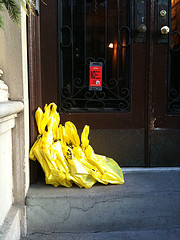


There was disappointing news a couple of months ago on Seattle residents’ right to say no to yellow pages directories. As reported in the Seattle Times, the city settled a lawsuit over an enormously popular law that created an “opt-out” system for phone books.
While the newspaper headline focused on the cost of the settlement, the real story is that so many people opted out in 2011. The first year the ordinance was in effect, phone book deliveries were down by 1 million from the prior year.
People were happy to have a choice, to finally be able to say “no thanks” to phone books they didn’t want, rather than tossing them into their recycling bins. By fining directory companies who failed to comply, the city’s law made choice a reality. That’s why it’s frustrating that the city gave up the fight.
When phone book companies sued Seattle over the ordinance, the US District Court sided with the city, saying government had a legitimate interest in reducing waste and preventing unwanted books from being deposited on private property. The court reasoned that yellow pages are “commercial speech,” which has less protection under the First Amendment than other forms of speech. Its decision stated, “There is no fundamental right to deliver yellow pages directories to the doorsteps of residents who do not want them.”
Unfortunately, the 9th Circuit Court of Appeals overruled that decision. A three-judge panel concluded that yellow pages directories, like newspapers, are non-commercial speech entitled to the full protection of the First Amendment. As non-commercial speech, restrictions on content are allowed only if they are the least restrictive possible. The court ruled that the city’s ordinance unreasonably restricts the free speech rights of the corporations who drop unwanted phone books at your front door.
The judges stopped there — they did not even consider whether the city and its residents have a valid interest in (1) waste reduction, (2) privacy, and (3) cost recovery. Here’s what the judges said: “We need not determine whether any or all of these interests are “compelling…” Their opinion went on to suggest that the city has other alternatives for enforcement.
The city apparently thinks an appeal to the US Supreme Court is unlikely to succeed, prompting the settlement. Yet common sense suggests that if corporations have a right to free speech, it means they can publish all the phone books they want. But it should not confer the right to come onto private property and deposit piles of books unwanted by the property owner.
Worse yet, the phone book companies will not even have to pay the disposal costs for all those phone books that end up in recycling and in the trash. They foist that cost onto taxpayers.
And phone books are heavy.
In 2010, before opt-out, the public had to pay for disposal of about 1,500 tons of directories in Seattle. By 2012, the second year of opt-out, that figure dropped to just 500 tons. In other words, the waste from unwanted phone books declined by 1,000 tons, already saving the city money on disposal costs.
The reduction in tons of waste was achieved three ways. More than 75,000 households and businesses stopped nearly 420,000 unwanted phone books. One of the big publishers, Superpages, got the message from Seattle residents and left the market; its books are no longer delivered. Another big publisher, Dex Media, streamlined several books into one. Reducing waste means lower disposal costs for the city and its residents.
After Seattle’s Opt Out program ends, it’s still possible to tell the yellow pages companies which books you don’t want by going to the website of the national Local Search Association. The drawback? Under their voluntary system, they are not required to honor your choices, and there’s no penalty if they don’t. Plus, the default setting is delivery of multiple phone books to your doorstep.
One idea offered to Seattle by the judges of the 9th Circuit: find a way to enforce this voluntary system offered by the yellow pages companies. Fine them if necessary.
Seattle is doing the right thing by reducing waste and helping residents stop unwanted phone book deliveries. The Seattle Opt-Out ordinance has been a huge success in a short time. It balances free speech and property rights, it saves money on disposal, and people love it.
The city should take the advice of the 9th Circuit Court: find a way to preserve Seattle residents’ right to say no to phone books.
Jeanette Henderson is chair of the board of directors of Sightline Institute and a member of Zero Waste Seattle. Heather Trim leads Zero Waste Seattle, a grassroots community group and coalition of environmental organizations that promotes optimal management and conservation of resources. You can find more by Sightline on the importance of reducing unwanted yellow pages deliveries here:

Sigh. It wouldn’t even be so bad if it was just one type of phone book — but these days we have dueling phone books from different companies, so we get extra-credit unasked-for deliveries of multiple doorstops on our doorsteps. Crazy.