
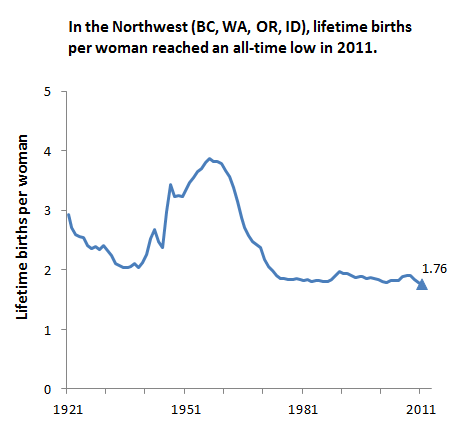


 According to the latest figures, birth rates in Cascadia (British Columbia, Washington, Oregon, and Idaho) have fallen to what could very well be an all-time low. And when I say “all time” I mean it: it’s quite possibly the lowest birth rate since humans first came to the Northwest.
(Click on the chart for a larger version.)
Of course, there’s no way to know with any certainty what the birth rate was before records were kept—but in times of high infant mortality, birth rates were generally far above what we see today. So it’s quite likely that the human inhabitants of what we now call the Northwest have never had such small families.
Oddly enough, though, birth rates in each Northwest jurisdiction have been lower at some point in the recent past. From the mid-1970s through the mid-1980s, Washington’s birth rates were lower than they are today. Oregon’s birth rates dipped below today’s in the mid-1970s; Idaho’s rates were lower in the late 1980s; and BC’s were lower in the early 2000s. It’s only when you combine all four regions that you see that today’s birth rates have fallen to an all-time low.
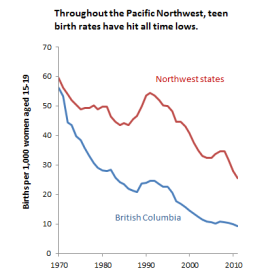
I’m sure that this news could send some people into a panic about a “birth dearth.” But remember that a large share of the fall in fertility can be traced to a rapid decline in teen birth rates—which are now almost certainly at their lowest level of all time. (See the chart to the right.) If teen births hadn’t fallen, overall birth rates today would remain higher than they were in the mid-1980s. So to a large extent, lower fertility rates are a cause for celebration: they suggest progress in giving teens both the reason and the ability to delay childbearing.
And now for the caveat: treat these figures with caution. After the 2010 census, Washington revised a decade’s worth of birth rates downward. So there’s always a chance that new population estimates could jiggle these numbers around a bit. That said, those sorts of changes tend to be very small—meaning that even if we aren’t at an all-time low in fertility, we’re pretty darn close.

Birth rates globally need to come down further, faster. It’s pretty simple really. There are far too many people on Planet Earth, and we are consuming far too much per person.
Too many people; too much consumption.
I think that sums it up well, but to cooperate to accomplish that on a global scale we need to be led by political leaders who will help organize that transition. Instead we have too many political leaders who are installed and/or enthralled by the economic powers that be, the oligarchs, who desire only growth in all things, especially population and consumption, for their short-term economic gain.
I’d like to hear more specifics about what we can do to instill good sense into that class of oligarchs and our political leadership. Effective action requires accurate analysis.