


This article was originally published on PBS Newshour’s Making Sen$e blog May 30, 2014, reprinted here with permission.
One of my goals in life as an environmental economist is to harness market forces to fight climate change. And I like to find innovative ways to communicate that message: hence the stand-up economist gig, which started as a hobby and is now my full-time occupation.
Another innovative communication approach is cartooning, and I’m delighted to share with you a chapter from my new book, The Cartoon Introduction to Climate Change, co-authored with and illustrated by Grady Klein. Grady and I also wrote the two-volume Cartoon Introduction to Economics, and both of those books touched on climate issues a bit. The new book provides an expanded treatment of climate science and policy using the same engaging cartoon format. (For more on our collaborative artistic process, see our Island Press Field Note that follows a page from idea to printed page.)
Cartooning has a bit of a bad reputation here in the U.S. in that people think it’s “just for kids” silliness. But in fact, cartooning is a terrific way to convey information, and my books with Grady are based on the idea that something can be fun and intellectual at the same time. That’s also true of my stand-up comedy career, and both the comedy and the books involve boiling down complicated topics and making them accessible to high school and college students and the general public.
Other countries like Japan and France have a greater degree of respect for cartoon books—the 12 foreign translations of Cartoon Econ are outselling the English-language version—but if you’d like to judge for yourself then take a look at our chapter below on carbon pricing.
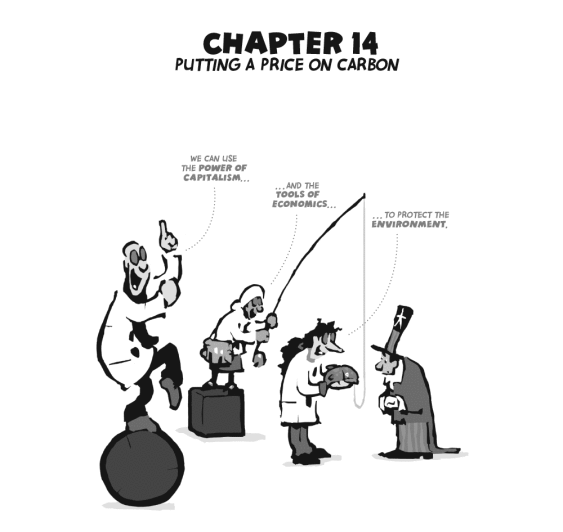
“Carbon pricing” is an umbrella term that includes both carbon taxes and cap-and-trade systems. They’re both ways to put a price on carbon—in other words, ways to harness market forces to reduce carbon emissions. They’ve both been in the news a lot lately, but there’s still a great deal of confusion about how they work and how they differ from each other and from more traditional regulatory approaches like fuel-economy standards. So, with that introduction, here’s chapter 14 from The Cartoon Introduction to Climate Change:


All images reprinted with explicit permission.


This is fantastic. So simple and clear, even funny. It almost seems like a child could understand carbon taxing from this, so certainly a congressman could too, right? Have you presented or sent this to Congress?