
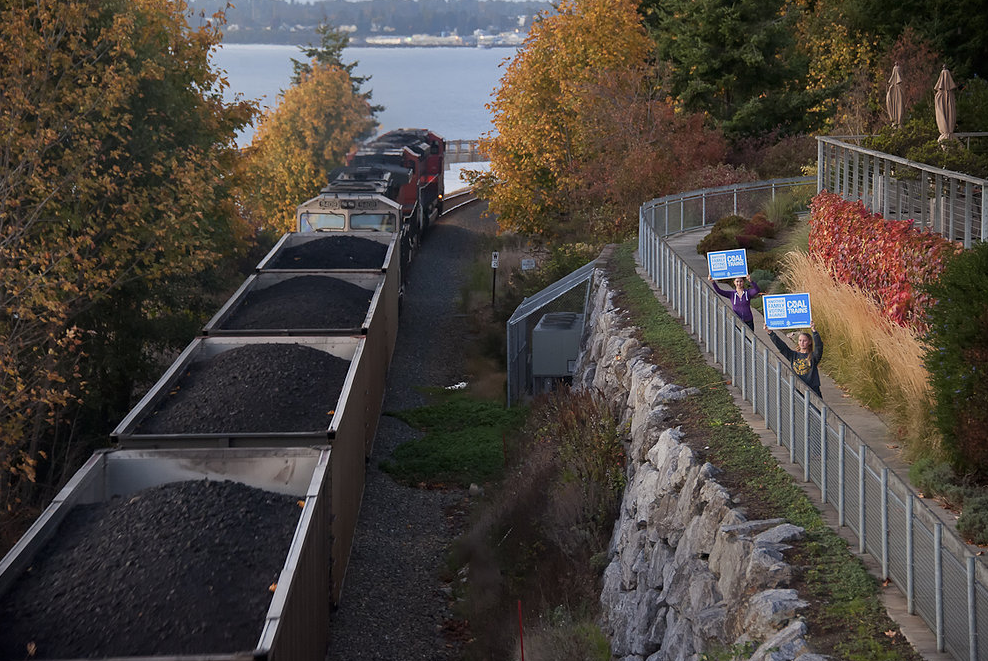


Today, Sightline is releasing a new report on the US Bureau of Land Management’s coal leasing programs: Unfair Market Value: By Ignoring Exports, BLM Underprices Federal Coal. As the report documents, coal companies operating in the western United States are buying coal from the American public with the explicit goal of shipping that coal overseas…yet the BLM is ignoring the potential profits from coal exports when setting its prices. As a result, the agency is giving away publicly owned coal for a song—boosting coal company profits, while denying the American public of millions of dollars of revenue each year. For details, read on…
Perhaps you may have seen some of the mile-long coal trains that are now plying the rails in the Pacific Northwest, carrying coal to export terminals to be shipped to Asia. And perhaps you’ve even paused to wonder how those companies got hold of all of that exportable coal in the first place.
As it turns out, there’s a simple answer to that: if you’re a US citizen, they got that coal from you.
The American public, you see, owns vast deposits of coal throughout the western United States. Most of the coal in the Powder River Basin, for example, is owned in common by all Americans. The same is true for major coal deposits in Colorado, Utah, New Mexico, and other states. The coal companies don’t own it: you do.
If coal companies want to mine that coal, they’ve got to go through the US Bureau of Land Management’s (BLM) coal “leasing” program, which gives private companies access to public coal in exchange for leasing payments, royalty payments, and compliance with some basic environmental requirements.
But here’s the thing: the BLM gives away federal coal for a song—sometimes just pennies per ton. And what’s worse—as documented by Sightline’s latest report, Unfair Market Value—BLM almost completely ignores the potential profits from coal exports when deciding on the minimum price it will accept for federal coal.
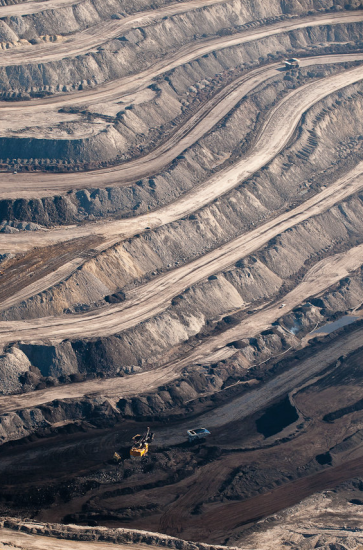
Many coal companies have been very explicit with investors and regulators about their plans to boost coal sales to overseas customers. In many cases, they’ve even identified the specific mines that will supply the export markets. Some of these companies hope to lease new supplies of coal from BLM, with the stated intent of exporting this coal to Asia.
Without the Asian market, many of these companies simply would not be interested in leasing federal coal at all. But with the Asian market, they believe they can reap significant profits from coal mining.
Yet even so, when deciding on the so-called “fair market value” of federal coal—the lowest price that BLM will accept for a bid on federal coal—the agency essentially ignores the export market. Despite all evidence to the contrary, BLM continues to assume that coal will be sold domestically.
If you’ve been looking at the stock performance of some of the big US coal producers, you’ll see that selling coal domestically has been deeply unprofitable of late. So assuming that coal will be sold domestically, where profits are slim, rather than internationally, where profits sometimes can be much higher, is tantamount to a giant subsidy to private coal companies. It’s a giveaway, pure and simple: when BLM ignores the economics of coal exports, the American public winds up selling a valuable resource at bargain basement prices. That boosts profits for coal companies…but shortchanges the American public by millions of dollars each year.
For all of the gory details, read the full report: Unfair Market Value: By Ignoring Exports, BLM Underprices Federal Coal.

Good work, Clark, I couldn’t have said it better myself. If the coal companies, and their customers, had to pay for all the real costs of coal, they’d be out of business tomorrow.
The most interesting thing is, you can see coal subsidies built into stock prices. Cloud Peak operates only in the Powder River Basin, and at the moment it only mines federally owned coal. Virtually every other coal company stock is in the dumps, but Cloud Peak is doing OK. The ONLY reason for that is that the company leased its coal for pennies. They bought Spring Creek coal for 18 cents per ton!! Boost that up to a real “fair market value” for coal, and Cloud Peak’s stock prices would look a lot like all of the other coal miners across the country.
Additionally, when the Powder River coal fields were expanded by former Sec. Salazar in 2011, it was under the auspices of filling domestic energy needs, not for corporate profit by export to Asia:
https://www.blm.gov/wo/st/en/info/newsroom/2011/march/NR_03_22_2011.html
“”Coal is a critical component of America’s comprehensive energy portfolio as well as Wyoming’s economy,” Secretary Salazar said in making his announcement with Wyoming Governor Matt Mead. “As the number one coal producer from public lands, Wyoming provided nearly 40 percent of the domestic coal used to generate electricity last year and it’s important that we continue to encourage safe production of this important resource.”
“I applaud Secretary Salazar and his agency for moving forward with these leases,” Governor Mead said. “The electricity our country needs to thrive has to come from somewhere and right now coal powers many of our cities and industries. This coal also keeps Wyoming men and women working.”
Exactly. As the report mentions, BLM itself describes coal leasing as a way to meet *domestic* energy needs. From the report:
For example, in its record of decision for the North Porcupine LBA, which was granted to Peabody Energy, the agency declares:
The Federal Coal Program encourages the development of domestic coal reserves and the reduction of the United States’ dependence on foreign sources of energy. BLM recognizes that coal extraction is currently necessary in order to meet the nation’s energy needs. A primary goal of the National Energy Policy is to add energy supplies from diverse sources including domestic oil, gas, and coal.
Thanks for pointing out the give away of public coal to increase global pollution. The point should be to phase out all coal mining to reduce global warming and sulfur and mercury pollution. Obama and the progressive Democrats must take on this issue directly after their good start on regulating domestic coal fired electricity. As the quote from Sec Salazar above shows we are far from getting Democrats to this commitment.