
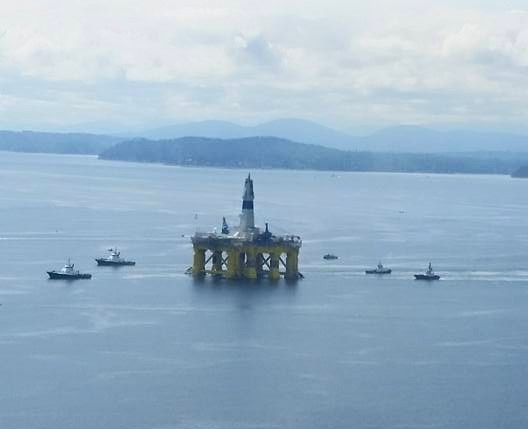


Yesterday afternoon, Shell Oil’s titanic drilling rig made its way into the Port of Seattle, where it will undergo repairs before heading north to drill in the Chukchi Sea off Alaska’s north coast this summer. After local company Foss Maritime inked a secretive lease with the Port to repair two of Shell’s skyscraper-sized oil drilling rigs, the region has been embroiled in a raging controversy over the wisdom of allowing the second largest company in the world to use Seattle as a staging ground for Arctic oil drilling. Shell’s last run at Arctic oil, when the company’s flagship Kulluk drilling rig ran aground near Alaska’s Kodiak Island, was a signal failure, but Shell plans to return to the precarious Arctic seas this summer for another try at tapping the oil reserves.
And in Skagit County, Shell has plans to build a large oil train facility at its Anacortes Refinery. After the county hearing examiner recently determined that the company should conduct a full environmental review of the project, Shell sued the county. The case will be heard this month.
Shell’s schemes have the region in an uproar, so now is a good time to explore the oil company’s well documented record of interfering in Washington’s politics.
Curiously unlike its major oil company peers (notably Tesoro), Shell makes few direct contributions to candidates for office, preferring to route its political spending through the shadows. During the 2012 and 2014 election cycles, for example, Shell gave a mere $2,500 directly to candidates in Washington: $2,000 to Democratic Congressman Rick Larsen (a perennial winner of fossil fuel industry spending) and $500 to Republican Congressman Doc Hastings. In 2012, Shell also gave $60,000 to the conservative Association of Washington Business PAC, a group that has been an intractable opponent of Governor Inslee’s Carbon Pollution Accountability Act, as well as other clean energy reforms.
Yet the rest of the oil giant’s spending in Washington—and it’s a lot—is much harder to track. From 2010 to 2014, Shell spent $396,187 on lobbying, a vague term usually associated with hiring representatives to interact with legislators. But lobbying expenditures can also be used to secretly funnel funds to projects and politicians—and Shell has done so with gusto.
[prettyquote align=right]”Pushing Shell’s colossal rig out of Elliott Bay is one thing. Ridding Washington’s democracy of the company’s influence is quite another.”[/prettyquote]
The giant spent hundreds of thousands of dollars on state lobbying over the last three election cycles. Public records show that Shell earmarked $110,000 for contributions to candidates using a clever but simple camouflage that works like this: Shell routes the money through local lobbyists Steve and Kathleen Gano, of the firm Gano and Associates, who in turn hand out the money to favored legislators. (In a typical year, Gano and Associates pulls down around $1 million in compensation from its clients, and the firm regularly ranks among the top five lobbying firms in Washington.) In theory, it’s simple pass-through spending, but by bouncing the money off Gano, a firm with many other clients and many other lobbying contributions, Shell is able to effectively mask the destination of its money from the prying eyes of the Washington public, or at least make tracking it prohibitively difficult. Steve Gano is one of the top paid corporate lobbyists in the state and is consistently among the highest spenders on wining and dining legislators.
Shell’s plans for the Arctic and the Port’s circumvention of a public process have stirred outrage with everyone from Greenpeace activists to the Mayor’s office. Yet the oil company’s influence in the state runs much deeper than the waters off the city’s port, and Shell is by no means unique. Oil, coal and gas interests put $3 million into the state in 2014 alone.
Pushing Shell’s colossal rig out of Elliott Bay is one thing. Ridding Washington’s democracy of the company’s influence is quite another.

