
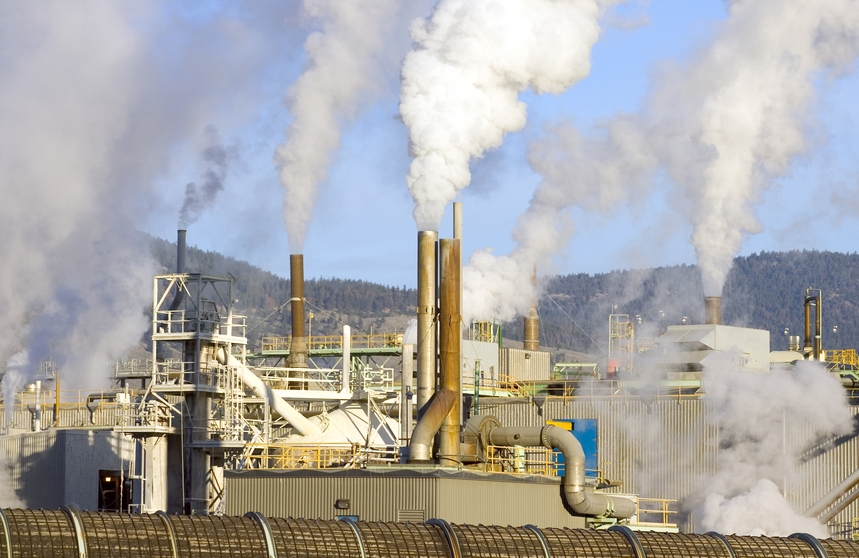


The methanol refinery proposed for Kalama, Washington, is, by any measure, a goliath. On the banks of the Columbia River in southwest Washington, the project’s backers aim to build a petrochemical plant to convert natural gas, much of it fracked, into liquid methanol for export to China’s plastics industry and vehicle fleet.
Operating the facility at full capacity would require staggering volumes of gas.

A new Sightline analysis finds that the project’s demand for gas would dwarf the consumption of the Northwest’s biggest cities combined. Even adding up all the gas used by every home, business, and industry in Seattle, Portland, Tacoma, Spokane, Bellevue, Eugene, Bellingham, and Corvallis, it does not come close to equaling the voracious appetite of the methanol export plans at Kalama.
Supplying that much gas would be a climate disaster. Researchers at Stockholm Environment Institute calculated that simply extracting and transporting the volumes of gas required by the facility could produce 4 million tons of carbon dioxide-equivalent—more than is emitted by every activity in the city of Seattle annually—and that’s just the total owing to methane leaks along the supply chain and does not include emissions at the site itself or when the methanol is ultimately used.
Notes and methods
(Except where noted, Sightline used the most recent greenhouse gas data available for each jurisdiction.)
Kalama methanol export project: 121,121,600 dekatherms per year from the Federal Energy Regulatory Commission’s environmental assessment of the feeder pipeline to the project, which reports 320 million cubic feet of gas per day and assuming that one thousand cubic feet of natural gas equals 1.037 dekatherms.
Seattle: 22,270,132 dekatherms per year from Stockholm Environment Institute’s “2014 Seattle Community Greenhouse Gas Emissions Inventory,” converted into dekatherms using the EPA’s conversion factor of 0.0053 metric tons CO2 per therm.
Multnomah County (reported here as “Portland”): 27,276,876 dekatherms per year from the “City of Portland and Multnomah County Climate Action Plan,” which reports data from NW Natural, the sole natural gas utility for Multnomah County.
Tacoma: 3,996,321 dekatherms per year from the Tacoma Office of Environmental Policy and Sustainability, “Community and Government Operations Greenhouse Gas Emissions Inventory 2016.” Sightline uses 2012 data for Tacoma because the most recent year available, 2016, reports abnormally low natural gas usage owing to the loss of a single industrial customer, a condition not expected to continue. Natural gas data provided by Puget Sound Energy and converted into dekatherms using the EPA’s conversion factor. (Tacoma also includes data from CNG used in Tacoma by Pierce County vehicles.)
Bellingham: 3,128,614 dekatherms per year from the City of Bellingham, “Greenhouse Gas Inventory and Climate Protection Action Plan.” Natural gas data provided by Cascade Natural Gas and Northwest Clean Air agency in million BTUs, which Sightline converted to dekatherms using a standard conversion factor of 1 million BTU per dekatherm.
Bellevue: 5,102,000 dekatherms per year from the City of Bellevue, “Community Energy Usage,” as reported by Puget Sound Energy.
Spokane: 7,736,662 dekatherms per year from the City of Spokane Environmental Programs, “Greenhouse Gas Inventory Report for 2010-2012” as reported by Avista.
Corvallis: 3,248,565 dekatherms per year from the City of Corvallis, “2012 Community Greenhouse Gas Inventory Report,” as reported by NW Natural in BTUs and converted to dekatherms by Sightline using a standard conversion factor of 1 million BTU per dekatherm.
Eugene: 4,574,962 dekatherms per year from the City of Eugene, “Community Greenhouse Gas Inventory,” converted into dekatherms using the EPA’s conversion factor.

Salem is bigger than Corvallis, but is not included. Why not ?
Pete, great question! Our researcher said we don’t have data available that’s comparable to the others. So we made a comparison based on the data that we could find. Thanks for asking!
Thanks for another fantastic visual on the fracked gas guzzling monster proposed in Kalama WA. One correction though. It should be 320 million cubic feet of gas per day not 320 thousand million cubic feet of gas per day, first paragraph under notes. With that correction then 121,121,600 dekatherms per year is accurate.
Why can’t we (China and the US) use recycled plastic instead of starting from scratch. An abundance of plastic already seems to be an environmental problem.
Although gas can produce therms, we don’t know if this gas will be. Some fraction will be converted to plastic.
Your statement is not clear to me. Gas measurements can be confusing. Therms are a measure of heat, that is equal to 100,00 btu. Some gases are hotter than others. For most of the country it takes about 100 cubic ft. of natural gas to equal a therm. But that can vary from place to place and with elevation changes.