
Takeaways
- Passed overwhelmingly by Seattle voters ten years ago, the city’s democracy voucher program is a model campaign finance reform that has surpassed many of the original initiative’s goals.
- It’s let tens of thousands more residents support local candidates they believe in; donors are now much more representative of Seattle as a whole; and more diverse candidates—including women, people of color, and younger Seattleites—are running, connecting with voters, and winning office.
- Candidates rely less on large donations from a few wealthy donors and more on small donations from people throughout the city, with both candidates and residents noting more direct engagement after vouchers came into play.
- The levy that funds Seattle’s democracy voucher program, a strikingly small amount for the benefits it delivers, will need to be renewed by voters this August.
Find audio versions of Sightline articles on any of your favorite podcast platforms, including Spotify, YouTube, and Apple.
Money doesn’t always win elections.
But it sure does help.
And Cascadia’s biggest city has a proven tool that democratizes who gives to city-level candidates: democracy vouchers. The program is now ten years old and has been through enough election cycles to tell if it’s working as intended.
The conclusion? This program is crushing its goals.
It has unlocked “an incredible explosion of participation” of people giving to candidates, in the words of researcher Dr. Jennifer Heerwig of Stonybrook University (who, with coauthor Brian McCabe of Georgetown University, wrote the actual book on Seattle’s democracy voucher program). The people who donate to Seattle campaigns are now a much more diverse slice of the city’s population than they used to be. Big-dollar and out-of-city campaign contributions have fallen dramatically.
And it’s fundamentally changed how candidates approach running for office. No longer spending all their time dialing for dollars, candidates instead visit potential “donors”—regular Seattle residents—door to door, collecting vouchers, small-dollar donations, and ideas for what the people of Seattle care about most. Since the program began, Seattle voters have been able to choose from a greater variety of candidates and seen more competition between people running. That’s increased the accountability of officeholders and the transparency of elections: both wins for local democracy.
After ten years, the miniscule property tax levy that funds the program is expiring, and Seattle voters have an opportunity to renew it in August’s primary election.
Ten years of democracy vouchers
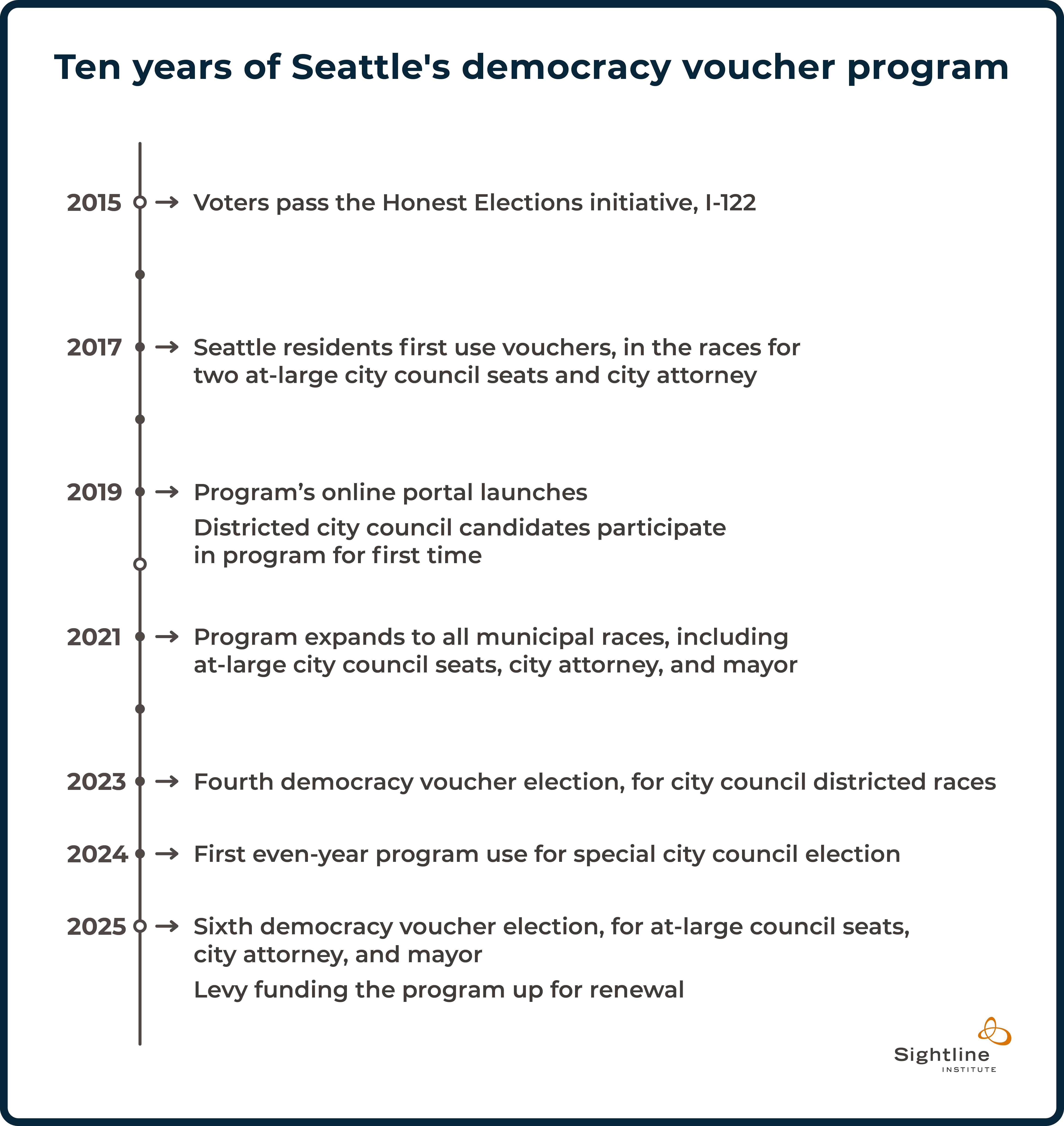
When Seattle voters first adopted democracy vouchers in 2015 as part of a broader package of good governance and transparency reforms, democracy vouchers were a new idea and a break from other public financing designs that mostly offer matching funds or grants.
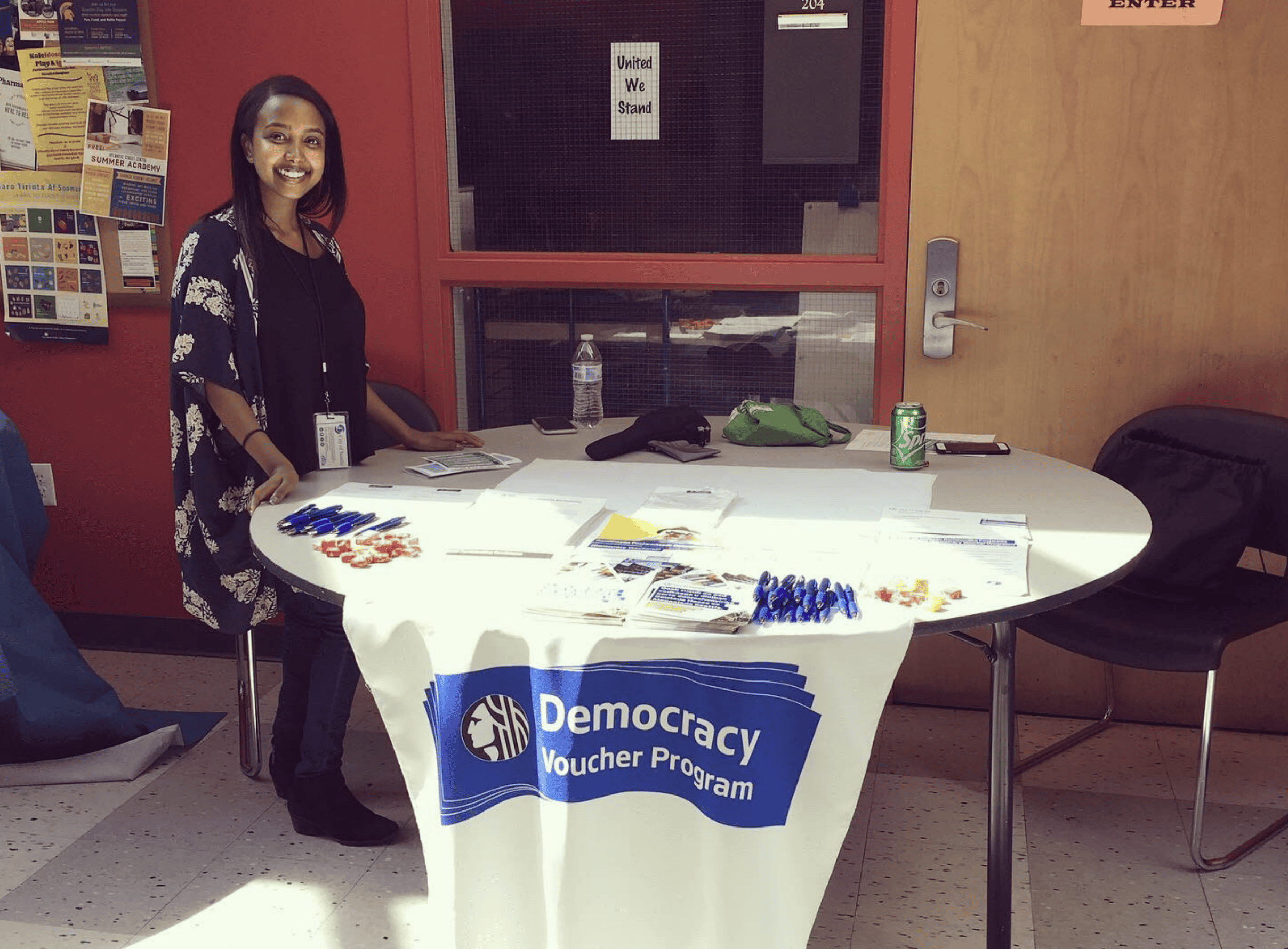
Under the program (of which, full disclosure, Sightline Institute was the principal designer), Seattle residents receive four $25 vouchers for each election cycle.1 They can donate the vouchers to qualifying candidates, who redeem them for money from the city.2 Participating candidates pledge to abide by contribution and spending limits, disclose their finances, and take part in a certain number of public forums. Since residents don’t have to spend any of their own money to donate to candidates, the program has made political giving accessible to everyone.
The program now covers all city races and has an online option in addition to the original paper vouchers. It’s benefited from a certain degree of administrative flexibility: the Seattle Ethics and Elections Commission (SEEC), which oversees the program, has made tweaks over the years in response to feedback from candidates and others to ensure its continued viability and use. The SEEC’s management also holds campaigns using the program accountable, since its office tracks other campaign finances, too.
Candidates and Seattleites have now used the program in six election cycles, and researchers have evaluated its effectiveness each time—recording just how much it’s opened up the Emerald City’s systems of democracy. This program has multiplied the number of everyday Seattleites who give to campaigns; elevated city residents over out-of-town donors; transitioned the bulk of campaign funds to come from small donations rather than large gifts; encouraged more Seattleites to vote; and fundamentally changed who runs for office and how they connect with voters.
Here are six reasons Seattleites can be proud of Democracy Vouchers:
1. More people in Seattle now give to city candidates than do people anywhere else
Before the democracy voucher program, Seattle’s elections were overwhelmingly funded by rich, white people who live in houses with great views. A tiny 1.5 percent of Seattle adults gave money to candidates in 2013, and two-thirds of the money came from just 0.3 percent of adult residents.
Now, the situation is different. Vouchers have multiplied the number of Seattleites giving to campaigns.
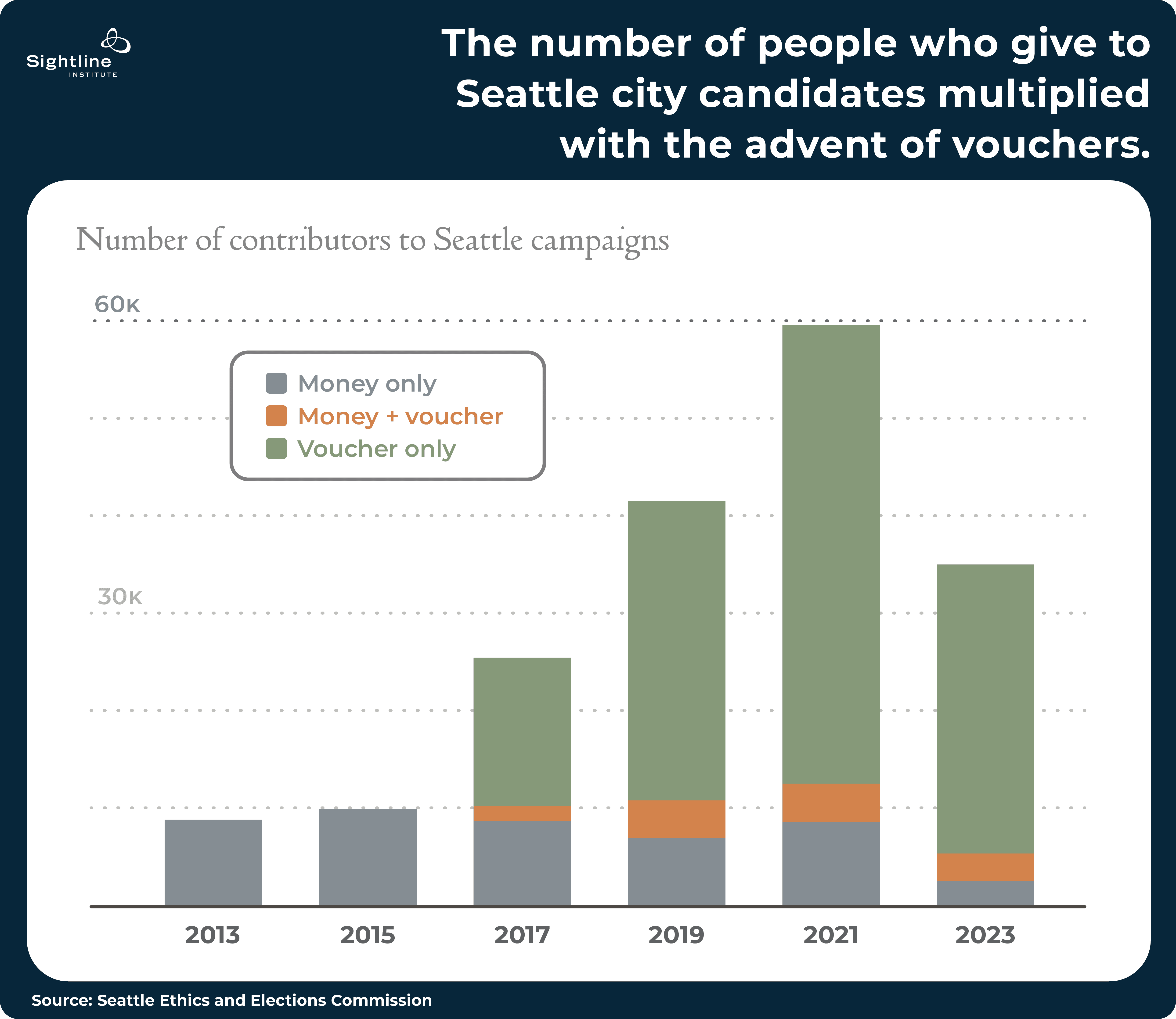
In 2017, the first year Seattleites received vouchers, the number of donors grew 2.5-fold over the local election two years prior—from 9,800 to more than 25,000 people contributing to local candidates. Two years later, more than 40,000 people made donations; and in 2021 almost 60,000 did, as shown below. The sleepy, low-turnout election cycle in 2023 still brought almost 35,000 participants, more than four times as many people as gave before the program began.3
The contributor rate won’t continually keep growing. It varies not only with turnout and broader election trends but also with which races are on the ballot, who’s running, and competition between candidates. That said, it’s already shifted politics by bringing in many more people.
Looking only at percentages, it might seem easy to minimize these statistics; in the strong giving year of 2021, for example, about 9.5 percent of Seattle adults contributed to campaigns, and the vast majority of city residents who received vouchers don’t allocate them.
But the proportion who give is enormous when compared with previous years or with similar cities, most of which have contributor rates that rarely exceed 2.5 percent.4 Professor Heerwig noted that Seattle now has the highest contributor rate of any major city she and her co-author studied. New York City, which has an extremely generous matching-fund system for campaign gifts, is the only one that even comes close.
Besides, with only a portion of city residents using them, democracy vouchers have still been covering most of participating candidates’ campaign budgets. Candidates are subject to spending caps, and most reach them—so they can no longer redeem vouchers after that point anyway.
2. A greater diversity of people contribute to city campaigns
The program has also changed the type of people who give.
- Voucher donors are younger, more racially diverse, and less affluent than cash donors.
- They live in a greater spread of neighborhoods than pre-voucher campaign contributors.
- In fact, voucher users better represented lower-income Seattleites and people of color than voters did in 2021, showcasing a particular strength in empowering underrepresented groups.
- What’s more, more than half of people using vouchers in each cycle are first-timers, so there is not a recurring “donor class” that dominates giving as exists in many other US elections.5
3. Out-of-towners get less sway
Campaign donations from people living outside of the city have also plummeted. In the pre-vouchers elections of 2013 and 2015, 27 and 29 percent (respectively) of total candidate campaign contributions came from outside of Seattle. In 2017, with the start of the program, external funding dropped to 18 percent. By 2023, the figure was down to 8 percent. (Other law changes likely influenced this metric as well, such as Seattle’s ban on political spending from foreign-influenced corporations.)
4. Small donations make up the bulk of campaign funds
In 2013, prior to democracy vouchers, almost 60 percent of campaign dollars given to candidates came from gifts of at least $400, and more than a third were from very large donations ($700 or more). People with big dollars were clearly using them. The next cycle, 2015, saw a similar proportion.
But in 2017, the first year of democracy vouchers? Donations of $400 or more dropped to 31 percent of the total dollars, with none over $700 (the Honest Elections campaign that established democracy vouchers also lowered contribution limits for all city candidates to below $700).6 In 2019, contributions of $400 or more dropped again to 19 percent of the total campaign funds.
Those big checks, which are more constricted for candidates opting in to use democracy vouchers than for city candidates not participating in the program, have continued to diminish in recent years as most candidates choose to participate in and abide by the program bounds.
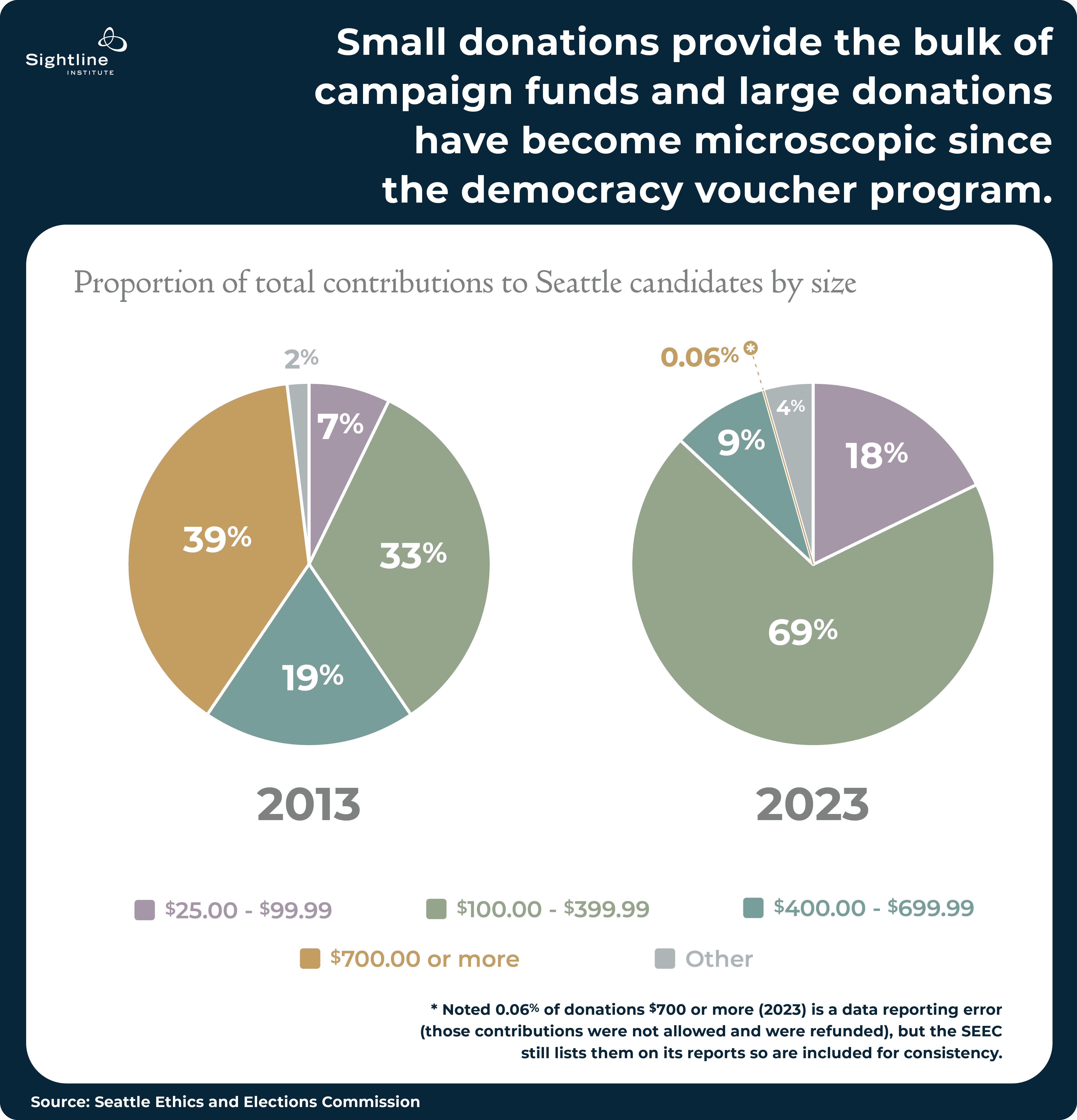
Meanwhile, the proportion of contributions coming from small donations has risen markedly since the start of the program. Average campaign contributions have decreased, and small donations (under $100) are a much larger funding source for campaigns than they used to be, as more candidates rely primarily on voucher donations. In all voucher program elections except the first, donations under $200 made up more than half of all funds to candidates.
Just as Sightline and other democracy voucher program creators had hoped, small-dollar donors have diluted the outsized influence of big ones. Anyone with a democracy voucher—that is, any eligible Seattle resident—can now help balance the scales of their local elections.
5. More Seattleites are voting
The democracy voucher program has also strengthened civic participation in other ways. Professors Heerwig and McCabe, in a report for the University of Washington, found that voucher users are more likely to vote, even after adjusting for their previous level of political engagement.
Similarly, researcher Sarah Papich at UC Santa Barbara found that the democracy voucher program increases voter turnout by 5 percentage points. Papich suggests that increased investment in election outcomes and renewed faith in the political system might drive this change in voter behavior. Anecdotes from voters support this idea, too—many Seattleites have reported having candidates knock on their door for the first time or meeting them at community events.7 Those personal touches directly get more people engaged.
Many Seattleites have reported having candidates knock on their door for the first time or meeting them at community events.
6. More diverse candidates run and win
Democracy vouchers also changed who runs for office.
Many public campaign finance programs fail because candidates don’t opt in. It’s not in their interest to participate. The programs remain on the books but they’re effectively dead (thasn’t been used in recent decades; campaign costs have skyrocketed, and Congress has not updated the program’s allowances).
Not so for democracy vouchers. In every cycle since the program’s inception, almost all serious candidates participated in the program: close to 77 percent of primary election candidates and over 80 percent of general election candidates between 2017 and 2021.8 In 2023, 42 of the 45 primary contenders pledged to participate (31 ultimately qualified), and all 14 general election candidates used the program. Among current office holders, the mayor, city attorney, and seven of the eight elected councilmembers all paid for their campaigns with vouchers.9
Since the program began, the number of candidates running in city elections has increased, suggesting that democracy vouchers have lowered barriers for people seeking office. Elections are more competitive, and incumbents have less of an advantage than before the program. More women, people of color, and younger Seattleites have declared candidacies and won, and candidate interviews indicate that the democracy voucher program is an important reason why people with underrepresented backgrounds feel they can take that first step.
Looking forward: Democracy vouchers adapt and renew
Seattle established democracy vouchers ten years ago, and voters must renew the levy providing funding for the program this year for the program to continue. With support from the mayor and many expressions of enthusiasm, Seattle City Council members unanimously passed legislation to send the levy renewal to the city ballot this August.
As Seattle voters consider whether to renew funding for democracy vouchers, many will see that the Honest Elections initiative that established Seattle’s democracy voucher program is an undoubted success as measured by its many original goals. It has given more people an opportunity to voice their support for local candidates, increased visibility of candidate fundraising, expanded the pool of candidates for city offices, and safeguarded the people’s control of their local elections process.
As the program progresses, the Seattle Ethics and Elections Commission, city council, and other stakeholders will consider further adjustments to ensure its continued success. The SEEC has already made a few tweaks in response to public and stakeholder feedback, such as prohibiting paid signature gatherers. If the program’s funding is renewed, the Seattle City Council will also convene a workgroup to study additional program improvements (the mayor included this proposal in the funding renewal legislation).
One well-understood challenge is that the city has no way to limit political spending that is not directly associated with campaigns, known as “independent expenditures” (IEs). Such spending has grown rapidly in many large US cities in recent years, including Seattle, and the US Supreme Court ruled it can’t be regulated (first in Buckley v. Valeo, then expanded in Citizens United v. FEC). Contrary to some speculation, democracy vouchers don’t seem to have caused independent expenditures to rise; other comparable cities have seen similar increases. (I’ll write more about IEs and democracy vouchers soon.)
Meanwhile, Seattle has set the prime example for empowering small-dollar donors in local elections, and locales near and far are taking note: Oakland, California, for example, passed a “democracy dollar” program in 2022 with a whopping 74 percent voter support. Los Angeles and South Dakota have both considered similar concepts, and 2019 Democratic presidential candidates Andrew Yang and Kristin Gillibrand also each recommended proposals for bringing them to US federal elections.
At a time when a single person’s voice in US democracy can feel tenuous, Seattleites should be proud to showcase hope for fairer elections.

