


Takeaways
- Public dollars to help families afford heat pumps are drying up in the US and Canada, even as interest in them grows.
- Still, at a time when energy bills are soaring and summers are growing hotter, heat pumps could be especially helpful to most of the region’s low-income households.
- To help tackle the large upfront cost of a heat pump, beyond rebates, Sightline recommends three policy tools: inclusive utility investments, green banks, and all-electric standards for new buildings.
- The payoff? With a medium-efficiency heat pump, nearly 1.3 million low-income households in Cascadia could cut their annual energy bills by $500 on average. For the lowest-income families, that could amount to a 40 percent reduction in energy bills.
Find audio versions of Sightline articles on any of your favorite podcast platforms, including Spotify, YouTube, and Apple.
Meeting Cascadia’s climate goals will require millions of households to stop burning fossil fuels for warmth.1 In Oregon and Washington, buildings emit more pollution than any other sector besides transportation. (The building sector is the third highest emitting in British Columbia and Idaho, and fifth in Montana.)
Heat pumps powered by renewable electricity are what the International Energy Agency calls the “proven technology of choice to decarbonize heating,” and several Cascadian jurisdictions are working hard to expand access to the technology. Oregon, for example, set itself a goal of heat pumps accounting for 65 percent of new residential heating, cooling, and water heating equipment sales by 2030. British Columbia resolved for all new space and water heating equipment sales and installations to be at least 100 percent efficient by 2030, a standard that favors heat pumps, which can exceed this threshold. Heat pumps have now outsold gas furnaces and central air conditioners for two consecutive years in Cascadia; nearly three heat pumps sold for every two gas furnaces in 2023.
Still, heat pumps are prohibitively expensive in upfront costs, and that fact, coupled with tightening public budgets, could threaten their rapid scale-up, especially among low-income families.
In this challenging context, leaders in Cascadia would do well to direct their limited treasuries of funds for public subsidies toward low-income households for whom heat pumps offer the biggest reductions in both utility bills and greenhouse gas emissions. At the same time, policymakers can support creative funding models, such as tariffed on-bill investments and green banks, to help more households get heat pumps installed. They can also strengthen building codes to ensure heat pumps are installed in new homes, avoiding costly future retrofits. This multi-pronged approach stretches scarce public dollars, while still reaching families that stand to benefit most from these clean, cost-saving, and comfortable systems.
Amid dwindling subsidies, Cascadians face heat pump sticker shock
Many families, particularly those with low incomes, cannot afford heat pumps. A medium-efficiency heat pump can cost between $14,000 and $22,000 in Cascadian states.2 The median heat pump costs $8,200 more than installing fossil-fuel heating equipment (such as a gas boiler) and air conditioning in Oregon; in Montana, that figure is $16,200. Steep costs stem from expensive manufacturing and labor, installer shortages and inexperience, the need for electrical upgrades in some homes, and the added cost of backup heating systems where required.
Governments have stepped in to help. The 2022 Inflation Reduction Act (IRA) provides rebates of up to $8,000 for low-income households purchasing medium- or high-efficiency heat pumps. These rebates have so far withstood roll-back attempts by the Trump administration; Oregon and Washington have already secured hundreds of millions of federal dollars to launch their rebate programs. (Montana has paused its rebate rollout, while Idaho has provided no public timeline.)3 But the IRA rebates are a one-time, capped allocation, and the Trump administration eliminated tax incentives for energy-efficient home improvements in July 2025, including heat pumps.
States and provinces also subsidize heat pumps, but tight budgets have led to substantial cutbacks. Washington scaled back funding for heat pump programs from $80 million in the 2023 budget cycle to $30 million in 2025. Oregon lawmakers appropriated $25 million to heat pump rebates in 2022 and added another $4 million in 2024, but allocated no new funds in 2025. British Columbia lowered its heat pump program budget from Can$150 million in 2024 to Can$50 million in 2025. (Idaho and Montana do not offer any state-funded heat pump rebates.)
Several utilities in the region chip in heat pump rebates of their own, though amounts tend to be modest. For example, Puget Sound Energy offers $3,900 rebates to low-income households, and Idaho Power offers $500.
Crucial as they are, public subsidies can help just a small share of Cascadians upgrade to heat pumps. If all the existing federal and state funding for energy-efficient retrofits went exclusively to heat pumps (an unlikely scenario), only 80,000 families would benefit—about 1 in 20 low-income households across Cascadian states.4
Still, most low-income Cascadians could save on energy bills with a heat pump
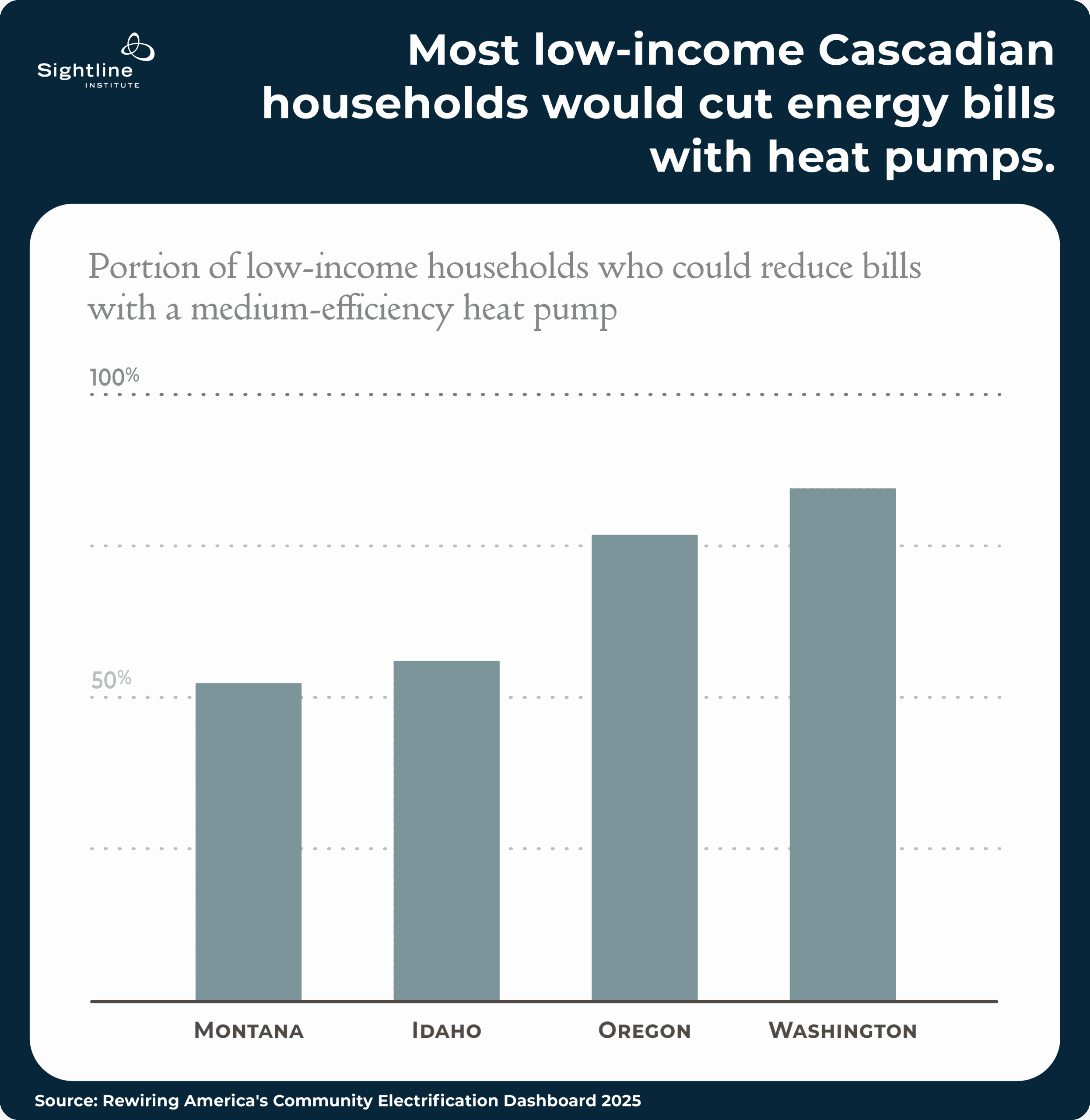
Nearly 1.3 million low-income households in Cascadia (about 76 percent of all low-income households) could cut their energy bills by upgrading to a medium-efficiency heat pump—assuming they can overcome high upfront costs.5 These households could save about $500 on average in annual energy bills (Figure 1), a 40 percent reduction on the typical $1,200 energy bill that extremely low-income households face each year in the region.6
These potential savings matter now more than ever as Cascadia faces a growing energy affordability crisis. From 2021 to 2024, residential electricity prices in Cascadia rose by 18 percent, and natural gas prices jumped 25 percent. Bill hikes hit low-income families the hardest: in Cascadian states, extremely low-income families spent about 10 percent of their income on energy, more than triple the share of higher-income households.7
Still, for roughly 400,000 low-income households in the region—about one in four—switching to a heat pump would likely raise annual bills. In some states, the proportion is even higher. More than half of low-income households in Idaho and Montana could see higher bills upon installing heat pumps.
Whether households save money by switching to a heat pump depends on three main factors:
- the heating system being replaced,
- the home size, and
- whether the household already has air conditioning.
Low-income households that currently use propane, heating oil, and electric resistance heating stand to save the most on energy bills by switching to heat pumps (Figure 2). For households using gas, the results vary by location. Most low-income households that rely on gas in Oregon and Washington could save, but switching from gas to a heat pump in Idaho or Montana may not reduce energy bills.

Further, households living in smaller homes, which generally use less energy and feature better insulation than larger homes, may not see enough efficiency gains from heat pumps to generate meaningful savings. Low-income Cascadian families are more than twice as likely to live in small homes (often apartments) than their higher-income counterparts.8
Finally, for households currently without air conditioning, heat pumps, which both heat and cool a home, add a new energy-consuming function, which can offset the savings from the heat pump’s more efficient heating. Nearly half of low-income Cascadian households lack air conditioning, and that figure reaches over 60 percent in Seattle and Portland.
Still, as Cascadia’s summers get hotter, cooling has become a necessity. Heat pumps provide efficient cooling that improves comfort and health, and that can prove lifesaving during extreme heat events. Many families with limited budgets turn to portable air conditioning units that cost about a tenth of what heat pumps do, at purchase. Heat pumps, though, last longer, provide lower summer electricity bills, and maintain more consistent temperatures than other air conditioners.
Overall, energy bill savings allow medium-efficiency heat pumps to pay for themselves over 15 years without subsidies for about 30 percent of Cascadian households, including nearly all households using propane and fuel oil, according to the National Renewable Energy Laboratory.9
Innovations like window heat pumps could drive down costs, spur market growth
The high upfront costs of heat pumps partly reflect the technology’s relatively early stage of market development. Heat pumps are not yet the standard choice in the heating, ventilation, and air conditioning (HVAC) industry.
Innovation could change that. In 2022, New York launched a challenge for manufacturers to create heat pumps that fit in windows like air conditioning units.10 The winning “window heat pumps” (or micro heat pumps) cost up to 40 percent less and are easier to install than conventional heat pump models. These heat pumps are already going into public housing apartments, and the New York City Housing Authority plans to scale up the pilot program, aiming to install 30,000 units over the coming years.
Cascadia has begun testing window heat pumps, too. From 2022 to 2023, the Northwest Energy Efficiency Alliance (NEEA) piloted 16 units in Oregon and Washington. Participants reported mostly positive experiences—especially for cooling—but the pilot exposed challenges in installing the equipment in certain common window and building types. (And the micro heat pumps still cost more than window air conditioners.)
NEEA plans to work with manufacturers and energy efficiency organizations to continue testing window heat pumps and potentially integrate them into the organization’s retail portfolio program, where participating retailers receive incentives to preferentially stock and sell specific products. NEEA is also sharing insights and coordinating with the New York City Housing Authority and the New York State Energy Research and Development Authority on window heat pump development. Expanding and accelerating these efforts could bring affordable heat pumps to homes across Cascadia.
Three tools beyond rebates to aid heat pump affordability
Many households with the lowest incomes will continue to need subsidies to afford heat pumps. State and utility rebates remain important for these families, many of whom could benefit the most from lower energy bills and face the greatest barriers to accessing heat pumps.
One piece of good news is that the households that stand to cut the most climate pollution with a heat pump—those using propane and oil today—are also the ones likely to save the most money. Across Cascadia, about 76,000 low-income households rely on propane or heating oil to heat their homes. On average, these households could each save over $1,000 a year on energy bills and reduce their emissions by nearly 6 metric tons of carbon—the equivalent of taking 1.3 gas-powered cars off the road each year.
But not all federal and state rebate programs prioritize applicants based on their current heating source. Oregon’s Community Heat Pump Deployment Program is an exception that prioritizes households using propane, fuel oil, and electric resistance heating. Other rebate programs could follow suit.
Directing most available state heat pump subsidies to this group alone would be a good idea, but it would nearly exhaust existing funds—and reach less than four percent of low-income households in Cascadia. Faced with this reality and tight state budgets, policymakers can consider several complementary approaches:
1. Enable utilities to front costs through inclusive investments
“Tariffed on-bill” investments, also known as inclusive utility investments, offer one alternative approach to help more families overcome heat pumps’ high costs. Under this model, a utility pays for the heat pump (or other energy efficiency measure), and the customer pays a monthly service charge on their bills, allowing the utility to recover its costs. Typically, regulators require the expected energy savings to exceed the heat pump’s upfront cost, so customers don’t see their bills rise. Some programs, such as Ameren Missouri’s Pay As You Save® (PAYS®) program, allow customers to make an upfront copayment for the portion of the total project cost that exceeds the utility’s recoverable investment.
Tariffed on-bill investments differ from traditional on-bill loans, where customers borrow money from a utility or a third-party lender and repay the loan on their monthly utility bills. On-bill loans typically require credit checks and low debt-to-income ratios. By contrast, tariffed on-bill investments do not require credit checks and do not create a personal debt obligation for residents—rather, utility regulators decide if the terms of the tariff meet the basic regulatory framework of “just and reasonable” rates. Landlords can authorize heat pump installations while payments stay tied to the property meter; both costs and benefits automatically apply to subsequent tenants with notice of the estimated bill savings communicated prior to signing a lease. As a result, these programs hold particular promise for reaching renters and low-income families, including those “locked out of the credit economy,” said Max Toth, Interim Director of Just Energy Transition at the nonprofit Clean Energy Works, in an interview with Sightline.
As of 2024, more than 20 utilities across ten states operated tariffed on-bill investments; none of them is in Cascadia. Regulators can direct utilities to create tariffed on-bill investments without legislation, or policymakers can spur commissions to act. For example, Illinois passed legislation in 2021 and Massachusetts proposed legislation in 2025, requiring the development of these programs and ensuring accessibility by low-income households. Regulators in California are currently considering pilot proposals from utilities in their state following a recommendation from the California Energy Commission identifying tariffed on-bill investments as a promising approach to address equity gaps. These models could guide Cascadian policymakers craft tariffed on-bill investments where heat pumps are cost-effective.
2. Establish and fund green banks
Green banks leverage limited public dollars to attract private investment—as high as $30 for every $1 of public funding—in energy efficiency measures, including heat pumps. By working with credit unions and other lenders, green banks use public funds to back loans with better terms than traditional loans, such as lower interest rates, longer repayment periods, and minimal underwriting requirements.
Green banks can enable families to access heat pumps more quickly and easily than through utility or some rebate programs, with application processes sometimes completed in as little as one day. In doing so, green banks can ideally offer an affordable alternative to credit cards, which low-income households tend to rely on to cover unexpected expenses, including the urgent replacement of heating or cooling equipment, Eli Lieberman, Executive Director of the Washington State Green Bank, told Sightline.
Green banks are succeeding in reaching households with moderate to low incomes, according to a 2022 study of the four largest and longest-running green banks in the Midwest and Northeast. Green banks prove especially valuable for the “missing middle” of the market: families who earn too much to qualify for income-tested rebates but still cannot afford a full heat pump upgrade. However, green banks primarily serve homeowners with high credit scores and the capacity to carry debt. Even so, green banks play a valuable role in filling funding gaps and could form part of a broader toolkit to expand access to heat pumps in Cascadia.
As of 2022, green banks operated in 28 states. In 2023 Oregon lawmakers considered exploring the creation of a green bank with House Bill 2763, but the governor vetoed the bill, citing concerns about implementation timelines and stretched departmental capacity. The bill came back in 2025 but didn’t advance beyond the Senate’s Labor and Business Committee; policymakers could revisit it in future years.
Washington’s green bank launched in 2025 with $800,000 from the state’s Climate Commitment Act (CCA), but it remains uncapitalized after the Trump administration froze federal funding for green banks. (No green banks operate in Idaho and Montana.) Green banks need $10 to $50 million in capitalization to operate one to two programs sustainably. Policymakers could consider allocating more CCA funding to get the bank up and running, multiplying the impact of these limited public dollars.
3. Require or incentivize new buildings to be all-electric
Building codes that encourage or require all-electric new homes offer one state-level policy that could accelerate a market shift by indicating sustained demand, all while saving money in the near term and avoiding costly retrofits down the line. In Seattle and Eugene, the cost of building an all-electric single-detached home is about nine percent lower than the cost of building a home with both gas and electric hookups. The same pattern holds in Vancouver, British Columbia, where all-electric new homes equipped with heat pumps cost less to build than their gas-heated counterparts. (In Idaho and Montana, evidence does not yet conclusively support heat pumps as a more cost-effective option than gas in new homes.)
Washington’s most recent residential and commercial energy code strongly encourages heat pumps in new homes. Similarly, British Columbia’s updated code mandates 20 percent better energy performance than the previous code in most new buildings; heat pumps offer one of the most cost-effective ways to get there. The province aims to require all new buildings to be net-zero by 2030, a target that hinges on heat pump adoption.
Oregon’s building codes are less ambitious. State statute requires that new buildings be 60 percent more energy efficient by 2030 compared with 2006 levels, and its building code lists heat pumps as one option among many for meeting energy efficiency standards. Policymakers could increase the energy efficiency target for new buildings, and the Oregon Building Codes Division could introduce new measures in the forthcoming 2029 building code, to steer more new construction toward full electrification.
Public dollars or no, Cascadia can still expand heat pump access
Heat pumps represent more than a solution to decarbonize buildings—they offer a path to lower energy bills and cleaner, safer homes for low-income families across Cascadia. While initial costs remain steep and not every household would save money switching to a heat pump, the technology presents a compelling opportunity for millions of households in the region.
With increasingly constrained public finances, limited public subsidies can go further by targeting homes with the highest potential for savings and emissions reductions. Creative financing tools such as tariffed on-bill investments and green banks can help more families overcome cost barriers, while stronger building codes can make heat pumps become the default in new construction. Together, these actions will help Cascadia cut emissions, reduce energy burdens, and deliver the clean energy transition to the families that need it most.
Appendix: Data and methodology
Sightline analyzed data from Rewiring America’s Community Electrification Dashboard to illustrate potential energy bill savings from heat pumps. Rewiring America uses the National Renewable Energy Laboratory’s (NREL) ResStock dataset, one of the most comprehensive sources for modeling residential energy use in the United States. ResStock includes over 500,000 simulated residential building models that statistically represent the full diversity of housing stock in the contiguous United States. For each simulated building, ResStock applies the Department of Energy’s open-source energy model to estimate each building’s energy use. Data on housing characteristics, including household income, also comes from ResStock. The savings estimates from heat pumps employ Rewiring America’s internal modeling to simulate the performance of different types of heat pumps.

