


Takeaways
- Most cities and counties in Oregon are mired in outdated voting methods, despite a constitutional provision that gives them free rein to adopt something better.
- One common method, block voting, shifts full governing power to whatever group has the most voters, locking out minority viewpoints and potentially leading to big policy swings from one year to the next.
- At-large numbered seats similarly give majority viewpoints unfair sway and set candidates up to jockey for open positions or choose more desirable opponents.
- Single-winner ward or district voting might seem more representative, but ward-based officeholders only represent voters geographically, and districts put election outcomes and voters at the mercy of artificial lines.
- Proportional representation offers more stable, representative government than these winner-take-all methods and would be an easy switch for Oregon localities.
Find audio versions of Sightline articles on any of your favorite podcast platforms, including Spotify, YouTube, and Apple.
In 2024, Democrat-endorsed candidates swept all seven seats on the Bend, Oregon, city council—even though city elections are technically nonpartisan. Democrats certainly outnumber Republicans in Bend, but 20 percent of city voters are registered with the G.O.P., and many more are not affiliated or are registered with smaller parties. Those voters don’t get their views represented in their city government.
In southern Oregon’s Jackson County, the representation failure is reversed. Democratic or Independent candidates have won more than 40 percent of the vote for every county commissioner contest over the last five general elections—but Republicans consistently hold all three seats. Even though county voters are split between the two major parties, Democrats are locked out of county policy decisions.1
Sightline catalogued voting methods in all Oregon counties and the 50 most populous cities (view and download the list here). The findings: Almost all of Oregon’s cities and counties operate with election methods that tend to fall into the same pattern of misrepresentation. These local governments use outdated, easily gamed voting methods.
Fortunately, Oregon’s constitution, unlike those of neighboring states, enables localities to choose a more effective path: proportional representation.
Common models of unstable representation
Nearly all local governments in Oregon—every county and all but one of the state’s 50 largest cities—use one of three methods of electing councils and commissions, or some combination.2 While each of them can, and often does, achieve adequate representation for residents, all three are susceptible to political manipulation and to oscillation between political extremes.
- Block voting can shift governing bodies wholesale based on whatever group turns out the most voters.
- At-large positions similarly give majority viewpoints unfair sway and set up additional avenues for political gamesmanship.
- And single-winner wards (or districts) put voters at the mercy of artificial lines, including gerrymandering.
Block voting doesn’t stack up
Voters in more than one-third of Oregon’s 50 largest cities and many more smaller towns, from Baker City to Yachats and Lake Oswego to Redmond, are familiar with block voting, even if they don’t know it by name; it’s a common method for electing multiple people to city council at once. But those candidates are not assured to reflect the diversity of public preferences.
With block voting, voters get the same number of votes as there are council seats up for election. In a three-seat election, for example, voters pick their three choices from the list of all candidates, and the three with the most votes win spots on the council. Some cities use block voting for all seats at once, while others elect some of their members in midterm years and the rest in presidential years.3
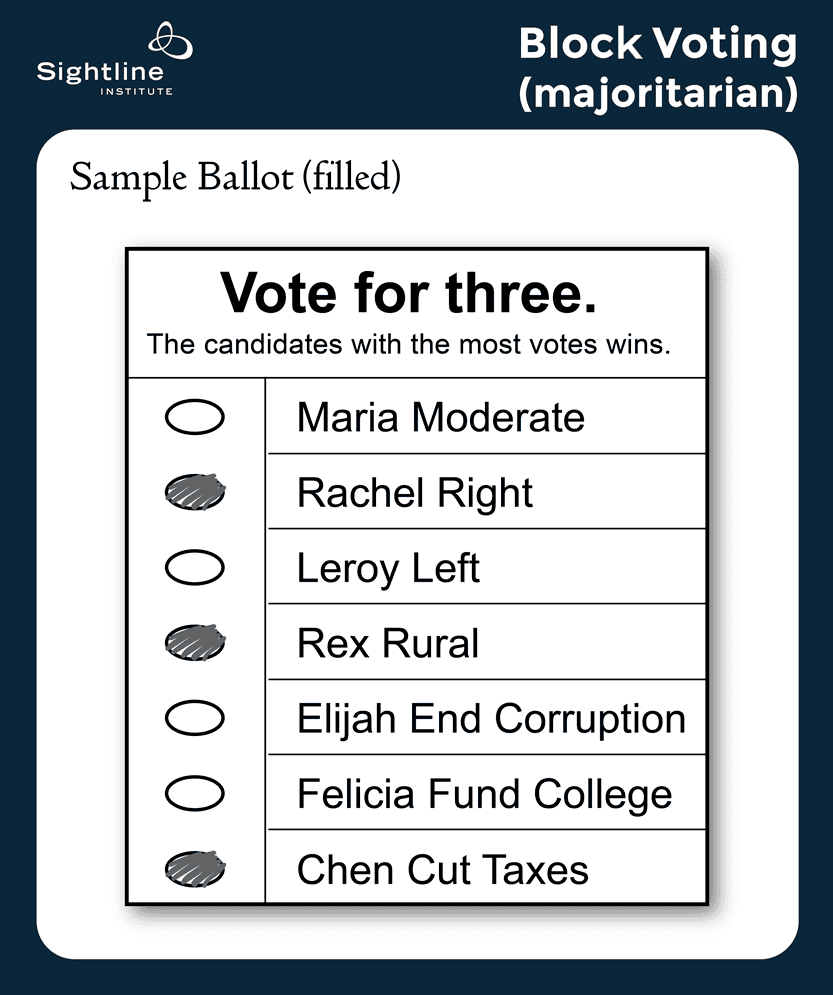
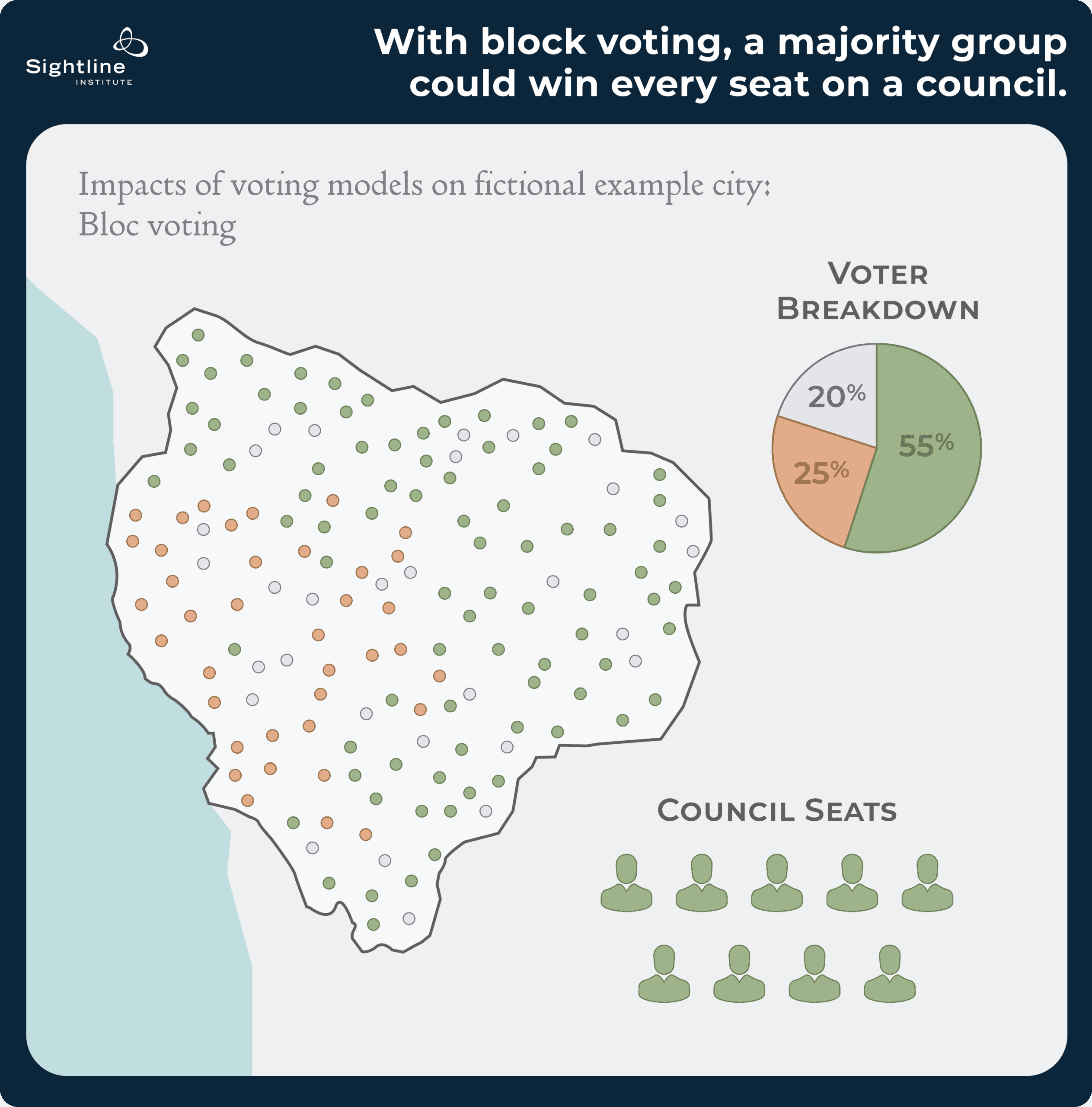
Block voting might seem like a simple method—choose three, elect three—but the outcomes can belie what voting is supposed to achieve. Instead of electing a council that can represent everyone, whichever group or faction gets the most votes can easily win all the seats. In partisan elections, block voting frequently means that the party with the most votes sweeps the board; in nonpartisan elections, candidates on either side of local wedge issues (like police funding or low-income housing) might win every single position even if voters are closely divided. A small shift in voter preference can flip half or all of a local council, so residents might have to endure dramatic policy swings; a policing or housing ordinance adopted one year could be reversed the next.
Plus, when votes are close, there’s no guarantee that the top vote-getters are actually the most popular candidates. Take the city of Forest Grove, for example. In 2024, six candidates ran for the three open seats in a block voting election, and all received between 12 and 19 percent of the vote. The third-place winner, Brian Schimmel, beat out next-place runner-up, Peter Truax, by less than half a percentage point. With fewer candidates, the results might have been dramatically different.
Numbered seats can be precarious positions
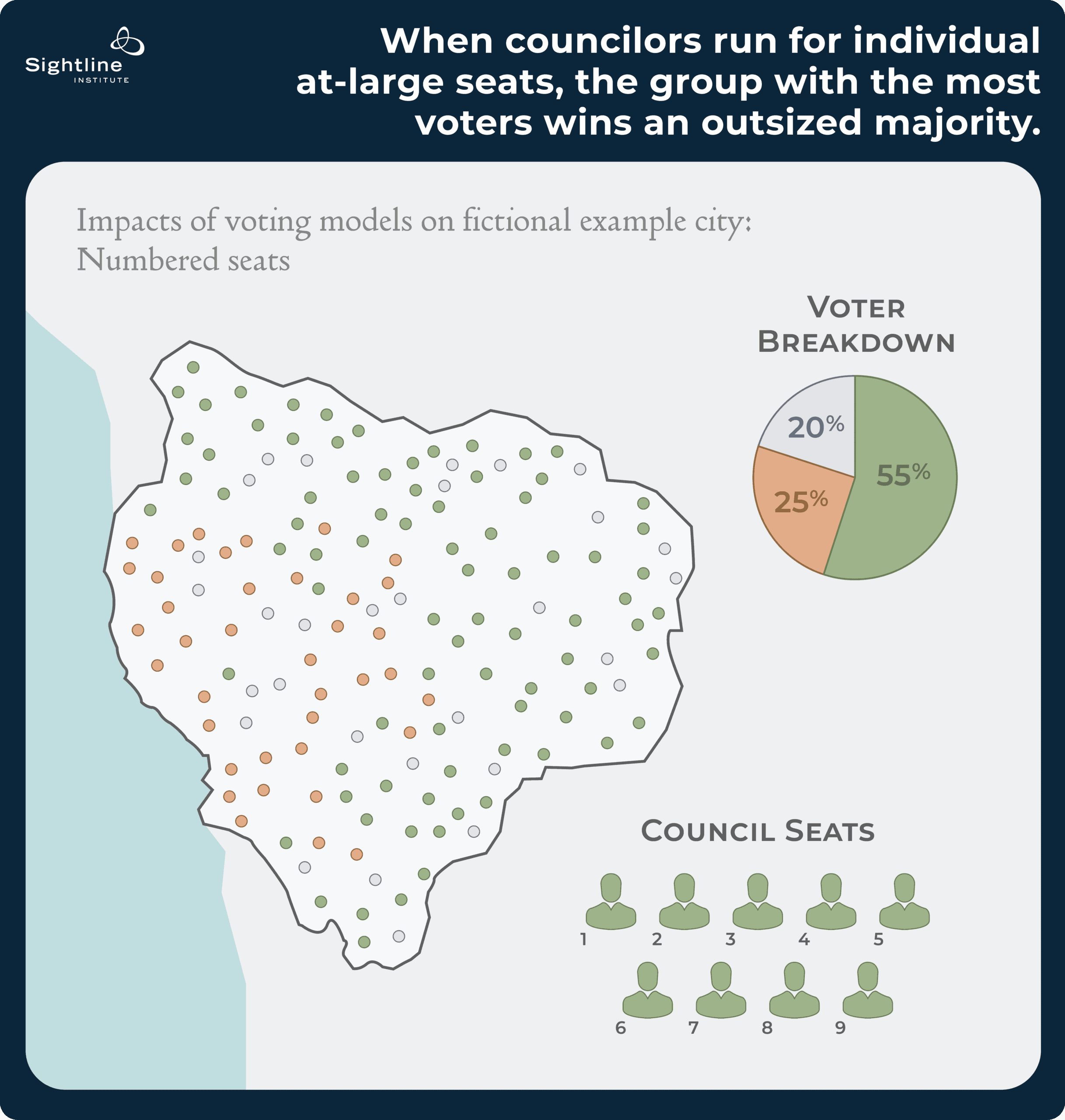
Nearly all counties (35 of 36) and close to one-third of the 50 largest cities in Oregon similarly elect members to their governing body city- or county-wide, but candidates run for individual seats (also known as designated positions or posts) rather than several seats as a block.4 Voters across the entire city or county vote for Position 1. They all vote for Position 2. The same goes for Positions 3, 4, and so on. The candidate with the most votes in each contest wins that seat.5
Numbered seats can have the same effect as block voting in that they give unfair weight to the largest group of voters. Although voters of all stripes cast ballots, each individual post will only reflect the group that turns out the most voters, whether that’s a party, a neighborhood, or another community with a common interest.
Position-based council seats also turn elections into a game of musical chairs, where candidates crowd into open or more competitive races and avoid challenging popular officeholders. In the 2018 elections for Gresham City Council, incumbent Mario Palermo was vulnerable, having won by less than one percentage point four years prior—so he faced five challengers jockeying for his Position 4 seat. But Janine Gladfelter, a community leader who the council appointed to fill a vacancy in 2017, ran unopposed for Position 6.
To maximize their odds of winning, candidates might even strategically switch which seats they are seeking or jump into a race at the very last second, like former state senator David Nelson did in Umatilla County, completely upending campaign dynamics and creating headaches for election officials.
All this behind-the-scenes strategy takes power away from voters. Rather than increasing choice, numbered positions create incentives for political operatives to cut backroom deals or move candidates around like chess pieces to reduce competition.
Ward voting shows the limits of district lines
Seventeen large Oregon cities and five counties divide themselves into single-winner districts, also known as wards, to elect some or all members of their governing bodies. Ward voting assures a degree of diversity that city-wide block and position voting lack: each ward produces a winner from a different part of the city (or county), guaranteed. This arrangement can work well for groups of voters clustered in neighborhoods. But the winners don’t necessarily reflect the area as a whole, and smaller groups or ones that aren’t geographically concentrated have a hard time electing someone who matches their views.
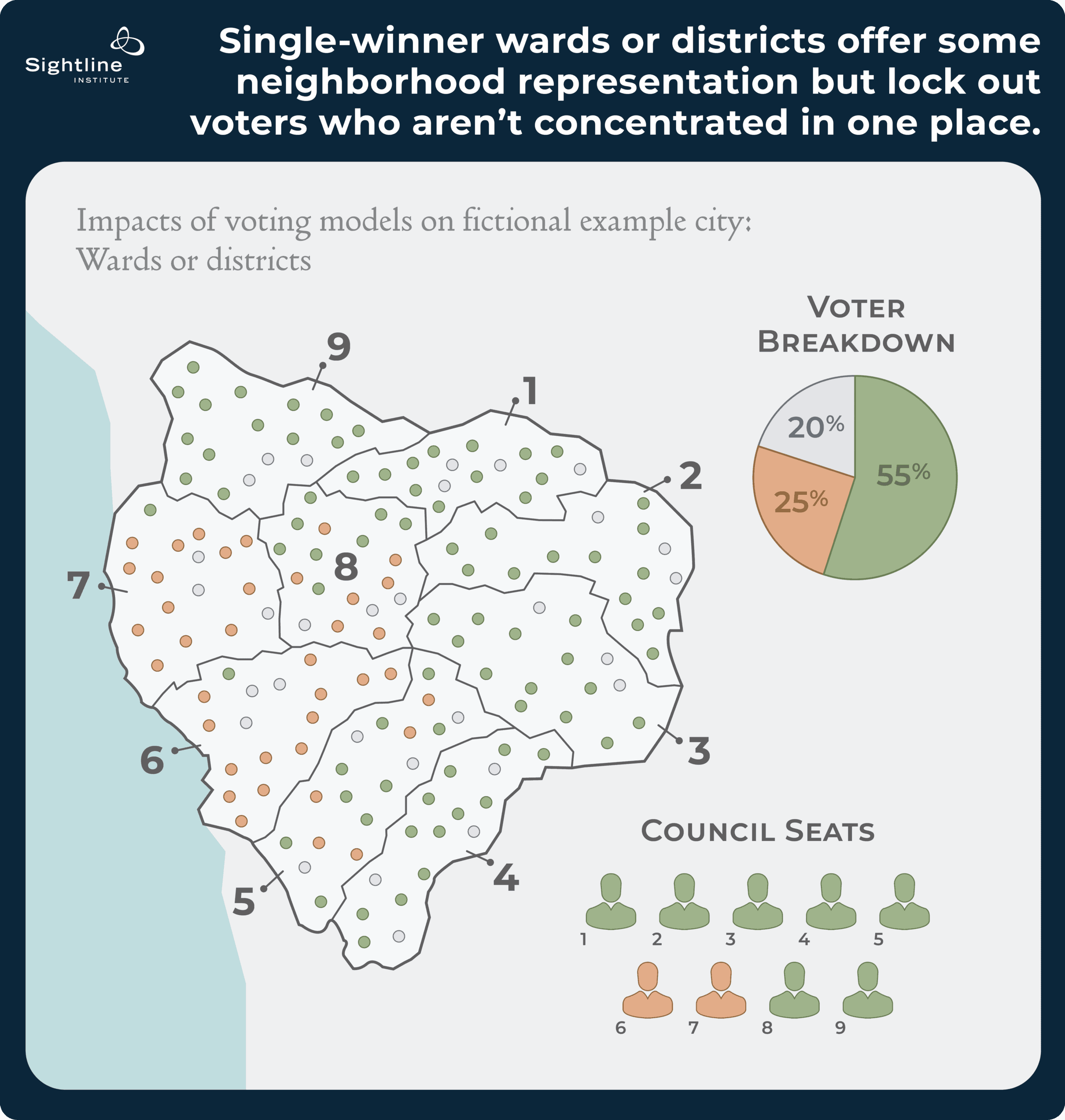
Like other winner-take-all methods of voting, single-winner wards can lock out voters who don’t agree with their immediate neighbors. Take Klamath Falls, for example. City elections may be nonpartisan, but Republicans outnumber Democrats in each of the city’s five wards. Democrats, despite making up about a quarter of registered voters, are unlikely to get even one person who reflects their views elected to city council. (The same goes for thousands of Republicans spread across Democratic-leaning Eugene.)
Ward voting’s problems aren’t limited to ideological representation. Portland briefly considered single-member wards, but an independent analysis revealed that voters of color were too widespread to win their fair share of council seats in a ward system. By extension, other groups not tied to one location (renters, parents of school-age children, and so on) also might go underrepresented. So even though wards elect individuals from specific neighborhoods, ward maps can’t ensure like-minded communities have a voice at the table.
Map-drawing is another avenue where the ward model can fail voters. Wards fall victim to the same conundrum that spurs gerrymandering at the state and federal levels: who draws district lines, and will they do so fairly—or will they try to use the process for political gain? Oregon cities and counties must follow statewide guidance for fair maps, but self-interested actors might still draw inspiration from infamously unfair local districts in places like Chicago, Illinois, or Jacksonville, Florida.
The on-the-ground consequences of this model can be stark for any growing locality. Research shows that single-winner wards suppress home-building and worsen housing shortages. In other words, wards might do the bare minimum to secure representation for neighborhoods; but they might also stifle growth potential for the city or county as a whole.
The freedom to choose proportional elections
Each of the most common models for electing city councils and county commissions in Oregon (block voting, numbered seats, and single-member wards) all share the same core defect: winner-take-all rules that overrepresent one viewpoint at the expense of all others. But local governments in Oregon aren’t stuck with the flawed, ineffective models of old. On the contrary, a little-known provision in Oregon’s state constitution gives cities and counties the freedom to adopt the gold standard of electoral systems: proportional representation.
The basic idea behind proportional representation is in its name: an elected body that represents the viewpoints of its constituents in proportion to their share of the vote. Proportional election methods ensure that if enough voters align with each other and vote same way—even if they don’t make up a majority—they can elect a candidate who reflects their political views to their body of government.
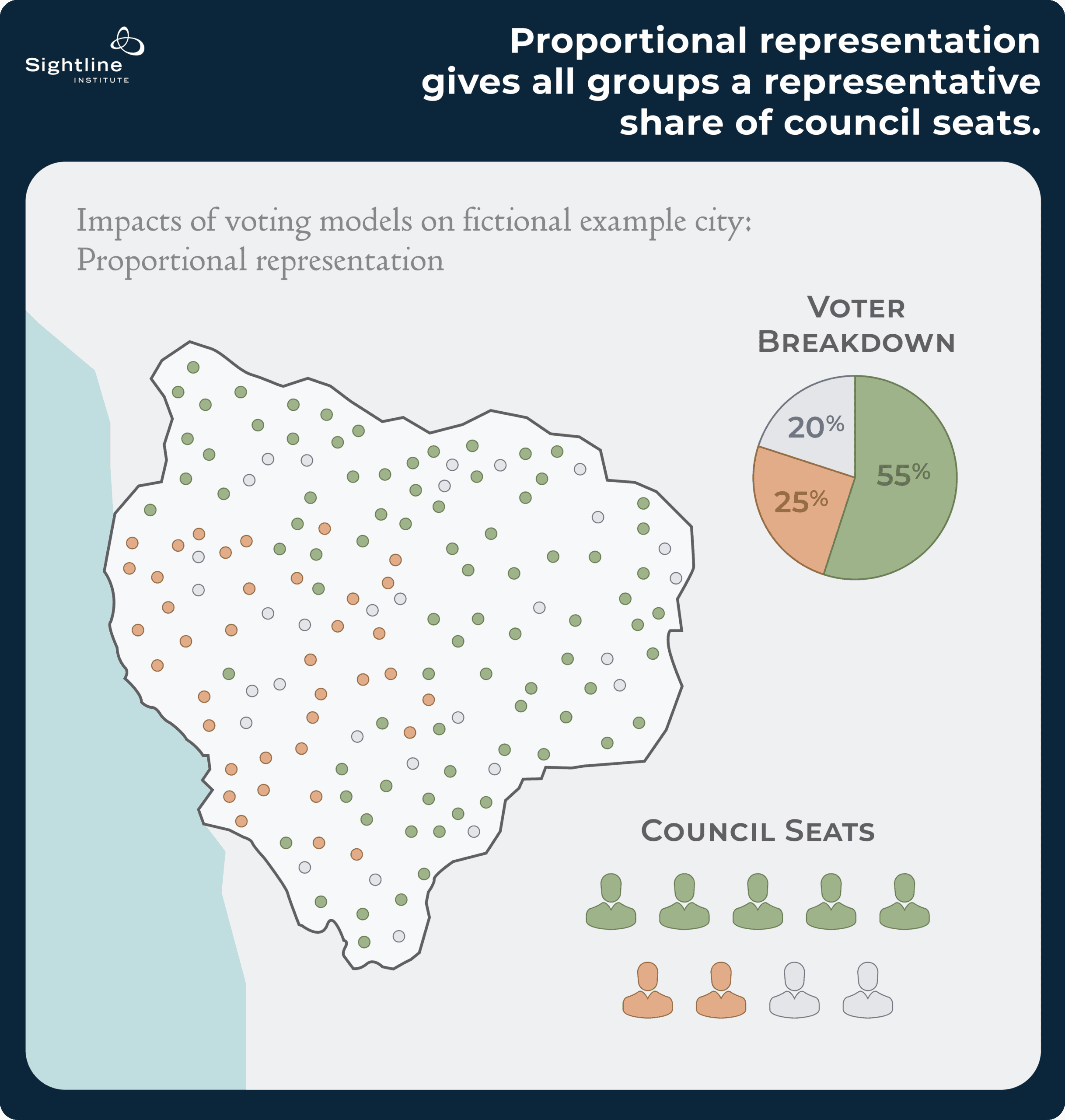
With better representation comes more stable policy that reflects the nuances of voters. Diverse viewpoints on a council mean more incentives for councilors to work toward consensus solutions and compromises in order to pass reasonable policy adjustments. Scholars have documented many benefits to proportional representation, from higher voter participation to reduced risk of political violence to better health outcomes.
Portland started using proportional elections in 2024 and immediately saw changes to who won representation in the city. A far cry from the ill-equipped numbered seats of the defunct city commission, Portland’s governing body now almost exactly mirrors the city in miniature. As a left-leaning city, councilors run the gamut from moderate liberals to socialists. A right-leaning locality, on the other hand, would likely send a mix of old-guard conservatives and MAGA-aligned members to the local council or commission. Somewhere more evenly divided would elect members across the political spectrum.
Under proportional representation, voters of all stripes have a shot at getting someone who prioritizes their issues on their local governing body. Proportional councils would be much less susceptible to full-body takeovers, become immune from jockeying for numbered positions, and would avoid relying on carefully drawn lines to give representation to different groups.
Oregon’s constitutional path to upgrading elections makes it fairly unusual; no other jurisdiction in Cascadia gives local governments the opportunity to adopt proportional representation so explicitly. Any city or county can drop block, position, or single-winner ward-based voting in favor of proportional representation with a simple change in local law.
Many thanks to Todd Newman for research assistance categorizing Oregon cities and counties.

