


Takeaways
- In municipal elections across British Columbia, voters are stuck using block voting or ward voting, methods that can overrepresent one party or ideology at the expense of all others.
- If not for a few lines of provincial law, local governments could adopt single transferable vote, a gold-standard form of proportional representation.
- A simple majority in the Legislative Assembly is all it would take to pass amendments giving cities, villages, towns, and districts the ability to upgrade their elections.
Find audio versions of Sightline articles on any of your favorite podcast platforms, including Spotify, YouTube, and Apple.
You made it! The last contestant standing on an old-school game show. “Behind Door Number One,” your charming host reveals, “a pile of rocks!” Behind Door Two, he grins, “a slightly larger pile of rocks!” And, gesturing to the last door with a glimmer of gold pouring out from beneath, “or will our lucky winner pick the million-dollar mystery prize?” It’s a no-brainer. But as you reach for the knob, the host grabs your wrist. “What are you doing?” he hisses. “You’re only allowed to pick between the first two doors!”
Hardly seems fair, does it? But municipalities in British Columbia get the same treatment when it comes to their local governments. The province strong-arms cities, towns, villages, and districts into using block voting to elect their councils, a poor fit for representation in local elections. Ward (or “district”) voting, the only current alternative, appears a bit more generous but has its own weighty problems: spoiled elections and two-party dominance.
This year, as a special provincial committee studies election reform, might it finally come to pass that local governments get a glimpse behind that third door? Gold-standard elections, using the new best-in-class model now operational in Portland, Oregon, are so close to being in reach: only a few lines of provincial law stand between municipal governments and better representation.
Local councils: Caught between a block and a ward place
British Columbia’s standing election laws simply don’t give local councils a fair shot at better elections. Block voting and ward voting—the only two choices municipalities are allowed—are hardly ideal for representing voters.
Block voting: Multiple winners, lopsided rules
Also known as plurality at-large voting, block voting is BC’s default voting method for local councils.1 If 10 seats on the body are up for a block vote election, voters get to pick 10 candidates. The 10 winners are the ones with the most votes.
The problem? In partisan contests, block voting often means the most popular party will win outsized representation on the council. Take the Vancouver City Council election of 1996, for example. The Non-Partisan Association (a center-right party, despite the name) won slightly more than 50 percent of the total vote… but took 100 percent of the seats.
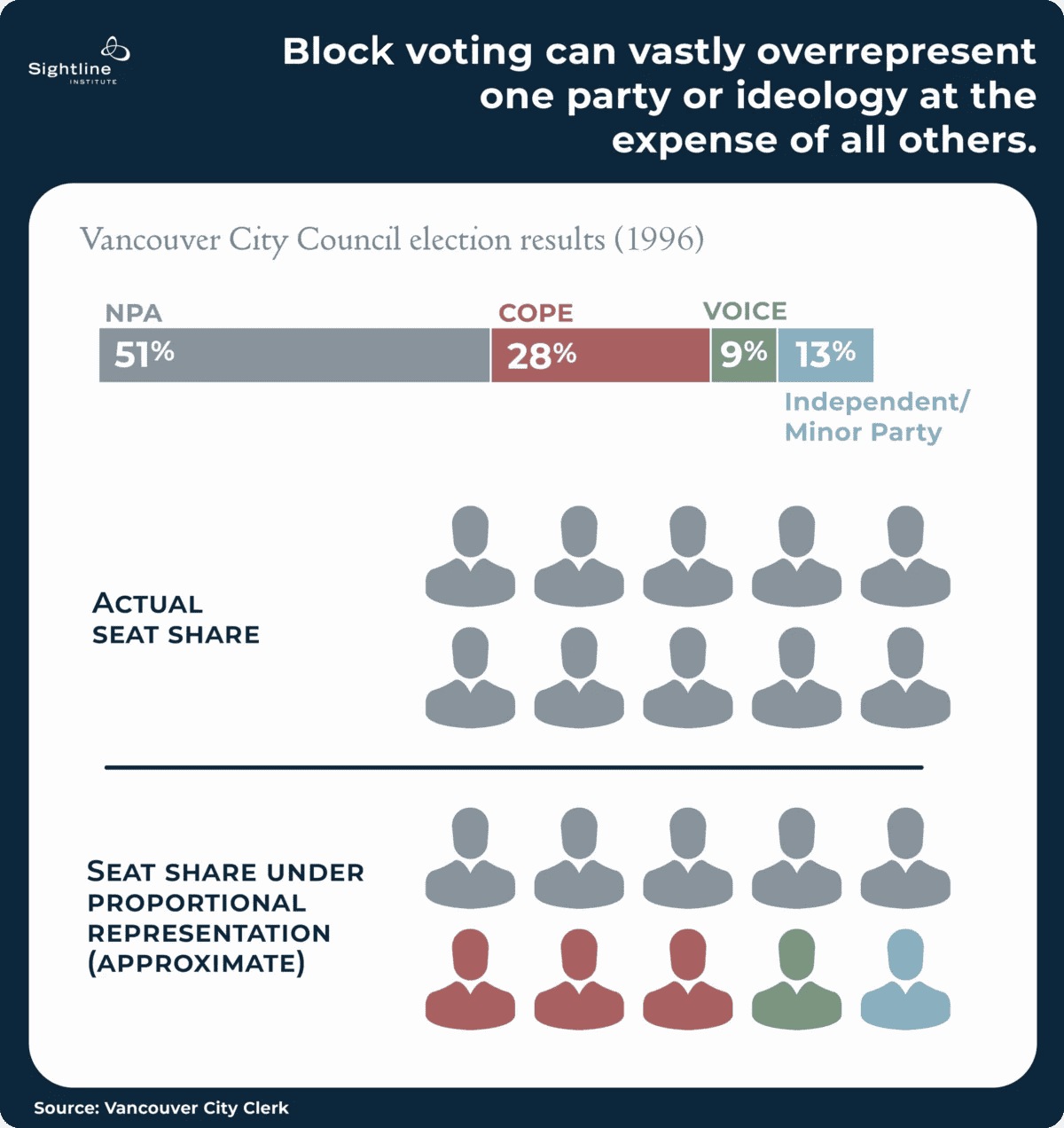
By contrast, if voters had the same preferences under a proportional model, the Non-Partisan Association likely would have wound up with half of the seats, roughly equal to their vote share. Other parties—including the Coalition of Progressive Electors, Vancouver Organized Independent Civic Electors, and others—would have split the remaining five seats, giving their communities a voice in local government.
With turnout perpetually low in BC municipal elections, it’s not out of the question that an extreme faction could seize control of most or all seats in a single election. As authors for Fair Vote Canada wrote in 2022, the winner-takes-all nature of council elections causes sudden and extreme policy swings, which can be expensive for taxpayers and create uncertainty for the individuals, communities, and businesses that local policies impact.
BC offers local governments only one alternative to block voting, which might provide slightly more accurate representation on a council but creates headaches of its own.
One-winner wards: Geographically accurate, but far from fair
Municipalities also have the option to elect councillors partially or entirely in districts, also known as wards.2 Wards that elect a single councillor operate under simple plurality rules (most votes wins), while multi-winner wards must use block voting. So far, only the District of Lake Country has adopted wards, but larger cities—including Burnaby, Surrey, and Vancouver—have debated or proposed converting to ward voting.
While wards guarantee geographic areas will have representation on a council, they create concerns for fairness and representation. First off, if wards split neighborhoods or communities between districts, those communities might not win representation at all, so local governments must take precautions to draw maps impartially and fairly.3 (The act of drawing district lines for political gain, or partisan gerrymandering, is a pervasive problem in the United States.)
Candidates and parties in one-winner wards might also split a base of voters and send a candidate to the council with a plurality (less than 50 percent) of the vote. The same is true of other one-winner elections, like the Vancouver mayoral election of 2018, in which 71 percent of voters cast ballots for someone other than the ultimate winner.
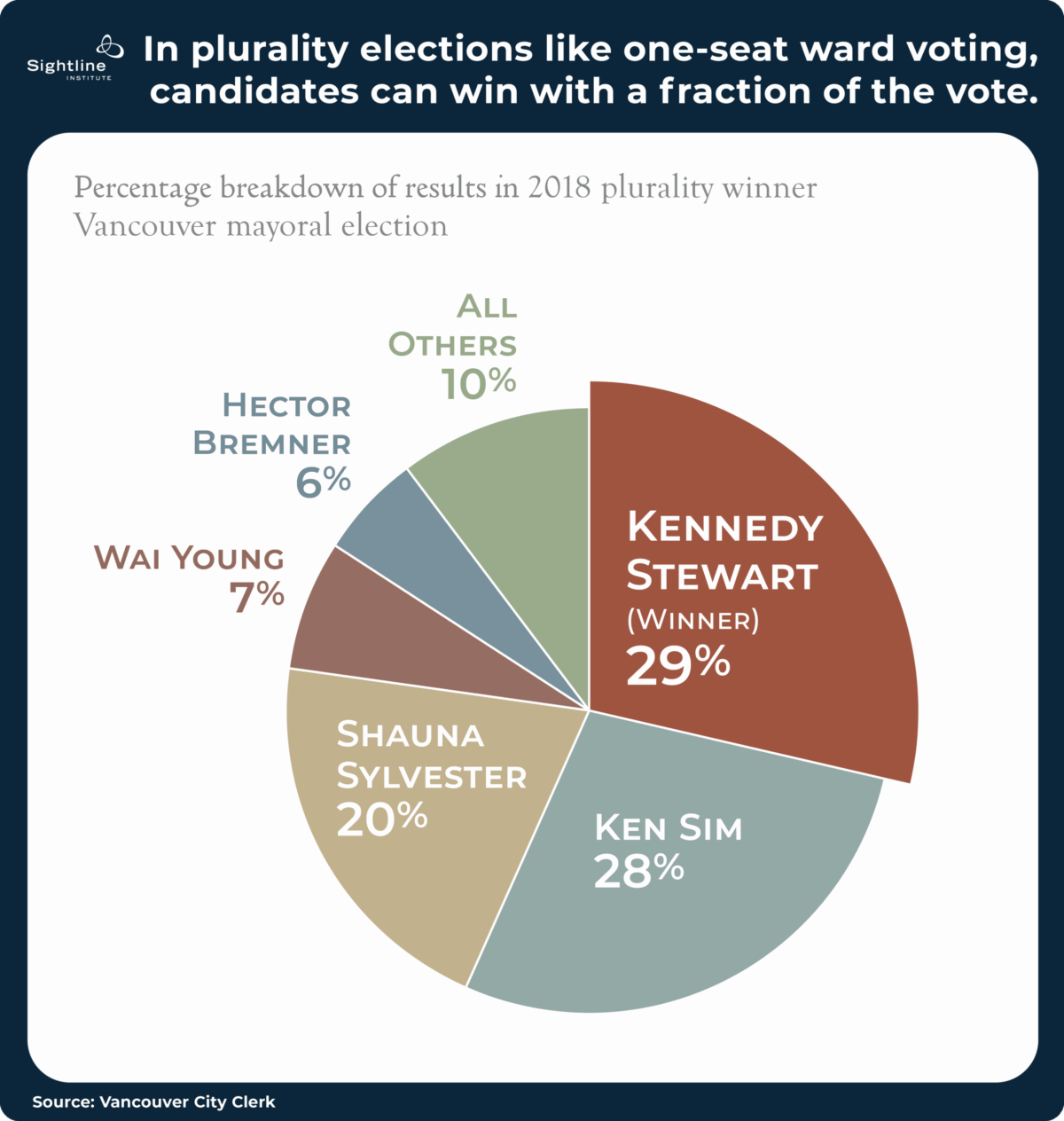
As BC voters witnessed in 2024, vote splitting is also a frequent concern in hotly contested, district-based legislative assembly elections. Look to divided results in the ridings of Columbia River-Revelstoke, Richmond-Stevenson, and West Vancouver-Capilano for just a handful of cases where the winner didn’t reflect the preferences of most voters.
Viewer discretion advised: US districts as a warning against ward voting
District-based winner-take-all elections are a primary source of polarization and dysfunction in the United States. Voters feel they have little choice but to pick between Democrats or Republicans to avoid “spoiling” a contest, cementing two-party dominance. That doesn’t stop activists from surreptitiously boosting minor parties, sneakily siphoning votes away from one major party to the advantage of the other. What’s more, amid a widespread housing shortage and resulting high home prices and rents, it’s noteworthy that US cities that switched to single-winner wards saw their housing shortages worsen, rather than get better.
Though BC and several of its cities have a rich history of multi-party elections, similar issues could plague municipalities that switch to one-winner wards, even in nonpartisan contests. If local governments seek better representation, consider single-member wards in the US experience a case of “If I were going there, I wouldn’t start from here.”
In short, wards with one winner could easily divide voters and misrepresent their interests, with other unwanted side effects. And wards with more than one winner would just use block voting, which isn’t any better for representation.
So what’s the answer? For $200: “This electoral method gives all groups their fair share of seats on a government body.”
What is proportional representation, Alex?
Proportional representation defines multi-seat elections in which, if half of aligned voters support a party, that party will win about half of the seats up for grabs—not zero, as can be the case under block or ward voting.
The concept should be familiar to British Columbians, who weighed in on provincial-level proportional methods in 2005, 2009, and 2018. Unfortunately, despite drawing more than majority support in 2005 and featuring homegrown models on the ballot in 2018, proportional representation never took off at the provincial level.
However, well before BC’s constrictive local block voting policy, the Assembly let cities use a proven, stable, and proportional method: single transferable vote. It’s the model of choice in Ireland, Cambridge, Massachusetts, and (most recently) Portland, Oregon, where it’s produced promising results for representation and public opinion.
How does single transferable vote work?
In a single transferable vote election, voters rank candidates in order of preference: first, second, third, and so on. Once a candidate hits a threshold of support (which depends on how many seats there are to fill), they win a spot on the council, and extra votes they receive beyond the threshold transfer to voters’ next choices. If no one meets the quota right away, officials eliminate the candidate with the fewest votes, and those votes “transfer” to other candidates based on voters’ next preferences.
How single transferable vote works in Portland, Oregon.
The cycle continues until all seats are filled. The result? Fewer wasted votes, an incentive for candidates to campaign on shared values instead of divisions, and a council that mirrors a community’s diversity far better than block or ward voting ever could.
More rewarding wards under single transferable vote
Municipalities can use single transferable vote for a full council all at once, but multi-member wards become quite valuable in proportional elections, particularly for large cities. Just like single-winner wards, they guarantee geographic representation on the council, just with none of the winner-takes-all downsides: it’s much harder for partisans to game the system when voters win representation proportionally. But that’s not all! Wards allow candidates to focus on their neighborhoods and give voters a more focused ballot—no need to pick between all 50 or more candidates citywide.
In Portland’s case, before single transferable vote, commissioners from just a handful of neighborhoods dominated the city’s governing body. But after its first proportional contest, all four corners of the city (now multi-winner wards) gained representation for the first time in over a century. While a similar outcome would have been possible (maybe even likely) in a city-wide proportional election, wards guarantee that residents within their boundaries will have a few contacts close to home on the council.
And the proportional nature of the election also increased diversity on Portland’s governing body: members come from different neighborhoods and vary in race and age. Voters elected a mix of homeowners and renters, political veterans and relative newcomers. And survey says: more residents are starting to feel they finally have someone speaking for them on the council.
Sounds great. So what’s the holdup?
For decades, one section of the Local Government Act (and the Municipal Act before it) has stood in the way of BC municipalities choosing better elections. And while Vancouver has its own separate provincial charter that doesn’t mention block voting, legal experts concluded years ago that the province’s largest city can’t adopt proportional representation under current rules.4
In either case, it would take only a majority of MLAs in favor of passing a law to free up municipalities to upgrade their council elections. But what might be the first step?
Start with giving Vancouver what it’s been asking for
Like any successful quiz show contestant, Vancouver has done its research and has the answer at the ready. Commissions studying election reform in 2004 and 2016–2017 both explicitly recommended that the city council ask the Legislative Assembly to change the Vancouver charter and allow it to adopt proportional representation. The council made a formal request in 2005—to no response.
Years later, representation problems in Vancouver are still a concern. The legislative assembly could add a provision to the Vancouver charter finally allowing the city to follow through on reform commission reports and kick off a plan to move to proportional representation, perhaps in consultation with Elections BC or, as with wards, with the approval of the lieutenant governor.
Vancouver could be a test screening to see how proportional representation plays for a modern, BC-specific audience. It could give election officials a chance to see how voters react to new rules and to learn what their needs may be if or when proportional representation expands to cities, or even to the province—all while addressing problems with the current block vote model.
For pro-reform MLAs, greenlighting a Vancouver pilot could be a low-stakes way to quell any concerns among their colleagues that a proportional model might disadvantage parties or cause uncooperative governance. And if single transferable vote were to prove successful in Vancouver, it could get picked up in other markets.
Coming up next: More choices across the province
Vancouver isn’t the only place that could benefit from an election upgrade. In 2022, for example, Surrey saw one party win 50 percent of council seats with only 25 percent of the vote. Fair Vote Canada has made the case that virtually all BC cities to some degree suffer from the block vote method and could be improved with single transferable vote.
With a “local options” law, the Legislative Assembly could provide guidelines and guardrails for using proportional representation, much as it did with the law authorizing ward voting. No city would have to adopt a new model, but those seeking a proportional upgrade would be free to do so with support from the province.
As for the degree of detail a local options law would require, the approach could vary. Oregon, for example, explicitly allows for proportional representation in a single paragraph in its constitution, making it unique among US states. The provision isn’t overly prescriptive but contains safeguards to ensure fairness in proportional contests.
For the last few legislative sessions, pro-reform Washington State legislators have pitched a more hands-on approach. The Washington VOICES Act would make local reform possible and outline detailed practices that municipalities looking to adopt ranked choice voting or single transferable vote would have to follow. As the Special Committee on Democratic and Electoral Reform deliberates over its final answers this summer and fall, members might weigh how specific reform-enabling legislation would have to be.
In any case, it doesn’t take a trivia show savant to see that BC’s local governments can do better than block and ward voting, the only two options the province has on offer. The former produces single-party sweeps and dizzying policy swings, while the latter splits voters and drives political gamesmanship. It’s time to stop stalling for time and let municipalities walk home with the real prize: fair, proportional representation with single transferable vote.

