


Takeaways
- British Columbia’s Bill 47, to spur transit-oriented development (TOD) provincewide, is about two years out from its June 2024 compliance deadline.
- The law was an important step toward spreading Metro Vancouver’s TOD success to other housing-strapped cities and towns in BC.
- Cities have been uneven in their uptake of Bill 47’s measures, and while it’s too early to judge the law’s overall success, it has made progress, especially in reducing costly excess parking in new buildings.
- If over time the measure should fail to achieve the homes British Columbians need, the province could give it more teeth—namely by mandating as-of-right development up to Bill 47’s standards in areas near transit.
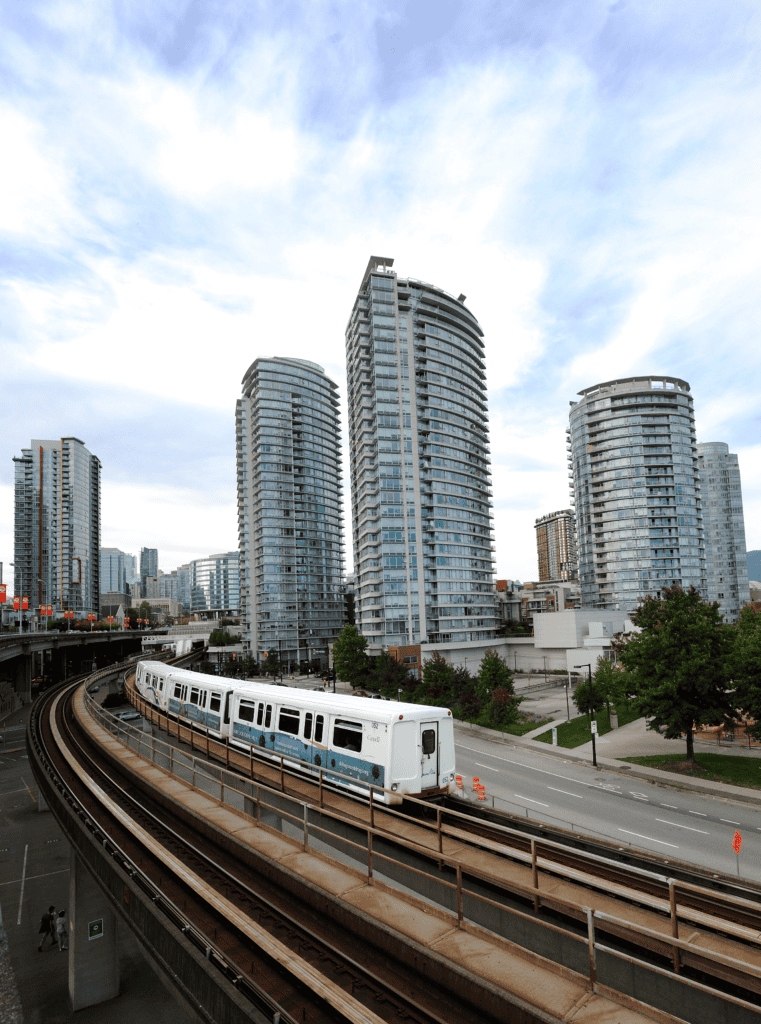
Ride any SkyTrain line in Metro Vancouver today, and residential towers rise beside nearly every station, reflecting 50 years of transit-oriented development (TOD) policy at work in British Columbia’s most urban region.
In November 2023, the BC government passed a new law to take that Vancouver-tested idea province-wide: Bill 47 sets building size minimums for areas around 104 transit stops in 31 municipalities—a big step toward addressing a widespread housing shortage and asserting BC’s authority to help address it.
A little more than two years since its June 2024 compliance deadline, it’s too soon to tell if Bill 47 will deliver a major boost of new homes near transit; large projects simply take longer than that to plan and build. But one bright spot is already shining through: parking reform. Builders are using Bill 47’s new rules to shrink their parking counts without having to slog through a lengthy and unpredictable approval process.
The law’s biggest flaw, though, is that it does not mandate “as-of-right” development—that is, automatic permitting for projects that meet the zoning rules, with no additional review. Under Bill 47, municipalities must allow the law’s minimum building dimensions, but they can still force projects through an unpredictable discretionary review process, often delaying them for years, if not killing them outright. If Bill 47 underdelivers in the years ahead, the fix the province can pursue is to require as-of-right TOD.
How Metro Vancouver led the way on transit-oriented development
Transit corridors have shaped settlement patterns in Greater Vancouver since the 1890s, when the region built the “interurban” streetcar network. But it wasn’t until 1975 that TOD became a deliberate planning policy, when the Greater Vancouver Regional District (later renamed Metro Vancouver) published The Livable Region plan. One of the plan’s five key principles was to “provide a transit-oriented transportation system linking residential areas, regional town centres, and major work areas.” Construction of the SkyTrain rapid transit system in the early 1980s, ahead of Expo 86, put that vision into motion.
Every regional growth strategy since has reinforced TOD as a guiding principle. Updating a strategy requires approval from all 21 cities in the region, which must then align their local plans with it. This reciprocal system creates a shared framework for managing growth, one that academics and international agencies have credited as a key driver of TOD’s success. In turn, this coordination has helped the region’s rapid-transit network to continually improve and expand into the present.
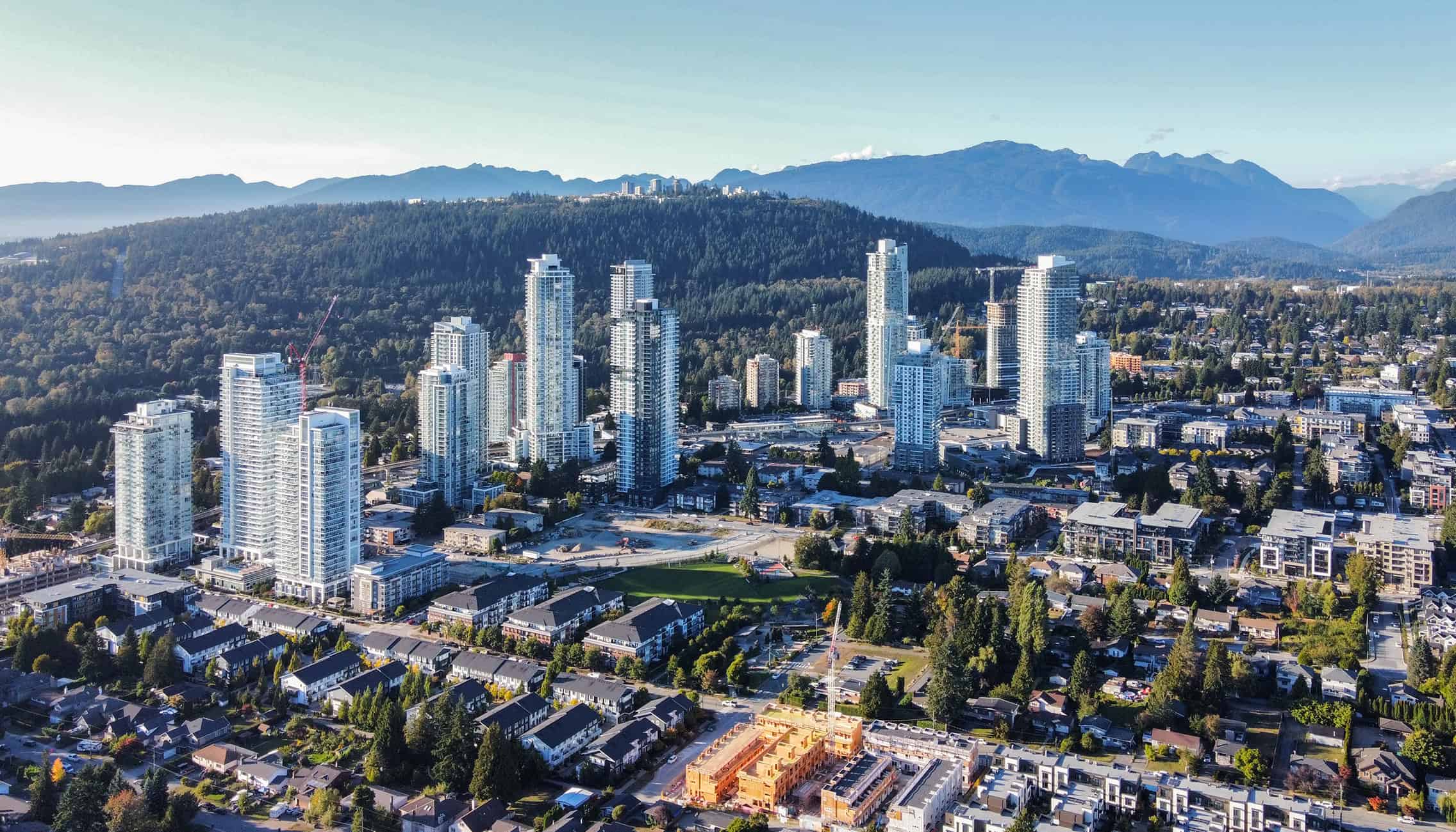
Individual cities have put TOD into practice over the last several decades, too: Surrey’s City Centre Plan, Coquitlam’s Transit-Oriented Development Strategy, Port Moody’s Moody Centre TOD Plan, Burnaby’s Brentwood Town Centre Development Plan, and Richmond’s City Centre Area Plan, among others. Outside Metro Vancouver, lower population density has rarely supported rapid transit, leaving TOD with a much thinner legacy across the rest of the province.
What Bill 47 requires
Passed in November 2023, Bill 47 designates Transit-Oriented Areas (TOAs) around transit stations and requires municipalities to permit specified building heights and densities within them. (“Density” here means floor-area-ratio (FAR), which is the building’s total floor area divided by its lot size.)
- SkyTrain TOAs cover an 800-meter radius around each station, while bus TOAs cover 400 meters.
- Each TOA is also split into tiers, with greater height and density required closer to stations.
- Allowed density scales with city size.
TOA Types in BC, and Municipalities Where Those Areas Apply
| TOA Types in BC, and Municipalities Where Those Areas Apply | |||||
| Category | Tier | Distance from TOA (m) | Mimimum Density (FAR) | Minimum Height (Stories) | Applicable Cities |
| Category 1: SkyTrain/Canada Line in Metro Vancouver | 1 | 200m or less | Up to 5.0 | Up to 20 | City of Burnaby City of Coquitlam City of Langley Township of Langley City of New Westminster City of Port Moody City of Richmond City of Surrey City of Vancouver |
| 2 | 200m–400m | Up to 4.0 | Up to 12 | ||
| 3 | 400m–800m | Up to 3.0 | Up to 8 | ||
| Category 2: Bus Exchange / West Coast Express in Metro Vancouver | 4 | 200m or less | Up to 4.0 | Up to 12 | City of Delta City of Langley City of Maple Ridge City of North Vancouver District of North Vancouver City of Pitt Meadows City of Port Coquitlam City of Surrey City of Vancouver |
| 5 | 200m–400m | Up to 3.0 | Up to 8 | ||
| Category 3: Bus Exchange or West Coast Express in Capital region and other medium-sized municipalities | 4 | 200m or less | Up to 3.5 | Up to 10 | City of Abbotsford City of Chilliwack City of Colwood City of Kamloops City of Kelowna City of Langford City of Mission City of Nanaimo City of Prince George District of Saanich City of Vernon City of Victoria Town of View Royal |
| 5 | 200m–400m | Up to 2.5 | Up to 6 | ||
| Category 4: Bus exchange in smaller municipalities | 4 | 200m or less | Up to 2.5 | Up to 6 | District of Lantzville City of Penticton Resort Municipality of Whistler |
| 5 | 200m–400m | Up to 1.5 | Up to 4 | ||
Under Bill 47, cities must designate by bylaw any TOA(s) within their jurisdiction and map their boundaries. Inside a TOA, cities cannot reject a project’s rezoning applications based on height or density alone, as long as the project meets Bill 47’s minimums. Nor can cities mandate off-street parking in TOAs, except for accessible parking.
Finally, a parcel can be exempt from Bill 47 if the land sits outside municipal jurisdiction, faces serious constraints such as flood risk, or carries zoning that treats residential use as secondary to industrial or agricultural use.
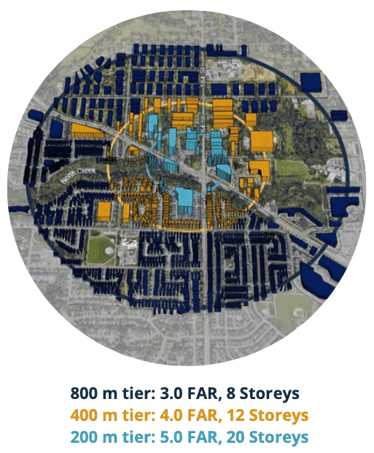
Depiction of a Bill 47 TOA, showing each density tier in concentric circles around a transit station, along with the parcels that would be captured by each tier. Image from Transit-Oriented: New Developments in Metro Vancouver, used with permission from the authors.
How many homes could bill 47 create?
A 2023 report estimated Bill 47’s likely home construction effects by modeling its zoning requirements alongside housing prices, construction costs, land values, developer profits, and labor constraints. Its conclusion: 17,000–59,000 net-new homes over 10 years1—a wide range that reflects how uncertain municipal implementation looked in 2023. For context, British Columbia had roughly 2.15 million homes as of 2023, meaning Bill 47 could increase housing stock 0.8–2.7 percent provincewide.
What’s more, those new homes would be efficiently concentrated. All 104 TOAs in British Columbia together cover roughly 149 km2, or just 3.5 percent2 of the total land area across the 31 cities that contain them. This is Bill 47’s promise in miniature: tens of thousands more homes, located near transit, that ask only a sliver of cities’ land.
Cities’ implementation has been uneven
Bill 47’s compliance deadline was June 30, 2024, and cities have implemented the legislation to varying degrees. Most did the minimum, adopting a simple “Transit-Oriented Areas Bylaw” that provides TOA maps and updates parking rules without changing zoning. Others integrated Bill 47 language into their existing zoning bylaws. A smaller group went further by creating policy guides and master plans to redevelop certain TOA neighborhoods. Vancouver went beyond provincial requirements, publishing a TOA rezoning policy guide that allows 5.5 FAR near transit stations, where Bill 47 only mandates 5.0.
This broad range of compliance, all allowable under Bill 47, shows that the law sets a loose standard for TOD that relies on local political will for meaningful uptake.
Bill 47’s impact also depends on TOAs’ pre-existing zoning. For example, at Vancouver’s King Edward station, where most of the land is still zoned for single-detached homes and townhouses, Bill 47 vastly increases the capacity for housing by allowing buildings of 8 to 20 stories. In contrast, most of Burnaby’s Metrotown station TOA was already zoned for buildings exceeding Bill 47’s minimums—up to 6.2 FAR, where the law only requires 3 to 5.
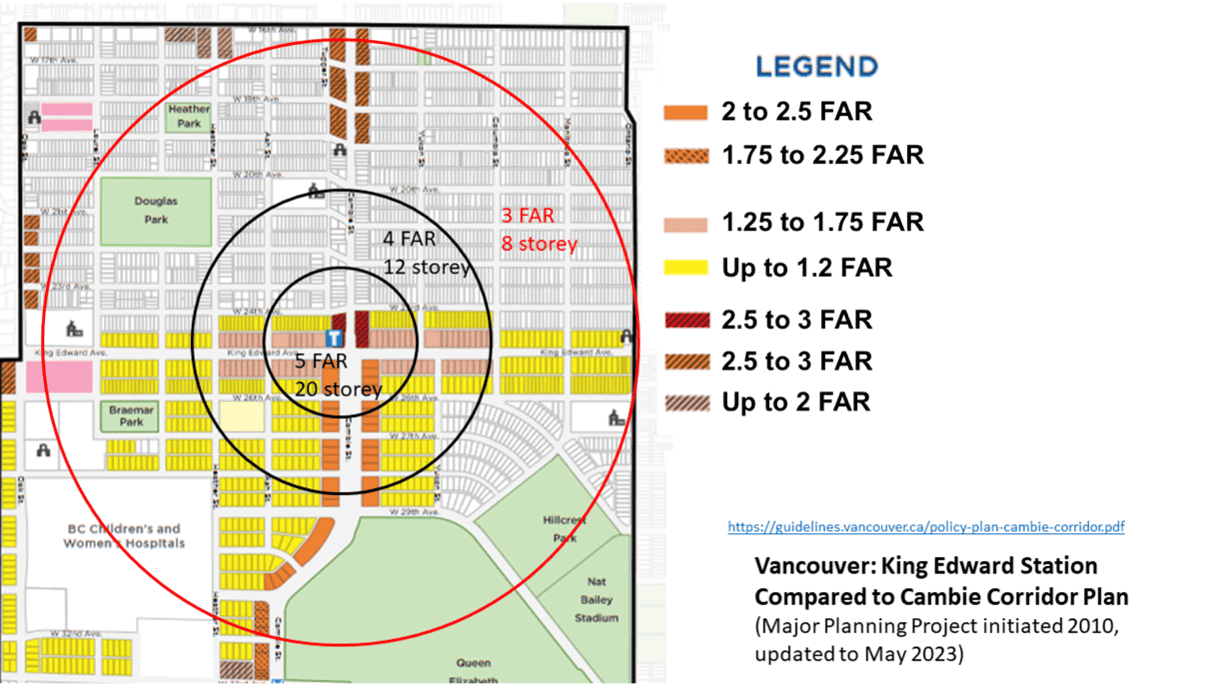
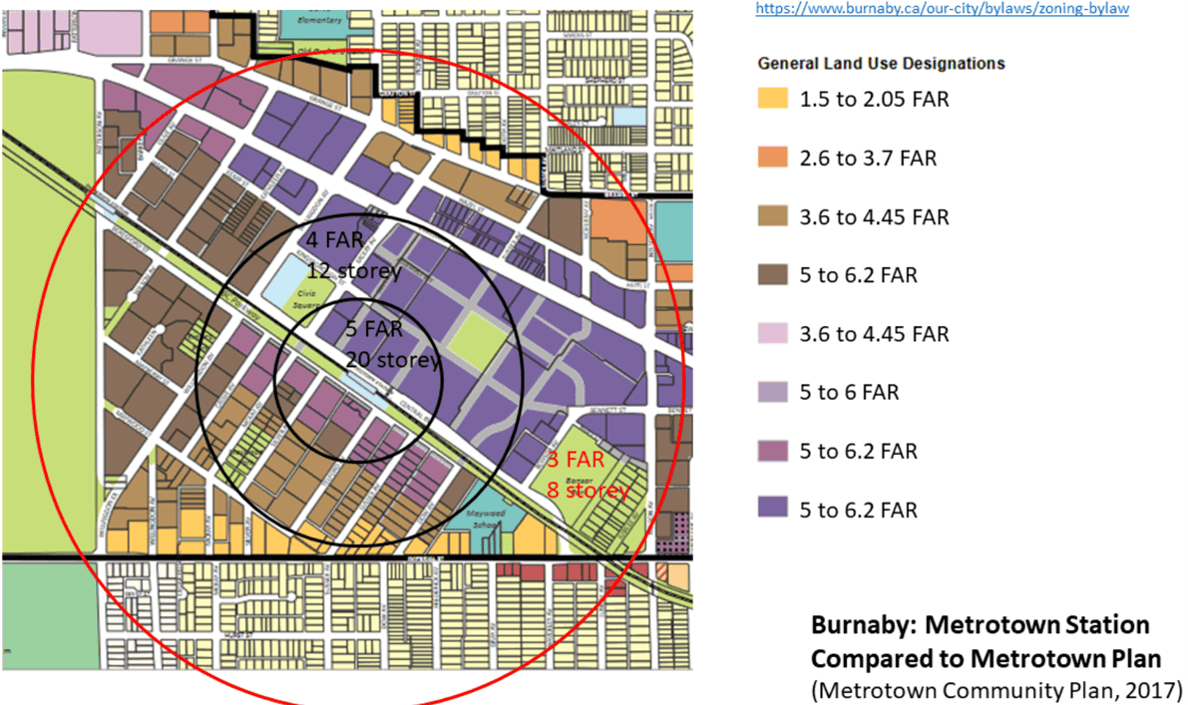
Those divergent effects have prompted some local governments to push back, arguing they were already embracing TOD and that a one-size-fits-all law risks straining infrastructure to accommodate new homes. Meanwhile, proposed projects in Prince George and Nanaimo, cities with little existing TOD, suggest the provincial legislation can help local governments facilitate homebuilding at a scale that may not have been politically feasible otherwise.
Bill 47: What’s working—and not
How effective will Bill 47 be for creating more homes near transit? The honest answer, about two years out from the compliance deadline, is that it’s too soon to say.
The standard process to get a rezoning approved and construction started takes several years, meaning any major projects underway in TOAs today were planned before Bill 47 existed. An assessment of apartment construction data in several TOA municipalities across BC was inconclusive.3
Parking reform is already paying off
One outcome is clear: Bill 47’s elimination of off-street parking mandates is already delivering tangible benefits. Underground parking is expensive and often underutilized in buildings near frequent transit, especially rental buildings. Bill 47 provides flexibility for developers to match parking supply to demand, cutting construction costs, expensive square footage wasted on asphalt, and embodied carbon.
One example is the 102+Park project, in Surrey. Developer Marcon converted it from ownership to rental and cut an entire floor of parking, reducing the number of stalls from 304 to 240. Similar moves are underway on two other projects in Surrey, as well as projects in Vancouver, Coquitlam, Port Coquitlam, and Port Moody.
Declining condo presale trends are pushing some of these decisions, too. But Bill 47 gives developers the option to cut parking unilaterally, skipping a zoning variance and council approval process that, before the law, could take far longer, or prove impossible.
As-of-right remains a gap
Bill 47’s big limitation is that it does not require cities to rezone TOAs so that compliant housing can be built as-of-right. Cities can impose restrictions besides height and density (like excessive setbacks, for example) that render typical TOD proposals non-compliant. In this way, a city can preserve its discretionary power to consider TOD rezoning applications case by case and to deny them based on factors other than building height or density. Not a single municipality has voluntarily sanctioned as-of-right development up to Bill 47’s standards in all their TOAs.
As a result, Bill 47 is effectively upholding the discretionary system that has underpinned planning across British Columbia for decades. Because most cities still zone large swaths of their land for single-detached homes or small-scale multi-unit housing, developers often must buy land not zoned for the apartments or condos they intend to build, then negotiate with city staff over how many homes that land can hold and under what conditions. Formalizing these deals through a rezoning application, review, council readings, and often a public hearing can take years. Worse, these discretionary processes favor wealthy homeowners over other residents, increase costs that are ultimately passed on to renters and first-time buyers, and create risk and uncertainty that discourage investment in homebuilding altogether.
The fix: Pre-zoning
The remedy is for the province to require municipalities to pre-zone their TOAs for as-of-right development up to Bill 47’s density and height allowances, removing the rezoning bottleneck. Washington state already does this: its 2025 TOD law requires cities to upzone their station areas to allow specified minimum building sizes. The downside, as with any zoning reform, is that the more prescriptive the measure, the more politically difficult it is to pass.
But even if BC doesn’t strengthen Bill 47 with a pre-zoning requirement, its recent shift toward proactive planning may nudge cities there voluntarily. Provincial law now requires every municipality to complete a Housing Needs Report every five years, projecting local housing demand. Upon completion, a municipality must update its bylaws to pre-zone for as-of-right development matching their projected 20-year housing need. Pre-zoning TOAs up to Bill 47’s minimums would help cities meet that quota while giving homebuilders and infrastructure planners more clarity on where new homes should go. Recent analysis indicates big potential: a 2025 report estimated that zoning the Moody Centre TOA up to Bill 47 thresholds would create capacity for 29,147 homes, nearly triple Port Moody’s 20-year housing need.
Looking ahead
Bill 47 took a planning principle championed by Metro Vancouver 50 years ago and applied it across British Columbia. Two years in, the law’s capacity to boost homebuilding near transit is still an open question. It has, however, already started to deliver results on parking, letting builders reduce their parking counts without needing to ask for city approval.
The law’s central weakness is the discretion it leaves to cities. Bill 47 mandates the height and density that TOD needs, but not the full pre-zoning that would let builders construct homes as-of-right. As a result, it leaves in place the same slow, unpredictable, case-by-case approval process that has driven up costs and delayed housing across BC for decades.
If Bill 47 falls short, the province’s clearest next move is to mandate as-of-right development up to the law’s own thresholds. Whether the province is willing to take this bolder step may determine Bill 47’s impact—if it remains a modest refinement to an existing planning practice, or a watershed that unlocks transit-oriented development across all of British Columbia.

Related: Worried about Infrastructure Costs? Then End the Apartment Ban | Allowing more homes, in all shapes and sizes, makes it easier and cheaper for communities to tackle infrastructure challenges.
Appendix
Table: Apartment starts, pre- to post-Bill 47
| Location | Apartment Starts Pre- to Post-Bill 47 | |||
| Area | City | # of TOAs | % Change | Real Change |
| Non-Metro Vancouver | Saanich | 4 | 115% | 788 |
| Kamloops | 3 | 118% | 743 | |
| Kelowna | 3 | -22% | -934 | |
| Vernon | 2 | 255% | 107 | |
| Prince George | 1 | 122% | 352 | |
| Metro Vancouver | Vancouver | 29 | -21% | -2359 |
| Burnaby | 16 | -5% | -312 | |
| Surrey | 15 | -28% | -3082 | |
| Coquitlam | 8 | 63% | 2730 | |
| New Westminster | 5 | -51% | -653 | |
A mixed bag of apartment starts construction, 23 months before to 23 months after Bill 47’s compliance deadline (so, July 2022 to May 2026). Table created by the author, with data from Canada Mortgage and Housing Corporation (https://www03.cmhc-schl.gc.ca/hmip-pimh/en/TableMapChart/).
Table: TOAs by Municipality
| All TOA Municipalities in BC by Number of TOAs | Municipality | Regional District | # of TOAs |
| City of Burnaby | Metro Vancouver | 16 |
| City of Coquitlam | Metro Vancouver | 8 |
| City of Langley | Metro Vancouver | 2 |
| Township of Langley | Metro Vancouver | 1 |
| City of New Westminster | Metro Vancouver | 5 |
| City of Port Moody | Metro Vancouver | 2 |
| City of Richmond | Metro Vancouver | 5 |
| City of Surrey | Metro Vancouver | 15 |
| City of Vancouver | Metro Vancouver | 29 |
| City of Delta | Metro Vancouver | 1 |
| City of Maple Ridge | Metro Vancouver | 3 |
| City of North Vancouver | Metro Vancouver | 1 |
| District of North Vancouver | Metro Vancouver | 2 |
| City of Pitt Meadows | Metro Vancouver | 1 |
| City of Port Coquitlam | Metro Vancouver | 3 |
| City of Abbotsford | Fraser Valley Regional District (FVRD) | 1 |
| City of Chilliwack | Fraser Valley Regional District (FVRD) | 1 |
| City of Colwood | Capital Regional District (CRD) | 1 |
| City of Kamloops | Thompson-Nicola Regional District (TNRD) | 3 |
| City of Kelowna | Regional District of Central Okanagan (RDCO) | 4 |
| City of Langford | Capital Regional District (CRD) | 1 |
| City of Mission | Fraser Valley Regional District (FVRD) | 1 |
| City of Nanaimo | Regional District of Nanaimo (RDN) | 3 |
| City of Prince George | Regional District of Fraser-Fort George (RDFFG) | 1 |
| District of Saanich | Capital Regional District (CRD) | 4 |
| City of Vernon | Regional District of North Okanagan (RDNO) | 2 |
| City of Victoria | Capital Regional District (CRD) | 1 |
| Town of View Royal | Capital Regional District (CRD) | 1 |
| District of Lantzville | Regional District of Nanaimo (RDN) | 1 |
| City of Penticton | Regional District of Okanagan-Similkameen (RDOS) | 3 |
| Resort Municipality of Whistler | Squamish-Lillooet Regional District (SLRD) | 1 |
| Total* | 123 | |
*There are 104 total TOAs, but some cross into multiple cities, thus counting in multiple jurisdictions.


