

Takeaways
- In Alaska, as in California and Washington, ballots list candidates’ parties but not parties’ endorsements.
- Adding party nominations to ballots would better inform voters who depend on party labels to help them find candidates who reflect their values.
- Ballots with party-tagged candidates would also help strengthen parties, which are essential for healthy democracy.
- Legislatures in Alaska, California, and Washington can take a leaf from a ballot measure recently filed in Oregon that empowers parties to claim their nominees on ballots.
Find audio versions of Sightline articles on any of your favorite podcast platforms, including Spotify, YouTube, and Apple.
In 2024 Alaska Democrats were understandably incensed when Eric Hafner, a convict who had never lived in their state, ran for Alaska’s US House seat as a Democrat. State and federal law allowed Hafner to seek the office, and state law let him register with the party he preferred.
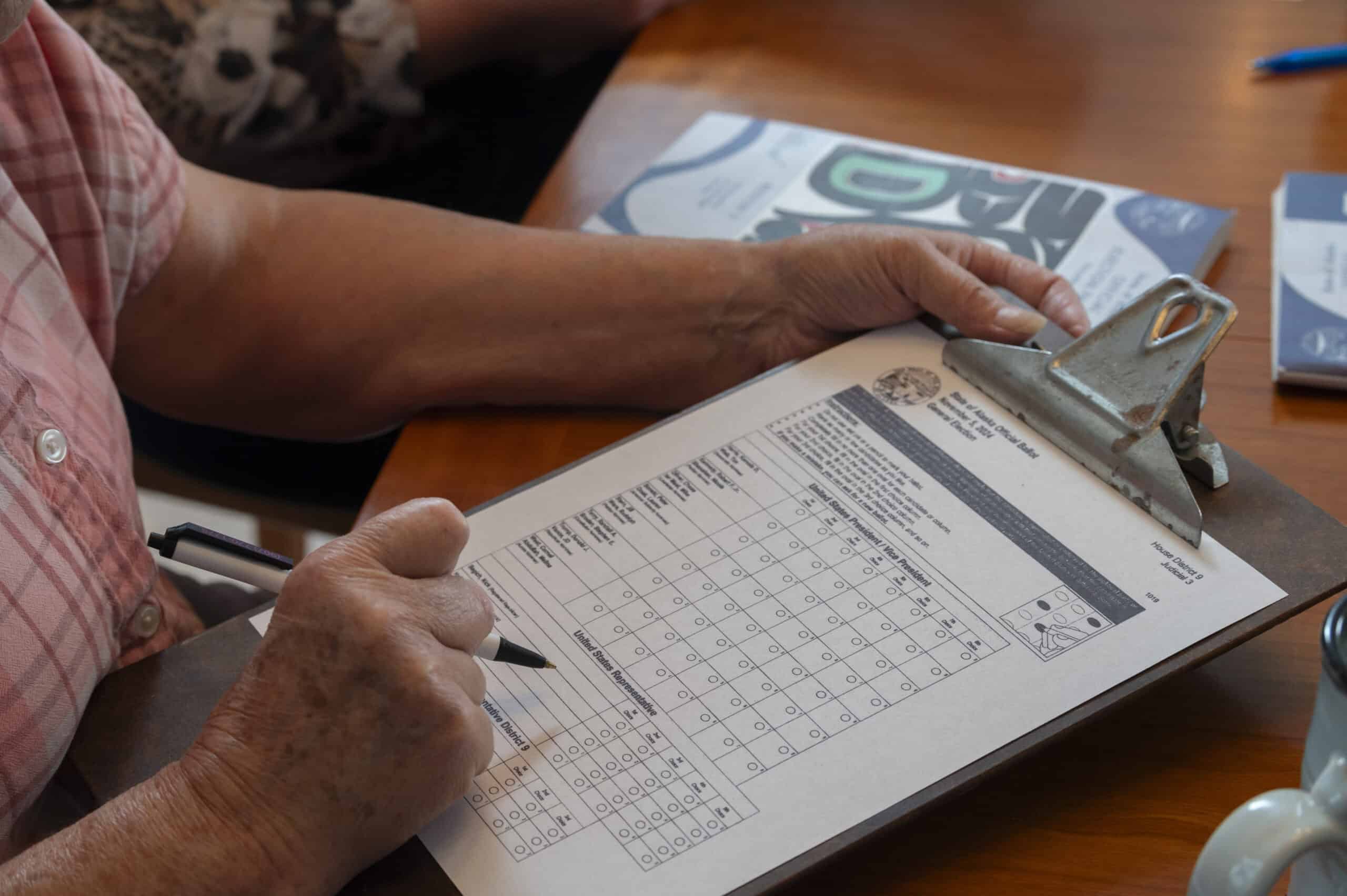
The state Democratic Party, for its part, could do nothing. It had no way to disavow him or indicate on the ballot (inserted below in full) its endorsement of incumbent Representative Mary Peltola. Come election day, Hafner got more than 3,500 first-choice votes from Alaskans who saw his name and party on the ballot but presumably had no idea that if elected, he would represent them from a New York prison where he was serving 20 years.
Two years earlier, the state Republican Party was the one fuming. Sarah Palin and Nick Begich III, registered Republicans, both on the top-four general election ballot, were feuding on the campaign trail, refusing to cross-endorse each other as co-partisans typically do in ranked choice elections. The state GOP endorsed Begich early and never endorsed Palin. In the general election, Palin and Begich split Republican votes, as expected, pushing the election to Mary Peltola, who became the first Democrat in the seat in 49 years. (Two years later, with Palin out of the picture, Begich reclaimed the post for the GOP.)
Now both Republicans and Democrats in Alaska have a beef with a minor flaw in their state’s ballot rules that lets candidates claim a party but doesn’t let parties claim candidates. The same flaw fusses California and Washington, the two other states that use unified all-candidate primaries.
In short, any candidate in these three states can claim any party, potentially confusing voters as to who really represents their values. And political parties can do nothing to stop them.1
The fix: Let parties tag their endorsed candidates on ballots
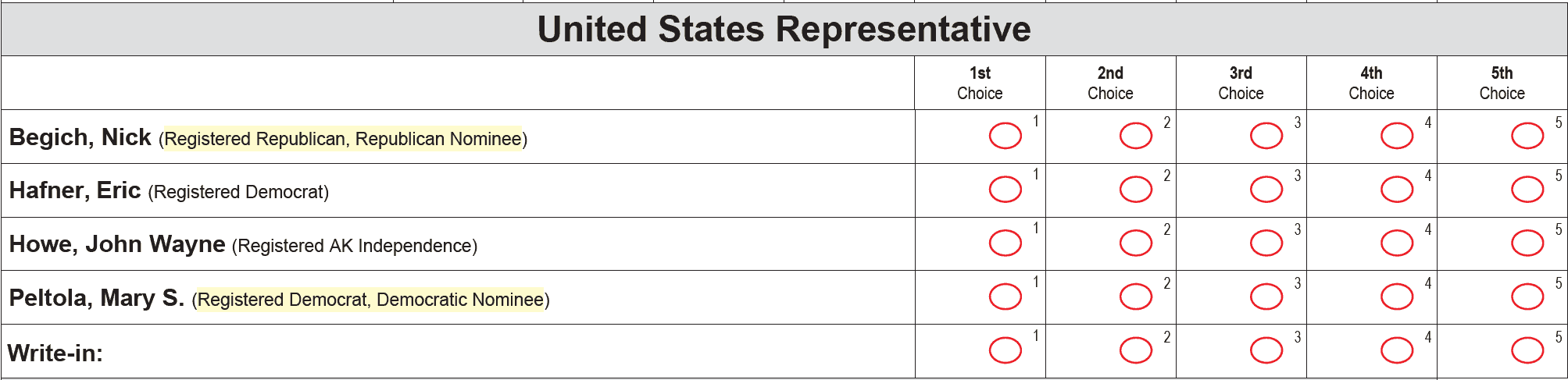
The fix to this problem in all three states is easy: let parties indicate their endorsement of a candidate with two words: “[Democratic or Republican] Nominee.”
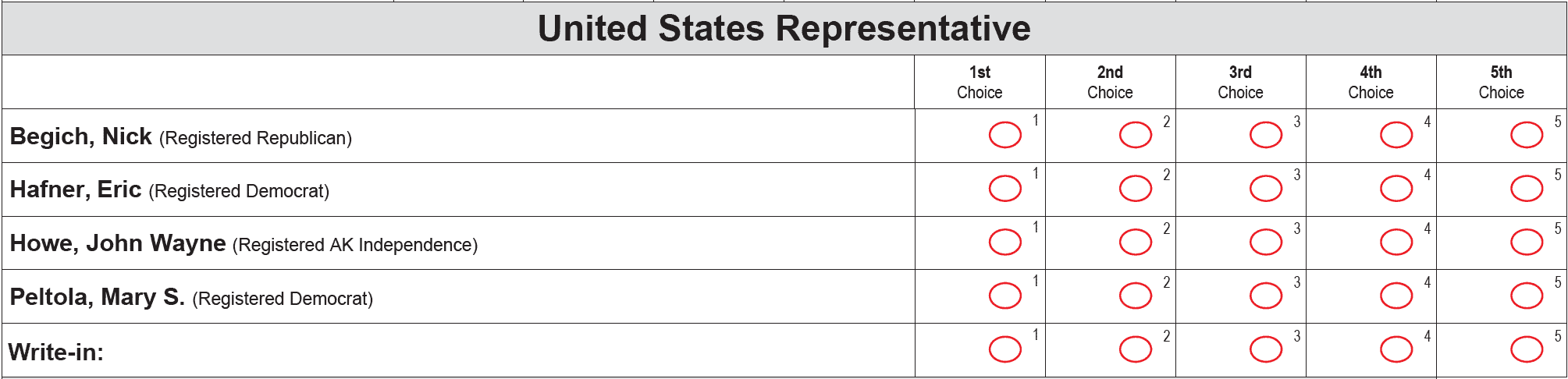
Here’s that 2024 Alaska ballot again, zoomed in on the US House race:
And here it is, with nominees indicated (highlighting only to draw your attention):
Simple enough.
Party IDs serve as important shorthand for voters
North Americans hate political parties (often including their own), and anti-party sentiment has been prevalent since the Progressive movement more than a hundred years ago. But political scientists concur that for all their disrepute, political parties are the essential intermediaries of democracies everywhere. They aggregate like-minded voters, assemble coalitions that can win, mediate disputes among coalition factions, articulate visions and platforms, and serve as shorthand identifiers on the ballot for time-strapped voters. Indeed, party identification is so valuable that in its absence, many voters lean on unreliable markers such as gender or surname to try to guess which right candidate is right for them.
Giving parties space to claim their nominees on ballots in Alaska, California, or Washington would not change the states’ election system in fundamental ways, but it would provide voters with more reliable information.
Party identification is so valuable that in its absence, many voters lean on unreliable markers such as gender or surname to try to guess which right candidate is right for them.
Research confirms party IDs help voters
Research by political scientist Cheryl Boudreau and her colleagues at the University of California, Davis, shows that informing voters of candidates’ party endorsements helps them correctly identify candidates whom they agree with. In an experiment with voters in a nonpartisan mayoral election in which political parties had made endorsements, informing voters of candidates’ party endorsements let voters find their best-matched candidate 59 percent of the time, compared to 53 percent of the time when they don’t know the parties’ endorsements. And that improvement came not with putting the party labels on the ballot but with a mailing sent to voters. A six-point gain in voters’ alignment is modest, but in close races it could be decisive.
Alaska already sends more information to voters than most states do. The state’s Division of Elections prints and mails official voters’ guides to all. These guides feature candidates’ statements and often include the endorsements they have won from party organizations and well-known interest groups. (You’ll find Sightline’s catalog of voters’ guides for all 50 states here.) The same research by Boudreau and her colleagues shows that voters’ guides boost voters’ success at choosing aligned candidates to 61 percent, a further improvement beyond the effect of party nominations alone.
Alaska voters’ guides help inform primary voters about party nominations. Adding those nominations to the ballots would do even more. (For one, people often misplace their voters’ pamphlets by the time they’re ready to vote.)
And parties can better serve and gather their voters
This reform would also let parties guide their voters more confidently toward the candidates they have endorsed. This increment of extra influence for parties would attract more people to participate in caucuses and conventions, somewhat counteracting the current trend toward party domination by the most extreme ideological factions.
In Washington, for example, the Republican Party’s nomination has become so unimportant to candidates that the leading Republican running for governor did not bother to show up to the GOP convention in 2024. The right wing–packed state convention nominated Semi Bird, an extreme partisan from central Washington, for governor.
Meanwhile, the Republican dominating polls at the time (and who later cruised through the primary with almost three times Bird’s votes) was former US Representative Dave Reichert. Reichert knew the convention would be packed with activists unrepresentative of the party’s rank-and-file voters. He also knew that the party’s nomination would not matter since it would appear nowhere on the ballot. He was right.
If parties’ nominations did appear on the ballot, it might matter enough to election outcomes that mainstream candidates such as Reichert and their pragmatic supporters would organize to retake control of the parties’ apparatuses.
In other words, giving parties a little more say might help them course-correct back to their mainstream majorities.
Ready legislative language to make the tweak
The multi-party coalitions that run each chamber in the Alaska legislature have shown no appetite for repealing the state’s top-four elections since their adoption in 2020. Indeed, a majority of members seem satisfied with the new system. They might, however, be open to improving it, which they could do with some legislative language from Oregon. California and Washington could do the same.
In Oregon, former Governor Ted Kulongoski and a multipartisan coalition recently filed a ballot measure to adopt unified primaries. Regardless of whether the measure succeeds, it offers model legal language for allowing parties to claim their candidates. Further, it specifies that candidates may list on ballots only their verified official party endorsements.2
Party-labeled ballots (only two words per candidate) are a modest adjustment. They better inform voters about candidates’ positions. They might yield healthier, less polarized, and more pragmatic parties. And they would allow parties to stop triflers serving time in distant prisons from hijacking American elections.
Thanks to Sightline Fellow Todd Newman for research support, including the catalog of voters’ guides.

