


Takeaways
- Deschutes County’s proposed districting plan favors conservative voters over the county’s current liberal majority, but making districts fair is difficult regardless of who draws the lines and what guidelines they follow.
- Plus, representation by district relies only on geography and limits how local government addresses countywide concerns such as housing construction.
- The current at-large numbered seats also don’t always provide representation that reflects the community. Majority groups are easily overrepresented, and minority representation is left to chance.
- Proportional representation would provide a more stable and consistent county government for voters of all stripes.
Find audio versions of Sightline articles on any of your favorite podcast platforms, including Spotify, YouTube, and Apple.
A new proposal to create districts in central Oregon’s Deschutes County illustrates all the flaws of the winner-take-all election model that predominates in Cascadia and beyond. It’s also a case study of how much better our elections could be.
The Deschutes County Board of Commissioners recently proposed switching the county’s election method from at-large numbered seats to single-member districts. The board-appointed committee tasked with drafting a possible district map, however, ran into a number of challenges in fulfilling its charge, including outdated data, unequal puzzle pieces, and a lot of concern over partisanship. In an increasingly liberal area, the conservative-majority committee ended up with a map that favors Republican voters.
Drawing districts inevitably brings up the specter of gerrymandering, but mapmakers didn’t have to gerrymander to prove that districts are a poor solution to the problem of how to best represent county residents. It’s difficult to draw districts fairly, and any mapmaking committee will trade some criteria for others.
Unfortunately, the current at-large winner-take-all model also fails to provide reliable representation for both majority and minority viewpoints.
But there’s another solution that offers consistent representation for people of all groups, whether based on neighborhood, party, or another unifying factor: proportional representation.
Yes, the proposed Deschutes map advantages conservatives
Deschutes County currently elects county commissioners to numbered at-large positions in staggered terms. County board seats were partisan positions for most of Deschutes’s history, but in 2022 voters approved a switch to nonpartisan elections, effective in 2024. Then in 2024, voters increased the number of commissioners from three to five, effective in 2026.
After the expansion proposal passed in 2024, the board of commissioners proposed an additional modification: abandoning the at-large numbered seats in favor of five geographic districts. Commissioners appointed a District Mapping Advisory Committee (DMAC) to draft a district map and set guidelines for the task. In early December 2025, DMAC proposed a five-district map to the county board, which appears likely to offer it to voters for approval in May or possibly November 2026.
The board may have tried its best to create a fair process. The problem? Bias is hard to escape.
The current board of county commissioners leans right. Tony DeBone and Patti Adair are Republicans, elected in 2022, before elections were nonpartisan; Phil Chang, the third member, was elected in 2020 as a Democrat and then reelected in 2024 in the technically nonpartisan race. These three commissioners appointed DMAC’s seven members. DeBone and Adair each selected two members and Chang chose three, so the majority of the committee owed its seats to the conservative commissioners.
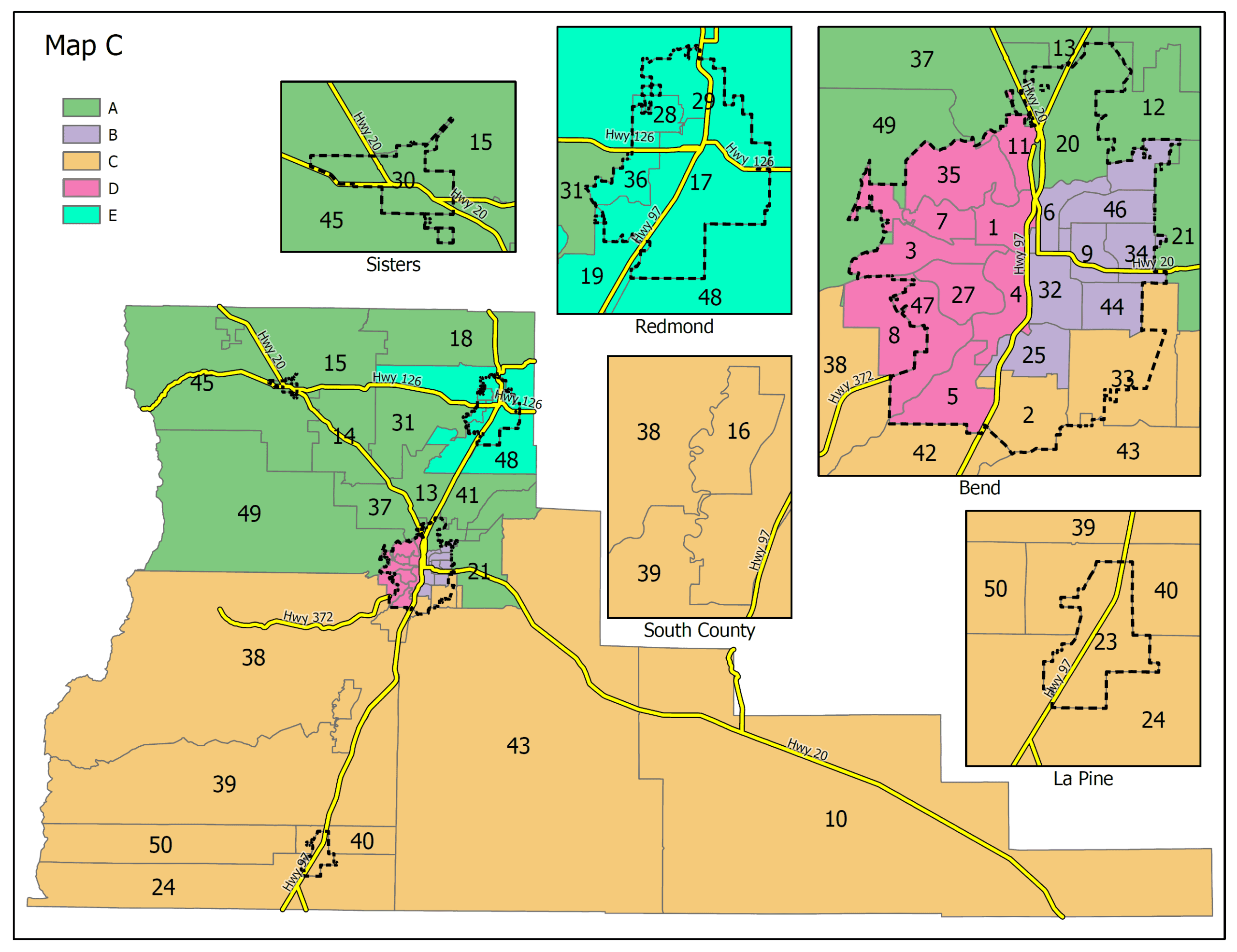
And the proposed map, with districts A through E, favors conservative voters.
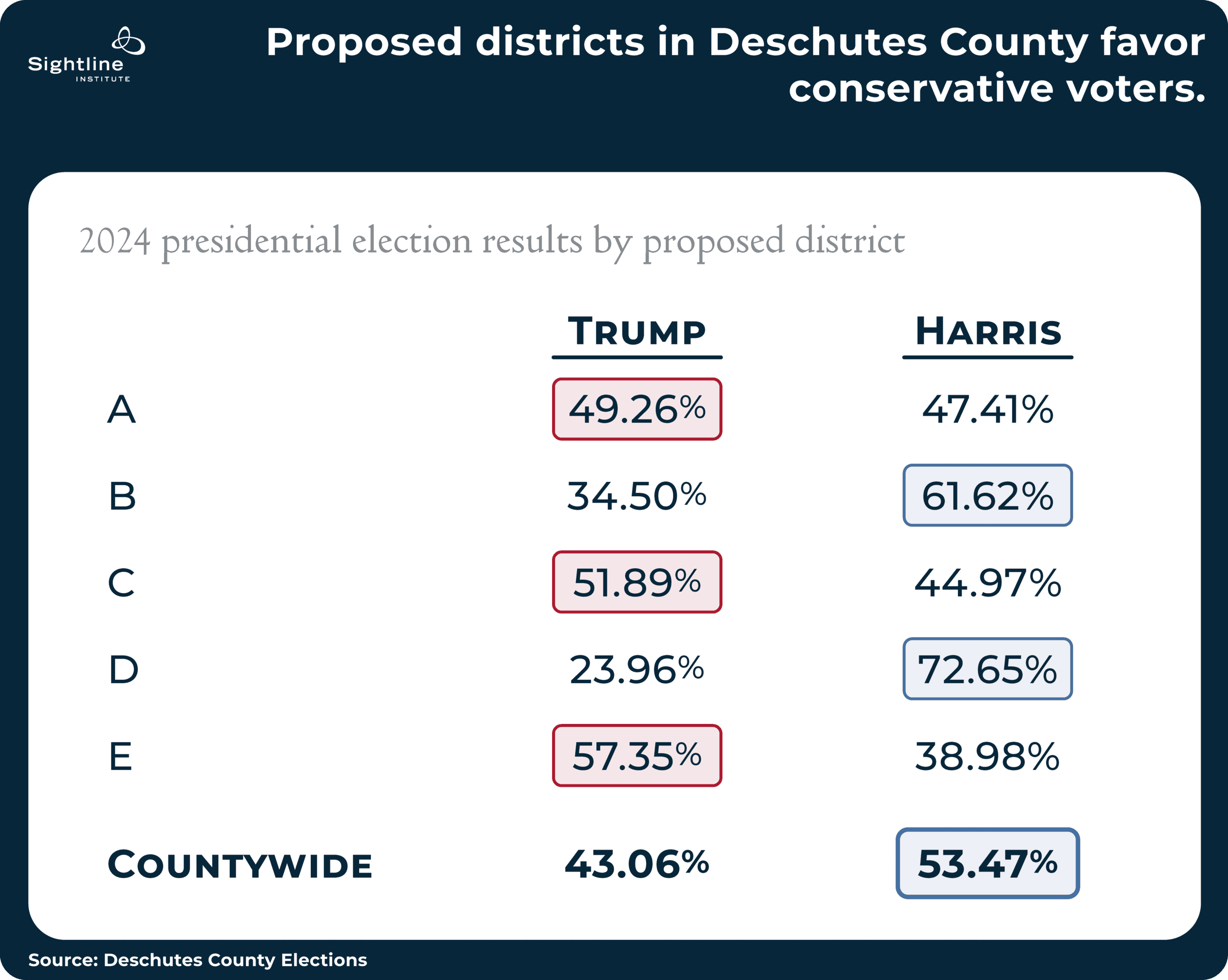
In the 2020 presidential election, 53 percent of Deschutes County voters chose the Democratic candidate, Joe Biden. The same proportion selected Kamala Harris for president in 2024.
Yet under the proposed district plan, three of the five districts would reliably vote conservative, constructing a conservative-majority board of commissioners, contrary to the partisan leanings of county voters. Based on the precinct breakdown of the 2024 presidential results, more voters in proposed districts A, C, and E chose Donald Trump over Kamala Harris; the opposite is true in districts B and D.
The same trend holds in voter registrations. In November 2025, as in every month since early 2020, the county saw more Democratic registrations than Republican ones. Broken down by district, though, the county leans conservative: Districts A, C, and E all have more registered Republicans than Democrats, leaving just two districts where Democrats have the edge. (Notably, more county voters registered with no party affiliation than with either major party, and another 6 percent registered with the Independent Party of Oregon, a separate designation from “nonaffiliated.”)
Sometimes local elections contradict trends displayed in national races, when county candidates connect with voters on day-to-day issues and national partisan platforms hold less sway. Not so in Deschutes. For instance, in 2020, when Democrat Chang won his countywide seat with 53 percent of the vote, he would have lost in the same three conservative districts.
Guidelines only get you so far
DMAC, though, can’t take all the blame. Most if not all its members had never participated in a similar process, and drawing districts is not easy. The committee tried to adhere to the rules the board had set to create a map viewed as fair. Most of these rules were similar to those used in other jurisdictions: that districts must be contiguous, keep communities of common interest together, be close to equal in population (within a 5 percent variance, as set by the board), and not favor a political party or dilute voting strength of any language or ethnic minority group. The committee also had to use existing precinct lines and consider current growth patterns.
But it couldn’t quite hold to the criteria.
The first problem was timing. The US census is the most comprehensive source of population data, but the census was five years out of date. Deschutes County has been growing rapidly; it has one of the highest rates of population growth in Oregon, mostly centered around Bend. To account for that change, committee members looked to voter registrations, which are updated every month.
Registered voters, however, are a specific subset of the population, and districts are supposed to be close to equal in overall population. Based on voter registrations, areas with a lot of families might look like they have fewer people than they actually do. Likewise, anywhere with fewer politically active residents might look less populous than it actually is.
Another challenge for DMAC was the requirement that it not split up precincts. The result was a mapping process in which all the puzzle pieces were relatively large. Most redistricting commissions in the United States use units as small as census blocks, giving them more flexibility in how to adjust borders.
Then there was the question of political favoritism. To avoid being accused of gerrymandering, the committee carefully opted not to consider partisan distribution when it drew the lines. Most committee members, though, likely knew which way neighborhoods leaned politically. In recent decades, most regions in the United States, including Deschutes County, see liberal voters concentrating in cities and conservatives converging in rural areas. The city of Bend has about half of the county’s residents, so either two or three of the five districts could be centered around the city. The choice between two or three, though, dramatically changes the political outcomes. Three Bend-area districts would lean the county commission to the left; two would lean it to the right.
In the end, the map the committee submitted to the board split Bend in two, with the remaining three districts covering the more rural areas around La Pine, Redmond, and Sisters. The districts are contiguous, but they don’t meet the 5 percent deviation threshold based on recent registration numbers.1 The map also doesn’t account for future growth, which will most likely happen in and around Bend.
DMAC members may have done their best under the constraints and trade-offs they had, but they still ended up with a map that cuts against the county’s political majority.
Districts have other drawbacks, too
Partisan implications might be top of mind for voters in an increasingly polarized United States, but political bias isn’t the only problem with single-winner districts such as those proposed. Single-winner districts can only ever guarantee geographic representation, and residents get only one person who “represents” them in government, even if they hold opposing views. Republicans in Bend likely won’t get a true county representative, nor will Democrats in La Pine.
Deschutes County residents are fired up about this mapmaking process because they know that with single-winner districts, the district boundaries can determine election outcomes. But any county board or council elected anywhere through single-member districts will have the same problem, regardless of who creates the maps.
Plus, districts encourage commissioners to focus only on concerns within their boundaries, not the whole county. One study, for example, showed that housing construction drops dramatically when towns switch from at-large elections to single-member districts. District representatives might see the need to create more housing countywide but don’t want construction happening in their own districts, so they oppose plans to build on their home turf. When each district rep does the same, little housing gets built.
In a county already challenged by housing affordability and a very limited supply of homes, any slowing in production would further devastate many residents. A similar dynamic would likely plague numerous other issues affecting residents, from roads to public safety.
The status quo of at-large numbered seats also fails to guarantee representation
Unfortunately, the current method of electing county commissioners to at-large numbered positions isn’t much better. Whatever group is in the majority can steamroll all other viewpoints.
With at-large numbered seats, everyone in the county votes for whatever seats are up that year, and whichever group is popular at that time tends to win everything. When two seats have been up at the same time, as Position 1 and Position 3 always are, candidates from the same party have won both every time since at least 1998.
The county’s staggered elections can sometimes balance perspectives on the board because close electorates will often swing back and forth from election to election, but exceptions do occur. Democratic viewpoints, for example, were locked out of county decisions from 2016 to 2020, when Republican Phil Henderson won the seat previously held by Democrat Alan Unger.
Using staggered terms to balance representation is like relying on coin tosses to perfectly alternate heads and tails. County elections are often close. Since 2012, almost every winner of a county commissioner race had 51 to 53 percent of the vote.2 Minute shifts in the mood of the electorate, the nuances of candidate dynamics, and the variabilities of voter turnout can nudge results in either direction. Since elections are winner-take-all, that margin of just a few points can dictate whether a party (or some other group) wins full control.
Plus, the majority of board seats is determined in just one election—whenever the larger number of seats is on the ballot. The other election years will decide if other perspectives get any space in county board discussions or are blocked from joining the table at all.
In future elections, three seats of the five seats will be up in presidential years. (This schedule changed when voters approved the board expansion; in the past, two of the three seats were up in midterm years.) Since more Democrats than Republicans are now registered to vote in Deschutes County, Democrats might have the edge, and they’ve typically won more often in presidential years. But Republicans won at-large seats in 2022 even after Democrats gained a registration advantage. Nothing is assured. Either way, elections will likely remain coin-toss close for some years to come.
A more reliable alternative: Proportional representation
Deschutes County could avoid both the instability and uncertainty of at-large winner-take-all elections and the biases of districts with proportional representation. Proportional ranked choice voting—the only proportional method that works with nonpartisan elections—offers more reliability and representation.
With proportional representation, commissioners would be elected to the county commission all at once based on their share of the votes. If three-fifths of the electorate voted for Democratic-leaning candidates and two-fifths for conservatives, the five-member commission would have three Democrats and two Republicans.
The county is closely divided. Each major party likely has enough voters to consistently elect two candidates. But at-large seats might give all five seats to one group (over the course of multiple elections). And even fairly drawn districts would most likely construct just one competitive district whose voters would get to determine the majority on the council. Proportional representation, in contrast, means that all voters influence the outcome of the election. It won’t give one party all the power, but it will ensure that every substantial group of voters has a voice.
What’s more, proportional representation opens opportunities for candidates without siloed party identification. A candidate or two without major party backing could garner enough traction to gain a seat. And voters would likely notice more nuanced policy positions even among candidates who align with the major parties, options that better reflect the diversity of the voters themselves.
The board of county commissioners would be more balanced over time, shifting election to election but maintaining consistency from one year to the next. That stability allows for thought-through policies that can last and build on each other—the type of perseverance county residents deserve.
Cambridge, Massachusetts, elects councilmembers using proportional ranked choice voting, and that model has allowed elected leaders to both prioritize the overall needs of city residents and represent specific constituencies. One recent article highlighted how proportional representation has expanded opportunities for housing growth in Cambridge, where other localities have stalled. Deschutes County could choose the same path.
Look to the future
Elections are meant to translate voter expression into a representative government, and some methods do that better than others. The proposal to introduce districts to Deschutes had a flawed process, but districts are hard to make fair no matter who’s drawing the lines and what guidelines they follow. The current at-large seats also don’t always accurately represent county residents.
Proportional representation is a surer path forward. It can balance competing partisan interests and provide an avenue for new perspectives. It’s a better method for county residents looking for a balanced path.

