


Editor’s note: this blog post was updated on October 1, 2013.
One hopes the grim news from Quebec is not a preview for the Northwest. Early yesterday morning an oil train in the province derailed, causing an explosion with deadly results:
Four of the cars – which each carried 30,000 gallons of North Dakotan crude oil – caught fire and blew up in a fireball that mushroomed many hundreds of feet into the air. It destroyed dozens of buildings, many of them totally flattened…
Lapointe said it was hard to calculate the number of possible victims because the area was still too dangerous for police to examine properly.
[sightline-embed]
Moving oil by rail has become increasingly common over the last couple of years, and the Northwest is poised to become a major center of oil-by-rail shipments.
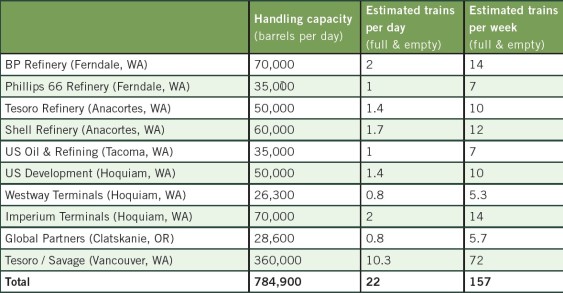
As Sightline documented in our recent report, The Northwest’s Pipeline on Rails, oil trains are already arriving several times a week at three locations in the region, while eight other sites are planning to build facilities to enable oil-by-rail deliveries. If all of the projects were built and operated at capacity, they would move nearly 800,000 barrels of crude oil per day on the Northwest’s rail system. Sightline estimates that would require 11 loaded oil trains per day.
Media outlets are reporting that the train in Quebec was carrying crude oil from North Dakota, which is almost certainly the same Bakken Formation oil destined for Northwest refineries and port terminals. The cause of the explosion is not yet clear, but most coverage suggests that the train had been parked for the night and was without a driver when it began moving.
There is good coverage of the explosion at CBC News, Reuters, CBS, and the AP. The official death toll stands at 47.
Sightline’s report, The Northwest’s Pipeline on Rails calculates oil train volumes for each of the 10 sites where oil-by-rail infrastructure is planned or already operating:


We won’t have to worry for long. Depletion of the fracked wells is very rapid. Within a very few years, the Bakken range will be history.
Yes Dean,
after 10 years of environmental destruction they will walk with the cash while the public pays for the damage.
The real danger here is that the oil industry will now position the discussion as an “either/or” situation – trains of pipeline. Which do you think is safer? I’ve already seen this in Andy Revkin’s Dot Earth blog on the NY Times.here.. See my comments in that same column dated July 8. In my comments I challenged that dichotomy saying, “Let me put another option on the table, Andrew. Why don’t we as a nation (meaning through Government policy) work to obviate the need for new pipelines OR oil trains through energy efficiency? I’m pretty sure we can do that. The oil companies want the pipeline and rail traffic for export purposes. We aren’t using but a small portion of that oil.”
Don’t let the oil industry hijack this discussion. I’m pretty sure that Keystone XL opponents will stand in solidarity with the people of Lac Megantic. The real question is, Why should anyone be sacrificed when we can “acquire” this energy through conservation? Ask this question everywhere you can1
That’s “trains OR pipeline.” Sorry.