Donate Newsletters

Parking Break

This is the season climax, the culmination, the big reveal.

Previously on Parking? Lots!

Cities mandate off-street parking (guided only by junk science and groupthink). They do it in fear of territorial neighbors who want “their” curb spaces left alone. Our communities suffer horribly as a result. Information technology is shaking things up, though, and cities can now charge for curb spaces more easily. They can also share the proceeds with neighborhoods. Doing that breaks the vicious political circle that perpetuates parking quotas.
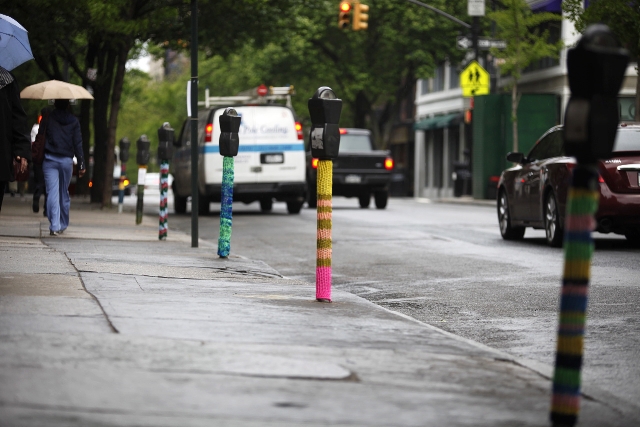
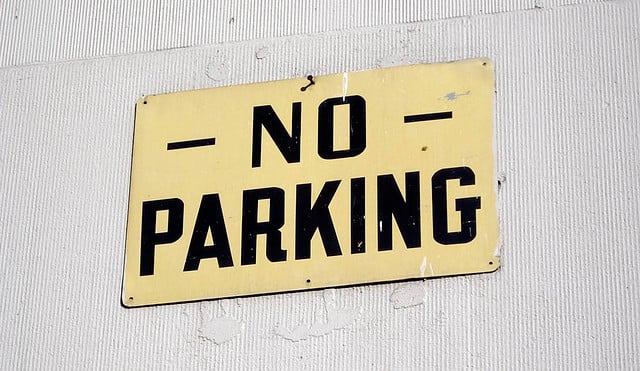
By flickr photographer Dunwich Type, cc.

The final step—here’s the reveal—is so simple it’s anti-climactic. (Sorry.) Once they’ve metered the curb and bought off neighborhoods, cities can just ditch parking quotas: scratch them out and turn the page.

There’s never been a good policy reason for minimum parking requirements. Their political rationale—preventing spillover parking—disappears when street parking is no longer free. Then, developers can figure out for themselves how much car storage to provide, just as they decide how many dishwashers, light fixtures, and bay windows to install. The market, a spot market, emerges.

What’s not anti-climactic—and what’s the focus of this episode—is the encouraging degree to which cities are already taking this step. A few are reducing or outright scrapping off-street parking quotas, and many are writing exceptions to them.
Read more

TransLink’s Gasoline Problem

Last Friday’s excellent Vancouver Sun story put a much needed spotlight on the Golden Ears Bridge—where traffic is running so far behind projections that TransLink now forecasts that the agency will lose between $35 and $45 million per year on the bridge, for at least the next several years.

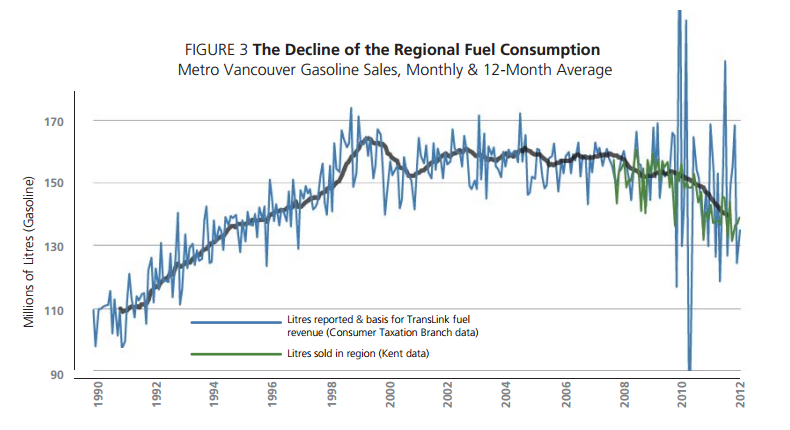
But the story is really just the tip of the iceberg in a much larger story about Greater Vancouver’s transportation finance woes. Not only are bridge tolling revenues falling behind projections, but gas tax revenues are too. Take a look at the black line in the chart below, representing the 1-year average gasoline sales volumes in Metro Vancouver:

Translink 2013 Base Plan, p. 12

Read more

Curb Appeal

Imagine if you could put a meter in front of your house and charge every driver who parks in “your” space. It’d be like having a cash register at the curb. Free money! How much would you collect? Hundreds of dollars a year? Thousands? How might all that lucre shift your perspective on local parking rules?

The idea of a private meter (already available on eBay)—or a variant of it that is legal and practical—is the crux of this whole series. It’s the deal with the devil that forms the pivotal second step in UCLA planning professor Donald Shoup’s three-point plan to fix parking. Why that’s true is because of politics, and those politics take some explaining. The explanation will bring us back to the buccaneer parking meter, I promise. First, though, I need to show you some other terrain.

Read more

British Columbia’s Traffic Delusion

It must be a syndrome. A mass delusion of endless traffic growth. Or maybe the idée fixe that the future will resemble the 1950s.

Earlier in the week I mentioned that, despite years of declines on the Tacoma Narrows Bridge, Washington’s transportation revenue forecasts assume that traffic will soon start growing, quickly and inexorably. It might be funny if the fiscal stakes weren’t so dire.

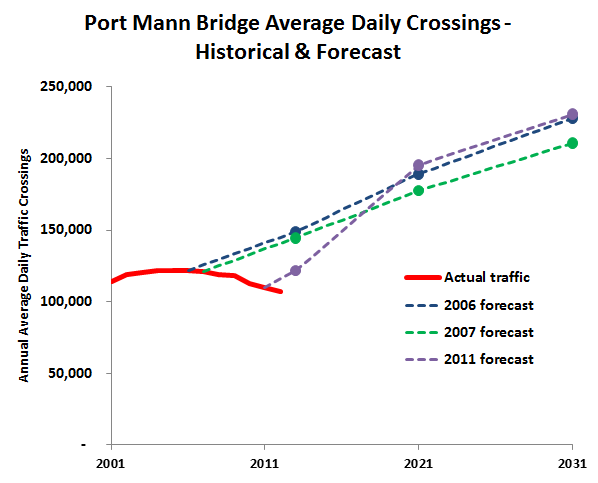
Apparently, the same mentality apparently holds sway north of the 49th parallel. Consider the newly twinned Port Mann Bridge—a project of British Columbia’s provincial government that opened to traffic last fall. The province was anticipating a rapid increase in traffic volumes to pay for construction. And while it’s too early to tell how the added road capacity will affect traffic volumes over the long haul, the declines in traffic volumes in recent years could make it very hard for the bridge to meet its toll revenue forecasts…

There’s a Place for Us

There are places in this world the savvy traveler would never drive with any hope of finding street parking: Fisherman’s Wharf in San Francisco, for example, or just about anywhere in downtown Los Angeles.

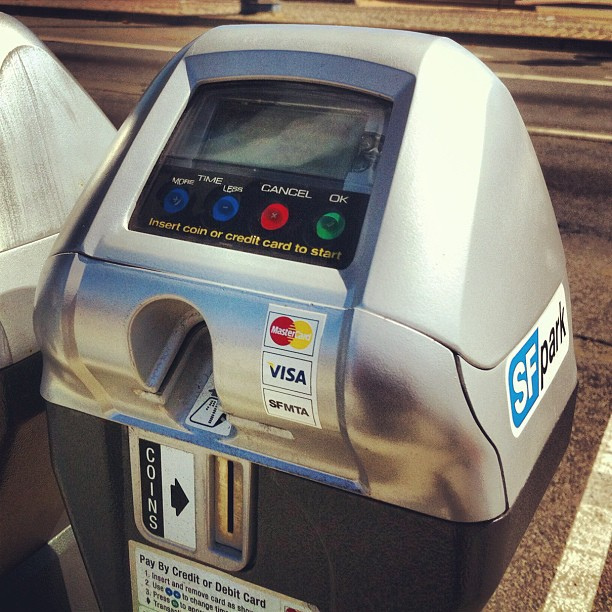
Parking meter in San Francisco.
Parking meter at Fisherman’s Wharf, San Francisco. Photo by Juli D’aniello.

That’s what you might think, anyway. If you actually drive to Fisherman’s Wharf today, though, you will have no problem finding a curb spot. A space will offer itself on each nearby block, if you’re willing to pay for it. The same goes for downtown LA.

These two cities plus Washington, DC, and a handful of others are experimenting with an approach to parking called “performance pricing.” Rather than dictating a flat meter rate citywide, their councils have set a performance goal: one or two empty spaces per block. They’ve instructed parking functionaries to charge what people are willing to pay, to use information technology to nudge meter rates up or down so that whatever block we citizens drive to, there will always be—with apologies to West Side Story lyricist Stephen Sondheim—a place for us.

Read more

What Caused the Lac-Mégantic Oil Train To Explode?

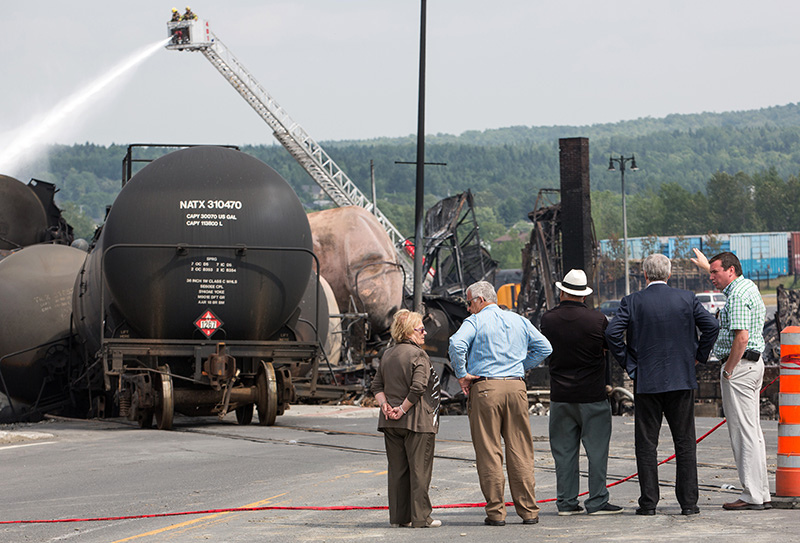
Canadian PM Stephen Harper survey the damage Lac-Mégantic the day after the explosion. Photo credit Stephen Harper, cc.
Canadian PM Stephen Harper surveys the damage in Lac-Mégantic the day after the explosion. Photo credit Stephen Harper, cc.

Last week saw a profusion of head-scratching news stories about July’s catastrophic oil train explosion in Quebec after the Transportation Safety Board of Canada announced that the tanker cars had been mislabeled. It turns out that although the rail cars were correctly classified as containing a “dangerous good,” a label that applies to all types of crude oil, they were incorrectly designated as PG III, the least dangerous sub-category, when they should have been labeled as the more dangerous PG II. (PG I is the most dangerous type.)

Mislabeling is a problem, to be sure, but it’s hardly the main issue. What none of the media accounts properly explained was why the crude oil—which does not normally explode—was so dangerous to begin with.

What we can learn from digging into initial reports from Canadian safety investigators is that the train was bearing crude oil from the Bakken oil fields of North Dakota, the same type of oil that is scaling up for massive increases in rail shipping in the Northwest. It’s also clear that the oil had a relatively low flash point for crude, which means that it would have ignited at lower temperatures. But at this point, we don’t know a lot more about the evidently deadly composition of the product.

Some experts speculate that the culprit may be hydrogen sulfide, a colorless, flammable, and extremely hazardous gas that is sometimes associated with Bakken oil. According to the oil industry, hydrogen sulfide is explosive when mixed with air, and it can cause severe corrosion to oil transport equipment, including pipelines.

Read more

Sightline on Coal and Oil Schemes in the Northwest

If you’re following Sightline’s work on Northwest fossil fuel exports and oil train projects, you may enjoy listening to this radio segment I did this morning on KBOO, a community radio station based in Portland. The piece is around 45 minutes long, which I think is a nice length for digging into issues in a more … Read more

Underground Parking

Game day near the University of Washington’s stadium, photo by Judy Dailey
Game day near the University of Washington’s stadium, photo by Judy Dailey.

In Peggy Clifford’s neighborhood, out back of the State Capitol in Olympia, Washington, a black market thrives. Early each year during the state’s legislative session, lobbyists go there—just a hop, skip, and a jump from the capitol dome—to buy what they crave: parking spaces. Peggy says, “This is a neighborhood, not a parking lot.”

Tell that to regular Capitol visitors. The neighborhood may be nationally registered as historic and staunchly defended by Peggy and other concerned citizens, but it also has driveways and backyards, and to some residents, the offer of hard currency for use of that real estate is persuasive. They park their cars at the curb, protected by their resident-only permits, and rent out their private spaces to professional Capitol-goers. A lot of money changes hands.

Read more

Apartment Blockers

City requirements for off-street parking spaces jack up rents.
Tweet This

Have you ever watched the excavation that precedes a tall building? It seems to take forever. Then, when the digging is finally done, construction rockets upward in no time. For the past few months, I’ve been watching a crew excavate the site of a new condo tower on Seattle’s First Hill. It’s on a route I walk three times a week, so I’ve had a ring-side seat. And here’s the thing that finally dawned on me, after years of not really thinking about these holes in the urban ground: what’s all the excavation for? It’s for parking. Underground parking. In most cities and in most soil conditions, the giant holes are only there to satisfy off-street parking rules, and to do that, you need a deep, deep hole. A hole like this one.

Photo by Alan Durning.
At Eighth Ave. and Seneca St. in Seattle. Photo by Alan Durning.

Digging these holes is astronomically expensive. They’re real-life money holes. The crew I’ve been watching has been laboring away for weeks, deploying enormous machinery and keeping a fleet of dump trucks in constant motion. They’ve undoubtedly spent millions of dollars removing rock and dirt. One Portland developer told me that each successive layer of excavation—each floor down in the garage—costs two to three times as much as the previous one.

Such costs are one reason housing is so expensive nowadays. A one-bedroom apartment in the city of Seattle rents for upwards of $1,300 on average. In Portland, rents are approaching $1,000 and, in Vancouver, BC, $1,400.

Read more

A Gateway for Petcoke

You often hear it said that coal is the world’s dirtiest fuel, which isn’t quite right. There’s actually an even dirtier fuel out there, petroleum coke. Often called “petcoke,” it’s a dense coal-like and carbon-intense fuel that is the byproduct of refining certain kinds of oils. It figures into the Northwest’s fossil fuel debate in a way that links coal exports to the region’s changing oil supplies.

The clearest link is perhaps at Cherry Point in northwest Washington, where a large refinery owned by BP sits practically next door to the site of the proposed Gateway Pacific export terminal. Although Gateway Pacific is usually, and correctly, referred to as a coal export terminal, the site’s plans clearly call for handling petcoke in the initial phases of operations. (In fact, calcined petroleum coke is one of the non-coal “dry bulk commodities” the project supporters refer to when they are trying to draw attention away from coal.)

Conveniently, the BP refinery at Cherry Point annually produces 800,000 tons of calcined coke as a salable byproduct of its refining process. BP currently ships its petcoke out by rail to industrial users in North America and beyond, but having a petcoke-ready export terminal in the neighborhood would surely add a financial incentive for BP to dial up its petcoke production. The same goes for the Shell Refinery at Anacortes, Washington, which also produces petcoke that it now ships by rail to a smelter in Kitimat, British Columbia.

Read more

×
Privacy Overview
Sightline Institute

More information about our privacy notice

Strictly Necessary Cookies

Strictly Necessary Cookie should be enabled at all times so that we can save your preferences for cookie settings.

3rd Party Cookies

This website uses Google Analytics to collect anonymous information such as the number of visitors to the site, and the most popular pages.

Keeping this cookie enabled helps us to improve our website.

Additional Cookies

This website uses social media to collect anonymous information such as which platform are our users coming from.

Keeping this cookie enabled helps us better reach our audiences.