Donate Newsletters

Transit Score: Cascadia Smackdown

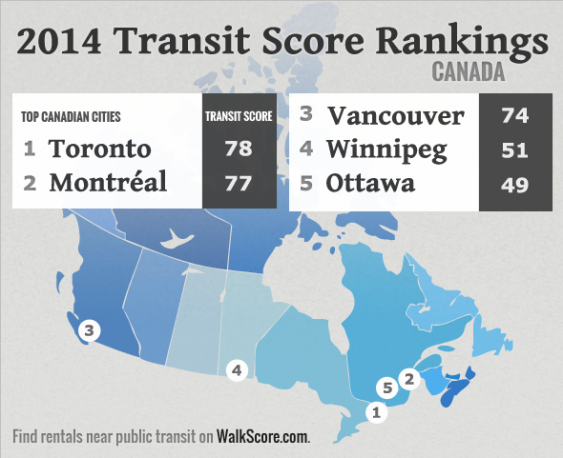
The 2014 Canadian Transit Scores are out…and Vancouver, BC clocks in as the third most transit-friendly city in the Great White North, narrowly bested by Toronto and Montreal. Pretty good, eh?

Canada Transit Score
Canadian Transit Scores by Walk Score (Used with permission)

But what’s even better: when you combine Canada and the US, Vancouver comes in at number 6! The only US cities with a better Transit Score than Vancouver are New York, San Francisco, and Boston.

Looking more narrowly within the Cascadia bioregion, Vancouver’s Transit Score beats the pants off its nearest two rivals. Portland and Seattle both do pretty well within the US, with Transit Scores of 50 and 57, respectively. But Vancouver shellacks both cities, with a score of 74.

So why does Vancouver’s Transit Score outstrip Seattle’s and Portland’s so handily?

Read more

All You Need to Know About BC’s Carbon Tax Shift in Five Charts

Author’s note:The graphs in this post were updated in August 2015 to include the most recent available data. 

When British Columbia enacted a carbon tax shift in 2008, many thought other jurisdictions would follow soon with their own ways of cashing in their carbon. Seven states and four provinces were working out the details of a huge carbon cap-and-trade market called the Western Climate Initiative. Candidates Barack Obama and John McCain were campaigning for president with promises of clean energy on the double quick; Senator Obama even pitched carbon pricing in his stump speech. Ottawa was murmuring about following the lead of Washington, DC, with a carbon cap or tax of its own.

Then history took a turn: financial collapse, bailouts, Tea Party, climate science denial, 2010 midterms, the fiasco at Copenhagen. The front in the war on climate disruption shifted from grand policy to fighting Keystone XL, coal trains, and other dirty-fuel infrastructure. Momentum abated for comprehensive laws at the state, provincial, and federal level that would gradually but persistently wean companies and households from fossil fuels by charging a small but rising fee for carbon pollution.

British Columbia then found itself alone: the only jurisdiction in North America with an appreciable, economy-wide price on global warming emissions. With this post, we launch a new series of articles on pricing carbon in Cascadia. Our ultimate focus will be Oregon and Washington, which sit between British Columbia, with its carbon tax, and California, with its new carbon cap (which we’ll discuss another day). But the best place to begin is where Cascadian carbon pricing began: in Canada.

What’s the latest on what BC’s carbon tax shift has done to carbon pollution, the provincial economy, and public revenue?

Read more

Port Mann Bridge: New Forecasts, Same Delusion

I’m old enough to remember the episode of The Simpsons when Homer Simpson, after 22 minutes of serial idiocy, wraps up the show by proudly declaring: “Marge, my friend, I haven’t learned a thing.”

Well, it seems that BC’s transportation officials are now treating The Simpsons as an instruction manual.

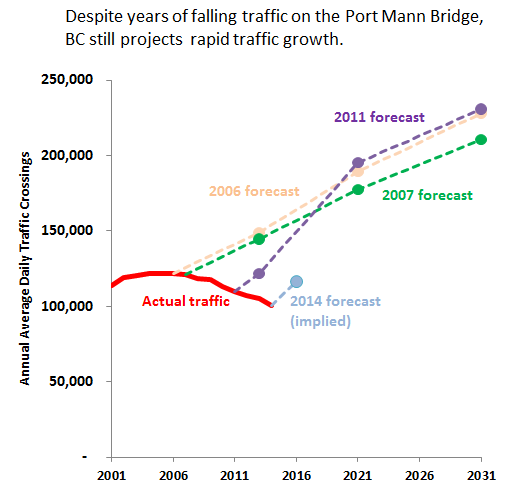
As I pointed out a few months back, British Columbia’s transportation planners have long been nursing a delusion that traffic across the Port Mann bridge will magically start to soar any day now…even though actual travel across the span has trended downward for the better part of a decade.

And they’ve apparently done it again:

Read more

Powder River Basin Coal: Unions Getting the Squeeze

Falling union hours and production in the PRB

Apparently, several unions in Vancouver, BC support a proposal to export more US coal to Asia. Which may strike some folks as odd, because coal companies in the Western US have been so deeply unsupportive of unions.

The coal that would be shipped out of southwestern BC would likely come from mines in the Powder River Basin in Montana and Wyoming—a place where coal companies have gradually squeezed unions out of the workforce…

Give Sightline Some New Year’s Resolutions!

Last year was a big one for Sightline. It was our 20th anniversary; we published the e-book Unlocking Home; and we continued to make waves on issues ranging from coal and oil exports to parking rules to ridesharing regulations, and more. All in all, it felt pretty great. But we want to know how it … Read more

A New Anthology of Northwest Voices

I’m looking forward to my evenings this winter because I’ll be settling in with Cascadia: The Life and Breath of the World, a new anthology of Northwest writers and artists put out by the University of Hawaii Press. Many of the region’s better-known voices are included, but this isn’t a volume of greatest hits. It’s … Read more

Talking Politics on Turkey Day

Elaine Mejia, Senior Program Associate at Public Works—a communications think tank fostering a more positive national discourse and public will around government and taxes—reminds us that turkey, dressing, and cranberry sauce are, unfortunately, often served up with a “heaping side dish of heated, unpleasant conversation about government and politics.”

Whether it’s the wine or the tryptophan or just…family dynamics, these holiday discussions can go terribly wrong. But with a solid game plan, we can all do our part to keep Turkey Day festive and, just possibly, while we’re at it, make a little progress reinforcing government as our best tool for coming together and making everybody’s lives better.

Of course every good quarterback knows delivery is key—and that means finesse. It’s a reminder that we can foul out too soon if we let our tone get angry or accusatory or defensive.

Anyway, the rule for talking politics at Thanksgiving is that it’s not about winning—or even about touchdowns or tackles—it’s about a productive conversation that moves the whole team forward. (Mejia’s football analogy should get her an MVP.)

I recommend reading the entire pre-game pep talk over at Public Works. But here’s a run-down of day’s best plays:

Walk Score Scores Again

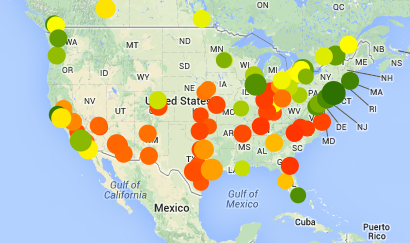
I never get tired of calling the folks over at Walk Score geniuses. The nation’s most widely used walkability measurement tool just updated its neighborhood rankings, using a new and improved algorithm. The news for the Northwest: Seattle clocks in as the 8th most walkable city in the US, while Vancouver ranks as the 4th most walkable … Read more

Spot-less?

Parking reform may finally be coming. Here are eight reasons to hope for change soon:

BP Statistical Review of World Energy - Motion Chart

By flickr photographer shutupyourface, cc.

1. Noah’s (P)ark. UCLA planning professor Donald Shoup, like a modern day Noah, has been carrying a new strategy for parking reform far and wide looking for dry land on which to release it. The three-step plan of action—charging market prices for curb spaces through performance pricing, rebating the proceeds to neighborhoods, and then eliminating off-street quotas—is now working in several cities: Old Pasadena and San Diego, for starters. Parts of it are working in many other places: Austin, Redwood City, Ventura, San Francisco, Washington, DC, and the Northwest’s big cities, too. Each success breeds more, as localities copy good solutions from each other.

2. Jurassic Park? Curb parking has long been an archaic, hunter-gatherer world with spotty enforcement and widespread cheating. But new technologies are dragging public parking out of prehistoric times and into the modern era. Smart parking meters, in-street sensors, parking-enforcement tools such as license-plate scanners, and apps for finding and paying for parking have opened up new possibilities for managing parking on the street. Cities can collect for and enforce parking charges even on quiet streets, and parkers can locate spots efficiently. All of this makes it much easier to charge for curb parking.

Residents selling space on their property for parking near the Puyallup Fair, Washington.
Puyallup Fair Parking, by Flickr photographer Dan O’Leary.

3. Spot Me. The same info-tech tools are making it possible for people to rent out their own parking spaces—a vast, distributed private market for parking spots. Dozens of new apps like Parkatmyhouse and Parkopedia are turning idle spaces into cash, allowing much fuller use of them and inverting their owners’ political motives. Owners of off-street spaces lose out from free on-street spaces and mandatory off-street spaces nearby. As parking space micro-entrepreneurs grow in numbers, and as they find their political voice, they will counteract parking territoriality.

Read more

×
Privacy Overview
Sightline Institute

More information about our privacy notice

Strictly Necessary Cookies

Strictly Necessary Cookie should be enabled at all times so that we can save your preferences for cookie settings.

3rd Party Cookies

This website uses Google Analytics to collect anonymous information such as the number of visitors to the site, and the most popular pages.

Keeping this cookie enabled helps us to improve our website.

Additional Cookies

This website uses social media to collect anonymous information such as which platform are our users coming from.

Keeping this cookie enabled helps us better reach our audiences.