In this 13-minute video, I tell the stories of everyday citizens who are organizing to make sustainability legal.
From clotheslines to reused pickle jars, from car-sharing to wilderness outings for poor teens, common-sense, green solutions are too often against the law.
Most northwesterners are well provided with housing. In fact, northwesterners near or above the median income are among the best-housed people of all time: we have a lot of private indoor space.
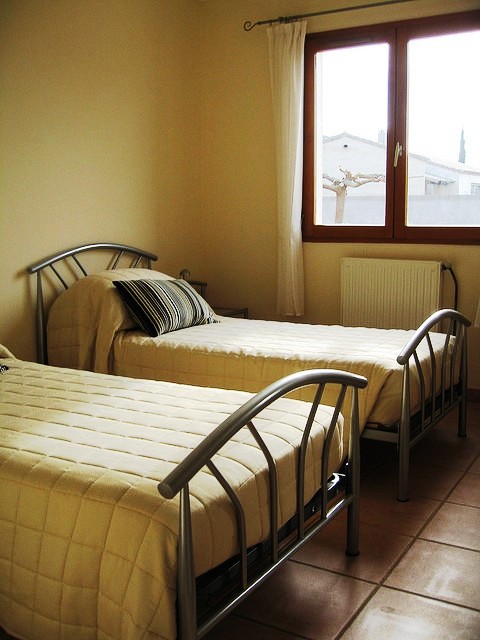
Consider bedrooms, for example. Through most of history, most people shared bedrooms. Many even shared beds. I’m not just talking about couples. When Abraham Lincoln was a lawyer riding the circuit in Illinois, he routinely shared a bed with others in his business. The future president of the United States did not think twice about crawling into bed at the end of the day with a fellow attorney. That’s how people lived.
The industry can’t hope to promote its own coal export schemes in the Northwest so instead it buys support from local consulting and PR firms willing to do coal’s dirty work. By taking money from Big Coal, these firms—many of which have carefully groomed reputations for sustainability and public-interest work—have themselves become a part of the coal industry.
Most of these firms might rather not have the public know about the work they do, with the blinds pulled down, on behalf of out-of-state coal giants. After all, their livelihoods depend on appealing to green-minded governments, nonprofits, and businesses in the Northwest. So as an exercise in letting in the sunlight—and as a sort of caveat emptor for clients—here is a look at the Northwest’s homegrown coal industry.
A friend of mine lives in a nine-bedroom, century-old house tucked among the wooden mansions of Seattle’s north Capitol Hill neighborhood. In some ways, it’s the quintessential home of the fortunate and green-minded in the urban Northwest: it has a hybrid car, an electric car, and bicycles in the drive and chickens in the yard. In another way, it’s unusual. The dwelling’s 5,000 square feet of indoor space are home to nine people: my friend and her husband, their two daughters, and five housemates. This living arrangement is in flagrant violation of city code.
Under Seattle law, as in almost every city in Cascadia and beyond, the number of people who may share a house or apartment is strictly limited, regardless of the dwelling’s size, unless all occupants are members of the same family. In Seattle, the limit is eight people (see Seattle Municipal Code 23.84A.016 “household” definition). With nine (and in the past up to eleven people) occupying her house, my friend is a law breaker. A city housing inspector could fine her and kick someone out.
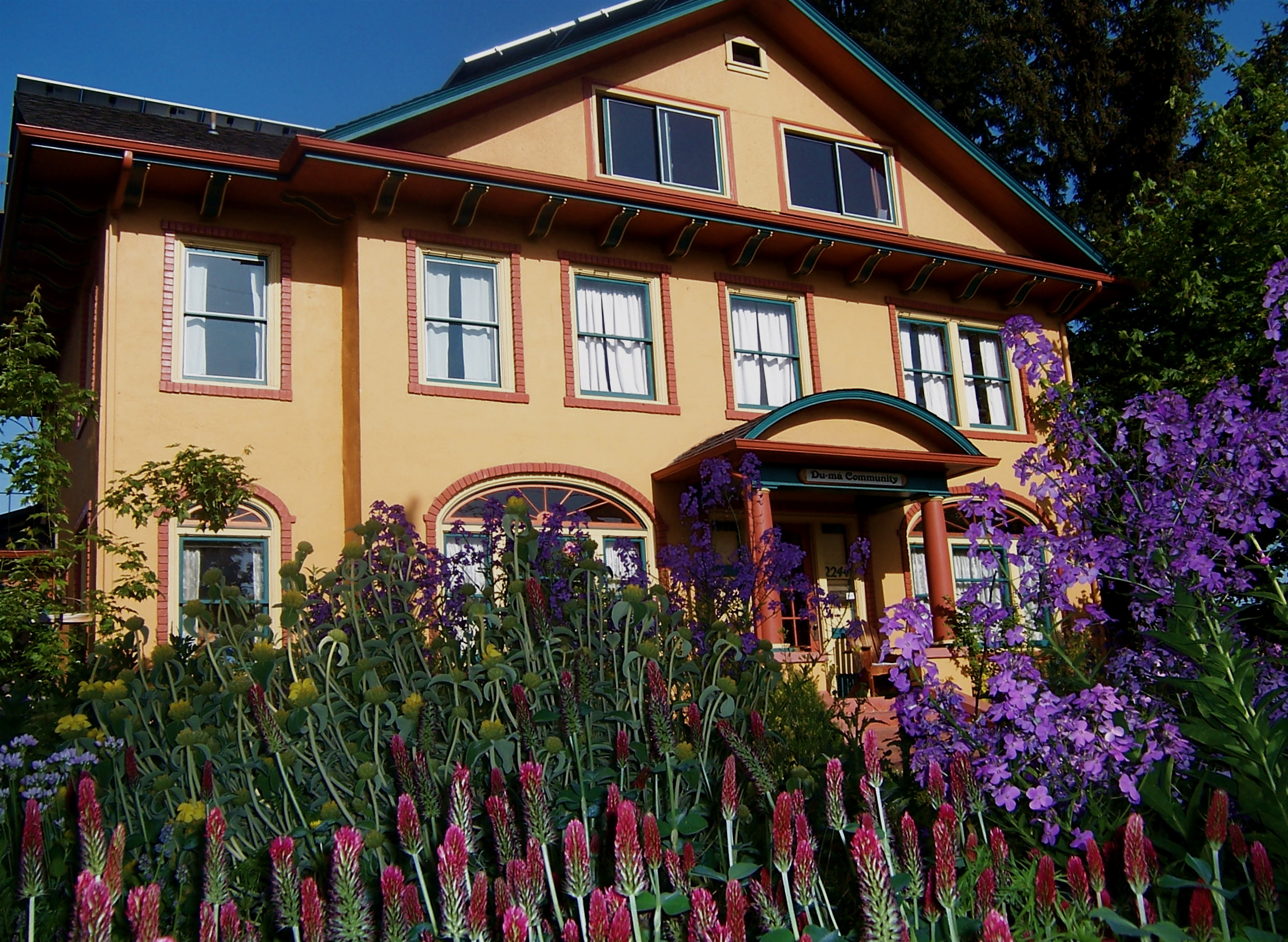
Photovoltaic panel installation at the Duma Community, Eugene OR. Photo courtesy of Allen Hancock.
Another friend of mine, Allen Hancock, owns a similarly spacious house near the University of Oregon in Eugene. A Christian college built the house in 1926 as a home for a dozen or more “wayward girls.” By the time Allen moved in, in 1990, someone had divided the 4,400-square-foot structure into six apartments and let it run down. He restored, remodeled and retrofitted the house. Today, it has 10 bedrooms plus a guest room and, usually, nine residents. Allen has personally devoted two decades of labor to turning Duma, as he calls the house, into a model of green living, with reused building materials throughout, extreme insulation and energy efficiency upgrades, photovoltaics on the roof, edible landscaping, and a rainwater catchment system, all located on one of Eugene’s main bicycle routes.
Except, oops: That’s a photo taken this morning of British Columbia’s Westshore Coal Terminal. A cargo vessel smashed through the center of the loading trestle—thus the big gap in the middle—putting it out of commission and dumping coal directly into the Strait of Georgia. The coal contamination is clearly visible as the dark streaks in … Read more
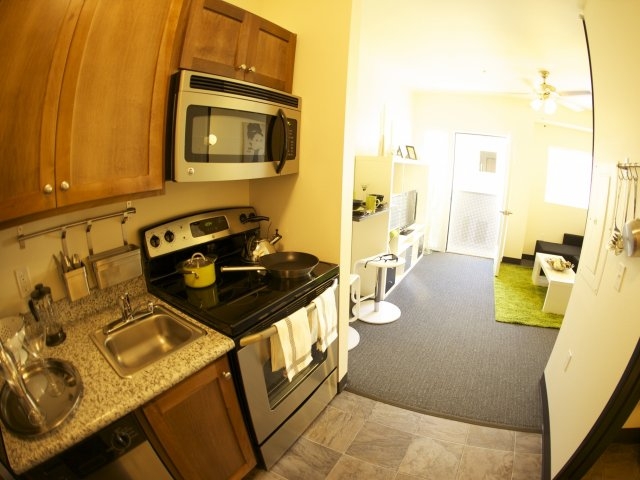
They may not be for you, but rooming houses and other small, basic dwellings should not be against the law. Some people want them — need them, in fact — and they provide housing affordably, with a tiny ecological footprint, and in walkable neighborhoods. Yet across most of the metropolitan Northwest, these basic homes are currently forbidden or rendered unprofitable by local codes.
My last article recounted how we arrived at this confounding pass, where the law has vacated the lower rungs of the historic housing ladder. This article describes nascent efforts to repopulate those rungs, by building neo-rooming houses and micro-apartments…
November is American Indian & Alaska Native Heritage Month, and that makes a good opportunity to take a quick look at the Northwest’s original residents. In North American terms, Cascadia is home to an unusually high concentration of people of Native descent.
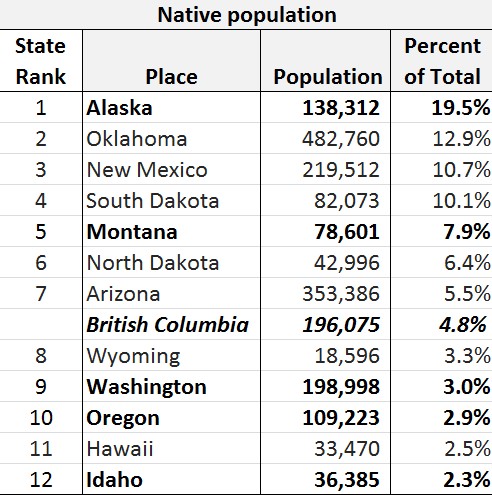
In fact, Northwest jurisdictions are home to more than three quarters of a million people of Native descent with nearly 200,000 in British Columbia and Washington each.
As a share of the population, no state has more Native Americans than Alaska where nearly 20 percent of residents self-identify as all or part Native. Montana ranks 5th nationally while Washington, Oregon, and Idaho occupy the 9th, 10th, and 12th spots, respectively. British Columbia’s population has a very similar profile to its US neighbors.
Let’s look more closely at the US portion of the Northwest, where localized population figures are easily available.
Today is the beginning of Diwali—one of the most important events in the Hindu calendar—and that seems like a decent reason to take a look at a new facet of the Northwest’s demographic makeup.
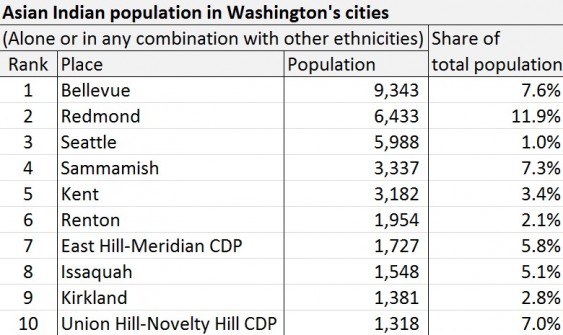
The world’s largest Hindu country, India, has added a substantial share of its people to some Northwest cities. Bellevue has far and away the highest number of Indian people in the state, though nearby Redmond claims the top spot on percentage basis.
Both have more in absolute numbers than the much bigger city of Seattle.
A quick word about the numbers. Theses figures come from the 2010 Census and refer to people who self-identify as either “Asian Indian alone” or “Asian Indian in combination with some other ethnicity” in official parlance.
Interestingly, every single one of Washington’s top cities for people of Indian descent is in King County and in particular, the high-tech cities of Seattle’s eastern suburbs—Bellevue, Redmond, Sammamish, Issaquah, Kirkland, and Union Hill-Novelty Hill—are home to a remarkable share of residents who identify as Indian. South King County rounds out the mix.
In 2008, British Columbia rolled out the first large-scale carbon tax in North America. It is a somewhat unique tax because it is “revenue-neutral,” meaning that the government returns the revenue to taxpayers in the form of reductions in personal and corporate income taxes, along with a few other targeted tax reductions. In short, BC aims to reduce emissions by taxing harmful pollution while at the same time boosting economic growth by reducing tax rates.
Together the reports show that BC’s carbon tax has been accompanied by the strongest GDP growth in Canada as well as modest reductions in greenhouse gas emissions. New data in the reports suggest that BC is decoupling its economic growth from fossil fuel use and carbon emissions—an encouraging sign for sustainable growth.
Decreasing Emissions
The past four years have been a success for emissions reductions in BC. The Sustainable Prosperity report finds that emissions in 2010—the latest year for which data are available—had dropped by 4.5 percent from 2007 levels. And in fact, according to the Ministry of Environment, emissions covered by the carbon tax decreased by 9.9 percent on a per capita basis between 2008 and 2010.