Donate Newsletters

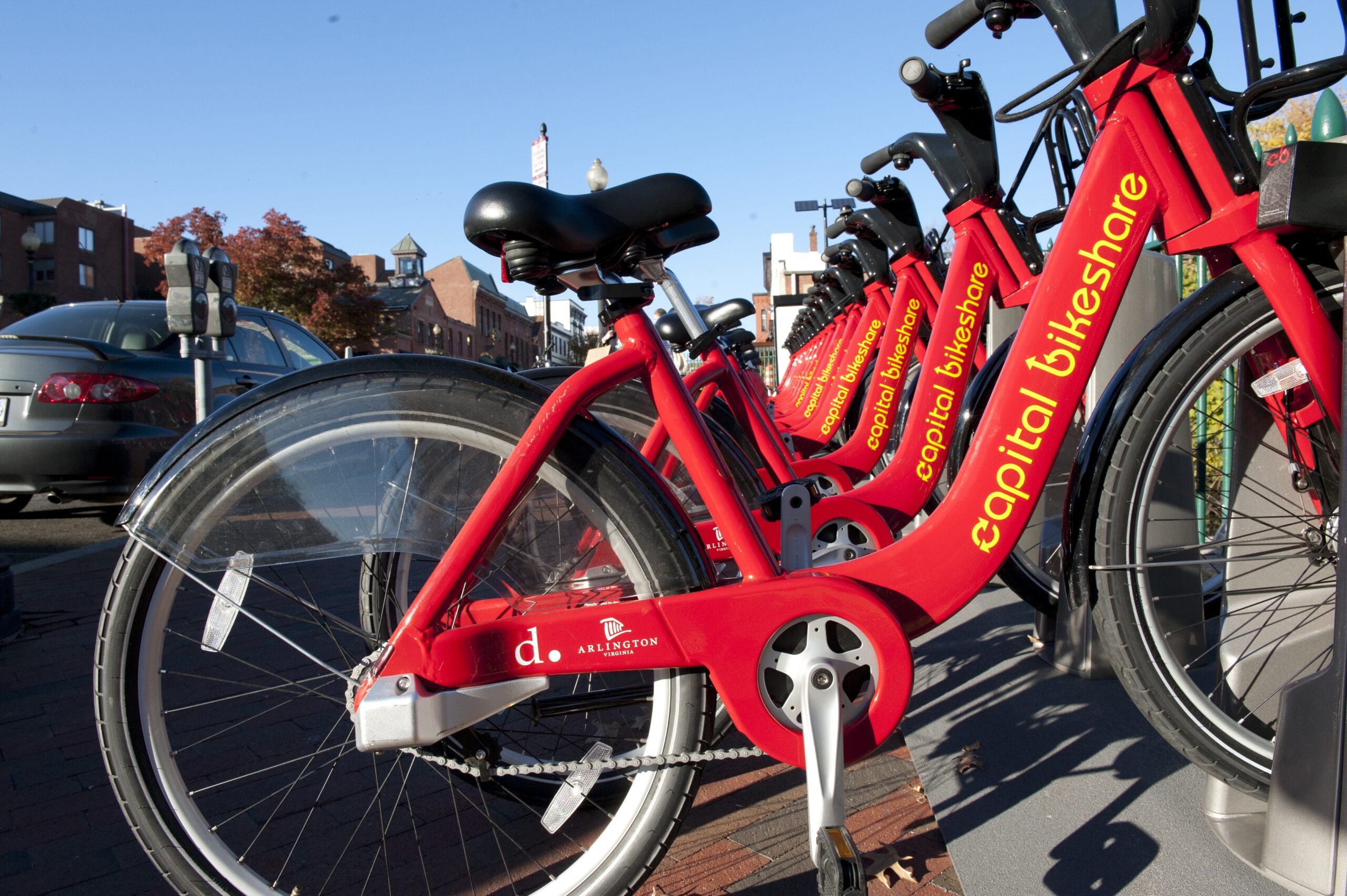
Unchain Bike Sharing

flickr, Jason Pier

Imagine for a moment that cities around the world are rolling out fleets of magic carpets and that those carpets are having truly wizardly effects: improved public health and safety, reduced traffic congestion and carbon emissions, and reduced dependence on foreign oil. City dwellers can check them out or drop them off at stations everywhere, and they are free to use for up to 30 minutes. After that, they cost something, but not much. Picture literally millions of citizens using these carpets for short, speedy trips all over town. Now imagine being in the Northwest and watching this opportunity fly by because fanatical carpet helmet laws discourage would-be riders.

This is exactly what’s happening. The magic’s not in carpets, though: it’s in the humble bicycle.

Read more

Pavement to Parklets

Courtesy of Streetfilms, here’s a video on the trend of converting pavement (parking spaces, awkward roadways, etc.) into little parks (h/t to Matt Lerner).

It’s a great idea—one that many cities are catching on to. The benefits are numerous: better street life, additional space for businesses, more green space to filter stormwater, and they’re just plain fun. (Back in March, the New York Times catalogs some of the downsides.)

Freeing Taxis, Addendum

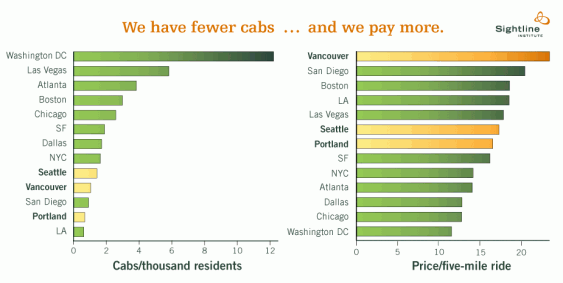
Last week’s article on the way taxis are regulated in the Pacific Northwest has generated a lot of attention and raised a lot of questions. (We’ve seen some conversations on Reddit feeds for Seattle, Portland, and Vancouver; been on the front page of 24 Hours Vancouver; and been heard on several radio and TV stations.) It’s a complex issue, and I’d like to revisit a few points that could have been covered in a longer article.

Many observers focused on the price differences, pointing out that the correlation between cab availability and price is not direct. That’s right. It’s not a one-to-one relationship.

Food Labels Of The Future

Do visual symbols of nutrition help us eat healthier? With the USDA recently replacing the confusing and unhelpful food pyramid with a more streamlined plate logo, it’s clear that the way we represent food matters. The food plate’s simple depiction of what a healthy diet looks like has the potential to be extremely effective—it allows people to rate their plate against a healthy standard at a glance.

An effective food icon could have a huge impact on the food choices we make, in-store and at home. So why not piggyback on the release of the food plate with a redesign of our food labels?

Current nutrition labels are a labyrinth of dietary information that most consumers don’t have time to decipher. The FDA has been working, slowly, on an overhaul of the food labeling system since 2005, and since 2010 has toyed with restrictions for front-of-package claims, which are notoriously misleading and have been blamed for contributing to rising obesity levels.

Read more

Washington Carbon Tax: New Model and Analysis

Sightline is very pleased to be hosting a new analytical paper and model, “Washington State Carbon Tax: Fiscal and Environmental Impacts” by Keibun Mori, a recent graduate of the University of Washington’s Evans School of Public Affairs. He created the Carbon Tax Analysis Model (C-TAM), for the Washington State Department of Commerce.

It’s an impressive piece of work on several levels. Mori’s analysis, which centers on a British Columbia-style carbon tax, is almost certainly the most comprehensive published treatment of a state-level carbon tax in Washington, and maybe anywhere. Even better, his spreadsheet-based C-TAM model manages to be open-source and comprehensible, but still allow for a remarkable degree of complexity and user input. Mori includes a terrifically thorough treatment of fuel prices and demand elasticity (which is a subject of much debate and confusion in climate geek circles). The result is a solid look at the economic effects and environmental benefits of a state carbon tax in Washington.

Read more

Freeing Taxis

Update 8/11: I have an addendum to this post published here. Also, the chart was altered to reflect a slightly higher number for Vancouver.

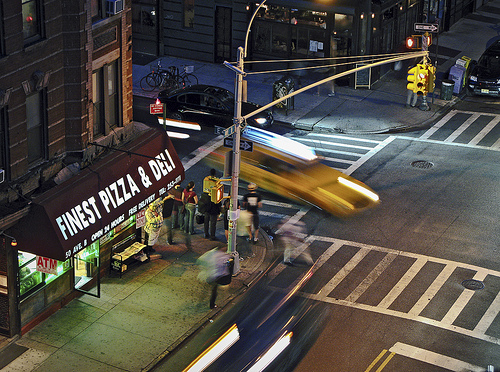
What if the Northwest’s cities legally capped the number of pizza delivery cars? What if, despite growing urban population and disposable incomes, our Pizza Delivery Oversight Boards had scarcely issued new delivery licenses since 1975? Pizza delivery would be expensive and slow; citizens would rise up in revolt.

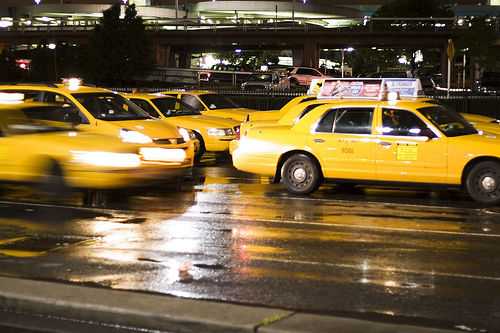
Substitute “taxicab” for “pizza delivery” and you have a reasonable facsimile of the taxi industry in Portland, Seattle, and Vancouver, BC: tightly restricted taxi numbers, high fares, and low availability.

Plentiful, affordable taxis facilitate greener urban travel. They help families shed second cars, ride transit more often, and walk to work on could-be-rainy days. They fill gaps in transit systems and provide a fallback in case of unexpected events.

(click for larger image)

Read more

Coal Exports From Canada

Sightline is publishing a new research memo today that documents the facts about Canada’s coal exporting capacity. The memo finds that ports in British Columbia do not have sufficient capacity to handle the volumes of coal planned for Washington ports.

The state coal lobby claims that US coal exports will simply shift to BC if Washington doesn’t build its own export facilities. Yet the numbers tell a different story. The truth is that even if BC’s coal ports were to devote all of their planned capacity expansions to shipping solely US coal, they could still handle only a small fraction of the coal planned for Cherry Point and Longview.

Getting Smart on Sewage

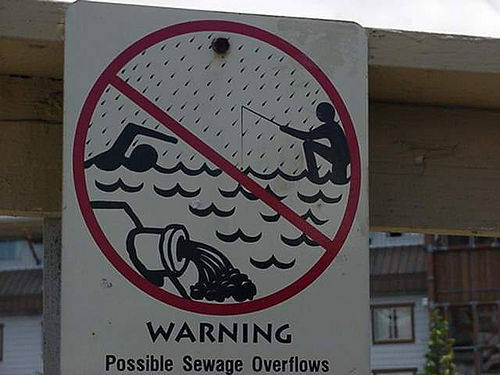
WARNING: possible sewage overflows

A rainstorm—a real gully washer—hits the Northwest. In numerous cities with antiquated public plumbing, the rain seeps into cracked sewage lines and flows into stormwater drains that link to the sewer system. From Port Angeles to Seattle to Spokane, treatment plants are overwhelmed by the deluge, causing raw sewage to spill into Port Angeles Harbor, Puget Sound, and the Spokane River. The sewage carries bacteria, viruses, and other pollutants that pose a risk to beach goers hunting clams or swimmers taking a dip.

Spewing sewage into waterways is potentially dangerous to people, and just plain gross. So Seattle and King County alone are preparing to spend $1.3 billion on projects to fix the problem.  The navy town of Bremerton on Puget Sound’s west shore recently finished a project costing more than $50 million to staunch the annual flow of hundreds of millions of gallons of sewage-tainted waste. Outside of the state, Vancouver, BC, is working to separate its sewage system and Portland this year is scheduled to complete its $1.4 billion Big Pipe projects to control sewage spills.

But there’s increasing concern that the regulations driving these costly fixes are based on an arbitrary benchmark. A recent article that I wrote for Crosscut and last Sunday’s piece by Lynda Mapes at the Seattle Times both called into question the sewage rule and the priority being placed on shrinking the number of combined-sewer overflows (CSOs) at a time when the region faces arguably more urgent water-quality challenges.

Washington’s leaders need to reconsider a rule that limits the number of sewage overflows to an average of one per outfall. Instead, they need to craft rules grounded in the actual harm being caused by the spill by considering how much and what kind of pollution is being dumped. By focusing the regulation on the environmental and human health effects, cities, counties, and utility rate payers will be able to direct their time and money to projects that will have the greatest benefits to the region. Reshaping the CSO rules could save money by shifting restoration dollars to projects that pay the largest dividends.

Read more

Letting Cities Slow Traffic

Update: The Washington Legislature passed the Neighborhood Safe Streets bill in April 2013, finally cutting red tape that cities and towns previously faced when they chose to set speed limits at 20 miles an hour on residential and business non-arterial streets. This common sense win for pedestrians, kids, and the elderly had overwhelming support in the House (86-10) and Senate (45-2), yet took three years to clear the roadblocks embedded in our political system.

A shorter version of this item ran on the Seattle Times’ op-ed page on August 2, 2011. This version includes links, a chart, and additional analysis.

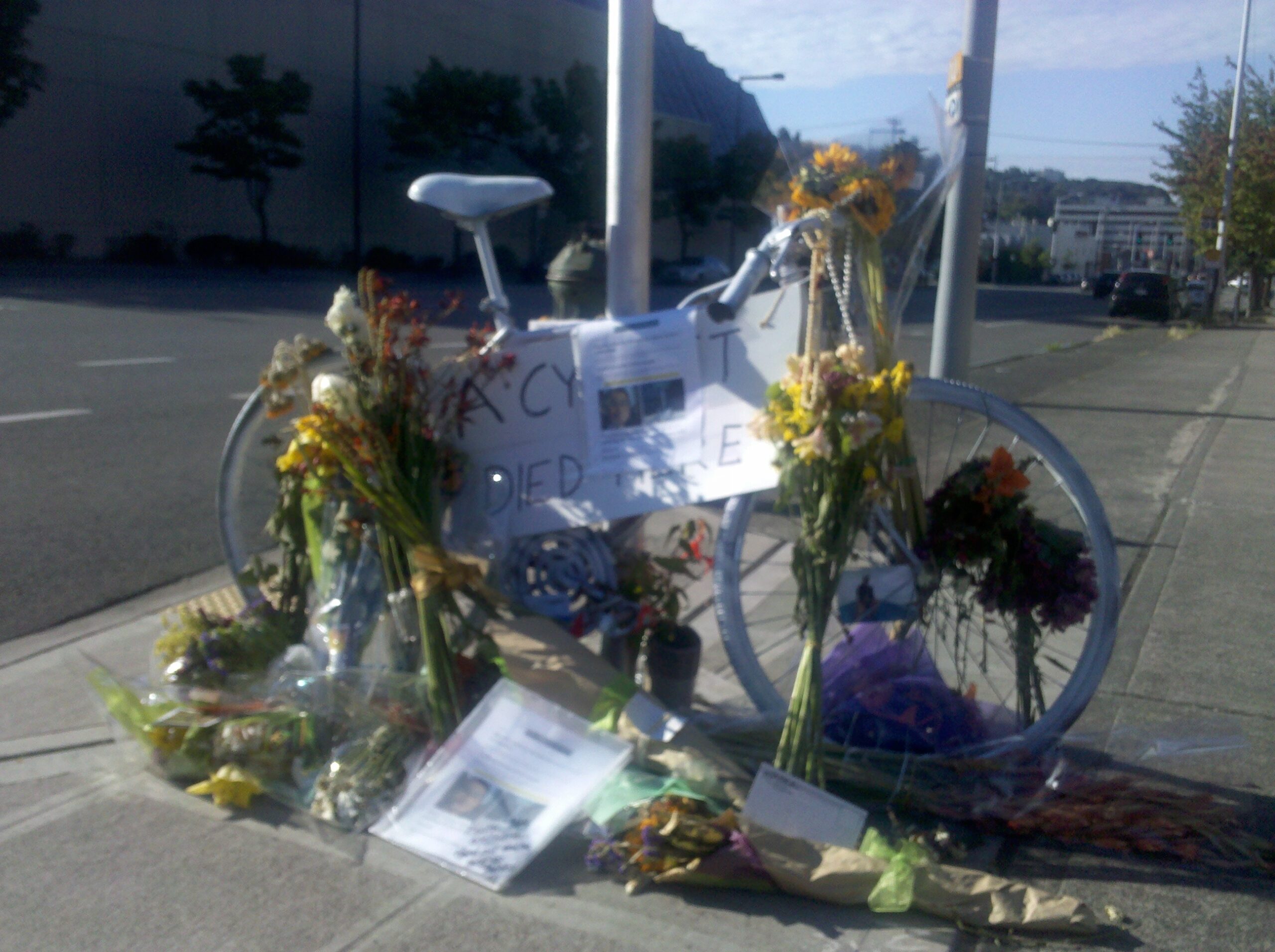
On Thursday afternoon, I got a pit in my stomach when I found strings of yellow police tape blocking the bike commute on Seattle’s Dexter Avenue. I learned over the hours that followed, with all of Seattle, that an SUV had struck and fatally injured Mike Wang, a PATH photographer of my age, in his forties. Mr. Wang had been riding in the Dexter bike lane at Thomas Street when the SUV sped across traffic, slammed into him, and fled the scene.

Such calamities are far too common. In 2009, traffic collisions killed 1,095 people—including 106 pedestrians and cyclists—in the Northwest states of Idaho, Oregon, and Washington. Car crashes are the number one cause of death among American children and young adults, and the group of pedestrians most in jeopardy is seniors. The pedestrian traffic death rate is more than twice as high among seniors as among others in Oregon and Washington. It’s three times as high in Idaho. (Sources for this paragraph and the next are at the bottom of this post.)

In almost all of these deaths, traffic speed is a critical variable. Some 91 percent of 2009 Northwest traffic deaths occurred on streets with speed limits of 30 mph, like Dexter, or higher. That’s a big number. Let’s make it more real: A new mapping tool allows you to pinpoint the exact locations, with street-view photos, of every scene where a motor vehicle killed an American pedestrian in the last decade. The map is harrowing. In a few short minutes of clicking and zooming, for example, I saw the death scenes of an 89-year-old man, a 73-year-old man, a 16-year-old boy, and a 1-year-old boy in Spokane; a 75-year-old woman and a 37-year-old man in Federal Way, Washington; and a 13-year-old girl in Sumner, Washington. Every one of these deaths was on a local street, the speed limit of which is dictated by state law at either 25 or 30 mph.

Read more

×
Privacy Overview
Sightline Institute

More information about our privacy notice

Strictly Necessary Cookies

Strictly Necessary Cookie should be enabled at all times so that we can save your preferences for cookie settings.

3rd Party Cookies

This website uses Google Analytics to collect anonymous information such as the number of visitors to the site, and the most popular pages.

Keeping this cookie enabled helps us to improve our website.

Additional Cookies

This website uses social media to collect anonymous information such as which platform are our users coming from.

Keeping this cookie enabled helps us better reach our audiences.